Romeo and Juliet: Act 1, Scene 1 – Analysis
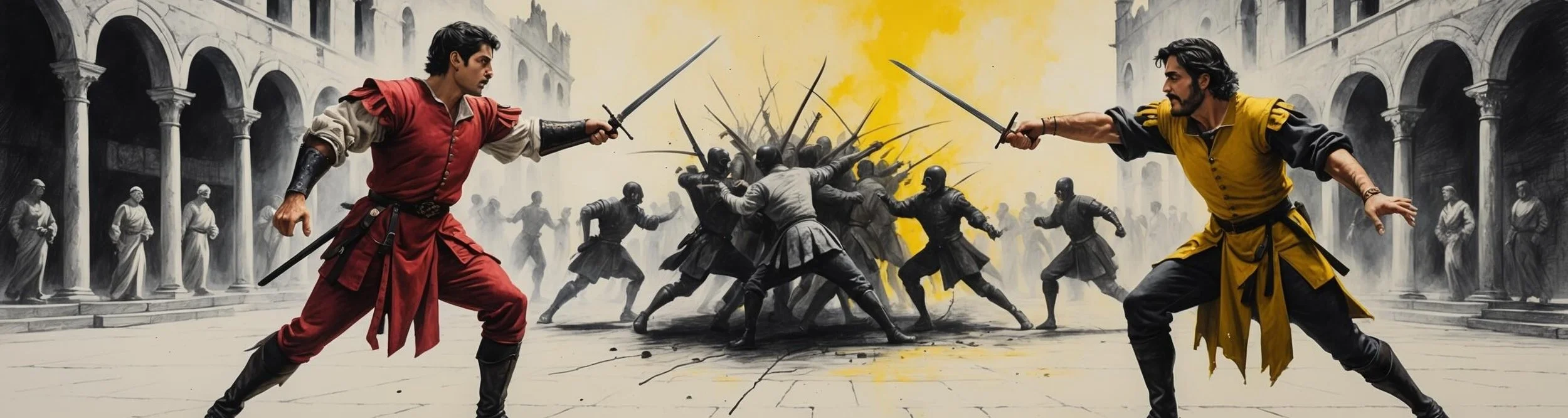
Scene Profile – At a Glance
- Location: A public place in the streets of Verona.
- What Happens: A street brawl between Capulet and Montague servants pulls in the whole city. The Prince stops it, then Benvolio draws out the cause of Romeo's misery: unrequited love.
- Key Characters: Benvolio, Tybalt, Romeo, Lord Capulet, the feuding servants, and Prince Escalus.
- Dramatic Function: The opening scene establishes the feud, sets the Prince's death-penalty deadline, and introduces Romeo as a lovesick young man – before Juliet has even been mentioned.
- Famous Quote:
"Why, then, O brawling love! O loving hate!"
(Romeo, Act 1, Scene 1) - Why It Matters: Everything the tragedy needs is planted here: the feud that traps the lovers, the clock that will kill them, and Romeo's habit of speaking about love as if it were war.
Scene Summary
The play moves out of the Prologue and into the streets. Two Capulet servants, Sampson and Gregory, swagger through a public square trading crude jokes about beating the Montagues and forcing themselves on Montague women. When two Montague servants, Abraham and Balthasar, appear, Sampson provokes them by biting his thumb – a deliberate insult – and a fight breaks out.
Benvolio, a Montague, draws his sword to break up the brawl, but the hot-tempered Tybalt, a Capulet, arrives and attacks him instead. Citizens rush in with clubs, and old Capulet and old Montague try to join the fight themselves, held back by their wives.
Prince Escalus arrives and stops the riot. Furious that a third street brawl has shattered the city's peace, he warns both families that anyone who fights again will be put to death, then orders the square cleared.
Left behind, Lord and Lady Montague ask Benvolio about their son. Benvolio explains that Romeo has been wandering alone at dawn, weeping, and shutting himself away from daylight. When Romeo appears, his parents leave, and Benvolio learns the cause: Romeo is lovesick over a woman, Rosaline, who does not love him back and has sworn to stay chaste. Benvolio advises him to look at other women; Romeo insists he never could.
From Wordplay to Bloodshed: The Servants' Quarrel
Romeo and Juliet does not open with its lovers. It opens with two armed servants strolling through a public square, swapping puns. Shakespeare writes the exchange in prose – the everyday register of comedy – and the jokes come fast: Sampson and Gregory play on "coals", "colliers", "choler" and "collar" as they boast about what they will do to Montague men and Montague women. The comedy is real, but it has an edge. The feud has reached so far down the social order that even the servants carry it, and their banter is steeped in violence before a single sword is drawn.
Original
Gregory, o' my word, we'll not carry coals.
(Sampson, Act 1, Scene 1)
Shakespeare Retold (Modern Verse)
Gregory, like we won’t carry coal, we won’t take insults.
The line sets the tone for the whole play. A grand quarrel between two noble houses is introduced from the bottom up, through men whose stake in it is borrowed. By the time Abraham and Balthasar arrive and Sampson bites his thumb at them, the wordplay has curdled into a street fight. Shakespeare shows us, before any of the principals appear, that the feud is not an abstraction. It is a habit of violence that ordinary people act out in the street.
The Prince's Judgement and the Cost of the Feud
The brawl escalates with frightening speed. Benvolio tries to part the fighters; Tybalt arrives spoiling for blood and turns the scuffle into a duel. Citizens pour in with clubs, and the heads of both houses – old men reaching for swords they are too old to wield – have to be held back by their wives. What began as servants' horseplay has become a civic emergency, and it takes the highest authority in Verona to stop it. When Prince Escalus speaks, the scene shifts into its most formal verse, and the change of register marks the change in stakes.
Original
If ever you disturb our streets again,
Your lives shall pay the forfeit of the peace.
(Prince Escalus, Act 1, Scene 1)
Shakespeare Retold (Modern Verse)
If ever you disturb our streets again,
You’ll pay the price by paying with your life.
The Prince's sentence is the hinge of the plot. He does not merely scold; he sets a price. A third brawl has broken the peace, and the next offence will cost lives. Every act of violence that follows – Mercutio's death, Tybalt's, Romeo's banishment – runs on the clock the Prince starts here. The quarrel is now a matter not only of family honour but of public order, and the collision between private vengeance and the law of the city is one the play returns to until it kills the people we have come to care about most.
Romeo and the Paradoxes of Love
With the square cleared, the scene empties of violence and fills with a different kind of trouble. Benvolio hears from Romeo's parents that their son has been keeping to himself, walking at dawn and shutting himself in a darkened room. When Romeo finally appears, the cause turns out to be love – or something he calls love. He is infatuated with a woman, Rosaline, who does not return his feeling, and he describes his condition in a torrent of contradictions.
Original
Why, then, O brawling love! O loving hate!
O any thing, of nothing first create!
(Romeo, Act 1, Scene 1)
Shakespeare Retold (Modern Verse)
Why bother? Fighting love! Or loving hate!
From nothing these two forces activate!
The oxymorons are the point. Romeo cannot speak of love except in the language of war and paradox – "brawling love", "loving hate", "cold fire" – and the scene has just shown us a literal brawl and literal hate. Shakespeare yokes the play's two great forces of love and violence together in Romeo's very first speech: the fighting outside in the street and the desire inside the lover are described in the same breath, with the same vocabulary. It is a brilliant piece of foreshadowing. The boy who can only imagine love as a kind of combat is about to fall, within hours, into a love that the combat of the streets will destroy.
Language and Technique
- Prose against verse: Shakespeare sorts his worlds by register. The servants quarrel in everyday prose; the Prince and the nobles speak formal verse; Romeo's lovesick speeches run in a verse-music of their own. The ear hears the social order before the eye sees it.
- Oxymoron and antithesis: Romeo's first love-speech is built from yoked opposites – "brawling love", "loving hate", "cold fire", "sick health". The figure fuses the scene's two subjects, love and violence, into single impossible phrases.
- Bawdy punning: The opening runs on puns – "coals / colliers / choler / collar", "maids / maidenheads" – comic wordplay that is also aggressive, the feud carried on by other means.
- Petrarchan convention: Romeo loves by the book. His paradoxes, his worship of an unattainable, chaste lady, and his luxurious self-pity all belong to the fashionable Petrarchan love-poetry of the 1590s – a style the play sets up partly in order to knock it down.
- Light and dark imagery: Romeo makes himself "an artificial night", shutting the dawn out of his room. The play's great chain of light imagery begins here, in its negative key.
Key Quotes from Act 1, Scene 1
Quote 1What, drawn, and talk of peace! I hate the word,
As I hate hell, all Montagues, and thee:
Have at thee, coward!
(Tybalt, Act 1, Scene 1)
Shakespeare Retold (Modern Verse)
What, with a sword, talk peace! I hate the word,
As I hate hell, all Montagues, and you:
I’ll fight you, coward!
Alas, that love, so gentle in his view,
Should be so tyrannous and rough in proof!
(Benvolio, Act 1, Scene 1)
Shakespeare Retold (Modern Verse)
Oh dear; that love appears so sweet in theory,
Should turn out wretched in reality!
Out of her favour, where I am in love.
(Romeo, Act 1, Scene 1)
Shakespeare Retold (Modern Verse)
I’m out of favour with the one I love.
O, she is rich in beauty, only poor,
That when she dies with beauty dies her store.
(Romeo, Act 1, Scene 1)
Shakespeare Retold (Modern Verse)
She’s beautiful, but one part is bereft:
Her beauty dies if she’s no children left.
Key Takeaways
- A feud everyone shares: The play opens with servants, not lovers. The Capulet–Montague quarrel reaches every level of Verona and turns ordinary people violent.
- The Prince starts the clock: Prince Escalus warns that the next brawl means death. His sentence sets the deadline that drives the whole tragedy.
- Love spoken as war: Romeo describes his feelings in contradictions – "brawling love", "loving hate". Love and violence are linked from his very first speech.
- Rosaline, not Juliet: Romeo begins the play in love with someone else. His passion for Rosaline shows how quickly, and how completely, he can fall.
Study Questions and Analysis
Why does Shakespeare open the play with servants joking and fighting?
The Prologue has just told the audience exactly how the play ends – two lovers dead, two families reconciled. Shakespeare then follows that solemn sonnet not with the lovers, but with two Capulet servants trading bawdy jokes in the street. The choice is deliberate, and it does a surprising amount of work. The comedy lowers the audience's guard and grounds the lofty "ancient grudge" of the Prologue in something concrete and physical: two ordinary men spoiling for a fight. The provocation that tips banter into bloodshed is a single rude gesture.
Do you bite your thumb at us, sir?
(Abraham, Act 1, Scene 1)
Shakespeare Retold (Modern Verse)
Do you flip the bird at us, mate?
Harley Granville-Barker, in his Prefaces to Shakespeare (1930), admired the craftsmanship of this opening, noting how quickly Shakespeare turns a comic squabble into a full civic riot and then into the entrance of the Prince – a single unbroken escalation that puts the whole machinery of the play on stage in a few minutes. M. M. Mahood, in Shakespeare's Wordplay (1957), showed how the servants' relentless punning is itself a kind of duelling: the men trade quibbles on "coals", "choler" and "collar" the way they will shortly trade sword-thrusts. On both readings the comedy is not a digression. It is the feud in miniature, the same aggression expressed first in words and then in steel.
What does Prince Escalus's speech reveal about Verona and the feud?
The Prince is the voice of public authority, and his single speech tells us how deep the problem runs. This is not a first offence. He calls it the third of "three civil brawls, bred of an airy word", which means the feud has been disturbing the city's peace for some time and that the smallest provocation is enough to set it off. His response is to criminalise the quarrel: from this point, fighting in Verona's streets is punishable by death.
That move reframes the whole conflict. Up to now the feud has been a private matter between two households, governed by the old code of honour in which an insult must be answered. The Prince asserts a competing authority – the law of the city – that places public order above family pride. The rest of the play lives in the space between these two systems. When Tybalt later answers a perceived insult with his sword, he is obeying the code of honour and breaking the law of the Prince at the same time, and it is the Prince's deadline, set here, that converts that collision into Romeo's banishment. The tension belongs to the play's larger themes of individual versus society and family and honour: private loyalty repeatedly runs up against the demands of the wider community, and in this play the community cannot keep the peace.
Why is Romeo so miserable at the start of the play, and who is Rosaline?
Before Romeo ever appears, we hear about him. His father describes a son who weeps at dawn, sighs, and locks himself away from the light, behaviour the Elizabethans would have recognised at once as the affliction of the melancholy lover.
Many a morning hath he there been seen,
With tears augmenting the fresh morning dew.
(Montague, Act 1, Scene 1)
Shakespeare Retold (Modern Verse)
There have been many mornings he’s been seen there,
In tears that add to early morning dew.
When Romeo speaks for himself, the cause turns out to be unrequited love for a woman named Rosaline, who has "forsworn to love" and intends to remain chaste. Rosaline never appears on stage and never speaks; she exists only as the object of Romeo's complaints. Samuel Taylor Coleridge, in his lectures on Shakespeare (1818), made the influential argument that Romeo is not really in love with Rosaline at all but in love with the idea of being in love – that Shakespeare gives his hero a rehearsal passion precisely so that the real thing, when Juliet arrives, can be measured against it. Not every critic accepts that the feeling is merely posed; to the lovesick Romeo it is real enough to ruin his sleep. But the play clearly invites the comparison. The literary, formulaic way Romeo grieves for Rosaline here is designed to contrast with the direct, shared language he will discover with Juliet.
What do Romeo's oxymorons mean, and why does he speak in paradoxes?
Romeo's first real speech about love is a cascade of contradictions – impossible pairings of opposites that cannot logically coexist.
Feather of lead, bright smoke, cold fire, sick health!
(Romeo, Act 1, Scene 1)
Shakespeare Retold (Modern Verse)
It’s like lead feathers, bright smoke, cold fire, sick health!
On the surface, the oxymorons dramatise confusion: Romeo's feelings are at war with one another, and he can only express them through self-cancelling phrases. But the device is also a deliberate literary signal. The piling-up of paradoxes was a hallmark of Petrarchan love-poetry, the fashionable courtly style of the 1590s, and an Elizabethan audience would have heard Romeo speaking in a recognisable, even clichéd, idiom. There is genuine critical disagreement about the tone. Some readers take the speech as gentle parody, Shakespeare flagging that this love is borrowed and performed – a young man playing the role of a lover with real conviction but little real feeling, a performer waiting for a subject worthy of him. Others insist the confusion is sincere whatever its borrowed form. What is not in dispute is the thematic charge: by describing love in the vocabulary of conflict – "brawling", "hate", "fire" – Romeo binds the play's two governing forces together at the level of language itself.
How does the scene introduce the theme of love and violence?
The opening scene fuses love and violence both structurally and verbally, and the join is so tight that the two are difficult to separate from the start. Structurally, Shakespeare places a brawl and a love-complaint side by side in a single scene: the square first fills with drawn swords and then, once it empties, with Romeo's lovesickness. The audience moves directly from one to the other, so that the lover's misery arrives still ringing with the noise of the fight.
Verbally, the link is made inside Romeo's own speech, where the language of war supplies the only words he has for desire. He calls love "brawling", pairs it with "hate", and likens it to "cold fire" – the very same register the scene has just used for the feud. The effect is to suggest that, in Verona, love and violence are not opposites but neighbours, drawing on the same heat. The play will literalise the connection again and again: a kiss at a feast guarded by Tybalt's drawn sword, a wedding shadowed by a killing, a marriage-bed that becomes a tomb. The pattern that ends the tragedy is announced, in miniature, in this first scene.
What does Sampson and Gregory's dialogue suggest about gender and honour in Verona?
The servants' opening banter is crude, but it is revealing rather than incidental. Sampson boasts that, having beaten the Montague men, he will turn on their women, and his jokes slide constantly between fighting and rape: he will "thrust" the maids "to the wall", he plays on "maidenheads", he treats sexual conquest and physical violence as a single proof of manhood. The talk presents masculine honour as something asserted through domination – over rival men in the street and over women's bodies – and it sets the tone for a city in which aggression and virility are tangled together.
This matters for the play's wider treatment of gender and society. Coppélia Kahn, in Man's Estate: Masculine Identity in Shakespeare (1981), argued that the feud functions as a violent code of masculinity into which the young men of Verona are pressured, a code that makes a boy prove himself through the sword and leaves little room for the tenderness Romeo is reaching towards. Read in that light, the servants are not just comic relief; they expose the brutal assumptions about manhood that the feud runs on, the same assumptions that will later push Romeo to kill Tybalt rather than be thought a coward. The women in the scene, by contrast, speak for restraint – Lady Capulet mocks her husband's call for a sword – but they have no power to stop the men.
How does this opening scene set up the rest of the play?
The first scene is a remarkably efficient piece of stagecraft, planting almost every mechanism the tragedy will need. It establishes the feud as an active, dangerous force rather than a backstory; it introduces the Prince and his death-penalty deadline, the clock against which the lovers will race; and it shows us a Romeo already primed to fall in love, so that the meeting with Juliet a scene later feels less like a beginning than a redirection.
It also sets the play's imagery in motion. Caroline Spurgeon, in Shakespeare's Imagery and What It Tells Us (1935), famously traced the play's dominant pattern of light against dark – the lovers repeatedly imagined as torches, stars and sudden brightness against the night. That pattern starts here in its negative form, with Romeo shutting out the dawn to make himself "an artificial night"; the light he is missing is the one Juliet will shortly supply. Harley Granville-Barker (1930) praised the scene's economy, the way a comic brawl is made to deliver the feud, the law and the hero in a single sweep. Some readers feel the heavy foreshadowing – the Prologue's "star-crossed lovers", the talk of death and fate – tips the play towards a sense of doom from the outset, an early statement of its concern with fate and destiny. Others see only a young man's ordinary unhappiness, with nothing yet fixed. The scene supports both readings, which is part of its craft: it loads the gun without yet telling us it will go off.