Romeo and Juliet: Act 1, Scene 2 – Analysis
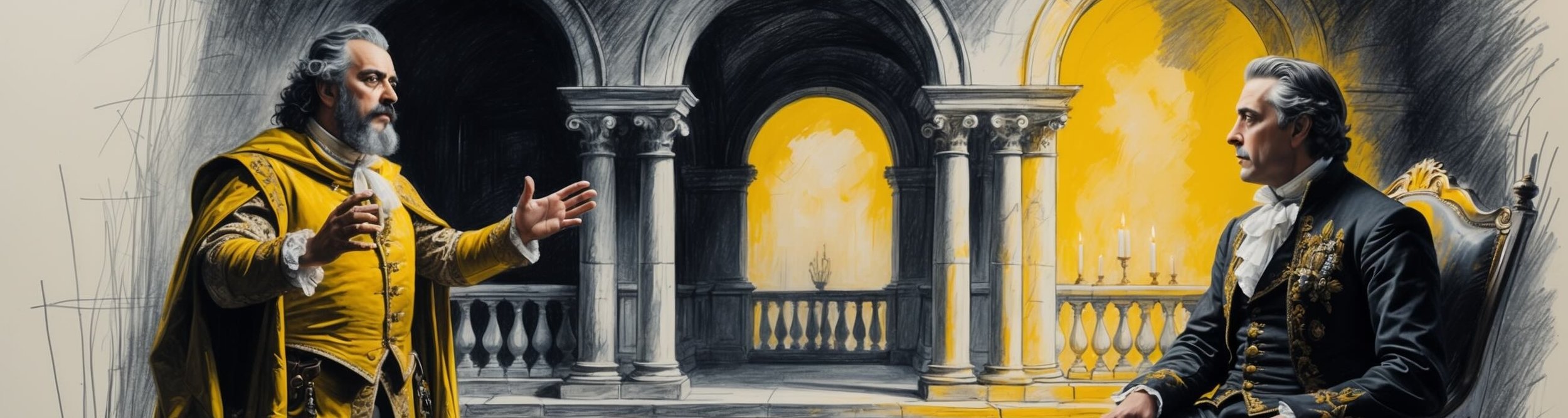
Scene Profile – At a Glance
- Location: A street in Verona.
- What Happens: Paris asks to marry Juliet; Capulet urges patience and invites him to a feast. By chance the illiterate servant delivering the guest list asks Romeo to read it, and invites him to the party.
- Key Characters: Lord Capulet, Paris, a Capulet servant, Benvolio, and Romeo.
- Dramatic Function: The scene sets up the Capulet feast, plants the marriage plot with Paris, and uses pure coincidence to send Romeo toward the night he will meet Juliet.
- Famous Quote:
"Earth-treading stars that make dark heaven light..."
(Capulet, Act 1, Scene 2) - Why It Matters: A quiet, half-comic scene quietly arms the tragedy: it builds the feast, introduces Paris as Romeo's rival, and turns an accident in the street into the cause of everything that follows.
Scene Summary
The play steps off the violent street of the opening scene into a calmer one. Lord Capulet is walking with Paris, a young kinsman of the Prince who wants to marry Capulet's daughter, Juliet. Capulet says she is not yet fourteen and asks Paris to wait two years, but he encourages him all the same: come to the feast I am holding tonight, look at the other young women of Verona, and try to win Juliet's heart.
As he leaves, Capulet hands a servant a list of guests and tells him to go through Verona inviting everyone named on it. The servant, left alone, admits he cannot read and has no idea whose names are on the paper. He needs to find someone who can read it for him.
At that moment Benvolio and Romeo arrive, mid-conversation: Benvolio is still trying to talk Romeo out of his misery over Rosaline by urging him to look at other women. The servant approaches Romeo and asks him to read the list aloud. Romeo does – and sees Rosaline's name among the guests.
Not realising he is speaking to a Montague, the servant invites Romeo to the feast. Benvolio seizes the chance and dares Romeo to come and compare Rosaline with the other beauties there. Romeo agrees, certain that no one could outshine her – and the audience already knows whom he is about to meet.
A Marriage Proposed: Capulet and Paris
The scene opens on a quiet street, a world away from the brawl that closed the first. Capulet is walking with Paris, a young nobleman who has asked for his daughter's hand. Capulet's answer is not the answer of a tyrant. He points out that Juliet is not yet fourteen and asks Paris to wait. There is real tenderness in the way he speaks of her, and real caution: she is too young, the world is too dangerous, and a father's first instinct is to protect.
Original
Let two more summers wither in their pride,
Ere we may think her ripe to be a bride.
(Capulet, Act 1, Scene 2)
Shakespeare Retold (Modern Verse)
Let two more summers bloom and then subside
Before we even think she’ll make a bride.
What makes the moment quietly painful is how reasonable Capulet sounds. He even insists that Juliet's own feelings must come first – that Paris should "woo her" and win her heart, and that a father's consent is "but a part". An audience that knows the play feels the irony at once. The careful, loving father of this scene is the same man who, by A3S5, will threaten to throw Juliet into the streets if she refuses the very marriage he is so patient about here. For now, that cruelty is still unimaginable, and the scene plants the theme of youth and age in its gentlest form: an older man trying, and failing, to slow time down for a child he loves.
Comedy and Chance: The Servant Who Cannot Read
Before he leaves, Capulet hands a servant a list of guests and tells him to invite everyone whose name is written on it. It is a small, ordinary instruction, and it sets the tragedy in motion. Left alone, the servant makes a discovery that is pure comedy: he cannot read a word of the list he has been told to deliver. Shakespeare drops the verse of the noblemen and lets the servant flounder in prose, tangling himself in a joke about tradesmen reaching for one another's tools – the shoemaker for the tailor's measure, the fisherman for the painter's brush. The humour is broad, and it is a deliberate change of air after the marriage talk.
Original
my master is the great rich Capulet; and if you be not of the house of Montagues, I pray, come and crush a cup of wine.
(a Servant, Act 1, Scene 2)
Shakespeare Retold (Modern Verse)
my master is the great rich Capulet; and if you’re not one of the Montague family, please, come and down a glass of wine.
Then chance takes over. Of all the people in Verona who might have helped him, the servant stops Romeo and Benvolio – and, not knowing he is speaking to a Montague, invites Romeo to the very feast he is trying to fill. The irony is total. A Capulet servant hands the enemy an invitation to the Capulet party, and the boy who reads the list aloud finds the name of his beloved Rosaline on it. Everything that follows – the meeting with Juliet, the secret marriage, the deaths – turns on this accidental encounter in the street. The play's sense of fate and destiny is built less from omens than from coincidences exactly like this one.
Love as Argument: Benvolio's Wager
Romeo arrives still sunk in the lovesickness we saw in the first scene, pining for Rosaline, who will not have him. Benvolio has a cure, and it is a brutally practical one: stop looking at her, and look at someone else. When the feast invitation falls into their hands, he seizes it as the perfect test. Come to the party, he says, and measure Rosaline against the other beauties of Verona.
Original
Compare her face with some that I shall show,
And I will make thee think thy swan a crow.
(Benvolio, Act 1, Scene 2)
Shakespeare Retold (Modern Verse)
Compare her face with some that I will show,
And I will make you think your swan’s a crow.
Benvolio's confidence is the engine of the plot. He is so sure Romeo's passion is a delusion of the eye that he turns the feast into a wager, certain he can make Romeo see his "swan" as a "crow". Romeo takes the bet, but for the opposite reason: he agrees to go only because he is convinced no woman there could rival Rosaline. Neither of them is right. Benvolio will win his argument and lose his point, because the face that ends Romeo's devotion to Rosaline will not be one of the beauties Benvolio has in mind – it will be Juliet's. The scene leaves the audience holding a piece of knowledge the characters do not have, which is the essence of dramatic irony.
Language and Technique
- Verse against prose: The noblemen speak in measured verse; the servant blunders in everyday prose. The shift in style marks the gap between the powerful and the ordinary, and signals the change from courtly business to street comedy.
- Light and star imagery: Capulet compares the young women at his feast to stars that light the night sky. This begins the play's great pattern of light imagery – the same kind of language Romeo will soon reach for when he describes Juliet.
- Dramatic irony: We know Romeo will meet Juliet at this feast, and we know the servant is inviting a Montague into a Capulet house. The characters do not. That gap between our knowledge and theirs is where the scene's tension comes from.
- Seasonal imagery: Capulet pictures young delight as "well-apparelled April" treading on the heel of "limping winter" – spring set against age, youth against time.
- Comic wordplay: The servant's muddle over which tradesman uses which tool is a simple, physical pun, a lighter cousin of the sharper word-duels heard elsewhere in the play.
Key Quotes from Act 1, Scene 2
Quote 1At my poor house look to behold this night
Earth-treading stars that make dark heaven light...
(Capulet, Act 1, Scene 2)
Shakespeare Retold (Modern Verse)
Come to my humble house and see tonight
The stars within the sky like heaven’s light...
Take thou some new infection to thy eye,
And the rank poison of the old will die.
(Benvolio, Act 1, Scene 2)
Shakespeare Retold (Modern Verse)
Observe some women, then you might be tempted,
And all your lovesick pain might be exempted.
One fairer than my love! The all-seeing sun
Ne'er saw her match since first the world begun.
(Romeo, Act 1, Scene 2)
Shakespeare Retold (Modern Verse)
One better looking than my love! The sun
Has never seen that since the world begun.
I'll go along, no such sight to be shown,
But to rejoice in splendour of mine own.
(Romeo, Act 1, Scene 2)
Shakespeare Retold (Modern Verse)
I’ll come, safe in the knowledge no one’s better,
And I’ll rejoice in knowledge that I met her.
Key Takeaways
- The feast is set: Capulet's party is arranged here, giving the play the setting where Romeo and Juliet will meet.
- A rival appears: Paris asks to marry Juliet, planting the marriage plot that will later collide with her love for Romeo.
- A gentler Capulet: Capulet is patient and protective about Juliet's youth – a sharp contrast with the furious father of the later acts.
- Chance drives the plot: An illiterate servant accidentally invites a Montague to a Capulet feast. The tragedy turns on coincidence.
- Romeo still loves Rosaline: He agrees to go only to admire her, sure no one is fairer – which is exactly what the feast will disprove.
Study Questions and Analysis
Is Lord Capulet a caring father in Act 1, Scene 2?
In this scene Capulet is strikingly gentle. Asked for Juliet's hand, he resists rushing her into marriage, points to her youth, and insists that her own consent must come first. He speaks of her as the last of his children, the one hope left to him.
The earth hath swallowed all my hopes but she,
She is the hopeful lady of my earth...
(Capulet, Act 1, Scene 2)
Shakespeare Retold (Modern Verse)
This life has quashed my dreams, except for her,
For in her I hope all my dreams come true.
The lines are tender, but they are also revealing. Coppélia Kahn, in Man's Estate: Masculine Identity in Shakespeare (1981), reads Verona as a city organised around a patriarchal code in which a daughter is part of a father's estate. Heard that way, Capulet's image of Juliet as "the hopeful lady of my earth" works in two directions at once: as the cry of a loving parent, and as the language of ownership, the child folded into the father's land and line. The gentleness is genuine, but it may be conditional. Critics have long noted the gap between this Capulet and the one who erupts in A3S5, threatening to disown Juliet when she defies him over the very marriage he is so patient about here. Whether the later rage contradicts this tenderness or simply exposes its limits – affection that lasts only as long as obedience – is one of the play's open questions, and it starts in this scene. The moment also belongs to the theme of family and honour, where a child's marriage is never only a private matter.
What does the scene suggest about marriage and the right age to marry?
The negotiation between Capulet and Paris turns on Juliet's age, and the play is unusually exact about it: she is not yet fourteen. Paris argues that girls younger than Juliet are already happy mothers; Capulet warns that marrying too young carries a cost.
And too soon marred are those so early made.
(Capulet, Act 1, Scene 2)
Shakespeare Retold (Modern Verse)
And soon grow old, those girls who give birth younger.
The exchange would have struck Shakespeare's first audiences as pointed. In Elizabethan England most women married in their twenties, not their early teens, and Shakespeare deliberately lowered Juliet's age from his main source, Arthur Brooke's poem The Tragicall Historye of Romeus and Juliet (1562), where she is sixteen, to not yet fourteen. As Jill Levenson observes in her Oxford Shakespeare edition (2000), that change sharpens the play's concern with youth and age: it makes Juliet a child caught in an adult world of marriage contracts, and it makes Capulet's caution – "too soon marred" – sound like a warning the play will tragically confirm. The theme of time and haste is already stirring here: the adults debate waiting two whole years, while the lovers will compress their entire story into a matter of days.
Why does Shakespeare include the comic scene with the servant who cannot read?
It can look like a throwaway gag, but the comic interlude does serious structural work. Susan Snyder, in her influential essay 'Romeo and Juliet: Comedy into Tragedy' (1970), argued that the first half of the play is shaped like a comedy – full of servants, jokes, feasts and young love – and only later swerves into tragedy; the illiterate servant is part of that comic surface, lulling the audience before the fall. M. M. Mahood, in Shakespeare's Wordplay (1957), showed how deeply the play runs on puns, and the servant's muddle – mixing up which tradesman uses which tool – is wordplay of the simplest, most physical kind.
But the comedy is also a mechanism. The servant's illiteracy is the precise reason he must stop a stranger in the street, and that stranger happens to be Romeo. Shakespeare uses a joke to engineer the most fateful coincidence in the play, so that the machinery of fate and destiny hides inside a moment of laughter. What feels like a digression is really the pivot on which the plot turns.
What does Benvolio's advice reveal about his character and his view of love?
Benvolio is the play's voice of level-headed common sense, and his prescription for heartbreak is pure folk wisdom: drive out one passion with another.
Tut, man, one fire burns out another's burning,
One pain is lessened by another's anguish...
(Benvolio, Act 1, Scene 2)
Shakespeare Retold (Modern Verse)
A fresh fire puts out one that burnt before,
A pain stops when a new pain has begun...
The advice is kindly meant and perfectly rational – and entirely wrong about the kind of love the play cares about. Benvolio treats desire as an ailment with a cure, something the will can manage simply by looking elsewhere. It is the same practical confidence that makes him propose the feast as an experiment. As a foil to Romeo he could hardly be sharper: where Romeo speaks of love as religion and fate, Benvolio speaks of it as a passing "infection". The irony is that he is half right. Looking elsewhere will indeed cure Romeo of Rosaline – just not in the harmless way Benvolio imagines, since the new love will be one worth dying for.
How does Shakespeare present Romeo's love for Rosaline?
Romeo's love for Rosaline is presented as sincere in feeling but thoroughly conventional in expression. He speaks in the elaborate, self-dramatising style of the Petrarchan lover, swearing his devotion in vast, unanswerable terms.
When the devout religion of mine eye
Maintains such falsehood, then turn tears to fires...
(Romeo, Act 1, Scene 2)
Shakespeare Retold (Modern Verse)
When things I trust, the sight out of my eye,
Tell lies like this, then turn my tears to fires...
Harry Levin, in his classic essay 'Form and Formality in Romeo and Juliet' (1960), described the play as deeply concerned with the difference between conventional forms of love-speech and genuine feeling, and Romeo's Rosaline rhetoric is the prime exhibit: love as a set of borrowed poses. Samuel Taylor Coleridge went further still in his lectures on the play, reading the early Romeo as in love less with Rosaline than with the idea of love itself – performing a passion he has read about more than felt. Critics disagree about how seriously to take the emotion – some hear real adolescent misery beneath the clichés – but not about its function. Shakespeare gives Romeo this stagey, second-hand devotion precisely so that the plain, mutual, urgent language he will find with Juliet can sound, by contrast, like the real thing.
How does Act 1, Scene 2 set up Romeo and Juliet's first meeting?
This scene is the hinge that swings Romeo toward Juliet, and it works almost entirely through irony. Capulet decides to hold a feast and sends his servant out with the invitations; the servant cannot read them; he therefore stops the first literate-seeming stranger he meets, who happens to be Romeo; and the list Romeo reads aloud carries the name of Rosaline. Benvolio at once proposes that they go to the feast to cure Romeo's infatuation. Every link in that chain is an accident, and every accident pushes Romeo toward the Capulet party where, in A1S5, he will meet Juliet.
The audience, primed by the Prologue's promise of "star-crossed lovers", watches the trap close while the characters believe they are merely chasing, or curing, a crush. It is a masterclass in dramatic irony: Romeo agrees to go for the one reason guaranteed to be overturned – to prove that no one is fairer than Rosaline. The scene also folds the love-story back into the feud, since the house Romeo is being lured toward is the enemy's, and the collision between private desire and the family quarrel is quietly being set in motion.
What is the significance of the star and light imagery in Capulet's invitation?
When Capulet describes the young women who will attend his feast, he reaches for the language of light, calling them "earth-treading stars that make dark heaven light". The image matters more than it first appears. Caroline Spurgeon, in her landmark study Shakespeare's Imagery and What It Tells Us (1935), traced how the play returns again and again to images of brightness flaring against darkness – torches, stars, lightning, the sun – and argued that this pattern is the play's defining poetic signature.
Capulet's line is one of the first sparks in that pattern, and it carries a quiet irony, because the brightest of his "earth-treading stars" will turn out to be his own daughter. The same vocabulary he uses so casually here, Romeo will use in earnest within hours: at the feast he will imagine Juliet teaching the torches to burn bright, and on the balcony he will call her the sun. The scene therefore seeds an image-system the rest of the play will harvest, binding the theme of love and violence to sudden, consuming brightness – beautiful, but as brief and dangerous as a flash in the dark.