Romeo and Juliet: Act 2, Prologue – Analysis
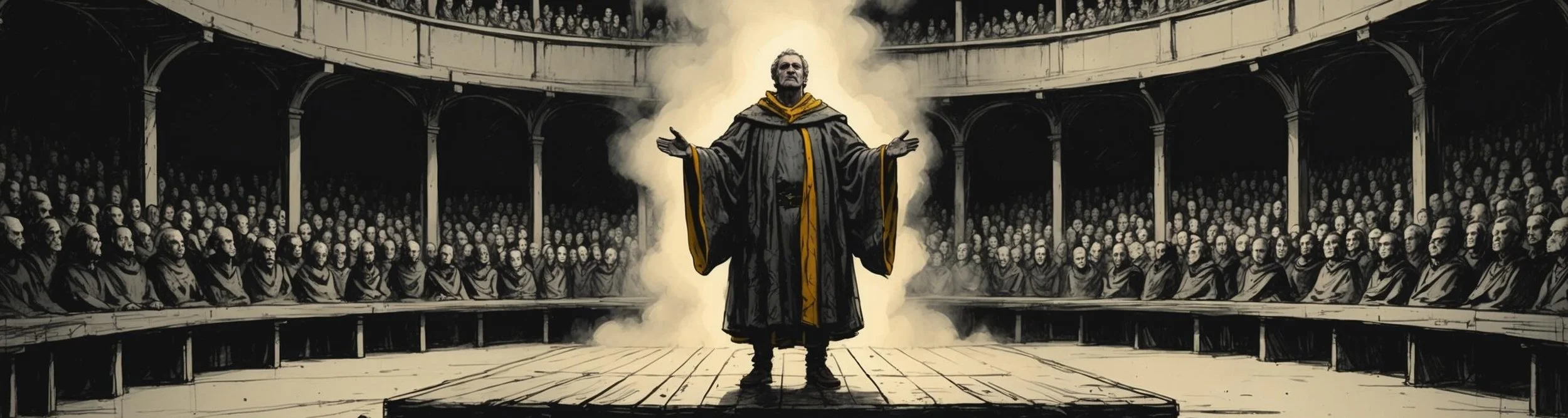
Scene Profile – At a Glance
- Location: None within the story – the Chorus speaks directly to the audience, outside the action.
- What Happens: The Chorus returns with a second sonnet, reporting that Romeo's old longing for Rosaline is dead, replaced by love for Juliet. Both lovers love and are loved, but each is the other's enemy, so they cannot meet freely.
- Key Characters: The Chorus.
- Dramatic Function: Bridges the two acts – marks Romeo's switch from Rosaline to Juliet and names the new problem the lovers must solve: how to meet when their families are foes.
- Famous Quote:
"But passion lends them power, time means, to meet..."
(The Chorus, Act 2, Prologue) - Why It Matters: It confirms Romeo's love is now real and mutual, and frames the danger ahead: a love that must grow in secret, across the divide of the feud.
Scene Summary
Before the second act begins, the Chorus steps forward again and speaks straight to the audience in a fourteen-line sonnet. He explains that Romeo's old infatuation with Rosaline is now dead, and that a new love has taken its place: his love for Juliet, against whom even the beautiful Rosaline no longer seems fair.
The Chorus then sets out the lovers' difficulty. Both of them now love and are loved in return, but each belongs to the family the other must treat as an enemy, so Romeo cannot court Juliet openly. Yet, the Chorus concludes, passion gives them the strength and the opportunity to meet despite the danger.
An Old Love Dies, a New One Is Born
The Act 2 Prologue opens on a transformation. The Romeo of the first act sighed and wept over Rosaline, who would not return his love; that longing, the Chorus tells us, is now on its death-bed. In its place a new affection has sprung up, eager to inherit everything the old one felt – only this time the love is for Juliet, and it is returned.
Original
Now old desire doth in his death-bed lie,
And young affection gapes to be his heir;
(the Chorus, Act 2, Prologue)
Shakespeare Retold (Modern Verse)
Romeo’s love of Rosaline lies dying,
And in her place, a new love is parading;
The Chorus is gently mocking the speed of the change. Romeo's passion for Rosaline had seemed, to him, the centre of the world; one sight of Juliet has killed it outright. By casting the old love as a dying man and the new as an heir impatiently waiting to take over, the speech captures how completely one feeling has displaced another. It also quietly raises a question the play never fully settles: if Romeo's love can switch so suddenly once, how sure can we be of it now? The theme of love is reintroduced here not as something steady, but as something that arrives all at once and overwhelms everything before it.
Loved at Last, but Forbidden
Having killed off the old love, the Chorus turns to the new one's central problem. For the first time, Romeo loves someone who loves him back – but she is a Capulet, and he a Montague. Each is, by the rules of the feud, the other's enemy, and an enemy cannot be openly courted.
Original
Being held a foe, he may not have access
To breathe such vows as lovers use to swear;
(the Chorus, Act 2, Prologue)
Shakespeare Retold (Modern Verse)
Because he is a foe, he is refrained
To whisper vows of love, as lovers do;
This is the engine of everything that follows. The lovers' feelings are no longer in doubt; the obstacle is now wholly external, fixed by the families they were born into. Romeo cannot simply call on Juliet and declare himself, as a suitor normally would. The Chorus adds that Juliet, just as deeply in love, has even fewer means to reach Romeo – a reminder of how little freedom a young woman of her world is allowed. The whole secret machinery of the play – the balcony, the hidden marriage, the Friar's plotting – grows from the simple fact stated here: these two may not love each other in the open.
Language and Technique
- The sonnet form returns: Like the first Prologue, this is a fourteen-line sonnet – the form of love poetry. Its return marks a fresh chapter and keeps the love theme tied to the play's formal patterning.
- Death imagery for the old love: Romeo's feeling for Rosaline lies on its "death-bed" while a "young affection gapes to be his heir" – love described in the language of dying and inheritance.
- Antithesis: The speech is built on opposites – old desire against young affection, loved against forbidden, foe against lover – mirroring the lovers caught between attraction and the feud.
- The fishing image: Juliet "steal[s] love's sweet bait from fearful hooks", a metaphor that makes their new love feel both tempting and dangerous.
- Direct address: The Chorus again speaks straight to the audience, summarising offstage change and steering how we read the act to come.
Key Quotes from the Act 2 Prologue
Quote 1Now Romeo is beloved and loves again,
Alike betwitched by the charm of looks,
(the Chorus, Act 2, Prologue)
Shakespeare Retold (Modern Verse)
Now Romeo is loved, and loves again –
Both smitten by their looks and by their charm –
But to his foe supposed he must complain,
And she steal love's sweet bait from fearful hooks...
(the Chorus, Act 2, Prologue)
Shakespeare Retold (Modern Verse)
But now his love’s a foe, and that’s a pain;
She’s swallowed bait of love that risks her harm.
But passion lends them power, time means, to meet,
Tempering extremities with extreme sweet.
(the Chorus, Act 2, Prologue)
Shakespeare Retold (Modern Verse)
But passion gives them strength and time to meet,
So risks involved make time and love more sweet.
Key Takeaways
- Out with Rosaline: The Prologue confirms Romeo's love for Rosaline is dead, replaced entirely by his love for Juliet.
- Love is now mutual: For the first time Romeo loves and is loved in return – a clear contrast with the one-sided longing of Act 1.
- The feud is the obstacle: Because the lovers are from enemy families, they cannot meet or court in the open.
- Danger sharpens desire: Passion gives them the power to meet, and the risk only makes the love feel sweeter – a warning of what is to come.
Study Questions and Analysis
What is the purpose of the Act 2 Prologue?
The Act 2 Prologue is a second sonnet, spoken by the Chorus, that bridges the two acts. Its main job is to confirm a change that has happened largely offstage: Romeo, who spent the first act pining for the unattainable Rosaline, has now fallen for Juliet, and this time his love is returned. The speech tidies away the Rosaline plot, makes sure the audience registers that the new love is mutual, and names the problem the rest of the act will turn on – that the two lovers belong to feuding families and cannot meet in the open.
Critics have sometimes found this second Chorus less essential than the first. Harley Granville-Barker, in his Prefaces to Shakespeare (1930), noted how lightly it sits against the action it introduces, doing little the following scenes do not show for themselves. Others read it more generously as part of a deliberate design: Harry Levin, in his essay 'Form and Formality in Romeo and Juliet' (1960), saw the recurring sonnet form as a structural signature of the play, linking the framing Chorus to the lovers, whose own first meeting is shaped as a sonnet. On that reading the Prologue is not redundant but a patterned echo, keeping the formal music of the play in the ear.
How has Romeo's love changed since Act 1?
The change is total, and the Prologue insists on its speed. In Act 1 Romeo's love for Rosaline was one-sided and unhappy: she had sworn to remain chaste and would not return his feelings, leaving him to mope in the dark and write melancholy verse. The Chorus now describes that "old desire" as lying on its "death-bed", killed off in an instant by the sight of Juliet. The new love is presented as its "heir", impatient to take over everything the old one felt.
The crucial difference is mutuality. For the first time, Romeo "is beloved and loves again": the feeling runs both ways. Yet Shakespeare is careful not to let us take the change too solemnly. The Chorus notes that both lovers are "betwitched by the charm of looks", grounding the new passion, like the old, in attraction at first sight. The sheer rapidity of the switch has divided readers. Coleridge, lecturing on the play in 1818, defended Romeo's earlier infatuation as a necessary first stage, an unfocused yearning that Juliet finally gives a true object – so the change marks growth, not mere fickleness. Others hear a gentle irony in the Chorus's account, a hint that a love so quickly kindled may prove as sudden as it is sincere.
Why can't Romeo and Juliet meet openly?
The obstacle is the feud, and the Prologue states it plainly: "Being held a foe, he may not have access / To breathe such vows as lovers use to swear." Romeo is a Montague and Juliet a Capulet, and the long quarrel between their houses means each is, by definition, the other's enemy. A young man would normally court a young woman openly, through her family; for Romeo that route is closed, because to the Capulets he is not a suitor but a foe.
The Chorus stresses that Juliet's position is even harder. She is "as much in love", but "her means much less" – a glance at the narrow freedom allowed a young woman of her time, who cannot seek Romeo out or arrange a meeting as a man might. This shared constraint is what drives the lovers into secrecy and makes the play's machinery necessary: the balcony scene, the clandestine marriage, the Friar's go-between schemes all exist because the feud forbids anything done in the light. The conflict between private feeling and public division is at the centre of the theme of the individual against society.
What does the closing couplet mean?
The final two lines – "But passion lends them power, time means, to meet, / Tempering extremities with extreme sweet" – resolve the problem the sonnet has built. Having shown that the feud forbids the lovers to meet, the Chorus declares that their passion will overcome it: love itself will lend them the power, the time, and the means to find one another in spite of the danger.
The clever turn is in the last line. "Tempering extremities with extreme sweet" means that the extreme difficulties they face are balanced, or offset, by an extreme sweetness – the risk does not kill the pleasure but heightens it. There is a warning folded into the comfort. The same forces that make the romance so intense, the secrecy and the peril, are the ones carrying it towards catastrophe, and the play repeatedly shows the lovers mistaking the thrill of danger for the strength of their bond. The couplet's neat balance of "extremities" and "extreme sweet" is the sound of a tragedy presenting itself, for a moment, as a triumph.