Romeo and Juliet: Act 2, Scene 1 – Analysis
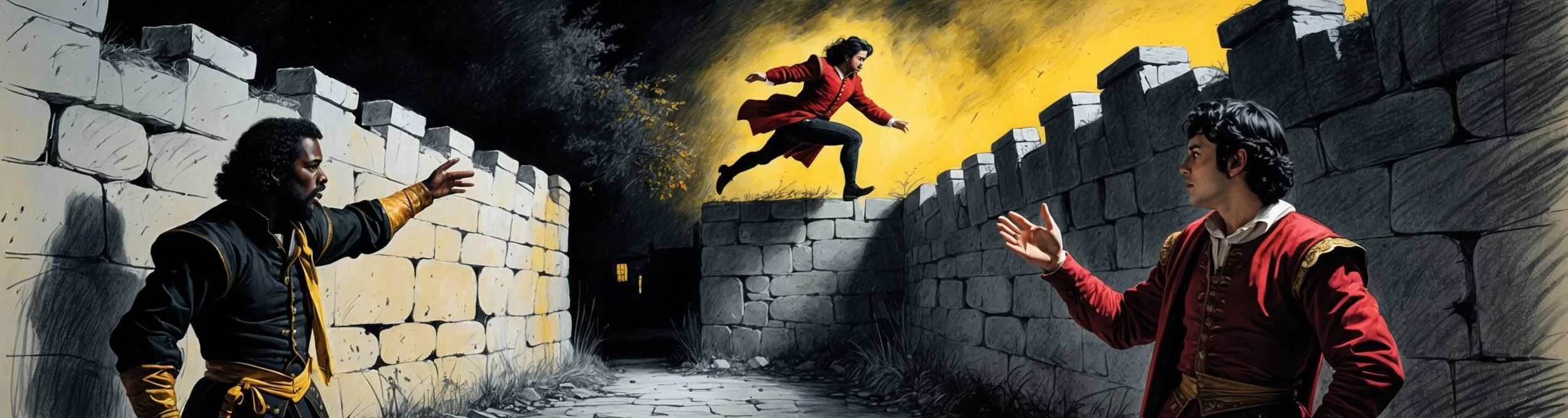
Scene Profile – At a Glance
- Location: A lane beside the wall of Capulet's orchard, just after the feast.
- What Happens: Romeo slips away from his friends and leaps the Capulet orchard wall. Mercutio and Benvolio look for him, and Mercutio mockingly tries to "conjure" him back by joking about Rosaline's body. Failing, they give up and head to bed.
- Key Characters: Mercutio, Benvolio (and Romeo, who hides nearby).
- Dramatic Function: A short comic bridge between the feast and the balcony scene – it shows Romeo breaking from his friends and sets Mercutio's bawdy view of love against the lyrical love about to follow.
- Famous Quote:
"If love be blind, love cannot hit the mark."
(Mercutio, Act 2, Scene 1) - Why It Matters: The scene marks Romeo's quiet break from his old life and friends, and its crude jokes about Rosaline make the tender balcony scene that follows feel all the more sincere by contrast.
Scene Summary
Leaving the feast, Romeo cannot bear to go home while Juliet is near. He turns back, climbs the wall of the Capulet orchard, and drops down out of sight.
Benvolio and Mercutio arrive, searching for him. Assuming Romeo is still pining for Rosaline, Mercutio teases him by pretending to be a magician "conjuring" a spirit, calling Romeo to appear by listing Rosaline's eyes, lips and body in increasingly crude terms. Romeo, hidden, does not answer. After a string of bawdy jokes, the two friends decide it is pointless to look for a man who does not want to be found, and go off to bed.
Romeo Slips Away
The scene opens with Romeo alone, unable to leave. He has just met Juliet, and the pull towards her overrides everything – including caution and his friends. In a few lines he decides to turn back and climb into the enemy's garden.
Original
Can I go forward when my heart is here?
Turn back, dull earth, and find thy centre out.
(Romeo, Act 2, Scene 1)
Shakespeare Retold (Modern Verse)
Can I go home when who I love is here?
Turn back and find the centre of my world.
Romeo calls his body "dull earth" and Juliet his "centre": she has become the point his whole self turns around. The image is quiet but decisive. The boy who spent the first act drifting and self-pitying now knows exactly what he wants, and he acts on it at once, leaping the wall while his friends are still calling his name. This is the last we see of the old Romeo before the balcony; from here, he belongs to Juliet, not to the gang of young men outside the wall.
Mercutio Conjures Romeo
Benvolio and Mercutio cannot find their friend, and Mercutio – certain Romeo is still lovesick for Rosaline – turns the search into a comic performance. He pretends to be a magician raising a spirit, summoning Romeo by naming the parts of Rosaline's body, each joke cruder than the last.
Original
I conjure thee by Rosaline's bright eyes,
By her high forehead and her scarlet lip,
By her fine foot, straight leg and quivering thigh
And the demesnes that there adjacent lie,
That in thy likeness thou appear to us!
(Mercutio, Act 2, Scene 1)
Shakespeare Retold (Modern Verse)
I summon you by Rosaline’s bright eyes,
By her sweet brow and by her scarlet lips,
By her fine feet, straight legs and quivering thighs
And all the parts that lay between those limbs,
That you appear to us just as you are!
The joke depends on dramatic irony, and it is rich. Mercutio thinks he is teasing a friend still mooning over Rosaline; the audience knows Romeo has already forgotten her and is hiding in the dark, in love with someone new. Mercutio's whole "conjuring" is aimed at a target that no longer exists. His view of love is entirely physical – eyes, lip, thigh, and the cruder "demesnes" beyond – the exact opposite of the worshipful, reverent language Romeo will use to Juliet moments later. Set side by side, the two scenes define the play's two ways of seeing love: Mercutio's bawdy, earthbound wit against the lovers' soaring idealism. The contrast is deliberate, and it makes the balcony scene that follows glow all the brighter.
Language and Technique
- Dramatic irony: Mercutio jokes that Romeo is lovesick for Rosaline, while the audience knows Romeo has already moved on to Juliet and is hiding a few feet away.
- Bawdy wordplay: Mercutio's "medlar" and "poperin pear" jokes use the names of fruit as crude puns about the body, his trademark style.
- Mock-conjuring: He pretends to be a magician raising a spirit, "summoning" Romeo by listing Rosaline's body parts – turning the search into a comic ritual.
- Antithesis: The whole scene sets Mercutio's physical, joking idea of love against the pure, idealised love Romeo is about to declare at the balcony.
- List and repetition: "He heareth not, he stirreth not, he moveth not" piles up parallel phrases for comic effect as the spell visibly fails.
Key Quotes from Act 2, Scene 1
Quote 1He is wise;
And, on my lie, hath stol'n him home to bed.
(Mercutio, Act 2, Scene 1)
Shakespeare Retold (Modern Verse)
He is wise;
And I am sure he’s nipped back home to bed.
Blind is his love and best befits the dark.
(Benvolio, Act 2, Scene 1)
Shakespeare Retold (Modern Verse)
For love is blind, and blindness suits the darkness.
Romeo, good night: I'll to my truckle-bed;
This field-bed is too cold for me to sleep...
(Mercutio, Act 2, Scene 1)
Shakespeare Retold (Modern Verse)
Romeo, good night: I’ve got to get to bed;
And sleeping on this ground is far too cold.
Key Takeaways
- Romeo breaks away: He leaves his friends and leaps the orchard wall, choosing Juliet over caution and over the gang outside.
- Mercutio's bawdy comedy: Mercutio "conjures" Romeo with crude jokes about Rosaline's body, sure his friend is still lovesick for her.
- Dramatic irony: The audience knows Romeo has already forgotten Rosaline and is hiding nearby, in love with Juliet.
- A deliberate contrast: The scene's earthy, physical view of love sets up the pure, idealised love of the balcony scene that follows.
Study Questions and Analysis
Why does Romeo climb over the Capulet orchard wall?
Romeo has just met Juliet at the feast and cannot bear to leave while she is near. As his friends head home, he turns back, telling himself that his "heart" is here and that he cannot simply walk away. He decides his true self belongs wherever she is, and he climbs the wall to be closer to her.
Can I go forward when my heart is here?
Turn back, dull earth, and find thy centre out.
(Romeo, Act 2, Scene 1)
Shakespeare Retold (Modern Verse)
Can I go home when who I love is here?
Turn back and find the centre of my world.
The decision is reckless and revealing. The orchard belongs to the Capulets, the family sworn to destroy his own, so by climbing the wall Romeo is putting himself in real danger to be near a girl he met an hour ago. It shows how completely he has changed since Act 1, where he merely sighed over Rosaline from a safe distance. Here, love makes him act. The wall itself is a neat image of the obstacle between the lovers – the feud made physical – and Romeo's leap over it is the first of many barriers he will cross for Juliet.
What is Mercutio doing when he "conjures" Romeo?
Mercutio pretends to be a magician casting a spell to summon a spirit. Believing Romeo is hiding because he is lovesick for Rosaline, he "conjures" him to appear by calling on the parts of Rosaline's body – her eyes, forehead, lips, and then, more crudely, her legs, thighs and the area beyond. It is a comic performance, designed to embarrass his friend into showing himself.
I conjure thee by Rosaline's bright eyes,
By her high forehead and her scarlet lip,
By her fine foot, straight leg and quivering thigh...
(Mercutio, Act 2, Scene 1)
Shakespeare Retold (Modern Verse)
I summon you by Rosaline’s bright eyes,
By her sweet brow and by her scarlet lips,
By her fine feet, straight legs and quivering thighs...
The speech is one of Mercutio's defining moments. His idea of love is physical, knowing and irreverent – he reduces Rosaline to her body and treats romance as a joke. Coppélia Kahn, in Man's Estate: Masculine Identity in Shakespeare (1981), reads Mercutio as the voice of an aggressive young-male world that mocks romantic love and pulls Romeo back towards the gang. The irony is that the spell is aimed at the wrong man entirely: the Romeo who pined for Rosaline no longer exists, and the real Romeo, hidden a few feet away, is already lost to a very different kind of love.
How does this scene use dramatic irony?
The whole scene runs on dramatic irony – the audience knows something the characters on stage do not. We have just watched Romeo fall for Juliet and forget Rosaline completely. Mercutio and Benvolio have not; they assume he is still moping over Rosaline, and every joke they make is built on that mistaken belief. So when Mercutio "conjures" Romeo by Rosaline's eyes and lips, we know the spell is useless: Rosaline means nothing to Romeo now.
The irony is sharpened by Romeo's hiding place. He is on stage the whole time, concealed behind the wall, hearing his friends joke about a love he has already abandoned. The audience can see both sides of the wall at once – the rowdy friends who do not understand, and the silent lover who has moved beyond them. Susan Snyder, in her essay 'Romeo and Juliet: Comedy into Tragedy' (1970), notes how the play's first half runs on comic devices like this one; the scene is pure romantic comedy, a joke that misfires because the joker does not know the truth. It also quietly underlines how alone Romeo now is: not one of his friends has any idea what has just happened to him.
How does this scene set up the balcony scene that follows?
This short scene is built as a deliberate contrast with the balcony scene that comes straight after it. Here, love is crude, physical and a subject for jokes: Mercutio talks about Rosaline's thighs, makes puns on fruit shaped like the body, and treats the whole idea of romance as a target for mockery. Then the friends leave, the stage clears, and within moments Romeo is gazing up at Juliet and speaking of her as the sun, in some of the most idealistic love poetry in the language.
Placing the two scenes back to back is one of Shakespeare's neatest pieces of staging. The bawdy comedy makes the tenderness that follows feel purer and more serious by comparison, while Mercutio's earthy wit keeps the love story from tipping into sentimentality – we have just been reminded that there is a coarser, funnier view of desire. Benvolio's parting line, that there is no point seeking a man "that means not to be found", marks the moment Romeo leaves his friends' world for good and steps fully into the private world of the lovers. The friends go to their cold beds; Romeo stays in the dark garden, and the play's greatest love scene begins.