Romeo and Juliet: Act 2, Scene 2 – Analysis
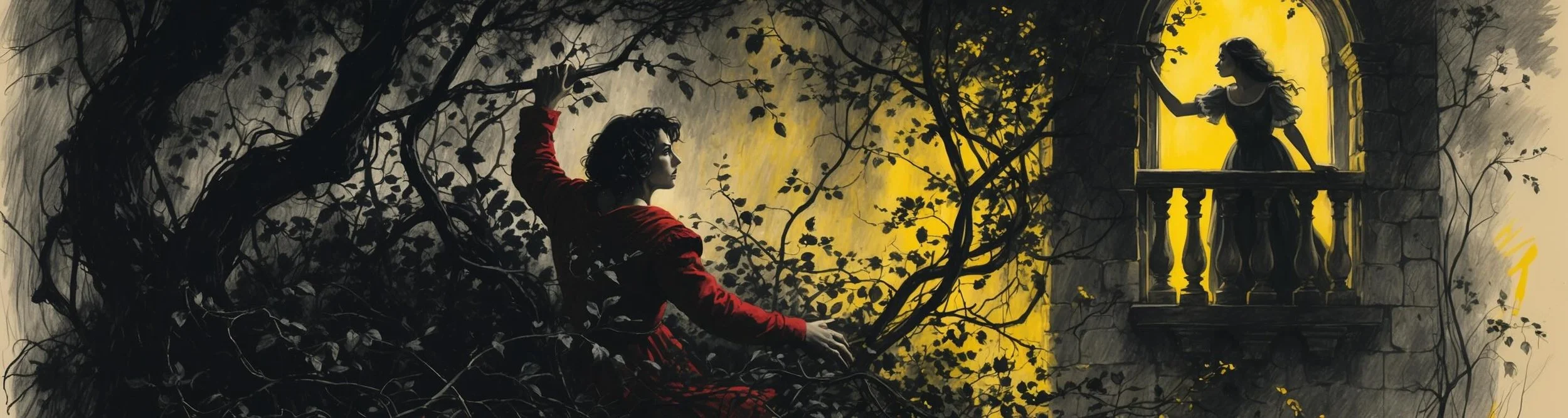
Scene Profile – At a Glance
- Location: The Capulet orchard, beneath Juliet's window, late on the night of the feast.
- What Happens: Romeo, having climbed the orchard wall, overhears Juliet at her window confessing her love and wishing away his name. He reveals himself; they exchange vows directly and joyfully, agree to marry, and part reluctantly as dawn approaches.
- Key Characters: Romeo, Juliet.
- Dramatic Function: The play's great love duet – it turns the feast's instant attraction into a mutual, committed bond and sets the secret marriage in motion.
- Famous Quote:
"It is the east, and Juliet is the sun."
(Romeo, Act 2, Scene 2) - Why It Matters: The most famous love scene in English drama. Here the lovers speak plainly and as equals, and the haste that will doom them is already visible in their joy.
Scene Summary
It is night, and Romeo has slipped back from the feast and leapt the wall into the Capulet orchard. Hidden in the dark, he sees a light at a window above him and Juliet appears. He watches her, comparing her to the sun and the stars, longing to speak but afraid to.
Not knowing she is overheard, Juliet speaks her heart aloud. She wishes Romeo were not a Montague, or that she were not a Capulet, and reasons that his name is no real part of him – a rose would smell as sweet by any other name. Unable to stay silent, Romeo answers her out of the darkness, startling her.
Once she knows it is Romeo, Juliet is honest rather than coy. She is embarrassed to have been overheard, but she will not pretend she does not love him. They exchange vows; she warns against swearing too rashly, then asks him directly whether his intentions are honourable.
Juliet proposes marriage: if Romeo means to wed her, she will send a messenger the next day to learn where and when. Twice the Nurse calls her away, and twice she returns, unwilling to leave. At last, as morning nears, they part with great reluctance, and Romeo sets off to find Friar Laurence and ask his help.
Juliet is the Sun
Alone in the dark orchard, Romeo sees Juliet appear at her window above him, and his language lifts at once into the play's great pattern of light against darkness. She is not just beautiful; she is the dawn itself, outshining everything around her.
Original
But, soft! What light through yonder window breaks?
It is the east, and Juliet is the sun.
(Romeo, Act 2, Scene 2)
Shakespeare Retold (Modern Verse)
But, hush! What light through yonder window breaks?
It is the east, and Juliet is the sun.
Romeo's imagery does real work here. By making Juliet the sun and the moon her jealous rival, he sets her above everything in the night sky and turns the darkness that hides him into a backdrop for her brightness. The whole speech is a private rhapsody – he is talking to himself, daring himself to speak, marvelling that "It is my lady, O, it is my love!" The audience, watching him hesitate, feels the gap between his soaring words and his nervous silence. This is the same light imagery he reached for at the feast, but sustained now into something larger: Juliet has become, for Romeo, the source of light itself.
What's in a Name?
Juliet, believing herself alone, speaks her own heart aloud – and lands on exactly the problem that will destroy them. It is not Romeo she objects to, but his name; and a name, she reasons, is nothing essential at all.
Original
O Romeo, Romeo! Wherefore art thou Romeo?
Deny thy father and refuse thy name;
(Juliet, Act 2, Scene 2)
Shakespeare Retold (Modern Verse)
Oh Romeo, Romeo! Why are you a Montague?
Forget your father and reject your name;
"Wherefore" means "why", not "where" – Juliet is not looking for Romeo but asking why, of all men, he had to be a Montague. From there she argues her way through the famous logic: a name is "nor hand, nor foot, nor arm, nor face"; it is no real part of the man who carries it. A rose would smell as sweet whatever we called it, so Romeo would keep every "dear perfection" even if he gave up the name "Romeo". It is clear, fearless thinking from a girl not yet fourteen, and it is the closest the play comes to naming its own tragedy: the lovers are kept apart by nothing but words, by labels their families have made deadly. Juliet sees through the feud to its emptiness – but seeing through it is not the same as escaping it.
The Lovers' Vows
Discovered and startled, Juliet quickly decides not to play games. She knows she has been overheard saying more than a careful girl should, and rather than retreat into denial she chooses honesty – and asks Romeo, plainly, to be honest too.
Original
Fain would I dwell on form, fain, fain deny
What I have spoke: but farewell compliment!
(Juliet, Act 2, Scene 2)
Shakespeare Retold (Modern Verse)
I'd gladly stick to courtship rules, denying
What I have said: but goodbye to convention!
This is the heart of why the scene matters. "Farewell compliment!" means goodbye to the rules of polite courtship – the coy, drawn-out games a young woman was expected to play. Juliet would gladly pretend, she admits, but she will not, because pretence now would be dishonest. She knows she risks seeming "too quickly won", and she says so; she even worries Romeo will think her "'haviour light". Yet she trusts the truth more than the performance. The contrast with Romeo's earlier posturing over Rosaline could not be sharper: that was love as a pose, all sighs and borrowed paradoxes; this is two people speaking to each other directly. It is also a meeting of equals – if anything, it is Juliet who leads, choosing candour and steering them both towards something real.
Planning the Marriage and Parting at Dawn
The vows turn at once towards action. It is Juliet, not Romeo, who raises marriage, and she does it with startling practicality: if he is serious, here is the plan. The lyrical love-talk gives way to a time, a messenger, a wedding.
Original
If that thy bent of love be honourable,
Thy purpose marriage, send me word to-morrow...
(Juliet, Act 2, Scene 2)
Shakespeare Retold (Modern Verse)
If love that you declare is truly real and
You want to marry me, tell me tomorrow...
The speed is breathtaking, and Shakespeare wants us to feel it. They met only hours ago, and already they are arranging a wedding for tomorrow. The lovers themselves sense the danger of it: earlier in the scene Juliet calls their love "too rash, too unadvised, too sudden, too like the lightning, which doth cease to be ere one can say 'It lightens.'" She names the very recklessness she cannot resist. The famous reluctant parting that ends the scene – the to-and-fro of "good night", the wish to keep Romeo like a pet bird on a thread – is tender and playful, but it also stretches out a leave-taking the lovers cannot bear to make. Even their happiness is shadowed: the haste that makes this love so intense is the same haste that will carry it, within days, to the tomb.
Language and Technique
- Light and dark imagery: Romeo turns Juliet into the sun, the stars, a source of daylight in the night – the play's central image of the lovers as sudden light against darkness.
- Soliloquy overheard: Juliet speaks her private thoughts aloud believing she is alone, so the audience and Romeo hear her honesty before she means to share it.
- Rhetorical questioning: "What's in a name?" lets Juliet reason out loud, picking the feud apart until a name seems like nothing at all.
- Religious language: Romeo calls Juliet a "bright angel" and a "dear saint", lifting their love towards worship rather than mere desire.
- Imagery of haste: Lightning that vanishes "ere one can say 'It lightens'" warns, even inside the love scene, that something this sudden may not last.
Key Quotes from Act 2, Scene 2
Quote 1What's in a name? That which we call a rose
By any other name would smell as sweet;
(Juliet, Act 2, Scene 2)
Shakespeare Retold (Modern Verse)
Why does it matter what we're called? A rose
Will smell as sweet whatever name we call it.
My bounty is as boundless as the sea,
My love as deep; the more I give to thee...
(Juliet, Act 2, Scene 2)
Shakespeare Retold (Modern Verse)
My love for you is endless as the sea,
And just as deep; the more I give to you...
O, swear not by the moon, the inconstant moon,
That monthly changes in her circled orb...
(Juliet, Act 2, Scene 2)
Shakespeare Retold (Modern Verse)
Oh, don't swear by the moon, the changing moon,
That shifts its spheric shape throughout the month...
Good night, good night! Parting is such sweet sorrow,
That I shall say good night till it be morrow.
(Juliet, Act 2, Scene 2)
Shakespeare Retold (Modern Verse)
Goodnight, goodnight! Parting is such sweet sorrow,
That I'll repeat 'goodnight' till it's tomorrow.
Key Takeaways
- The balcony scene: Romeo overhears Juliet at her window and they confess their love directly, turning the feast's spark into a real bond.
- The problem of the name: Juliet wishes away the feud – "What's in a name?" – seeing that only words keep the lovers apart.
- Honest, equal love: Juliet refuses coy games and speaks her heart plainly; this mutual love is far deeper than Romeo's earlier posing over Rosaline.
- Marriage and haste: Juliet proposes marriage and they plan it for the next day – love this sudden is thrilling, but the speed already feels dangerous.
Study Questions and Analysis
Why is the balcony scene so famous, and what makes it different from Romeo's love for Rosaline?
Act 2, Scene 2 is the most celebrated love scene in English drama, and its power lies in how completely it differs from everything Romeo has said about love before. Pining for Rosaline, he was a textbook Petrarchan lover – sighing, weeping, talking in worn-out paradoxes about a woman who never appears and never answers. That love was a pose, performed for an audience of one. Here, for the first time, love is mutual: two people speak to each other, listen, and reply.
M. M. Mahood, in her influential study of the play's language in Shakespeare's Wordplay (1957), traced how Romeo's verse changes as the play goes on, moving away from artificial conceits towards something more direct and felt. The balcony scene is the great turning point in that journey. Harley Granville-Barker, in his Prefaces to Shakespeare (1930), praised the scene's blend of lyrical beauty and dramatic naturalness – the lovers soar into poetry, yet the exchange feels like real conversation, complete with hesitations, teasing, and Juliet's sudden bursts of practicality. That double quality, soaring and grounded at once, is what has kept the scene alive for four centuries.
What does Juliet mean by "What's in a name?"
Believing herself alone, Juliet reasons aloud about the one obstacle between her and Romeo: his name. She argues that a name is only a label, attached to a person but no real part of them – "nor hand, nor foot, nor arm, nor face". A rose would smell exactly as sweet if it were called something else, so Romeo would keep every quality she loves even if he were not called "Montague".
What's in a name? That which we call a rose
By any other name would smell as sweet;
(Juliet, Act 2, Scene 2)
Shakespeare Retold (Modern Verse)
Why does it matter what we're called? A rose
Will smell as sweet whatever name we call it.
The line is a direct attack on the feud: the families' hatred, and the names that carry it, are exposed as arbitrary, with no power to change who Romeo really is. Yet the tragedy turns on Juliet being wrong. Marjorie Garber, in Shakespeare After All (2004), notes how insistently the play makes names matter – it is exactly because Romeo bears the name Montague that he must come by stealth, marry in secret, and die. Juliet's reasoning is faultless and the world simply refuses to honour it; the gap between her clear thinking and Verona's stubborn reality is one of the scene's deepest ironies.
How does Juliet's behaviour in this scene show her as Romeo's equal?
The balcony scene is often remembered as Romeo's, but it is Juliet who shapes it. She speaks more, reasons more clearly, and makes the decisive moves. Embarrassed to have been overheard, she refuses to retreat into the coy games expected of a young woman and chooses honesty instead.
Fain would I dwell on form, fain, fain deny
What I have spoke: but farewell compliment!
(Juliet, Act 2, Scene 2)
Shakespeare Retold (Modern Verse)
I'd gladly stick to courtship rules, denying
What I have said: but goodbye to convention!
It is Juliet who checks Romeo's hasty oath by the moon, Juliet who demands to know whether his intentions are honourable, and Juliet who proposes marriage and arranges the practical details. Coppélia Kahn, in Man's Estate: Masculine Identity in Shakespeare (1981), reads Juliet as the more mature and self-possessed of the two, the partner who turns a romantic encounter into a binding commitment. Against the conventions of the period, in which the man courts and the woman is wooed, Shakespeare gives the initiative largely to Juliet – which makes the love feel genuinely mutual rather than a one-sided pursuit, and makes her later courage easy to believe.
How does this scene develop the theme of love and haste?
For all its beauty, the balcony scene is shot through with warnings about its own speed. Romeo and Juliet met only hours earlier, and by the end of this single night they have confessed their love, exchanged vows, and arranged to marry the next day. Strikingly, it is Juliet herself who names the danger.
It is too rash, too unadvised, too sudden;
Too like the lightning, which doth cease to be...
(Juliet, Act 2, Scene 2)
Shakespeare Retold (Modern Verse)
It is too rash, impulsive, and too sudden
Too much like lightning, which just disappears...
The lightning image is double-edged: it captures the dazzling brilliance of their love and, in the same breath, its frightening brevity. Susan Snyder, in her essay 'Romeo and Juliet: Comedy into Tragedy' (1970), showed how the play accelerates from comic beginnings towards tragedy, and the balcony scene sits at the hinge: it has the joy of romantic comedy but already carries the seeds of disaster in its pace. The theme of time and haste runs through the whole tragedy, and here it is at its most seductive – the very suddenness that makes the love thrilling is what will, within days, destroy it.
Why does Juliet stop Romeo swearing by the moon?
When Romeo starts to swear his love "by yonder blessed moon", Juliet interrupts him immediately. The moon, she points out, is "inconstant" – it changes shape every month – so an oath sworn by it would suggest a love just as changeable. She wants constancy, not a pretty but unstable gesture.
O, swear not by the moon, the inconstant moon,
That monthly changes in her circled orb...
(Juliet, Act 2, Scene 2)
Shakespeare Retold (Modern Verse)
Oh, don't swear by the moon, the changing moon,
That shifts its spheric shape throughout the month...
The exchange does two things at once. It characterises Juliet as the clearer-headed partner, suspicious of empty romantic forms and asking instead for something she can rely on. And it gently satirises the conventions of love poetry, in which lovers routinely swear grand oaths by the heavens. Coppélia Kahn, in Man's Estate: Masculine Identity in Shakespeare (1981), reads Juliet as the steadier and more grounded of the two, repeatedly pulling the scene back from rhetoric towards reality; this is a clear instance, as she refuses to let Romeo hide behind a borrowed gesture. Tellingly, she asks him to swear by his "gracious self" if he must swear at all – it is the man, not the metaphor, she wants to trust.
What is the dramatic significance of the lovers planning their marriage so quickly?
The turn from love-talk to wedding plans is one of the most important moments in the play's machinery. It is Juliet who raises marriage, and she does so with remarkable directness: if Romeo's love is honourable and his purpose is marriage, she will send a messenger the next day to learn where and when the ceremony will be.
If that thy bent of love be honourable,
Thy purpose marriage, send me word to-morrow...
(Juliet, Act 2, Scene 2)
Shakespeare Retold (Modern Verse)
If love that you declare is truly real and
You want to marry me, tell me tomorrow...
Dramatically, this is the moment the secret marriage – the engine of the whole tragedy – is set in motion. It also reframes the love as serious rather than a passing infatuation: Juliet insists on commitment, on something honourable and binding, not a stolen night. Jill Levenson, in her Oxford edition of the play (2000), observes how Shakespeare compresses the action far more tightly than his sources did, turning months into days; this scene is where that compression bites, as a courtship that has barely begun rushes straight to marriage. The audience feels both the romance of it and the recklessness, and that mixture is exactly the point.
How does Shakespeare use light and darkness in the balcony scene?
The scene takes place in darkness, and Shakespeare uses that darkness to make Juliet shine. From the moment Romeo sees her at the window, he describes her as a source of light: she is the sun rising in the east, brighter than the envious moon, her eyes like the two fairest stars in heaven.
But, soft! What light through yonder window breaks?
It is the east, and Juliet is the sun.
(Romeo, Act 2, Scene 2)
Shakespeare Retold (Modern Verse)
But, hush! What light through yonder window breaks?
It is the east, and Juliet is the sun.
Caroline Spurgeon, in her landmark study Shakespeare's Imagery and What It Tells Us (1935), identified light against dark as the dominant image-pattern of the whole play, and the balcony scene is its richest expression: the lovers are repeatedly seen as flashes of brilliance against a dark and hostile world. The imagery is lovely, but it is also ominous. Light in this play is sudden and brief – a torch, a flash of lightning, a shooting star – and the lovers' brightness, like the dawn Romeo invokes, is the kind that cannot last. The same darkness that protects them now will, by the end, become the night of the tomb.