Romeo and Juliet: Act 2, Scene 3 – Analysis
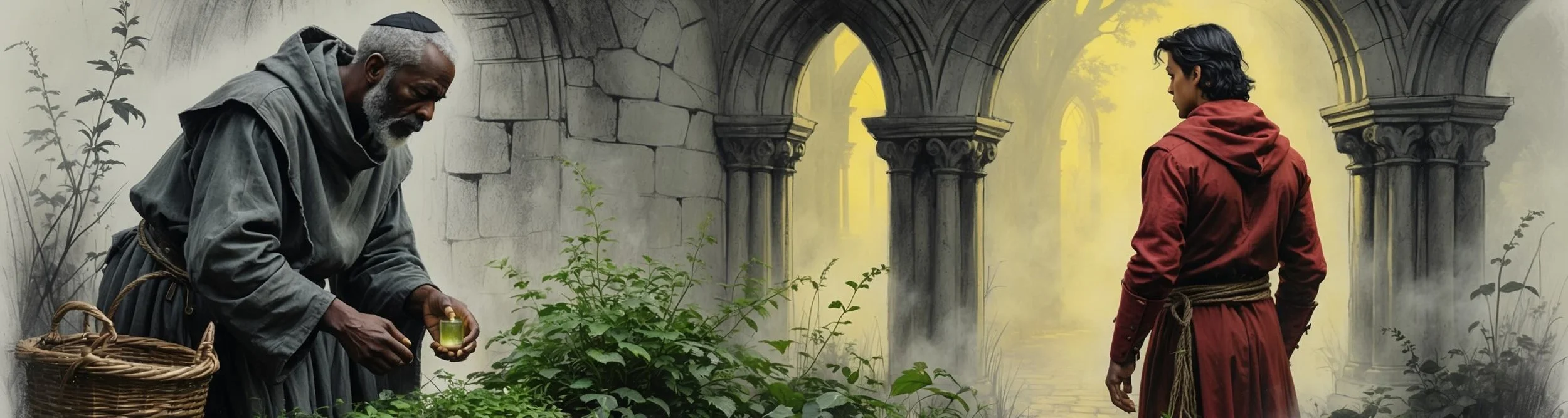
Scene Profile – At a Glance
- Location: Friar Laurence's cell, at dawn.
- What Happens: Friar Laurence gathers herbs at sunrise and muses on how the same plant can heal or kill. Romeo arrives, reveals he has abandoned Rosaline for Juliet, and begs the Friar to marry them that day. The Friar, startled by the sudden change, warns against haste but agrees, hoping the match will end the feud.
- Key Characters: Friar Laurence, Romeo.
- Dramatic Function: The plan is set in motion – the Friar agrees to a secret marriage that he hopes will heal the feud, the decision on which the whole tragedy turns.
- Famous Quote:
"Wisely and slow; they stumble that run fast."
(Friar Laurence, Act 2, Scene 3) - Why It Matters: The Friar's herbal soliloquy states the play's idea that good and harm share one root, and his warning against haste names the very flaw that will destroy the lovers – even as he hurries to help them.
Scene Summary
The scene opens at dawn outside Friar Laurence's cell. Alone with his basket, the Friar gathers herbs and flowers and reflects on the natural world: how the earth is both mother and grave, and how every plant holds the power to heal or to harm depending on how it is used.
Romeo arrives, unusually early, and the Friar guesses at once that he has not been to bed. He assumes Romeo has spent the night pining over Rosaline. Romeo corrects him: he has forgotten Rosaline entirely.
Speaking in riddles at first, Romeo finally tells the Friar plainly that he loves Juliet, the daughter of his family's enemy, that she loves him back, and that he wants the Friar to marry them that very day. The Friar is astonished at how quickly Romeo's heart has turned, and gently mocks him for weeping so recently over Rosaline.
Despite his misgivings, the Friar agrees to perform the marriage. He sees in it a chance to end the long feud between the two households by turning their hatred into love. As they leave, he cautions Romeo against rushing: those who run too fast, he warns, are the ones who fall.
The Friar's Soliloquy
The scene begins not with the lovers but with an old man and a basket. As the sun rises, Friar Laurence gathers herbs and turns his work into a meditation on nature itself – the earth as both womb and tomb, the giver of life and the grave it returns to.
Original
Within the infant rind of this small flower
Poison hath residence and medicine power:
(Friar Laurence, Act 2, Scene 3)
Shakespeare Retold (Modern Verse)
Within the new-formed petals of this flower
Lives poison, yet it has medicinal power:
This is the philosophical heart of the scene, and one of the clearest statements of an idea the whole play turns on: that good and harm are not opposites but neighbours, often growing from the same root. The same flower that cheers when smelled will kill when tasted. The Friar then widens the thought from plants to people – the same mixture of grace and "rude will" lives in every man – and warns that when the worse impulse wins, it destroys the whole. It is a quiet, almost academic opening, but it casts a long shadow: the Friar's own well-meant remedy, the secret marriage, will be exactly such a double-edged thing, healing intended but death produced.
Romeo's Confession
Romeo arrives, and the Friar, sharp-eyed, reads his sleepless face at once. When he assumes the cause is Rosaline, Romeo brushes the name aside – he has forgotten her completely. After teasing the old man with riddling half-answers, Romeo finally speaks plainly.
Original
Then plainly know my heart's dear love is set
On the fair daughter of rich Capulet:
(Romeo, Act 2, Scene 3)
Shakespeare Retold (Modern Verse)
Then speaking clearly, all my heart is set
On the fair daughter of rich Capulet:
The confession is also a request: Romeo wants the Friar to marry the pair that same day. What is striking is how little of the night before he is willing to explain – the where, the how, the exchange of vows can wait; the marriage cannot. The whole exchange is built on Romeo's impatience, and on the gap between his certainty and the Friar's caution. To Romeo, the speed is proof of how real this love is; to the audience, who have just heard the Friar warn that the worse impulse can consume the whole plant, that same speed begins to look like danger.
The Friar's Rebuke and the Plan
The Friar's reaction is the famous one. He is not delighted; he is staggered. Only hours ago Romeo was drowning in tears for Rosaline, and now he wants to marry someone else by nightfall.
Original
Holy Saint Francis, what a change is here!
Is Rosaline, whom thou didst love so dear,
(Friar Laurence, Act 2, Scene 3)
Shakespeare Retold (Modern Verse)
Holy Saint Francis, what a change is here!
Is Rosaline, who you did love so dear,
The Friar's scepticism is shrewd: young men's love, he says, lies "not truly in their hearts, but in their eyes". He remembers Romeo's groans and the tear-stains still on his cheek. And yet, having made the case against haste, he reverses himself and agrees – not because Romeo persuades him, but because he sees a use for the marriage. If it can turn the two households' hatred into love, it is worth the risk. The decision that drives the rest of the tragedy is taken here, by a good man for a good reason, and undercut in the very last line by the warning he cannot make himself obey.
Language and Technique
- Soliloquy: The Friar opens alone, thinking aloud over his herbs – a calm, reflective speech that lets the play state its central idea before the plot rushes on.
- Antithesis and paradox: The speech is built on opposites held together – mother and tomb, poison and medicine, grace and rude will – the play's habit of pairing things that should be enemies.
- Extended metaphor: The herb that heals or kills stands for human nature, and quietly for the marriage plan itself: one remedy that could go either way.
- Rhyming couplets: Almost the whole scene is in couplets, giving the Friar's wisdom a neat, proverbial ring – never more so than in the closing "they stumble that run fast".
- Dramatic irony: The Friar warns against haste and then acts in haste, and the audience, who know the ending, hear the warning land on him as much as on Romeo.
Key Quotes from Act 2, Scene 3
Quote 1The earth that's nature's mother is her tomb;
What is her burying grave that is her womb,
(Friar Laurence, Act 2, Scene 3)
Shakespeare Retold (Modern Verse)
The earth is nature’s mother and her tomb;
It is the grave for what’s born from her womb,
Virtue itself turns vice, being misapplied;
And vice sometimes by action dignified.
(Friar Laurence, Act 2, Scene 3)
Shakespeare Retold (Modern Verse)
A strength that is exploited gets corrupted
And this can turn to good if it’s disrupted.
Two such opposed kings encamp them still
In man as well as herbs, grace and rude will;
(Friar Laurence, Act 2, Scene 3)
Shakespeare Retold (Modern Verse)
These two opposing forces both appear
In men as well as herbs, kind and severe;
For this alliance may so happy prove,
To turn your households' rancour to pure love.
(Friar Laurence, Act 2, Scene 3)
Shakespeare Retold (Modern Verse)
This union might have a happy ending
By leading to both houses’ hatred mending.
Key Takeaways
- Good and harm share a root: The Friar's herb soliloquy states the play's idea that the same thing can heal or kill, depending on how it is used.
- Romeo's sudden change: Rosaline is forgotten overnight, and the Friar is amazed that the boy who wept for her now wants to marry Juliet by nightfall.
- The marriage is agreed: The Friar consents not from trust in Romeo's love but in the hope the match will end the feud between the families.
- A warning against haste: "They stumble that run fast" names the flaw that will destroy the lovers – even as the Friar himself hurries to help them.
Study Questions and Analysis
What is the meaning of Friar Laurence's opening soliloquy about herbs and flowers?
The Friar's speech, delivered as he gathers plants at dawn, is the play's clearest statement of one of its central ideas: that good and harm are bound together, often in the same thing. He observes that the earth is both the mother that gives life and the grave that takes it back, and that a single flower can heal when smelled but kill when tasted. He then applies the thought to people: the same mixture of "grace and rude will" lives in everyone, and when the worse impulse wins, it destroys the whole.
For nought so vile that on the earth doth live
But to the earth some special good doth give,
(Friar Laurence, Act 2, Scene 3)
Shakespeare Retold (Modern Verse)
For nothing on this earth is so disgusting
It won’t enhance the earth with sweet adjusting.
Caroline Spurgeon, in her landmark study Shakespeare's Imagery and What It Tells Us (1935), traced how patterns of image carry a play's deeper meaning, and the Friar's herb-lore is a good example: the flower that both cures and poisons is a small model of the whole drama, in which a marriage meant to heal will end in death. The soliloquy also characterises the Friar himself – a thoughtful, scientific man who weighs the good and bad in everything – and it plants the irony that runs through the scene, since his own "remedy", the secret wedding, will prove exactly the kind of double-edged thing he describes.
Why is Friar Laurence so surprised by Romeo's change of heart?
The Friar's astonishment is one of the scene's best-loved moments, and it is entirely earned. He has clearly spent weeks listening to Romeo grieve over Rosaline – the groans still "ring" in his ears, and he claims the tear-stains are barely dry on Romeo's cheek. Now, overnight, Rosaline is forgotten and Romeo wants to marry a different girl by the end of the day. The speed is dizzying.
So soon forsaken? Young men's love then lies
Not truly in their hearts, but in their eyes.
(Friar Laurence, Act 2, Scene 3)
Shakespeare Retold (Modern Verse)
So soon rejected? Young men’s love thus lies
Not truly in their hearts, but in their eyes.
The Friar's verdict – that young men love with their eyes, not their hearts – raises a question the play never quite settles. Is Romeo's new love any more real than the old one, or is he simply infatuated again? Harley Granville-Barker, in his Prefaces to Shakespeare (1930), stressed how carefully Shakespeare measures Romeo's growth across the play, and many readers see the contrast as deliberate: Rosaline was a pose, a young man in love with the idea of being in love, while Juliet is the real thing. Either way, the Friar's scepticism gives the audience permission to doubt, and makes his eventual agreement feel like the gamble it is.
Why does Friar Laurence agree to marry Romeo and Juliet?
He does not agree because he believes in Romeo's love – he has just finished mocking it. He agrees because he sees a larger good that the marriage might achieve: the chance to end the long, bloody feud between the Montagues and Capulets by binding the two houses together.
For this alliance may so happy prove,
To turn your households' rancour to pure love.
(Friar Laurence, Act 2, Scene 3)
Shakespeare Retold (Modern Verse)
This union might have a happy ending
By leading to both houses’ hatred mending.
This makes the Friar a far more interesting figure than a simple meddler. His motive is public-spirited and even wise: a secret wedding is risky, but if it could stop men dying in Verona's streets, the risk might be worth taking. The trouble is that he commits to the plan in exactly the spirit of haste he warns against moments later. Critics have long debated his responsibility for the tragedy. Marjorie Garber, in Shakespeare After All (2004), reads him as one of the play's many figures who try to manage events and are overtaken by them, his good intentions undone by the speed of everything around him. Whether he is wise or reckless – or both at once, like his own herbs – is one of the scene's open questions.
What does "Wisely and slow; they stumble that run fast" mean, and why is it important?
It is the Friar's parting advice as he and Romeo leave to arrange the wedding, and it is the scene's most famous line. The meaning is plain: move carefully and steadily, because those who rush are the ones who trip and fall.
Wisely and slow; they stumble that run fast.
(Friar Laurence, Act 2, Scene 3)
Shakespeare Retold (Modern Verse)
Go wise and slow; for haste makes one unsteady.
The line matters because it names the flaw that destroys the lovers. Haste drives the entire second half of the play – the wedding the next day, the duel, the banishment, the desperate potion plan, the misread message, the suicides within hours. The Friar's proverb is the wisdom the play keeps offering and the characters keep ignoring. The deepest irony is that the warning falls flat in the mouth that speaks it: the Friar has just agreed to a rushed secret marriage and is hurrying off to perform it. He preaches patience while practising speed, and the play will punish exactly that contradiction.
How does this scene develop the theme of fate and the play's sense of doom?
For a quiet scene of herbs and conversation, this one is thick with foreboding. The Friar's soliloquy keeps pairing life with death – womb with tomb, medicine with poison – so that even before Romeo appears, the air is full of the idea that good things carry their own destruction inside them. When the marriage is agreed, the audience, who know the ending, hear every hopeful line shadowed by its opposite.
The sense of fate here is subtle rather than supernatural. There is no omen, no star, just a series of choices that feel, in hindsight, like a trap closing. The Friar reasons his way to the marriage with the best of motives, yet the speech he gives first has already told us that remedies turn to poison and that the worse force can consume the whole plant. Susan Snyder, in her essay 'Romeo and Juliet: Comedy into Tragedy' (1970), argued that the play's first half borrows the shape of comedy – a clever friar, a secret wedding, a plan to outwit the parents – before tipping into tragedy. This scene sits on that fault line: it looks like the start of a comic scheme, but the Friar's own words quietly promise it will not end like one.
What does Act 2, Scene 3 reveal about Friar Laurence's character?
This is our introduction to the Friar, and it establishes him as one of the play's most fully drawn minor figures. He is learned and scientific, at home with herbs and their properties, and he thinks in terms of balance, weighing the good and bad in everything. He is also shrewd: he reads Romeo's sleepless face instantly and is not taken in for a second by the young man's sudden passion, teasing him for the tears so recently shed over Rosaline.
For doting, not for loving, pupil mine.
(Friar Laurence, Act 2, Scene 3)
Shakespeare Retold (Modern Verse)
I mock for doting, not for love benign.
The word "pupil" matters: the Friar is Romeo's teacher and confessor, a kind of substitute father, and the affection between them is real. Yet the scene also shows the flaw that will prove fatal. For all his wisdom about patience and balance, the Friar lets himself be hurried into a dangerous decision, persuaded by a young man's urgency and his own hope of doing good. He is neither saint nor villain but something more human: a thoughtful man who knows the right counsel and fails to follow it. That gap between his wisdom and his action is the heart of his tragedy and, in part, of the play's.