Romeo and Juliet: Act 2, Scene 4 – Analysis
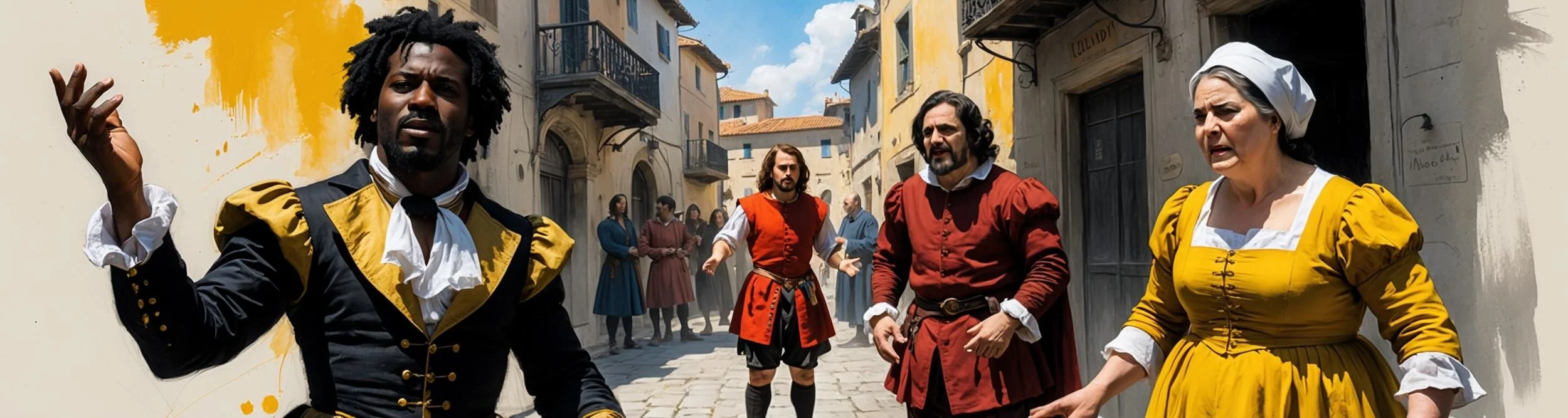
Scene Profile – At a Glance
- Location: A street in Verona, the morning after the Capulet feast.
- What Happens: Mercutio and Benvolio learn Tybalt has sent Romeo a challenge, and Mercutio mocks Tybalt as a fashionable duellist. Romeo arrives in high spirits and trades a torrent of wordplay with Mercutio. The Nurse then finds Romeo, who gives her the plan: Juliet should come to Friar Laurence's cell that afternoon to be married.
- Key Characters: Mercutio, Benvolio, Romeo, the Nurse.
- Dramatic Function: A fast, comic scene that delivers the wedding plan while keeping Tybalt's challenge hanging over it – romance and danger advancing together.
- Famous Quote:
"Now art thou sociable, now art thou Romeo..."
(Mercutio, Act 2, Scene 4) - Why It Matters: The wedding is set in motion here, the threat of Tybalt is planted, and Mercutio is at his brilliant, dangerous best just before the play turns dark.
Scene Summary
Mercutio and Benvolio are out in the street the morning after the feast, wondering where Romeo spent the night. Benvolio reports that Tybalt has sent a letter to Romeo's house – a challenge to a duel. Mercutio, sure Romeo is too lovesick to fight, launches into a long, scornful description of Tybalt as a vain, rule-bound swordsman, all fashionable jargon and posing.
Romeo then arrives, no longer moping but quick and cheerful, and he and Mercutio fall into a rapid contest of puns and wordplay. Mercutio is delighted: this, he says, is the real Romeo, restored to himself now that he has stopped groaning over love.
The Nurse arrives with her servant Peter, looking for Romeo and trying to keep her dignity. Mercutio teases her with a stream of bawdy jokes, then leaves with Benvolio for dinner. The Nurse, ruffled, complains about his rudeness.
Alone with the Nurse, Romeo gives her the plan: Juliet should find an excuse to come to Friar Laurence's cell that afternoon, where she will be married to him. He also arranges for a rope ladder to be delivered so he can reach her window that night. The Nurse, fond and talkative, promises to carry the message, and the scene ends with the wedding set for that very day.
Tybalt's Challenge and Mercutio's Mockery
The scene opens with worry disguised as banter. Romeo has not been home, and Benvolio brings dangerous news: Tybalt has sent a letter to Romeo's house. Mercutio reads it instantly for what it is – a challenge.
Original
A challenge, on my life.
(Mercutio, Act 2, Scene 4)
Shakespeare Retold (Modern Verse)
A challenge, I will bet.
This is the threat that hangs over the whole comic scene. The duel that will eventually kill both Mercutio and Tybalt in A3S1 is already in the post. But Mercutio will not treat it seriously. Instead he turns Tybalt into a figure of fun, mocking him not as a brawler but as a fashionable poseur – a man who fences by the rulebook, all foreign jargon and affected manners. The comedy is real, and it is also a kind of blindness: Mercutio's contempt for Tybalt's formality blinds him to how lethal Tybalt actually is. The scene laughs at the danger it is walking towards.
The Battle of Wits
Romeo arrives, and the mood lifts at once. Gone is the sighing lover of the earlier scenes; in his place is a quick, playful Romeo who matches Mercutio pun for pun. Mercutio is openly delighted to have his friend back.
Original
Why, is not this better now than groaning for love? Now art thou sociable, now art thou Romeo; now art thou what thou art, by art as well as by nature...
(Mercutio, Act 2, Scene 4)
Shakespeare Retold (Modern Verse)
Well, isn't this more fun than groaning out of love? You've opened up again, back to being Romeo, back to your old self, by how you look as well as how you act...
For Mercutio, this is what Romeo should be: sharp, sociable, alive to a joke, rather than wasting himself on lovesick verse. The irony, of course, is that Mercutio has it exactly wrong. He thinks Romeo is cured of love when in fact Romeo is more deeply in love than ever – he is about to arrange his own wedding. Mercutio celebrates the return of the "real" Romeo at the very moment Romeo is keeping the biggest secret of his life. The friendship is genuine and warm, but it rests on a misunderstanding the audience can see straight through.
The Nurse and the Plan
The Nurse arrives, comically grand, and Mercutio cannot resist teasing her with bawdy jokes before sweeping off with Benvolio. Once he is gone, the scene changes register entirely. Alone with Romeo, the Nurse becomes the go-between, and Romeo gives her the message that will marry the lovers that very afternoon.
Original
Some means to come to shrift this afternoon;
And there she shall at Friar Laurence' cell
Be shrived and married. Here is for thy pains.
(Romeo, Act 2, Scene 4)
Shakespeare Retold (Modern Verse)
A plan to make an oath this afternoon;
And she will then, at Friar Laurence' chapel,
Confess and marry me. Here's money for you.
Notice how the language shifts into verse here, after pages of prose. The banter is over; this is the real business of the scene. The plan is breathtakingly fast – the lovers met only the night before, and already the wedding is set for that afternoon. This is the play's haste in action: everything happens at a sprint. The Nurse, fond and garrulous, becomes the essential link between the lovers, and her willingness to carry the message makes her, for now, the engine of the romance. The comic scene quietly does the most important plot work in the act.
Language and Technique
- Prose for comedy: The wit-duel and the Nurse's scenes are in prose, the natural register for jokes and everyday banter; the verse only returns when Romeo turns to the serious business of the wedding.
- Puns and wordplay: Romeo and Mercutio fire off layered double meanings at speed – on shoes, geese, and sauce – the dialogue racing as fast as their wits.
- Bawdy humour: Mercutio's jokes are full of innuendo, especially towards the Nurse, giving the scene its earthy, mischievous energy.
- Dramatic irony: Mercutio thinks Romeo has shaken off love, while the audience knows Romeo is arranging his wedding in the very same scene.
- Foreign affectation: Mercutio mocks Tybalt with imported fencing terms and French phrases, satirising the fashionable duellist as all show and no substance.
Key Quotes from Act 2, Scene 4
Quote 1More than prince of cats, I can tell you...
(Mercutio, Act 2, Scene 4)
Shakespeare Retold (Modern Verse)
He's more than Tybalt from the folk tale, that's for sure...
A gentleman, nurse, that loves to hear himself talk, and will speak more in a minute than he will stand to in a month.
(Romeo, Act 2, Scene 4)
Shakespeare Retold (Modern Verse)
A gentleman, nurse, that loves to hear himself talk, and will speak more in a minute than he will stand still in a month.
And stay, good nurse, behind the abbey wall:
Within this hour my man shall be with thee...
(Romeo, Act 2, Scene 4)
Shakespeare Retold (Modern Verse)
And wait, good nurse, behind the abbey wall;
Within an hour, my servant will arrive...
Key Takeaways
- Tybalt's challenge: Tybalt has sent Romeo a letter daring him to a duel – the threat that will explode into violence in the next act.
- Mercutio at his best: He mocks Tybalt as a fashionable poseur and trades dazzling wordplay with Romeo, but underrates the real danger.
- Romeo restored: Romeo is sharp and cheerful again, and Mercutio wrongly thinks he is cured of love – not knowing he is about to marry.
- The wedding is set: Through the Nurse, Romeo arranges to marry Juliet that very afternoon at Friar Laurence's cell.
Study Questions and Analysis
What news does Benvolio bring at the start of the scene, and why does it matter?
Benvolio reports that Tybalt has sent a letter to Romeo's house, and Mercutio immediately reads it for what it is: a challenge to a duel. This small piece of news is the dramatic fuse of the scene. While the rest of the action is comic – wordplay, bawdy jokes, the Nurse – the challenge sits underneath it all, waiting.
A challenge, on my life.
(Mercutio, Act 2, Scene 4)
Shakespeare Retold (Modern Verse)
A challenge, I will bet.
The challenge matters because it points directly at the play's hinge. Tybalt is the cousin Romeo will marry into within hours, yet Tybalt now wants Romeo dead for the "insult" of attending the Capulet feast. The duel he is demanding will, in A3S1, kill Mercutio, provoke Romeo to kill Tybalt, and trigger the banishment that destroys the lovers. Placing this letter in a comic scene is a characteristic Shakespearean move – the comedy and the coming catastrophe occupy the same stage at once, and the audience feels the dread beneath the laughter.
How does Mercutio characterise Tybalt, and what does it reveal about Mercutio himself?
Mercutio mocks Tybalt mercilessly, but not as a brawler – as a poseur. He calls him "the prince of cats" and a duellist who fights "by the book", obsessed with the correct stance, the right distance, the fashionable foreign jargon of the fencing schools. To Mercutio, Tybalt is all affectation and no substance.
More than prince of cats, I can tell you...
(Mercutio, Act 2, Scene 4)
Shakespeare Retold (Modern Verse)
He's more than Tybalt from the folk tale, that's for sure...
The speech is one of the great comic riffs in the play, and it reveals Mercutio entirely. He is a man of pure wit, who meets everything – love, danger, death – with a joke. Harold Bloom, in Shakespeare: The Invention of the Human (1998), thought Mercutio so vital and anarchic that Shakespeare had to kill him off before he overran the play. The poet John Dryden had recorded the tradition as early as 1672, reporting that Shakespeare himself said he was forced to kill Mercutio in the third act lest Mercutio kill him. The danger of all this brilliance is visible here: Mercutio's contempt for Tybalt's formality is also a fatal underestimation. He laughs at the very swordsman who will run him through, and his refusal to take the threat seriously is the over-confidence that costs him his life.
Why is Mercutio so pleased to see Romeo in this scene?
Mercutio is delighted because Romeo arrives quick, cheerful and ready to spar – nothing like the sighing, lovesick figure of the play's opening. The two of them tumble into a rapid contest of puns, and Mercutio greets it as the return of the real Romeo.
Why, is not this better now than groaning for love? Now art thou sociable, now art thou Romeo; now art thou what thou art, by art as well as by nature...
(Mercutio, Act 2, Scene 4)
Shakespeare Retold (Modern Verse)
Well, isn't this more fun than groaning out of love? You've opened up again, back to being Romeo, back to your old self, by how you look as well as how you act...
The moment is rich with dramatic irony. Mercutio believes Romeo has been cured of love and restored to his witty, sociable self – but the audience knows Romeo is more in love than ever, and is in fact about to arrange his own marriage in this very scene. Susan Snyder, in her essay 'Romeo and Juliet: Comedy into Tragedy' (1970), argued that the play runs on comic conventions in its first half before turning tragic, and this scene is comedy at full tilt. Mercutio's joy in the "sociable" Romeo belongs to that comic world; he has no idea that the love he dismisses as cured is quietly steering Romeo towards a wedding, and beyond it towards the grave.
What is the dramatic purpose of the wit-duel between Romeo and Mercutio?
The long exchange of puns has more than entertainment value. First, it shows the depth and ease of the friendship between Romeo and Mercutio: they think at the same speed, finish each other's jokes, and clearly delight in one another's company. This warmth matters, because it raises the stakes of Mercutio's death – we have to love him before we lose him.
Second, the wit-duel re-establishes Romeo as a clever, engaged young man rather than the self-pitying lover of Act 1. The audience sees that his transformation since meeting Juliet is not a collapse into mooning sentimentality but a return to vitality. And third, the verbal sparring is a kind of harmless rehearsal for the real duel coming in the next act: here the young men fence with words, all skill and pleasure and no blood. In A3S1 the same energy will turn lethal. The comedy of the wit-duel makes the tragedy of the real one land all the harder.
How does Shakespeare present the Nurse in this scene?
The Nurse arrives trying to be dignified – calling for her fan, demanding respect – and Mercutio immediately deflates her with a stream of bawdy mockery, treating her as a figure of fun. After he leaves, she is left flustered and indignant, complaining at length about the "saucy merchant" who insulted her. It is a thoroughly comic entrance.
But the scene also shows the Nurse as the indispensable go-between of the romance. For all her bluster and rambling, she is the one trusted to carry the most important message in the play so far: the time and place of the wedding. Her affection for Juliet is real, and so is her loyalty – she will keep the lovers' secret and ferry their plans back and forth. Shakespeare balances the two sides carefully: the Nurse is comic, earthy and easily ruffled, but she is also the warm, practical channel through which the marriage actually happens. The comedy never quite cancels her usefulness, which is why her later betrayal of Juliet's trust, when she advises her to forget Romeo and marry Paris, will sting so much.
What plan does Romeo give the Nurse, and how does it advance the plot?
Once Mercutio is gone, Romeo gives the Nurse the message for Juliet: she is to find an excuse to come to Friar Laurence's cell that afternoon, where she will be married to Romeo. He also arranges for a rope ladder to be brought, so that he can climb to her window that night.
Some means to come to shrift this afternoon;
And there she shall at Friar Laurence' cell
Be shrived and married. Here is for thy pains.
(Romeo, Act 2, Scene 4)
Shakespeare Retold (Modern Verse)
A plan to make an oath this afternoon;
And she will then, at Friar Laurence' chapel,
Confess and marry me. Here's money for you.
This is the real plot work of the scene, and it advances the action with astonishing speed. The lovers met for the first time the previous night; now, less than a day later, the wedding is fixed for that afternoon. The breakneck pace is part of the play's deliberate design – the theme of time and haste drives everything, and the lovers act as though they have no time to lose, which, the audience knows, they do not. The plan also commits the Nurse and the Friar fully to the secret marriage, drawing the two adults who should be guiding the young lovers into the very scheme that will help destroy them.
How does the scene balance comedy and the coming tragedy?
On its surface this is one of the funniest scenes in the play: a virtuoso comic riff on Tybalt, a dazzling pun-contest, and a long bawdy tease of the Nurse. Yet Shakespeare threads the danger through it from the first lines. The scene opens with Tybalt's challenge already delivered, and it is Mercutio – the very heart of the comedy – who will die because of that quarrel within a day.
The balance is exactly the join Susan Snyder identified in 'Romeo and Juliet: Comedy into Tragedy' (1970): the first half of the play borrows the shapes of romantic comedy – lovers, go-betweens, jokes, a wedding being arranged – before the form turns and the same materials become tragic. Here the wedding plan and the death-warrant of the challenge are delivered in the same half hour. The audience laughs at Mercutio's brilliance while knowing it is about to be silenced; we enjoy the arrangement of the marriage while sensing that this much haste, this much secrecy, can only end badly. The comedy is genuine, but it is comedy with the tragedy already showing through the seams – which is what makes the scene so much more than a comic interlude.