Romeo and Juliet: Act 1, Scene 5 – Analysis
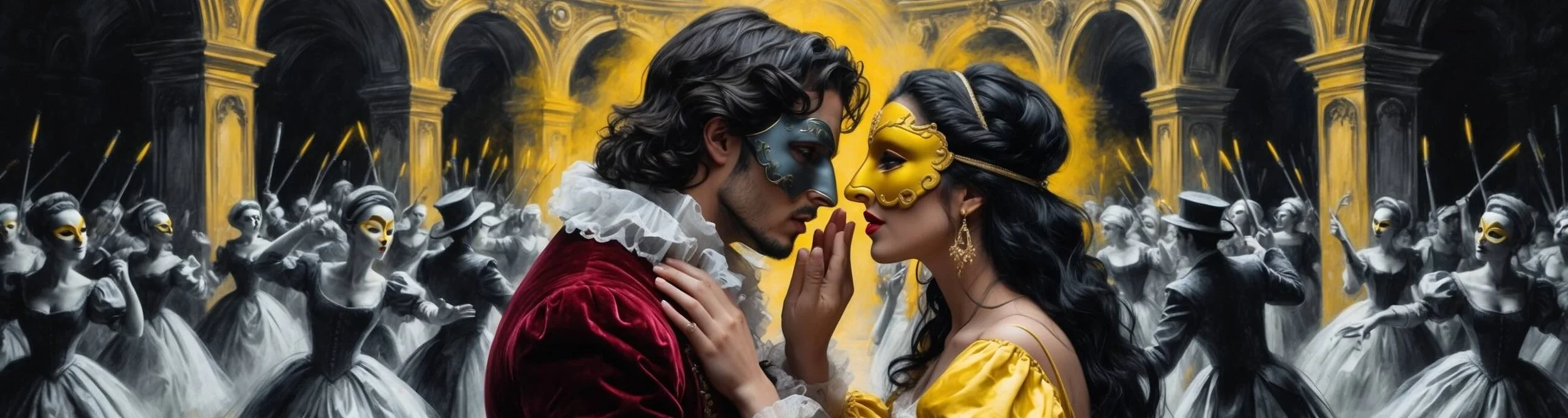
Scene Profile – At a Glance
- Location: A hall in the Capulet house, during the feast.
- What Happens: At the Capulet feast, Romeo sees Juliet and falls instantly in love. Tybalt recognises him and is restrained by Capulet. Romeo and Juliet share a sonnet and a kiss, then each discovers, with horror, that the other belongs to the enemy family.
- Key Characters: Romeo, Juliet, Lord Capulet, Tybalt, the Nurse.
- Dramatic Function: The hinge of the play – the lovers meet, the feud intrudes, and the love that will drive the whole tragedy is born at the enemy's feast.
- Famous Quote:
"O, she doth teach the torches to burn bright!"
(Romeo, Act 1, Scene 5) - Why It Matters: This is where the play turns: Romeo's real love begins, Tybalt's grudge is set, and the lovers learn they have fallen for an enemy – the contradiction the tragedy will never resolve.
Scene Summary
The Capulet feast is in full swing. After the servants clear the hall, Lord Capulet welcomes his guests warmly, urging them to dance and reminiscing about his own younger days.
Romeo, who has slipped in masked, catches sight of Juliet and is instantly transfixed, forgetting Rosaline entirely. His voice gives him away, and Tybalt recognises him as a Montague and wants to fight. Capulet, refusing to allow violence at his feast, sharply orders Tybalt to leave Romeo alone; Tybalt withdraws, furious, vowing revenge.
Romeo reaches Juliet and they speak for the first time. Their exchange forms a shared sonnet built on the imagery of pilgrims and saints, and ends in a kiss. They are interrupted by the Nurse.
From the Nurse, Romeo learns that Juliet is a Capulet, the daughter of his family's enemy; moments later, Juliet learns that the young man she has fallen for is Romeo, a Montague. Each is appalled. As the guests leave, Juliet is called away, already in love with the one person she should hate.
Capulet the Host
The scene opens with the feast at its height: bustling servants, music, dancing. At its centre is old Capulet, a generous, slightly vain host, full of good cheer – teasing the ladies, urging everyone to dance, and reminiscing with an elderly cousin about the masked balls of their own youth.
Original
Nay, sit, nay, sit, good cousin Capulet;
For you and I are past our dancing days...
(Capulet, Act 1, Scene 5)
Shakespeare Retold (Modern Verse)
No, sit you down, good cousin Capulet;
For you and I are far too old to dance...
It is worth holding on to this image of Capulet, because it is so unlike the one to come. The expansive, affable old man of this scene is the same father who, by A3S5, will rage at Juliet and threaten to throw her into the streets. Here, his good humour matters in another way too: it is precisely his determination to keep his party pleasant that stops Tybalt drawing blood when the feud flares. For now, Capulet is the genial host, and the feast is a place of welcome – which makes what happens in it all the more charged.
Romeo Sees Juliet
Across the crowded hall, Romeo catches sight of Juliet, and everything changes. The lovesick poseur of the earlier scenes vanishes in an instant; his language turns pure, direct and radiant.
Original
O, she doth teach the torches to burn bright!
It seems she hangs upon the cheek of night...
(Romeo, Act 1, Scene 5)
Shakespeare Retold (Modern Verse)
Oh, she does teach the torches to burn bright!
It’s though she’s hanging in the dark of night...
The contrast with the affected, second-hand verse Romeo wasted on Rosaline could not be sharper. He reaches at once for images of light against darkness – Juliet as a torch, a jewel against the cheek of night, a white dove among crows – the very imagery the Prologue and the whole play attach to the lovers. And, tellingly, he forgets Rosaline completely: "Did my heart love till now?" The boy who an hour ago swore no one could match her now cannot remember why he cared. Whatever this new feeling is, the language insists it is real in a way the old one never was.
Tybalt and the Threat of Violence
Romeo's voice betrays him. Tybalt recognises a Montague at the Capulet feast and reaches for his sword: to him, Romeo's presence is an insult that can only be answered with blood.
Original
Now, by the stock and honour of my kin,
To strike him dead, I hold it not a sin.
(Tybalt, Act 1, Scene 5)
Shakespeare Retold (Modern Verse)
Now, by my family’s honour, held so strong,
I’ll strike him dead, and won’t think it is wrong.
The moment is the whole play in miniature: at the very instant love is born, hatred draws its sword in the same room. Capulet, unwilling to have a brawl spoil his feast and conscious that Romeo is well regarded in Verona, orders Tybalt to stand down – and is sharply, even brutally, obeyed. Tybalt withdraws, but not before swearing that this "intrusion" will turn to "bitter gall". The grudge he conceives here will erupt in violence in A3S1 and cost him his life. Love and the feud are not merely neighbours in this scene; they share a hall, and the audience watches them brush past each other.
The Pilgrim Sonnet
With Tybalt gone, Romeo reaches Juliet, and they speak for the first time. Astonishingly, their opening exchange forms a complete, shared sonnet – fourteen lines built between them on the conceit of a pilgrim worshipping at a saint's shrine, ending in a kiss.
Original
If I profane with my unworthiest hand
This holy shrine, the gentle fine is this...
(Romeo, Act 1, Scene 5)
Shakespeare Retold (Modern Verse)
If I upset you with my calloused hand
By holding yours in mine, the fine is this...
The shared sonnet is one of the most admired moments in all of Shakespeare. The two strangers complete a single poem between them, trading the rhymes as though they already think as one, and the religious imagery – pilgrim, saint, shrine, prayer – makes their desire feel reverent rather than crude. It is also a meeting of equals: Juliet matches Romeo image for image, turns his arguments back on him, and gets the last, teasing word – "You kiss by the book." For a few lines the feud, the families, the danger all disappear into a perfectly enclosed poem. Then the Nurse calls Juliet away, the sonnet ends, and reality comes flooding back.
Language and Technique
- Light imagery: Romeo describes Juliet as a torch, a jewel against the night, a white dove among crows – beginning the play's great pattern of the lovers as sudden light in darkness.
- The shared sonnet: Romeo and Juliet's first words form a complete sonnet spoken between them, the form itself showing how perfectly matched they are.
- Religious conceit: The lovers speak of pilgrims, saints, shrines and prayer, turning a first touch and kiss into something close to worship.
- Oxymoron: Juliet's "My only love sprung from my only hate" packs the play's central contradiction into a single line.
- Dramatic irony: The audience knows both identities all along, and watches the lovers fall before they learn what we already know.
Key Quotes from Act 1, Scene 5
Quote 1Did my heart love till now? Forswear it, sight!
For I ne'er saw true beauty till this night.
(Romeo, Act 1, Scene 5)
Shakespeare Retold (Modern Verse)
Has my heart ever loved? My lying sight!
For I’ve not seen true beauty till tonight.
You kiss by the book.
(Juliet, Act 1, Scene 5)
Shakespeare Retold (Modern Verse)
You’ve studied kissing.
Is she a Capulet?
O dear account! My life is my foe's debt.
(Romeo, Act 1, Scene 5)
Shakespeare Retold (Modern Verse)
Is she a Capulet?
I’ve fallen for my foe – I’m so upset!
My only love sprung from my only hate!
Too early seen unknown, and known too late!
(Juliet, Act 1, Scene 5)
Shakespeare Retold (Modern Verse)
The man I love’s the son of whom I hate!
I didn’t know at first, but learnt too late!
Key Takeaways
- The lovers meet: Romeo sees Juliet and is transformed in an instant, forgetting Rosaline and finding a new, sincere voice.
- The feud follows them in: Tybalt recognises Romeo and is barely restrained, swearing the revenge that will later turn deadly.
- A shared sonnet: Romeo and Juliet's first exchange forms a single sonnet, the form itself showing them as equals and a perfect match.
- Love and hate locked together: Each learns the other is an enemy – "My only love sprung from my only hate" – the contradiction that drives the tragedy.
Study Questions and Analysis
How does Romeo react when he first sees Juliet, and how is it different from his love for Rosaline?
The change is immediate and total. The moment Romeo sees Juliet, the affected, self-pitying lover of the opening scenes disappears, and his language becomes clear, vivid and full of light. He compares her to a torch, to a jewel glowing against the dark, and to a white dove among crows.
So shows a snowy dove trooping with crows,
As yonder lady o'er her fellows shows.
(Romeo, Act 1, Scene 5)
Shakespeare Retold (Modern Verse)
Much like a dove, all white, amongst some crows,
Beside those ladies, that is how she shows.
Caroline Spurgeon, in her landmark study Shakespeare's Imagery and What It Tells Us (1935), showed that light against dark is the play's dominant image-pattern, and Romeo's first sight of Juliet is where it bursts into life. The difference from his love for Rosaline is not only in feeling but in language: where he mourned Rosaline in borrowed Petrarchan paradoxes, he sees Juliet in fresh, concrete images. Some critics argue this speed makes Romeo shallow; others that the very contrast is the point – Shakespeare gives him the rehearsal of Rosaline precisely so that the real thing, when it comes, sounds completely different. Either way, the scene asks us to hear this love as sincere where the last was performed.
What is the significance of the "pilgrim" sonnet that Romeo and Juliet share?
When Romeo and Juliet first speak, their words fall into a perfect sonnet, shared between the two of them, built on an extended conceit in which Romeo is a pilgrim and Juliet the saint's shrine he longs to touch. The kiss is the prayer at the end of the pilgrimage.
Harry Levin, in his classic essay 'Form and Formality in Romeo and Juliet' (1960), drew attention to how much of the play is patterned around the sonnet form – the Prologue, the Chorus before Act 2, and here, most beautifully, the lovers' first meeting. The effect of the shared sonnet is to show, through form alone, that Romeo and Juliet are made for each other: they complete each other's rhymes, pick up each other's images, and think in the same shape. The religious imagery does delicate work too, lifting their desire above the bawdy, physical view of love offered by Mercutio and the Nurse, and presenting it instead as reverent, even holy. It is one of the most admired courtship scenes in English drama precisely because the form and the feeling are doing the same thing at once.
Why does Tybalt want to fight Romeo, and how does Capulet stop him?
Tybalt recognises Romeo's voice and is enraged that a Montague has dared to enter the Capulet feast. For Tybalt, this is an unforgivable insult to family honour, and he immediately calls for his sword. Capulet, however, refuses to allow any violence at his party: he points out that Romeo is well regarded in Verona and that he will not have a guest harmed in his house. When Tybalt protests, Capulet turns on him sharply, reminding him who is master, and Tybalt is forced to back down – but not quietly.
I will withdraw: but this intrusion shall
Now seeming sweet convert to bitter gall.
(Tybalt, Act 1, Scene 5)
Shakespeare Retold (Modern Verse)
I will withdraw; though Romeo’s intrusion
Seems sweet now, he’ll regret it in conclusion.
The exchange does important work. It shows Capulet, for once, as a force for restraint, which deepens the irony of his later fury at Juliet. And it plants the grudge that drives the rest of the plot: Tybalt leaves vowing that this slight will turn to "bitter gall", and it is this stored-up rage that will explode in A3S1, kill Mercutio, and trigger Romeo's banishment. The scene quietly loads the gun that the third act fires.
How does the scene develop the theme of love and violence?
This scene fuses the play's two great forces more tightly than any other. Romeo and Juliet fall in love at a Capulet feast – that is, in the heart of enemy territory, surrounded by the very people whose hatred will destroy them. While the lovers move towards their first kiss, Tybalt is in the same hall reaching for his sword. Love and violence are literally in the same room, and only Capulet's wish for a pleasant party keeps them from colliding on the spot.
The language carries the same fusion. The instant Romeo learns Juliet's identity, he describes his new life as owed to his "foe", and Juliet calls her love a thing "sprung from my only hate". Their happiness is expressed in the vocabulary of debt, enmity and danger. The scene thus dramatises the idea the Prologue announced: in Verona, love cannot be separated from the feud, and this love is "death-marked" from the moment it begins. It is the clearest early statement of the theme of love and violence that runs through the whole play.
What is the effect of the lovers discovering each other's identities?
Shakespeare stages the discovery twice, once for each lover, and the symmetry is devastating. Romeo asks the Nurse who Juliet is and learns she is a Capulet: "My life is my foe's debt." Then Juliet, just as happily, sends the Nurse to find out Romeo's name, and learns he is a Montague: "My only love sprung from my only hate." Each is given a moment of pure joy and then, seconds later, the knowledge that poisons it.
The effect is to bind the lovers' happiness to dread from the very start, and to deepen the play's sense of fate. The audience, who knew both identities all along, has been waiting for this recognition throughout the scene, so the irony is acute: we watch them fall, knowing what they are about to learn. Juliet's response is especially telling. She does not waver or recoil from the love; she simply registers, in a grim rhymed couplet, that it has come "too late" to be anything but dangerous. From this point, both lovers know exactly what they are risking, which makes everything that follows a choice rather than an accident.
What does Act 1, Scene 5 reveal about Juliet's character?
This is our first real sight of Juliet as more than a dutiful daughter, and she is immediately impressive. In the shared sonnet she matches Romeo line for line, holds her own in the witty religious wordplay, and ends the exchange with a poised, teasing joke – "You kiss by the book." She is not a passive object of Romeo's adoration but an equal partner in the courtship, as quick and articulate as he is.
The end of the scene shows a second side of her: decisiveness, and an instinct for the stakes. Even before she knows Romeo's name, she tells the Nurse that if he is married, her wedding bed will be her grave.
Go ask his name: if he be married.
My grave is like to be my wedding bed.
(Juliet, Act 1, Scene 5)
Shakespeare Retold (Modern Verse)
Go ask his name. If he’s already married,
I’ll never wed, till to my grave I’m carried.
The line is extraordinary for a girl not yet fourteen: it is absolute, a little melodramatic, and darkly prophetic, since her marriage and her grave will indeed turn out to be bound together. It shows the seriousness and intensity beneath Juliet's wit, and it prepares us for the courage and resolve she will show throughout the rest of the play.
Why is this scene a turning point in the play?
Act 1, Scene 5 is the moment the whole tragedy pivots. Everything before it has been setup – the feud, the Prince's warning, Romeo's mooning over Rosaline, the marriage planned for Juliet. Here the central engine of the plot finally starts: Romeo and Juliet meet, fall in love, and discover they are enemies. From this point, the play has its lovers, its obstacle, and its doom.
Susan Snyder, in her essay 'Romeo and Juliet: Comedy into Tragedy' (1970), argued that the play runs on comic conventions in its first half – feasts, masks, love at first sight – before turning tragic. This scene sits exactly on the join. It has all the trappings of romantic comedy, the masked ball and the instant love, yet it ends with both lovers naming the danger they are in. The comedy and the tragedy meet here. It also starts the clock the Prologue set ticking: from this feast, events accelerate – the balcony that night, the marriage the next day, the deaths within the week. The meeting that should begin a love story instead begins a countdown, and that is what makes the scene the hinge of the play.