Romeo and Juliet: Act 1, Scene 4 – Analysis
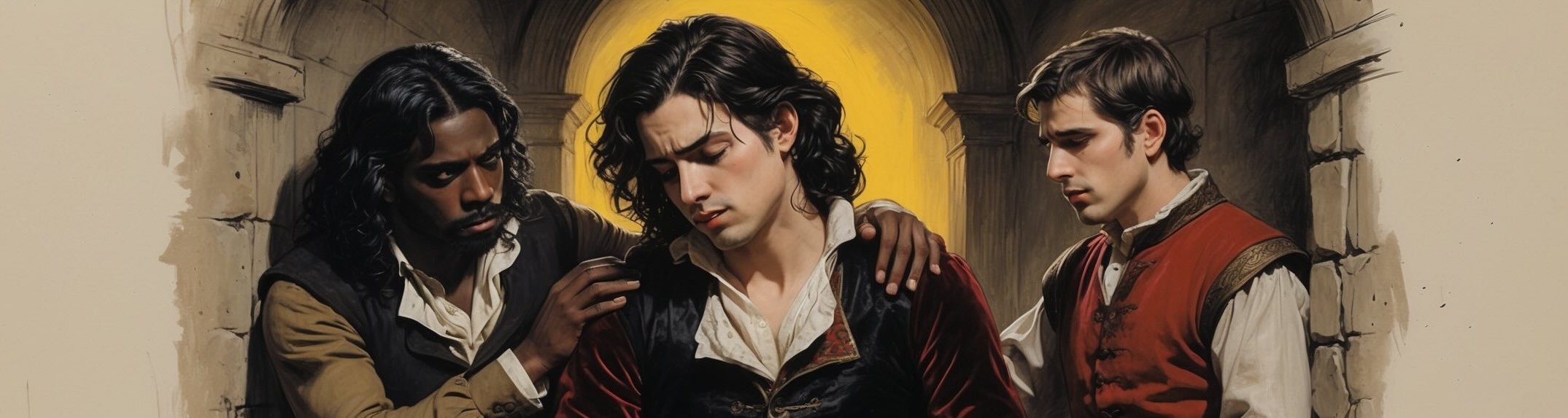
Scene Profile – At a Glance
- Location: A street in Verona, outside the Capulet house.
- What Happens: On their way to crash the Capulet feast, Romeo, Mercutio and Benvolio pause in the street. Romeo is too lovesick to dance; Mercutio teases him and delivers the dazzling Queen Mab speech; Romeo, uneasy, senses disaster ahead.
- Key Characters: Romeo, Mercutio, Benvolio.
- Dramatic Function: Delays the lovers' meeting for one more scene, introduces Mercutio in full flow, and ends on Romeo's premonition of death – turning the comedy towards the tragedy to come.
- Famous Quote:
"O, then, I see Queen Mab hath been with you."
(Mercutio, Act 1, Scene 4) - Why It Matters: It contains Mercutio's great showpiece and the play's last burst of pure comedy, then tips towards tragedy on Romeo's fate-haunted exit, right on the threshold of the feast.
Scene Summary
In the street outside the Capulet house, Romeo, Mercutio and Benvolio arrive in costume, ready to slip uninvited into the feast. They decide to go in without the usual formal speech of apology.
Romeo, still miserable over Rosaline, says he will not dance and will carry a torch instead. Mercutio tries to jolly him out of his gloom, joking about love and dreams. When Romeo mentions that he had a dream, Mercutio launches into his famous speech about Queen Mab, the tiny fairy who brings sleepers dreams of whatever they desire.
The speech runs on, growing wilder and darker, until Romeo cuts him off. Mercutio dismisses dreams as meaningless. As the group finally moves towards the feast, Romeo confesses a sense of dread – a feeling that the night will set in motion something that ends in his early death – before resolving to go in anyway.
Romeo Will Not Dance
On their way to gatecrash the Capulet feast, the three young men stop in the street. Mercutio and Benvolio are in high spirits, ready to dance and be seen; Romeo, still nursing his unrequited love for Rosaline, is in no mood for either. He asks to carry a torch instead, so he can stand at the edge and watch.
Original
With nimble soles: I have a soul of lead
So stakes me to the ground I cannot move.
(Romeo, Act 1, Scene 4)
Shakespeare Retold (Modern Verse)
With nimble soles; my soul is made of lead
And stakes me to the ground so I can’t dance.
The exchange turns on a pun that captures Romeo exactly: the others have nimble "soles" on their dancing shoes, but he has a "soul of lead" that pins him to the ground. It is a neat quibble, but also a real picture of melancholy – the lovesick Romeo weighed down, passive, watching life from the sidelines. The contrast with the quicksilver Mercutio could hardly be sharper, and it sets up the great speech that follows: where Romeo is heavy and earthbound, Mercutio is about to take flight.
Queen Mab
Mercutio tries to tease Romeo out of his gloom, and when Romeo mentions a dream, Mercutio is away. The Queen Mab speech is the most famous set-piece in the play: a headlong flight of fancy about a tiny fairy who drives her chariot through sleepers' brains and gives them dreams of whatever they most desire.
Original
O, then, I see Queen Mab hath been with you.
She is the fairies' midwife, and she comes...
(Mercutio, Act 1, Scene 4)
Shakespeare Retold (Modern Verse)
Oh, then I see Queen Mab’s paid you a visit.
She is the fairies’ midwife, and she is...
Mab is "the fairies' midwife" – the one who delivers dreams – and Mercutio pictures her in exquisite miniature: a chariot made from a hazelnut, a whip of cricket's bone, a wagon drawn by gnats. But the speech does not stay charming. As it gallops on, the dreams it describes grow darker and more cynical – lawyers dreaming of fees, soldiers of cutting throats, women of sex – until Romeo has to stop him. The speech shows Mercutio's brilliance and his bitterness at once: he sees dreams, and love itself, as so much self-deceiving fantasy.
Romeo's Foreboding
Mercutio dismisses dreams as "the children of an idle brain", nothing but air. But Romeo cannot shake the sense that the night ahead is dangerous. As the men finally turn towards the feast, he voices a premonition that turns the scene cold.
Original
I fear, too early: for my mind misgives
Some consequence yet hanging in the stars...
(Romeo, Act 1, Scene 4)
Shakespeare Retold (Modern Verse)
I fear, too early: something’s bothering me
About the fate that’s written in the stars...
This is the moment the comedy darkens. Romeo senses "some consequence yet hanging in the stars" – a disaster, set in motion tonight, that will end in his "untimely death". The lines reach straight back to the Prologue's "star-crossed lovers" and forward to everything about to happen. He does not yet know that he is about to meet Juliet; he knows only that something is coming. Then, with a kind of fatalism, he hands himself over to whatever power steers his life and walks into the feast. The theme of fate and destiny closes the scene and carries us across the threshold into the night that will decide everything.
Language and Technique
- Extended fantasy (the Mab conceit): Mercutio builds an entire miniature world from tiny things – a hazelnut chariot, a cricket-bone whip, a gnat for a coachman – a virtuoso flight of imagination.
- Wordplay and puns: The scene runs on quibbles, from Romeo's "soles" and "soul" to Mercutio's relentless double meanings, much of it bawdy.
- Tonal shift: The Queen Mab speech slides from charming to cynical to disturbing, mirroring the whole play's movement from comedy towards tragedy.
- Foreshadowing: Romeo's closing speech about "the stars" and "untimely death" plants dread on the very threshold of the feast.
- Foil: The earthbound, melancholy Romeo and the airborne, witty Mercutio are set against each other, each defining the other.
Key Quotes from Act 1, Scene 4
Quote 1Is love a tender thing? It is too rough,
Too rude, too boisterous, and it pricks like thorn.
(Romeo, Act 1, Scene 4)
Shakespeare Retold (Modern Verse)
Is love a tender thing? It is too rough,
Too rude and fierce, and pricks you like a thorn.
If love be rough with you, be rough with love;
Prick love for pricking, and you beat love down.
(Mercutio, Act 1, Scene 4)
Shakespeare Retold (Modern Verse)
If love is tough on you, get tough on love;
If love pricks you, then use your prick to beat it.
Her chariot is an empty hazel-nut
Made by the joiner squirrel or old grub...
(Mercutio, Act 1, Scene 4)
Shakespeare Retold (Modern Verse)
Her chariot’s an empty hazelnut shell
Made by a squirrel carpenter or larva...
True, I talk of dreams,
Which are the children of an idle brain...
(Mercutio, Act 1, Scene 4)
Shakespeare Retold (Modern Verse)
Yes, I talk of dreams,
And they are born out of a lazy mind...
Key Takeaways
- The threshold scene: The men are on their way to the feast, so the whole scene is a delay, holding off the lovers' meeting for one more beat.
- Mercutio in full flow: The Queen Mab speech shows his brilliance, his wit, and his deep cynicism about love and dreams.
- Romeo the melancholy lover: Too heavy-hearted to dance, Romeo is still trapped in the lovesickness of the opening scenes.
- Comedy turning to dread: The scene ends on Romeo's premonition of "untimely death", tipping the play from comedy towards tragedy.
Study Questions and Analysis
What is the Queen Mab speech about, and what does it mean?
On the surface, the Queen Mab speech is a fanciful description of a tiny fairy who rides through sleepers' bodies at night and gives them dreams. Mercutio builds her world in loving miniature – a hazelnut chariot, a whip of cricket's bone – before turning to the dreams she brings. And this is where the speech's meaning emerges: each sleeper dreams of exactly what they most want.
And in this state she gallops night by night
Through lovers' brains, and then they dream of love...
(Mercutio, Act 1, Scene 4)
Shakespeare Retold (Modern Verse)
And every night Queen Mab rides out like this
Through lovers’ brains, and then they dream of love...
Lovers dream of love, lawyers of fees, soldiers of slaughter. The speech is really a satire on human desire: it suggests that dreams are simply our wishes playing out, and that beneath the surface everyone is driven by greed, lust or violence. That cynical view is Mercutio's own, and the speech grows increasingly dark and sexual as it goes, until it stops being charming at all. It is one of the most celebrated passages in Shakespeare, and a brilliant piece of characterisation: the meaning is less about fairies than about the mind that invents them.
What does the Queen Mab speech reveal about Mercutio?
The speech is the fullest portrait of Mercutio in the play, and it shows why he is so often singled out as its most vivid creation. It reveals an extraordinary, restless imagination – he spins an entire world out of nothing – paired with a deep cynicism. For Mercutio, love is a joke, dreams are rubbish, and idealism of any kind is there to be punctured. His wit is dazzling but edged with bitterness, and the speech runs away with him until it tips into something almost manic, which is why Romeo finally has to stop it.
Critics have long recognised his magnetism. John Dryden, writing in 1672, recorded the tradition that Shakespeare himself said he "was forced to kill" Mercutio in the third act, "to prevent being killed by him" – that is, that the character was so alive he threatened to take over the play. Harold Bloom, in Shakespeare: The Invention of the Human (1998), reads Mercutio as a brilliant, doomed sceptic whose death drags the play out of comedy and into tragedy. The Queen Mab speech is where that vitality is most on display, which makes his later death all the more shocking.
Why won't Romeo dance at the start of the scene?
Romeo is still sunk in the unrequited love for Rosaline that has dogged him since the first scene. While Mercutio and Benvolio are eager to dance and enjoy the feast, Romeo insists he is too heavy-hearted, and asks only to carry a torch and watch from the side. He puns that he has a "soul of lead" that pins him to the ground.
The detail matters for two reasons. First, it keeps the melancholy, passive, self-dramatising Romeo of the opening firmly in view, so that the change at the feast – when he sees Juliet and is instantly transformed – lands as a genuine reinvention. Second, his reluctance is loaded with irony: he goes to the feast expecting nothing, dragging his feet, certain only that Rosaline cannot be bettered. The audience, who know what waits inside, watch him resist the very evening that will change his life.
How does the scene present different attitudes to love?
The scene stages a debate about love without ever calling it one. Romeo offers the romantic view: love is tender in theory but cruel in practice, a force that "pricks like thorn" and weighs the lover down. Mercutio offers the opposite: love is not a delicate feeling at all but a physical, sexual appetite, to be met with a joke and "beaten down" rather than worshipped.
Between them they map the play's two poles. Mercutio's bawdy cynicism keeps the romance honest, reminding us of the body and of desire's rougher side; Romeo's idealism reaches for something higher. The Queen Mab speech belongs to Mercutio's camp, reducing even dreams to appetite. By placing these views side by side just before Romeo meets Juliet, Shakespeare sharpens what is about to happen: the love Romeo finds at the feast will have to answer both his own painful idealism and Mercutio's mockery, and the play's binding of love and violence is already audible in the language of thorns, pricking and beating.
What is the significance of Romeo's foreboding about "the stars"?
As the men finally head inside, Romeo's mood shifts from melancholy to dread. He senses that the night will begin "some consequence yet hanging in the stars" and end in his own "untimely death", then resolves to go in regardless, trusting himself to whatever power directs his life.
But He, that hath the steerage of my course,
Direct my sail! On, lusty gentlemen.
(Romeo, Act 1, Scene 4)
Shakespeare Retold (Modern Verse)
But God, who steers me through the path of life,
Direct me! Now, full-blooded men, let’s go!
The speech does important thematic work. It picks up the Prologue's description of the lovers as "star-crossed" and turns it into Romeo's own intuition, so that fate seems to press in from outside the story and from within his mind at once. It also frames the central question of the play: are the lovers doomed by the stars, or do they walk into disaster by their own choices? Romeo feels the danger and goes in anyway – an act that is both submission to fate and a free decision. The tension between those two readings runs through the whole tragedy and is concentrated, here, in a single uneasy speech on the doorstep, deepening the theme of fate and destiny.
Why does Shakespeare place this comic scene right before Romeo meets Juliet?
The placement is deliberate and clever. Coming between the Capulets' marriage planning and the feast itself, the scene delays the lovers' meeting at the very moment the audience is most eager for it, building anticipation. It also gives the play its last sustained burst of comedy before everything turns.
Susan Snyder, in her influential essay 'Romeo and Juliet: Comedy into Tragedy' (1970), argued that the first half of the play is built on the conventions of romantic comedy – witty young men, feasts, disguises, love at first sight – and only later swerves into tragedy. This scene is comedy at its height: Mercutio's verbal fireworks, the banter, the gatecrashing. But Shakespeare undercuts it at the close with Romeo's premonition, so the comedy and the coming tragedy are pressed right up against each other. The effect is to make the feast that follows feel charged: we step from Mercutio's laughter straight into the meeting that dooms the lovers, and the contrast makes both halves sharper.
Is the Queen Mab speech just a brilliant digression?
It can certainly be enjoyed as a detachable showpiece, and for a long time it was admired chiefly as a virtuoso set-piece – a dazzling aria that a gifted actor could deliver almost as a turn in its own right. Nothing in the plot strictly depends on it, and Romeo's impatient interruption ("Thou talk'st of nothing") almost invites the audience to agree that it has gone on too long.
But most modern readings argue that the speech is woven into the play's concerns rather than separate from them. Its subject is dreams and desire, in a play obsessed with both; its cynicism about love sets up the test the lovers' idealism must pass; and its restless slide from charm into darkness mirrors the play's own movement from comedy to tragedy. Coming immediately before Romeo's dread about "the stars", it also frames the question of whether dreams and premonitions mean anything – a question the tragedy answers in the affirmative. Read that way, the speech is not a digression at all but a compressed image of the whole play: beautiful, runaway, and edging towards the dark.