Romeo and Juliet: Act 3, Scene 3 – Analysis
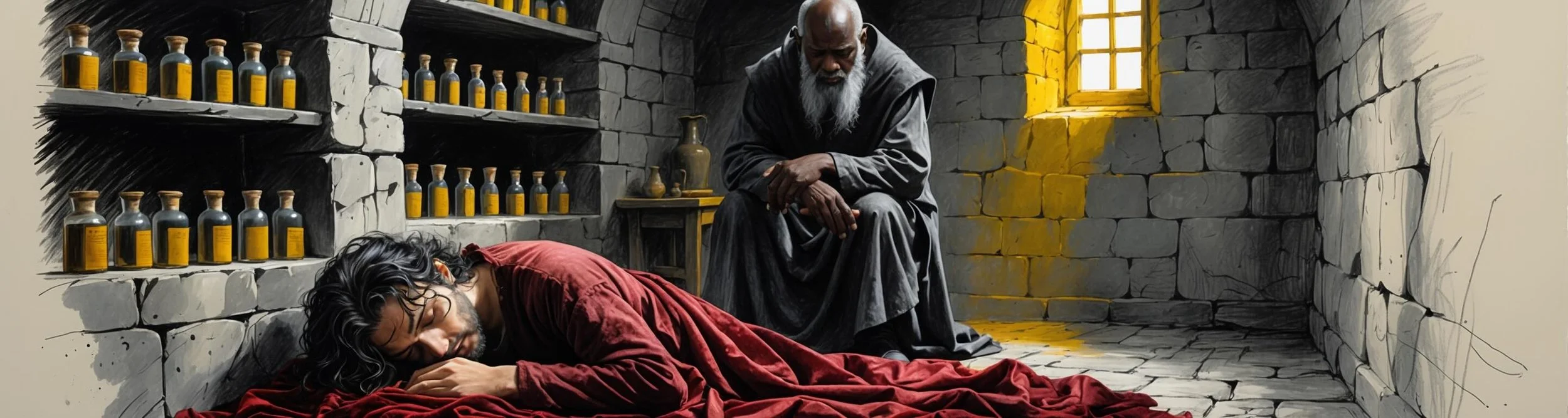
Scene Profile – At a Glance
- Location: Friar Laurence's cell.
- What Happens: The Friar tells Romeo the Prince has sentenced him to banishment, not death. Romeo collapses into despair, insisting exile from Juliet is worse than dying. The Friar rebukes his unmanly grief, the Nurse brings news of Juliet, and a plan is made: Romeo will spend the night with Juliet, then flee to Mantua.
- Key Characters: Romeo, Friar Laurence, the Nurse.
- Dramatic Function: Romeo's lowest point – despair, a near-suicide, and a rescue plan that sets up the secret farewell and the desperate scheming of the final acts.
- Famous Quote:
"There is no world without Verona walls,
But purgatory, torture, hell itself."
(Romeo, Act 3, Scene 3) - Why It Matters: Romeo's extravagant despair here, set against Juliet's later composure, shapes how we judge him, and the Friar's plan begins the chain of schemes that will end in tragedy.
Scene Summary
In Friar Laurence's cell, the Friar brings Romeo the Prince's decision. Romeo fears the worst, but the news is that he is to be banished rather than executed.
Far from being relieved, Romeo reacts with overwhelming grief. To him, banishment from Verona means banishment from Juliet, and that is worse than death. He refuses to be comforted, dismisses the Friar's appeals to reason and philosophy, and throws himself to the ground in despair.
The Friar is interrupted by knocking; it is the Nurse, come from Juliet. She finds Romeo weeping on the floor and urges him to stand and be a man. When Romeo, hearing how distraught Juliet is, draws his sword to kill himself, the Friar stops him with a long, severe rebuke.
The Friar then lays out a plan. Romeo will go to Juliet that night to comfort her, but must leave for Mantua before the watch is set. There he will wait until the marriage can be announced, his friends reconciled, and a pardon won from the Prince. The Nurse leaves a ring from Juliet, and Romeo, his spirits revived, sets out for one last night with his wife.
Banishment, Not Death
Romeo enters dreading a death sentence, and the Friar's news ought to bring relief: the Prince has spared his life. But Romeo will not hear it as mercy. For him, to be cut off from Verona is to be cut off from Juliet, and that is a fate he ranks far below death.
Original
Ha, banishment! Be merciful, say 'death;'
For exile hath more terror in his look,
Much more than death: do not say 'banishment.'
(Romeo, Act 3, Scene 3)
Shakespeare Retold (Modern Verse)
What, I am banished? Kindly, say it’s ‘death;’
For I’m more scared of living life in exile
Than I am scared of death. Don’t say I’m banished.
The reasoning is pure adolescent absolutism. The Friar offers the broad, sensible view – "the world is broad and wide" – and Romeo rejects it outright: there is no world beyond Verona's walls. He bends logic into a fierce little syllogism, insisting that "banished" is simply "death mis-termed", a golden axe that kills him while pretending to be kind. It is grief talking, not thought, and it tells us a great deal about Romeo: he feels in extremes, and he cannot imagine a life rearranged around loss.
Heaven Is Here
Romeo's despair finds its most lyrical form when he turns Verona into heaven and exile into damnation. Because Juliet lives in Verona, the city itself becomes paradise, and everything in it – even flies on rotten meat – is more blessed than he, because it may stay near her.
Original
'Tis torture, and not mercy: heaven is here,
Where Juliet lives; and every cat and dog
And little mouse, every unworthy thing,
Live here in heaven and may look on her;
(Romeo, Act 3, Scene 3)
Shakespeare Retold (Modern Verse)
It’s torture, and not mercy. Heaven’s here,
Where Juliet lives; and every cat and dog
And little mouse, and every simple creature
Lives in this heaven where they all can see her.
The imagery is beautiful and faintly absurd at once, which is exactly the point. Romeo's love is real, and the speech is genuinely moving; yet there is something self-indulgent in envying flies and dwelling so lovingly on his own misery. When the Friar offers "philosophy" as armour against the word "banished", Romeo's scorn is total: "Hang up philosophy!" No abstract comfort can touch him, because his whole world has shrunk to a single person. It is a portrait of love as overwhelming need – and a warning of how little stands between this Romeo and self-destruction.
The Friar's Rebuke
The scene's turn comes when the Nurse arrives and Romeo, hearing how Juliet weeps and cries out his name, draws his sword to cut his own name out of his body. The Friar seizes his hand and unleashes the longest speech of the scene – a stern, bracing lecture that names Romeo's grief for what it is.
Original
Hold thy desperate hand:
Art thou a man? Thy form cries out thou art:
Thy tears are womanish; thy wild acts denote
The unreasonable fury of a beast:
(Friar Laurence, Act 3, Scene 3)
Shakespeare Retold (Modern Verse)
Put your sword down:
Are you a man? You look as though you are:
Your tears are womanlike; your wildness states
You have the fury of an angry beast;
The Friar attacks Romeo's self-pity from every side. He tells him his behaviour shames his "shape", his "love" and his "wit" – the three gifts he is squandering. Then he reframes everything as good fortune: Juliet is alive, Tybalt is dead instead of Romeo, and the law that should have killed him has turned to mere exile. "A pack of blessings lights up upon thy back," the Friar insists, and Romeo sulks at his luck "like a misbehaved and sullen wench". It is the voice of age and reason against the storm of youthful feeling – and it works, where the earlier appeal to philosophy did not, because the Friar finally couples the lecture with a plan.
The Plan
Having shamed Romeo out of his despair, the Friar gives him something to do. The grief is replaced by action, and the scene's energy turns from collapse to escape.
Original
Go, get thee to thy love, as was decreed,
Ascend her chamber, hence and comfort her:
But look thou stay not till the watch be set,
For then thou canst not pass to Mantua;
(Friar Laurence, Act 3, Scene 3)
Shakespeare Retold (Modern Verse)
Go out and see your lover, per your marriage,
Climb to her bedroom, and then comfort her.
But do not stay until the guards start watch,
For then you cannot get to Mantua,
The plan is hopeful, even reasonable: a night with Juliet, then Mantua, then a slow campaign to announce the marriage, reconcile the families and beg the Prince's pardon. Romeo will return, the Friar promises, "with twenty hundred thousand times more joy" than he leaves in. The Nurse hands over Juliet's ring and Romeo is transformed in an instant – "How well my comfort is revived by this!" The same volatility that plunged him into despair now lifts him just as suddenly. The audience, though, hears the plan's fragility: it depends on time, secrecy and luck, the very things this play never grants its lovers.
Language and Technique
- Repetition: Romeo says "banished" again and again, worrying at the word like a wound; the Friar notes it is a word "the damned use in hell".
- Hyperbole: Romeo's grief is built from extremes – Verona is the whole world, exile is hell, even flies are luckier than he is – showing feeling that has outrun all proportion.
- Religious imagery: Verona becomes "heaven" because Juliet lives there, so banishment from the city is recast as banishment from paradise.
- Metaphor: Banishment is "death mis-termed", a "golden axe" that kills while pretending to be kind – making mercy and execution one and the same.
- Rhetorical contrast: The Friar answers Romeo's wild grief with cool argument, reframing every disaster as a "blessing" to shame him back into reason.
Key Quotes from Act 3, Scene 3
Quote 1There is no world without Verona walls,
But purgatory, torture, hell itself.
(Romeo, Act 3, Scene 3)
Shakespeare Retold (Modern Verse)
There is no world beyond Verona’s walls,
Except for purgatory and hell itself.
Yet 'banished'? Hang up philosophy!
Unless philosophy can make a Juliet,
Displant a town, reverse a prince's doom,
It helps not, it prevails not: talk no more.
(Romeo, Act 3, Scene 3)
Shakespeare Retold (Modern Verse)
But still I’m banished? Screw philosophy!
Unless philosophy can make a Juliet,
Transplant a town, reverse the prince’s verdict,
There’s no way it can help me, so stop talking.
What, rouse thee, man! Thy Juliet is alive,
For whose dear sake thou wast but lately dead;
(Friar Laurence, Act 3, Scene 3)
Shakespeare Retold (Modern Verse)
Find strength, young man! Your Juliet’s alive,
And for her sake, you thought that you had died;
Thou fond mad man, hear me but speak a word.
(Friar Laurence, Act 3, Scene 3)
Shakespeare Retold (Modern Verse)
You foolish mad man, let me say a few words.
Key Takeaways
- Banishment feels worse than death: Romeo ranks exile from Juliet below execution, because Verona without her is no world at all.
- Despair to the point of suicide: Hearing how Juliet weeps, Romeo draws his sword on himself and has to be stopped by the Friar.
- The Friar's rebuke and rescue: The Friar shames Romeo's unmanly grief, reframes his luck as a "pack of blessings", and gives him a plan.
- The plan that sets up the end: A night with Juliet, then Mantua and a hoped-for pardon – a fragile scheme that the tragedy will undo.
Study Questions and Analysis
Why does Romeo react to banishment as though it were worse than death?
For Romeo, Verona and Juliet have become the same thing. To be banished from the city is to be banished from her, and since she is now his whole world, exile is not a lesser punishment than death but a crueller one. He builds the idea into a fierce piece of logic: "banished" is merely "death mis-termed", a sentence that kills him while pretending to spare him.
There is no world without Verona walls,
But purgatory, torture, hell itself.
(Romeo, Act 3, Scene 3)
Shakespeare Retold (Modern Verse)
There is no world beyond Verona’s walls,
Except for purgatory and hell itself.
Harley Granville-Barker, in his Prefaces to Shakespeare (1930), reads Romeo throughout as a creature of pure feeling, living wholly in the emotion of the moment, and this scene is the clearest case: his grief has no sense of proportion or future, only the unbearable present. Critics have long debated how to take it. Harold Bloom, in Shakespeare: The Invention of the Human (1998), is impatient with Romeo's self-dramatising despair, contrasting it with Juliet's far greater maturity. Others see the extravagance as the point: Romeo feels in absolutes, and the same intensity that made his love so beautiful now makes his grief uncontainable. Either way, the speech prepares us for the play's end, where this same inability to wait or to imagine a way through will kill him.
How does this scene contrast Romeo's behaviour with Juliet's?
The contrast is deliberate and damning. Romeo and Juliet receive the same blow – Tybalt's death and Romeo's banishment – in consecutive scenes, and Shakespeare invites us to compare their responses. Juliet, in A3S2, moves through grief to resolve, deciding that Romeo's banishment is a sorrow she must live with and acting to keep her marriage alive. Romeo, here, throws himself on the floor, refuses all comfort, and reaches for his sword.
Coppélia Kahn, in Man's Estate: Masculine Identity in Shakespeare (1981), reads the play closely for its anxieties about manhood, and this scene is central: it is the Friar and even the Nurse, not Romeo, who must call him to behave "like a man", and his collapse is repeatedly figured as womanish or childish. The irony is sharp. The thirteen-year-old Juliet shows more composure and clearer thinking than her husband. Many readers find that the scene tips the balance of the tragedy: from here on, it is Juliet who acts with courage and calculation, while Romeo lurches from feeling to feeling. The Friar's rebuke – "Art thou a man?" – lands so hard precisely because the audience has just watched Juliet be exactly that.
What is the purpose of the Friar's long rebuke to Romeo?
The Friar's speech does two jobs at once: it stops Romeo from killing himself, and it argues him out of despair by force of reason. He begins by shaming Romeo – his tears are "womanish", his wildness the "fury of a beast" – then accuses him of squandering his three gifts, his "shape", his "love" and his "wit". Finally he reframes the whole disaster as good fortune.
What, rouse thee, man! Thy Juliet is alive,
For whose dear sake thou wast but lately dead;
(Friar Laurence, Act 3, Scene 3)
Shakespeare Retold (Modern Verse)
Find strength, young man! Your Juliet’s alive,
And for her sake, you thought that you had died;
The rhetoric is carefully built: Juliet lives, Tybalt is dead rather than Romeo, and the law that demanded death has softened to exile – "a pack of blessings". Marjorie Garber, in Shakespeare After All (2004), notes how the Friar consistently functions as the play's voice of moderation, counselling patience and warning against extremes – "Wisely and slow; they stumble that run fast." Here that role is at full stretch. The lecture succeeds where the earlier appeal to "philosophy" failed, but only because it ends in a plan: Romeo can be redirected, not reasoned, out of his grief. The speech is also quietly ominous – the Friar's faith in patient, managed solutions is exactly what the play's relentless speed will defeat.
What does Romeo mean when he tells the Friar to "Hang up philosophy"?
When the Friar offers "philosophy" – calm, reasoned acceptance – as "armour" against the pain of the word "banished", Romeo throws it back at him with contempt. Reason is worthless, he says, unless it can do impossible things: create another Juliet, move a town, or overturn the Prince's sentence.
Yet 'banished'? Hang up philosophy!
Unless philosophy can make a Juliet,
Displant a town, reverse a prince's doom,
It helps not, it prevails not: talk no more.
(Romeo, Act 3, Scene 3)
Shakespeare Retold (Modern Verse)
But still I’m banished? Screw philosophy!
Unless philosophy can make a Juliet,
Transplant a town, reverse the prince’s verdict,
There’s no way it can help me, so stop talking.
The line dramatises a tension the play returns to often: feeling against reason, youth against age. Harley Granville-Barker (1930) saw the Friar and Romeo as embodying these opposed temperaments, the older man's measured counsel set against the younger's headlong passion. There is genuine force in Romeo's protest – abstract comfort really is cold help to a grief this raw – but it also reveals his limitation. He cannot step outside his own feeling for a moment, and so he is deaf to advice that might save him. The exchange looks forward to the final act, where Romeo's refusal to wait, to doubt, or to seek counsel will prove fatal.
What part does the Nurse play in this scene?
The Nurse's arrival breaks the deadlock between Romeo and the Friar and brings the outside world – and Juliet – into the cell. She comes as Juliet's messenger, finds Romeo weeping on the ground, and reacts with her usual blunt practicality, telling him to "stand up" and "be a man". Her description of Juliet, weeping and calling out Romeo's and Tybalt's names by turns, is what tips Romeo towards suicide, since it convinces him he has destroyed Juliet's happiness.
Dramatically, the Nurse serves several purposes. She links the two halves of the lovers' shared catastrophe, carrying news between the parallel grief-scenes of A3S2 and A3S3. Her plainness throws Romeo's extravagance into relief: where he philosophises about exile and heaven, she simply tells him to get up. And she is the bearer of the ring, the small token of Juliet's love that, with the Friar's plan, finally lifts Romeo out of despair. Her comic bustle – admiring the Friar's "learning", fussing over the lateness of the hour – also briefly lightens one of the play's darkest scenes, a tonal contrast Shakespeare uses repeatedly to make the surrounding grief sharper.
How does the Friar's plan set up the rest of the play?
The plan the Friar lays out is the engine of everything that follows. Romeo is to spend the night with Juliet, then slip away to Mantua before the watch is set; there he will wait while the Friar works to announce the marriage, reconcile the families, and win a pardon from the Prince.
Go, get thee to thy love, as was decreed,
Ascend her chamber, hence and comfort her:
But look thou stay not till the watch be set,
For then thou canst not pass to Mantua;
(Friar Laurence, Act 3, Scene 3)
Shakespeare Retold (Modern Verse)
Go out and see your lover, per your marriage,
Climb to her bedroom, and then comfort her.
But do not stay until the guards start watch,
For then you cannot get to Mantua,
The plan directly sets up the secret wedding night of A3S5 and Romeo's removal to Mantua, which in turn makes the later catastrophe possible: with Romeo absent and out of reach, the Friar must improvise the sleeping-potion scheme, and it is the failure of a message to reach Mantua in time that destroys them both. Susan Snyder, in 'Romeo and Juliet: Comedy into Tragedy' (1970), argued that the play's first half runs on the conventions of comedy – and the Friar's hopeful, marriage-mending plan is pure comic logic, the sort of scheme that in a comedy would tidily resolve everything. The tragedy lies in how it fails. Everything the Friar counts on – time, secrecy, a letter safely delivered – is exactly what this fast, unlucky play refuses to grant, so that his sensible scheme becomes the mechanism of disaster.