Twelfth Night: Act 1, Scene 1 – Analysis
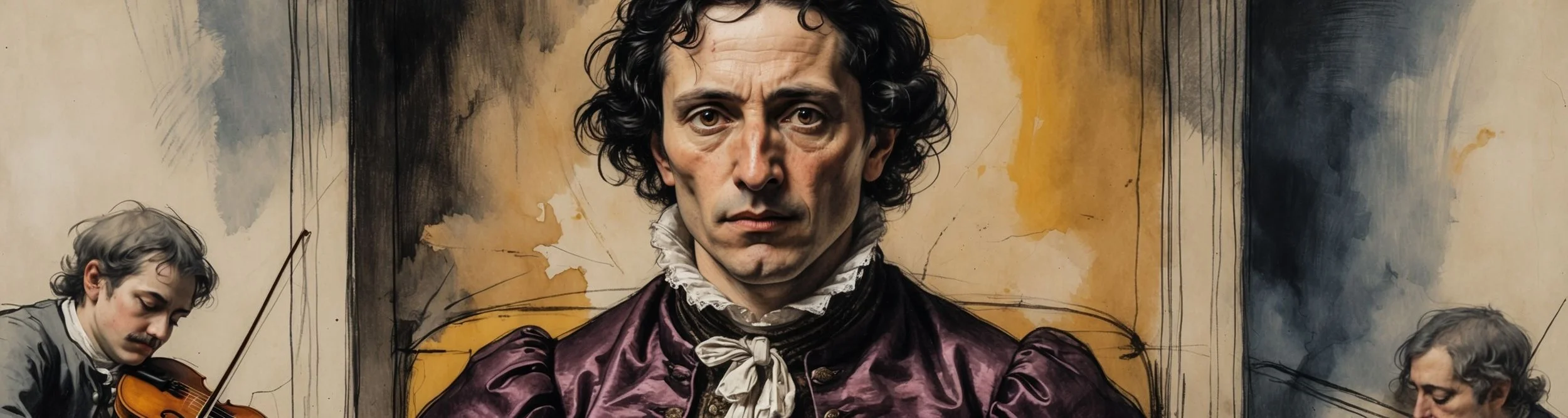
Scene Profile – At a Glance
- Location: Duke Orsino's palace in Illyria.
- What Happens: Orsino, sick with love for Olivia, calls for music and broods on his own desire. His messenger Valentine returns to report that Olivia has refused to see him and will mourn her dead brother, veiled, for seven years.
- Key Characters: Orsino, Curio and Valentine (his attendants), with Olivia spoken of at length but not yet seen.
- Dramatic Function: The play's opening note. It establishes Orsino's court of love-sick melancholy and Olivia's house of grief – the romantic deadlock that Viola, shipwrecked in the next scene, will break open.
- Famous Quote:
"If music be the food of love, play on;
Give me excess of it, that, surfeiting,
The appetite may sicken, and so die."
(Orsino, Act 1, Scene 1) - Why It Matters: It sets the comedy's central idea – that love can be a mood you feed and perform rather than a bond with another person. We meet Orsino and hear of Olivia, both locked in self-regarding feeling, before the outsider arrives to unsettle them.
Scene Summary
The play opens in Duke Orsino's palace, where the lovesick Duke is listening to music. He asks for more of it, hoping to glut his appetite for love until the feeling fades, then changes his mind and tells the musicians to stop. His thoughts circle around Olivia, the countess he loves and cannot have.
When Curio suggests hunting, Orsino turns the idea into a pun – he is already being hunted, like a stag, by his own desires. Valentine, sent to court Olivia on the Duke's behalf, returns with bad news: Olivia will not receive any messenger. She is in mourning for her dead brother and has vowed to live veiled, like a nun, weeping each day for seven years. Far from discouraged, Orsino takes her capacity for such devoted grief as proof of how richly she will one day love. He leaves to lie among flowers and dream of her.
"If Music Be the Food of Love"
The play's first words are about appetite, not romance. Orsino treats his love as a hunger he wants to overfeed until it sickens and dies, and the moment the music stops pleasing him he dismisses it. This restless craving and quick boredom tell us a great deal: Orsino is in love with the experience of being in love, savouring his own emotion like a connoisseur.
Original
O spirit of love! How quick and fresh art thou,
That, notwithstanding thy capacity
Receiveth as the sea, nought enters there,
Of what validity and pitch soe'er,
But falls into abatement and low price,
Even in a minute: so full of shapes is fancy
That it alone is high fantastical.
(Orsino, Act 1, Scene 1)
Shakespeare Retold (Modern Verse)
Oh love, one moment you are fresh and racy,
And even though you have capacity
To drink all water from the sea, you don't,
Despite how fine and wonderful it is;
You let your thirst decline and fade away
In just a minute. Love is always changing
And that's fantastically magnificent.
Orsino describes love as something vast as the sea yet forever shrinking in value, so changeable that nothing keeps its worth for more than a minute. He means this as a complaint, but it is really a self-portrait. His own feelings are exactly this fickle, and the speech quietly warns us not to trust his grand passion too far – an appetite this changeable can be redirected, as it eventually will be, in a heartbeat.
Olivia's Mourning
The scene's second half turns to the woman Orsino loves. Valentine reports that Olivia has shut herself away to grieve a dead brother, refusing all suitors and vowing to weep, veiled, for seven years. Her grief is the mirror image of Orsino's love: extravagant, theatrical, and turned inward.
Original
But, like a cloistress, she will veiled walk
And water once a day her chamber round
With eye-offending brine: all this to season
A brother's dead love, which she would keep fresh
And lasting in her sad remembrance.
(Valentine, Act 1, Scene 1)
Shakespeare Retold (Modern Verse)
Because she'll wear a veil like a nun,
And cry each day as she walks round her bedroom
With stinging tears, for only to preserve
The love for her dead brother, which she'll keep
Alive in her sad memories of him.
The image of Olivia salting her grief to keep it "fresh" is telling. Like Orsino feeding his love, she is preserving an emotion, making a performance of mourning that shuts out the living world. Shakespeare sets the two of them side by side in this first scene – one drowning in love, the other in grief – so that we can see how alike they are. Both are stuck, and the comedy will need Viola's disguise to jolt them out of their poses and into real feeling.
Language and Technique
- Appetite imagery: Love is "food", "excess" and "surfeiting" – Orsino treats emotion as something to be eaten until it makes him sick, showing how self-indulgent his passion is.
- The sea simile: Love is as huge and receptive as the sea, yet nothing keeps its value in it – a picture of feelings that are vast but never steady.
- The hart/heart pun: Orsino turns Curio's hunting into wordplay, casting himself as a stag (a "hart") chased to death by his own desires.
- Music as mood: The opening strain, called for and then cut off, sets a languid, melancholy tone and shows a man ruled by passing whims.
- Mirroring: Orsino's love-sickness and Olivia's grief are described in matching terms, so the scene pairs them before they ever meet.
Key Quotes from Act 1, Scene 1
Quote 1That instant was I turned into a hart;
And my desires, like fell and cruel hounds,
E'er since pursue me.
(Orsino, Act 1, Scene 1)
Shakespeare Retold (Modern Verse)
And from that moment I became a stag,
And my desires, akin to savage hounds,
Have hounded me since then.
O, when mine eyes did see Olivia first,
Methought she purged the air of pestilence!
(Orsino, Act 1, Scene 1)
Shakespeare Retold (Modern Verse)
For when my eyes first saw Olivia,
I thought she cleansed the air of all disease.
Away before me to sweet beds of flowers:
Love-thoughts lie rich when canopied with bowers.
(Orsino, Act 1, Scene 1)
Shakespeare Retold (Modern Verse)
Lead me away to lie amongst sweet flowers;
For plants give thoughts of love far greater powers.
Key Takeaways
- Love as appetite: Orsino treats his love as a hunger to be overfed, showing he is in love with the feeling more than with Olivia.
- Orsino is changeable: His own speech admits that love loses its value "in a minute" – a warning that his passion can be redirected.
- Olivia mirrors him: Her seven-year vow of mourning is as extravagant and inward-looking as Orsino's love-sickness.
- Two stuck households: The scene pairs a court of love and a house of grief, both frozen, ready to be shaken up.
- Set-up for Viola: We meet both lovers before the heroine arrives, so we understand the world she is about to disrupt.
Study Questions and Analysis
What does the opening speech tell us about Orsino's character?
The famous opening lines establish Orsino as a man steeped in his own emotions. He asks for music as the "food of love", wanting to gorge on the feeling until his "appetite may sicken, and so die", and then dismisses the music the moment it stops giving him pleasure. This restlessness reveals a lover who is more interested in the sensation of longing than in the woman he claims to long for.
Critics have long read Orsino as a study in self-indulgent passion. C. L. Barber, in his 1959 Shakespeare's Festive Comedy, places appetite and release at the heart of the play, and Orsino's opening is its first example: a courtly lover feasting on his own melancholy. The speech is beautiful, but Shakespeare frames it so that we hear the self-absorption underneath the poetry. By the time Orsino's affection switches to Viola at the play's end, this opening has already prepared us to find the change believable rather than shocking.
Is Orsino genuinely in love with Olivia?
The scene casts real doubt on it. Orsino loves an idea of Olivia formed at first sight, and his attention wanders even within his opening speech: he calls for music and then, a few lines later, cuts it off because it is "not so sweet now as it was before".
This sudden boredom is the key. A man whose pleasure curdles "in a minute" is unlikely to sustain a deep, steady love, and Shakespeare plants the suspicion early that Orsino's feeling is a pose he enjoys. Many productions play him as faintly comic for this reason. The doubt matters for the play's ending: because we never quite believed in his love for Olivia, his eventual turn to Viola feels less like betrayal than like a man finally loving a real person instead of an image.
How does the scene present Olivia before we meet her?
We learn about Olivia entirely through Valentine's report, and the picture is of grief taken to an extreme. She has refused to see Orsino's messenger and has vowed to walk veiled "like a cloistress", weeping daily for seven years to keep her dead brother's memory "fresh". Shakespeare deliberately makes her mourning sound excessive, even performative.
The effect is to pair Olivia with Orsino before either has appeared opposite Viola. He feeds a love no one returns; she nurses a grief that shuts out the living. Both are indulging an emotion and using it to avoid the ordinary risks of life and love. Setting them up as mirror images prepares the audience for the comedy's real business: the arrival of Viola, whose honesty and disguise will draw both of them out of their self-enclosed moods and into genuine attachment.
Why does Shakespeare open the play with Orsino rather than Viola?
Opening with Orsino lets Shakespeare paint the world before the heroine disturbs it. In a single short scene we are given the play's emotional climate – a court of refined, idle love-melancholy – and we hear of Olivia's matching withdrawal into grief. The stage is set as a place where strong feelings are performed but nothing actually moves.
When Viola is then washed ashore in the second scene, having lost her own brother to the sea, the contrast is sharp. Her grief is real and active: she does not retreat into mourning but disguises herself and gets to work. By meeting Orsino's and Olivia's stylised emotions first, the audience can measure Viola's sincerity against them. The opening scene is, in effect, the problem; Viola is the solution Shakespeare is about to introduce.