
Twelfth Night: Act 1, Scene 2 – Analysis
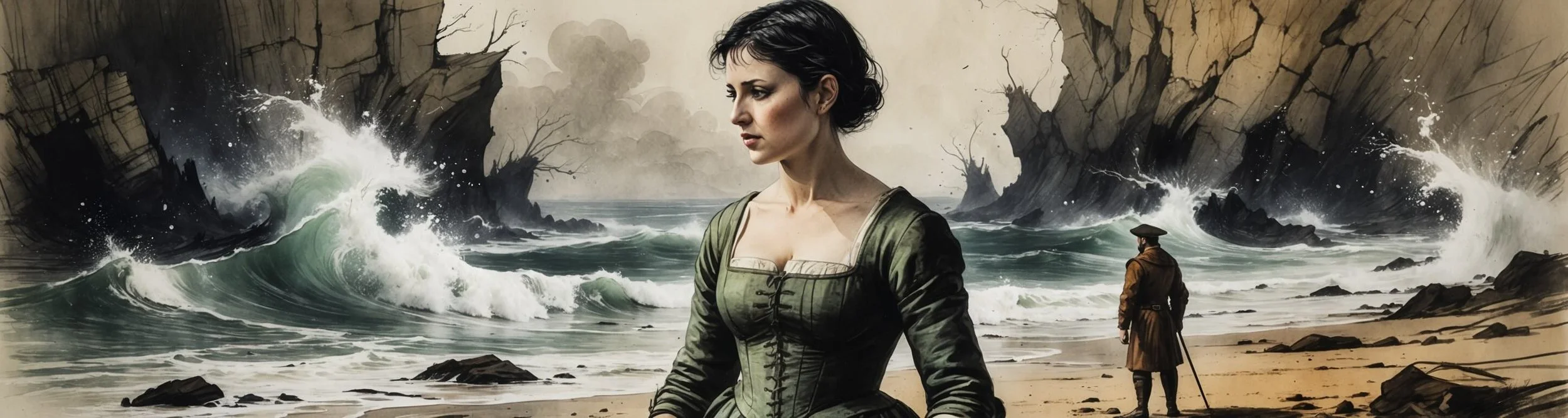
Scene Profile – At a Glance
- Location: The sea-coast of Illyria.
- What Happens: Viola is washed ashore after a shipwreck. Fearing her brother Sebastian is drowned, she learns she is in Illyria and resolves to disguise herself as a young man called Cesario and enter the service of Duke Orsino.
- Key Characters: Viola and the Captain (her rescuer).
- Dramatic Function: The scene introduces Viola – the play's true centre – and sets the disguise plot in motion. Her decision to become Cesario is the engine that drives everything that follows.
- Famous Quote:
"Conceal me what I am, and be my aid
For such disguise as haply shall become
The form of my intent."
(Viola, Act 1, Scene 2) - Why It Matters: It is the hinge on which the whole comedy turns. The moment Viola chooses her disguise, she sets in motion every romantic tangle – and every eventual resolution – of the play.
Scene Summary
Viola has survived a shipwreck off the coast of Illyria, pulled ashore with the ship's Captain and a few sailors. Her first thought is for her twin brother Sebastian, and the Captain offers her what comfort he can: he saw Sebastian lash himself to a mast and was still watching him ride the waves as the Captain lost sight of him. Viola takes this as grounds for hope.
Learning that Illyria is governed by Duke Orsino – a name her father once mentioned – Viola hears that Orsino has been pursuing the Countess Olivia, who has shut herself away in mourning for her dead brother and refuses all visitors. Viola's first instinct is to enter Olivia's service and keep her own identity hidden, but the Captain warns her that is impossible. She quickly pivots: she will instead enter Orsino's service, disguised as a young man. She pays the Captain well, swears him to secrecy, and the plan is made.
Hope in the Wreckage
The scene opens in loss. Viola has just survived a shipwreck and believes her brother is dead. Yet her response is not to collapse into grief but to search at once for reasons to hope. When the Captain describes seeing Sebastian bind himself to a mast, she seizes on the detail – "For saying so, there's gold" – and uses it as a foundation for action. Her grief is real, but she does not perform it; she converts it.
Original
When you and those poor number saved with you
Hung on our driving boat, I saw your brother,
Most provident in peril, bind himself,
Courage and hope both teaching him the practise,
To a strong mast that lived upon the sea;
Where, like Arion on the dolphin's back,
I saw him hold acquaintance with the waves
So long as I could see.
(Captain, Act 1, Scene 2)
Shakespeare Retold (Modern Verse)
When you and those few others that survived
Clung to our drifting raft, I saw your brother,
With foresight in the danger, tie himself –
As bravery and optimism taught him –
To a strong mast that floated on the sea,
Where, like Arion rode the dolphin's back,
He held his own, buoyant above the waves,
As long as I could see.
The Captain's classical allusion to Arion – the legendary musician saved by a dolphin – lends Sebastian's survival a mythic quality, as though the sea itself might spare him. Shakespeare plants a seed of hope here that the play will eventually honour. The parallel with Viola is quiet but unmistakable: both siblings are provident in peril, finding a way to stay afloat.
The Decision to Disguise
What makes Viola remarkable is not that she is wrecked on a foreign shore but what she does next. Within minutes of arriving she has assessed her situation, considered her options, and devised a plan. She chooses her disguise not from vanity or whim but from a clear-eyed reading of her circumstances: a young woman alone in an unknown country, with no connections and no protection, needs cover. She trusts the Captain because she reads his character, not just his face.
Original
There is a fair behaviour in thee, captain;
And though that nature with a beauteous wall
Doth oft close in pollution, yet of thee
I will believe thou hast a mind that suits
With this thy fair and outward character.
(Viola, Act 1, Scene 2)
Shakespeare Retold (Modern Verse)
You seem to be a decent person, captain,
And though in nature things that look delightful
Can often hide a nasty trait, but you
Possess, I think, a disposition matched with
Your kind and generous outward character.
This is Viola exercising judgement under pressure. She knows that appearances can deceive – she is about to build her own survival on exactly that principle – and yet she trusts the Captain. The speech is quietly self-aware: the woman who will live by disguise is also the one who sees through it most clearly.
Conceal Me What I Am
The scene closes with Viola laying out her plan in full. She will present herself to Orsino as a young eunuch who can sing and serve. The scheme is bold and practically thought through, right down to the musical skill she will offer as her credential. Nothing is left to chance. Her final instruction to the Captain – "Only shape thou thy silence to my wit" – is as much a summary of her character as of her plot: she works by wit, and she needs everyone around her to keep up.
Original
Conceal me what I am, and be my aid
For such disguise as haply shall become
The form of my intent. I'll serve this duke:
Thou shall present me as an eunuch to him:
It may be worth thy pains; for I can sing
And speak to him in many sorts of music
That will allow me very worth his service.
What else may hap to time I will commit;
Only shape thou thy silence to my wit.
(Viola, Act 1, Scene 2)
Shakespeare Retold (Modern Verse)
Help me conceal myself and help me find
A suitable disguise to match the will
Of whom I want to be. I'll serve this duke.
You'll introduce me as a eunuch to him.
It will be worth your while, for I can sing
And play to him all different kinds of music
And thereby justify my service to him.
Whatever else may happen, time will tell,
But you must keep my secret safe as well.
The last couplet – "time will commit" and "silence to my wit" – neatly frames Viola's approach to fate. She does not pretend to know everything that will happen; she trusts time, keeps her counsel, and acts. It is the opposite of Orsino's passive brooding and Olivia's self-enclosure. From her very first scene, Viola is the play's engine.
Language and Technique
- Classical allusion: The Captain compares Sebastian to Arion – a musician rescued by a dolphin in Greek myth – lending his survival a sense of destiny rather than mere luck.
- Appearance and reality: Viola's speech to the Captain ("nature with a beauteous wall / Doth oft close in pollution") names the play's central theme: surfaces hide inner truths. She uses this insight to plan her own deception.
- Rhyming couplets: The scene closes with two rhyming couplets, giving Viola's plan a sense of settled resolve. Shakespeare often uses rhyme to close a scene and signal a decision made.
- Practical verse: Where Orsino's verse in Act 1, Scene 1 is decorative and self-regarding, Viola's is brisk and purposeful – a stylistic contrast that marks the difference between the two characters from the outset.
- The name "Cesario": Viola coins her male identity almost in passing, but the name will carry the entire comic plot for the next four acts.
Key Quotes from Act 1, Scene 2
Quote 1Conceal me what I am, and be my aid
For such disguise as haply shall become
The form of my intent.
(Viola, Act 1, Scene 2)
Shakespeare Retold (Modern Verse)
Help me conceal myself and help me find
A suitable disguise to match the will
Of whom I want to be.
When you and those poor number saved with you
Hung on our driving boat, I saw your brother,
Most provident in peril, bind himself,
Courage and hope both teaching him the practise,
To a strong mast that lived upon the sea;...
(Captain, Act 1, Scene 2)
Shakespeare Retold (Modern Verse)
When you and those few others that survived
Clung to our drifting raft, I saw your brother,
With foresight in the danger, tie himself –
As bravery and optimism taught him –
To a strong mast that floated on the sea,...
There is a fair behaviour in thee, captain;
And though that nature with a beauteous wall
Doth oft close in pollution, yet of thee
I will believe thou hast a mind that suits
With this thy fair and outward character.
(Viola, Act 1, Scene 2)
Shakespeare Retold (Modern Verse)
You seem to be a decent person, captain,
And though in nature things that look delightful
Can often hide a nasty trait, but you
Possess, I think, a disposition matched with
Your kind and generous outward character.
Key Takeaways
- Viola is the play's engine: Unlike Orsino and Olivia, who are stuck in their feelings, Viola arrives with nothing and immediately starts acting.
- Grief and action together: Viola fears her brother is dead, but she does not let mourning paralyse her – a contrast with Olivia's seven-year vow of grief.
- Disguise as survival: Viola's decision to dress as Cesario is a practical response to being a lone woman in a foreign land, not a whim.
- The twins mirror each other: The Captain's account of Sebastian shows him "most provident in peril" – the same quality Viola shows on shore.
- Appearances and reality: Viola names the play's central theme in this scene, even as she sets up her own deception.
Study Questions and Analysis
Why does Viola choose disguise rather than seeking help openly?
Viola's situation is genuinely precarious. She is a noblewoman, stranded in a foreign country, with no family, no connections, and no protection. Presenting herself openly as a woman of rank would leave her dependent on the goodwill of strangers with no leverage of her own. The disguise gives her access and agency that her true identity, in this world, simply cannot.
Critics have pointed to the social realism underneath the comic convention. C. L. Barber, in Shakespeare's Festive Comedy (1959), argues that Shakespeare's disguised heroines use the holiday freedom of male costume to act with a freedom their gender would otherwise deny them. Viola's choice is not mere plot mechanism – it is a response to genuine constraint. The comedy that follows is built on the irony that the disguise, intended to protect her, immediately creates new difficulties: Olivia falls in love with Cesario, and Viola herself falls in love with the master she is supposed to serve.
How does this scene establish Viola as different from Orsino and Olivia?
Act 1, Scene 1 showed us Orsino luxuriating in his own melancholy and Olivia enshrined in a performance of grief. Both are defined by inaction: Orsino broods among flowers and sends messengers; Olivia shuts the world out and mourns. Viola arrives in Act 1, Scene 2 in objectively worse circumstances – she has actually lost a brother (or believes she has), she is alone on a foreign shore with nothing – and her response is to act.
The contrast is unmistakable and deliberate. Where Orsino and Olivia perform their emotions, Viola converts hers into plans. Harold Bloom, in Shakespeare: The Invention of the Human (1998), singles out Viola as one of Shakespeare's most vital creations: she does not merely endure her situation but transforms it. This energy is what makes her the comedy's centre of gravity, even though Orsino and Olivia have more social power and more stage time in the early scenes.
What is the significance of the Arion allusion?
Arion was a legendary Greek poet and musician who, according to Herodotus, was thrown overboard by sailors but saved by a dolphin enchanted by his music. The Captain invokes this myth when he describes Sebastian lashing himself to a mast as the ship went down. The allusion does several things at once.
First, it gives Sebastian's survival a mythic dimension – he is not merely lucky but, like Arion, somehow under the protection of something larger. Second, it connects Sebastian to music and art, which will matter when his twin Viola uses musical skill to gain access to Orsino's court. Third, and most subtly, it plants the sense that the sea in this play is not simply a destructive force but one that also delivers people to their destinies. The shipwreck does not end lives; it begins the play's action. Shakespeare's romances often use the sea this way, and Twelfth Night is in some respects a comedy edging toward that genre.
How does Viola's trust of the Captain reflect the play's theme of appearance and reality?
Viola explicitly names the problem in her speech to the Captain: "nature with a beauteous wall / Doth oft close in pollution." She knows that outward goodness is no guarantee of inward virtue. And yet she trusts him – not naively, but on the basis of something she reads in his "fair behaviour". The distinction she makes is between passive prettiness and an active, displayed character.
This nuance matters because it shows Viola is not simply credulous. She is making a judgement, accepting some risk, and choosing to act on it. The play will repeatedly test whether characters can distinguish the genuine from the performed: Olivia falls for a persona, Malvolio reads his own wishes into a letter, Orsino mistakes infatuation for love. Viola alone seems to read people accurately from the start – and it is this quality, rather than her disguise alone, that makes her the play's moral centre.
