Twelfth Night: Act 1, Scene 3 – Analysis
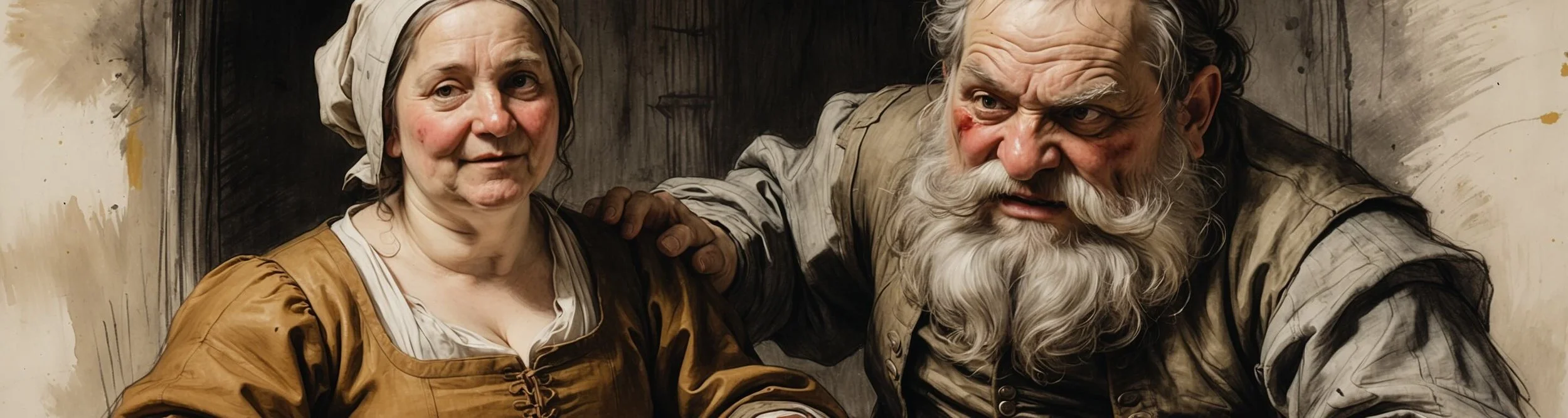
Scene Profile – At a Glance
- Location: Olivia's house.
- What Happens: Sir Toby Belch and Maria quarrel about his late nights, then Sir Andrew Aguecheek arrives. Toby praises Andrew's qualities; Andrew is easily flattered, shows off his (limited) dancing skills, and is talked into staying another month to woo Olivia.
- Key Characters: Sir Toby Belch, Sir Andrew Aguecheek, Maria.
- Dramatic Function: The comic subplot opens. The scene establishes Olivia's chaotic household as a counterweight to Orsino's melancholy court, and introduces the two knights whose foolishness will generate most of the play's low comedy.
- Famous Quote:
"I am sure care's an enemy to life."
(Sir Toby Belch, Act 1, Scene 3) - Why It Matters: It introduces revelry as a value and a way of life, and establishes Sir Toby as the spokesman for appetite and disorder – the comic force that will eventually upset Malvolio's reign of propriety.
Scene Summary
Sir Toby Belch, Olivia's uncle, opens the scene by complaining about his niece's prolonged mourning for her dead brother. Maria, Olivia's waiting-gentlewoman, scolds him for his own behaviour – he has been staying out late, drinking, and he has brought home a foolish knight as a would-be suitor for Olivia. Toby is untroubled by any of this.
The knight in question, Sir Andrew Aguecheek, then enters. He is immediately outmatched by Maria's wit, misunderstanding Toby's instruction to "accost" her as a name rather than a command. Toby smooths things over and praises Andrew's qualities at length – his income, his languages, his musical talent – while Maria's asides puncture every claim. Andrew is an amiable fool: extravagant with money, hopeless with women, and thoroughly outclassed by everyone he meets.
Andrew announces he is thinking of leaving, since Olivia will never look at him while the Count Orsino is courting her. Toby dismisses this easily – Olivia won't go with the Count, he insists, so Andrew should stay. Andrew is persuaded, and the scene ends with the two men planning revelry. Toby's motives are clearly self-interested: Andrew's three thousand ducats a year are a strong argument for keeping him in Illyria.
Toby's Philosophy of Life
The scene's opening exchange establishes Sir Toby's worldview instantly. Olivia is mourning; Toby thinks this is nonsense. His response to grief, constraint, and respectability is cheerful, unapologetic defiance. "Care's an enemy to life" is not a careless throwaway but a genuine credo: worry and propriety are things that kill you, and Toby has no intention of dying of either.
Original
What a plague means my niece, to take the death of her brother thus? I am sure care's an enemy to life.
(Sir Toby Belch, Act 1, Scene 3)
Shakespeare Retold (Modern Verse)
Why does my niece lament her brother's death as though it were the plague? It can't be healthy.
The irony is sharp. Toby accuses Olivia of making herself ill with grief – yet his own habits of drinking and late nights are their own form of self-destruction. Shakespeare gives us two versions of excess side by side: the excessive grief above stairs and the excessive appetite below. Both are comic, but only one is being criticised. Toby's blitheness is itself a kind of wisdom, though a self-serving one.
Defending Sir Andrew
When Maria calls Sir Andrew a fool and a prodigal, Toby defends him with comic extravagance. He praises Andrew's musicianship, his languages, and his "gifts of nature" – and everything he says is at least partly true, which makes the portrait funnier. Andrew does play the viol-de-gamboys; he does speak several languages after a fashion. The gap between Toby's enthusiastic advocacy and the bumbling figure we see is the joke.
Original
Fie, that you'll say so! He plays o' the viol-de-gamboys, and speaks three or four languages word for word without book, and hath all the good gifts of nature.
(Sir Toby Belch, Act 1, Scene 3)
Shakespeare Retold (Modern Verse)
Go wash your mouth with soap! For he can play the cello, and speaks three or four languages without a dictionary, and has been blessed with natural talent.
Maria's reply is perfect: the gifts are "almost natural" – meaning almost those of a born fool. She then lists Andrew's real qualities: he is foolish, quarrelsome, and only his cowardice saves him from an early grave. This deft undercutting is characteristic of Maria, who throughout the play is sharper than anyone around her. Her quick, deflating intelligence makes her the true wit of this scene, even if Toby gets the best lines.
Toby on Revelry and the Dancing Leg
The scene's funniest passage is Toby's absurd enthusiasm for Andrew's dancing. He interrogates Andrew about his galliard, his caper, his back-trick, and his general excellence in the arts of merriment. Andrew is briefly animated by the praise, showing off his leg. Toby's climactic speech – "Wherefore are these things hid?" – is a mock-philosophical lament that such talents should be concealed from the world, and it is a masterpiece of comic overstatement.
Original
Wherefore are these things hid? Wherefore have these gifts a curtain before 'em? Are they like to take dust, like Mistress Mall's picture? Why dost thou not go to church in a galliard and come home in a coranto? My very walk should be a jig; I would not so much as make water but in a sink-a-pace. What dost thou mean? Is it a world to hide virtues in?
(Sir Toby Belch, Act 1, Scene 3)
Shakespeare Retold (Modern Verse)
Why do you hide these skills? Why close a curtain around these gifts you have? Should they be getting all dusty, like that painting? Why not go to church doing the hot-step, then return by skipping? I would dance instead of walking. I'd even take a piss doing the five-step! What are you thinking? Why d'you hide your skills?
The speech works because Toby is at once ridiculous and completely sincere. He genuinely believes in the value of dancing, festivity, and physical pleasure. His mock-sermon on the sin of hiding one's "virtues" inverts the conventional morality – in Toby's world, the real vice is not revelry but sobriety. The festive philosophy he embodies is the play's great counterforce against Malvolio's puritan respectability.
Language and Technique
- Prose throughout: The entire scene is written in prose rather than verse. This marks it as belonging to the comic, lower-status characters. Their world is one of appetite, wordplay, and practical cunning rather than poetic feeling.
- Wordplay and puns: The "accost" misunderstanding – Andrew thinks it is Maria's name – is the scene's sharpest comic routine. It sets up Andrew immediately as a man who takes language at face value and misses almost every joke.
- Comic deflation: Toby's extravagant praise of Andrew is punctured line by line by Maria's dry corrections. Shakespeare builds the scene on this pattern of inflation and deflation, giving the audience the pleasure of knowing more than Andrew does.
- The festive body: References to drinking, dancing, leg-showing, and bodily functions ("make water") fill the scene. Where the play's upper plot is about emotional and spiritual longing, the comic subplot is unashamedly physical.
- Dramatic irony: Toby's claim that Olivia won't go with the Count is true – but not for the reason he implies. The audience already knows from Act 1, Scene 1 that Olivia will refuse any suitor. Toby is right for the wrong reasons.
Key Quotes from Act 1, Scene 3
Quote 1She'll none o' the count: she'll not match above her degree, neither in estate, years, nor wit; I have heard her swear't. Tut, there's life in't, man.
(Sir Toby Belch, Act 1, Scene 3)
Shakespeare Retold (Modern Verse)
She won't go with the Count. She's not attracted to smarter, richer, older, funnier men. I heard her swear it; you've still got a chance.
Wherefore are these things hid? Wherefore have these gifts a curtain before 'em? Are they like to take dust, like Mistress Mall's picture? Why dost thou not go to church in a galliard and come home in a coranto? My very walk should be a jig; I would not so much as make water but in a sink-a-pace. What dost thou mean? Is it a world to hide virtues in?
(Sir Toby Belch, Act 1, Scene 3)
Shakespeare Retold (Modern Verse)
Why do you hide these skills? Why close a curtain around these gifts you have? Should they be getting all dusty, like that painting? Why not go to church doing the hot-step, then return by skipping? I would dance instead of walking. I'd even take a piss doing the five-step! What are you thinking? Why d'you hide your skills?
Fie, that you'll say so! He plays o' the viol-de-gamboys, and speaks three or four languages word for word without book, and hath all the good gifts of nature.
(Sir Toby Belch, Act 1, Scene 3)
Shakespeare Retold (Modern Verse)
Go wash your mouth with soap! For he can play the cello, and speaks three or four languages without a dictionary, and has been blessed with natural talent.
Key Takeaways
- Comedy vs melancholy: The scene deliberately follows Orsino's lovesick court and Viola's shipwreck with laughter and foolishness, establishing the play's double register.
- Sir Toby's philosophy: "Care's an enemy to life" is not just a joke. Toby genuinely believes that grief, propriety, and self-restraint are bad for you – and the play partly agrees with him.
- Andrew is a tool: Toby keeps Andrew in Illyria because Andrew is rich. The friendship is almost entirely one-sided, though Andrew is too cheerful to notice.
- Maria's sharpness: In every exchange, Maria is the wittiest person in the room. She will become the mastermind of the Malvolio plot in Act 2.
- Prose marks the subplot: The shift from verse (Orsino's court, Viola's scenes) to prose signals that we have moved to a different social and emotional world.
Study Questions and Analysis
What does Sir Toby's behaviour reveal about life in Olivia's household?
Toby's very presence in the scene is a sign of disorder. He is living in his niece's house, staying out late, drinking heavily, and importing unsuitable visitors – all while Olivia upstairs maintains a household of mourning and strict respectability. The gap between the two floors of Olivia's house is one of the play's running comic tensions.
Maria's scolding establishes this clearly: Toby must "come in earlier o' nights" and "confine himself within the modest limits of order." But Toby's response – "Confine! I'll confine myself no finer than I am" – is a pun and a manifesto. He refuses any constraint that is not literally the clothes on his back. C. L. Barber, in Shakespeare's Festive Comedy (1959), reads such characters as embodying the spirit of festive licence that Elizabethan holiday culture allowed – a temporary suspension of hierarchy and rule. Toby does not observe the temporary: for him, the holiday is permanent.
Is Sir Andrew a sympathetic character or simply a butt of the play's humour?
Andrew sits in an interesting position. He is clearly foolish – he cannot keep up with Maria's wordplay, he brags about his dancing and his languages in ways the audience can see through, and he is being exploited by Toby for his money. Yet he is not malicious, and his cheerful willingness to be flattered has a kind of innocence about it.
Productions differ sharply on how much sympathy Andrew gets. Some play him as pathetic, revealing the cruelty in Toby's friendship. Others make him buoyant enough that his ignorance feels like a form of happiness. The play itself does not resolve this: Andrew will be humiliated further in the duel plot, but he bounces back with a readiness to believe the best of everyone. Harold Bloom, in Shakespeare: The Invention of the Human (1998), notes that Shakespeare's fools often carry a kind of dignity in their very lack of self-awareness; Andrew never quite reaches that level, but he is never wicked, and the play does not entirely punish him. His final exit – beaten and confused – invites some sympathy alongside the laughter.
How does the comic subplot relate to the romantic main plot?
The two plots are in constant dialogue. Orsino in Act 1, Scene 1 is sick with love and full of beautiful poetry; Toby in Act 1, Scene 3 is sick with drink and full of beautiful nonsense. Olivia upstairs is performing a seven-year vow of mourning; Toby downstairs is cheerfully ignoring her grief. The contrast is not just tonal – it is thematic.
Scholars of Shakespearean comedy have long noted that the subplot functions as a comic mirror to the main action. Northrop Frye, in A Natural Perspective (1965), argues that the comic subplot exposes the absurdity lurking in the romantic main plot by pushing the same drives – desire, self-indulgence, performance – into broader, more visible forms. Toby's love of pleasure is Orsino's love of love seen without the poetry; Andrew's hopeless suit to Olivia is a low comic version of Orsino's hopeless suit. The two plots do not merely alternate; they interpret each other.
What role does Maria play in this scene?
Maria is, by some distance, the sharpest intelligence in this scene. She outpaces Andrew instantly in the "accost" exchange, deflates every one of Toby's claims about Andrew with a single cutting line, and manages the social situation with the ease of someone who has long since sized up everyone around her. The scene introduces her as the household's practical intelligence – the person who actually knows what is happening and can manoeuvre within it.
This matters because Maria will become the architect of the Malvolio plot in Act 2 – a scheme that requires exactly the wit and organisational intelligence she displays here. Some productions cast her as already planning, already scheming, even in this early scene; her lines about Malvolio's sternness suggest she has scores to settle. Her eventual marriage to Toby, revealed at the play's end, completes a pairing that has been implicit from the start: she is the wit, he is the appetite, and together they are considerably more dangerous than either is alone.
How does the scene contribute to the play's theme of appearance and reality?
The scene runs on the gap between what Toby claims and what we see. He praises Andrew's languages; Andrew cannot understand the French word "pourquoi". He praises Andrew's wit; Andrew is bested by every person he meets. He insists Olivia will not go with the Count; the audience knows this is self-serving fiction.
More subtly, the scene raises the question of what "gifts of nature" actually are. Maria's play on "almost natural" – meaning almost a fool by nature – suggests that Andrew's gifts are indistinguishable from his deficiencies. His confidence, his good humour, his willingness to try: these are the same qualities that make him a target. The comedy of the scene depends on audience knowledge that the characters themselves lack. We know what Andrew is; he does not. This structure of ironic knowledge, running through the scene, is the same structure Shakespeare builds into the disguise plot: the audience always knows more than the characters, and the comedy flows from that gap.
What is the dramatic purpose of the scene's comic banter and wordplay?
The "accost" scene and the exchange about dry hands and dry jokes are not merely filler. They establish the play's characteristic pleasure in language being misread, misapplied, and turned to unexpected uses. Andrew takes a word at face value; Maria turns a handshake into an innuendo; Toby interprets a rebuke as a compliment. This linguistic instability – the persistent sense that words mean something different to each speaker – is the low-comic version of the play's deeper preoccupation with misreading.
Viola's disguise works because people read the wrong thing into Cesario. Olivia reads love where there is only service. Malvolio reads destiny where there is only Maria's forgery. The comic wordplay of Act 1, Scene 3 prepares the audience for a world in which meaning is always contested and language is always being captured and redirected. Toby and Andrew are not at the heart of that theme, but their banter is the play's first extended demonstration of it.