A Midsummer Night’s Dream: Act 3, Scene 1 – Analysis
Scene Profile – At a Glance
- Location: The wood, by the bank where Titania lies asleep.
- What Happens: The workmen rehearse Pyramus and Thisbe and solve the problems of the lion, the moonlight and the wall. Puck gives Bottom an ass’s head; his friends flee; Titania wakes, falls in love with him and orders her fairies to attend him.
- Key Characters: Bottom, Quince, Flute, Snout, Snug and Starveling; Puck; Titania; Peaseblossom, Cobweb, Moth and Mustardseed.
- Dramatic Function: The play’s one physical transformation, and the fairy plot’s first result: Oberon’s revenge on Titania is accomplished by making her love a weaver with a donkey’s head.
- Famous Quote:
"Bless thee, Bottom! Bless thee! Thou art translated."
(Quince, Act 3, Scene 1) - Why It Matters: The workmen’s earnest debate about what an audience can be trusted to believe is answered, within a hundred lines, by a fairy queen who believes an ass is an angel.
Scene Summary
The workmen meet at the green plot that Quince has chosen for their stage, with a hawthorn thicket for a dressing room. Before they begin, Bottom raises problems. Pyramus must kill himself with a sword, which the ladies cannot abide; Bottom’s solution is a prologue explaining that the sword does no harm and that Pyramus is really Bottom the weaver. The lion will frighten the ladies; Bottom proposes that Snug show half his face through the costume and tell them plainly he is Snug the joiner. Quince adds two hard things: the lovers meet by moonlight, and they talk through a wall. After checking the almanac they decide that one man will carry a lantern and a bush and be Moonshine, and another, plastered with loam, will be Wall and hold up his fingers for the chink.
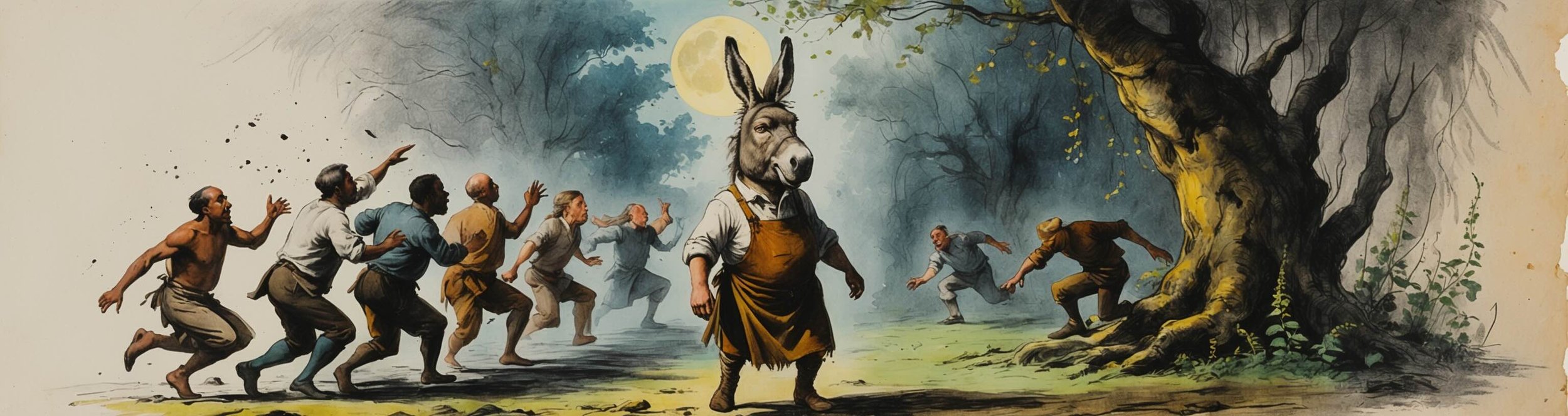
They begin the rehearsal. Puck, passing, is surprised to find hempen home-spuns swaggering so near the fairy queen’s cradle and decides to watch, and perhaps to act. Bottom, as Pyramus, mispronounces “odours” as “odious”, speaks his lines and goes into the thicket to await his cue. Flute, as Thisbe, speaks his whole part at once, cues and all, and calls Ninus’s tomb Ninny’s tomb. Bottom returns on his cue wearing an ass’s head, which Puck has put on him. Quince cries that they are haunted, and the workmen run, with Puck after them, promising to chase them through bog and brier in the shape of a horse, a hound, a hog, a headless bear and a fire.
Bottom, who cannot see the head, decides his friends are playing a trick to frighten him. Snout and Quince come back for one look each – thou art changed, thou art translated – and flee again. Bottom resolves to walk up and down and sing so that they will hear he is not afraid. His song wakes Titania, who asks what angel has woken her, begs him to sing again, and swears on first sight that she loves him. Bottom remarks that she has little reason to, but that reason and love keep little company nowadays. Titania tells him he is as wise as he is beautiful, that he shall not leave the wood whether he will or no, and that she will give him fairies to wait on him and purge his mortal grossness so that he goes like an airy spirit.
She calls Peaseblossom, Cobweb, Moth and Mustardseed, and orders them to feed Bottom with apricots, grapes, figs and mulberries, to steal honey from the bees, to light him to bed with glow-worms and to fan the moonbeams from his eyes with butterfly wings. Bottom greets each fairy with elaborate courtesy, promising to make use of Cobweb if he cuts his finger and sympathising with Mustardseed for the relatives lost to roast beef. Titania orders the fairies to lead him to her bower, observes that the moon looks as if it is weeping, and tells them to tie up her love’s tongue and bring him silently.
Prologue, Lion, Moonshine, Wall
Before a line is rehearsed, the workmen hold a production meeting, and it is the play’s most sustained joke about theatre. Every problem they identify is a problem of belief: the ladies will believe the sword is real, the lion is real, and a wall cannot be brought in. Bottom has a solution for each.
Original
Some man or other must present Wall: and let him have some plaster, or some loam, or some rough-cast about him, to signify wall; and let him hold his fingers thus, and through that cranny shall Pyramus and Thisbe whisper.
(Bottom, Act 3, Scene 1)
Shakespeare Retold (Modern Verse)
Someone must play the part of Wall: and have him have some plaster, or clay soil, or pebbled plaster around him, to signify that he’s a wall; and have him hold his fingers like this, and through that gap Pyramus and Thisbe will whisper.
A prologue to say that Pyramus is not killed and is in any case only Bottom; a lion who shows half his face and gives his name; a man with a lantern to present Moonshine; a man in plaster to present Wall, holding up his fingers for the chink. The workmen assume their audience cannot tell art from life and then destroy the art to make sure. It is funny because it is backwards – a real theatre works by asking the audience to pretend – and it is not entirely wrong, because the play they are in works the same way. The audience of A Midsummer Night’s Dream is being asked, at this moment, to believe in a fairy queen asleep upstage. The debate about art and theatre that the workmen conduct in prose is the debate Theseus will conduct in verse in Act 5, and Bottom, absurdly, gets there first.
An Auditor and an Actor
Puck arrives in the middle of the rehearsal and announces himself as the play’s first critic. Then he joins the cast.
Original
What hempen home-spuns have we swaggering here,
So near the cradle of the fairy queen?
What, a play toward! I'll be an auditor;
An actor too, perhaps, if I see cause.
(Puck, Act 3, Scene 1)
Shakespeare Retold (Modern Verse)
What cloth-clothed bumpkins have we strutting here,
So close to where our fairy queen is sleeping?
They’re putting on a play! I will review it;
And maybe act in it, perhaps, if needs be.
The rehearsal is a disaster of a familiar kind – a mispronounced word, an actor who speaks his whole part at once, cues and all, a tomb renamed Ninny’s – and Puck’s contribution is to send the leading man back from the thicket with the head of an ass. The workmen flee; Puck chases them as horse, hound, hog, headless bear and fire, a catalogue of the shapes Robin Goodfellow took in the old stories. What matters for the play is the phrase Puck uses of himself. He will be an auditor, and an actor too if he sees cause; the fairies watch the mortals as a play, and intervene when the play gets dull. The magic and illusion of the wood is the magic of a theatre in which the audience can climb onto the stage, and the mortals never learn who has been directing them.
Translated
Bottom’s friends see the head and run. Bottom cannot see it, and reasons his way to the only explanation available.
Original
I see their knavery: this is to make an ass of me; to fright me, if they could. But I will not stir from this place, do what they can: I will walk up and down here, and I will sing, that they shall hear I am not afraid.
(Bottom, Act 3, Scene 1)
Shakespeare Retold (Modern Verse)
I see through their trick: they’re trying to make an ass of me; they think they can scare me. But I’ll not move from this place, whatever they try to do. I will walk up and down here, and I will sing, so that they hear me and know I am not afraid.
The pun is his own – to make an ass of me – and he cannot hear it. Quince’s word for what has happened, translated, is exact: Bottom has been carried across into another shape without being changed inside it, which is why the transformation is a comedy rather than a horror. Ovid’s men turned into beasts lose their speech; Bottom keeps his, and uses it to insist that he is not frightened and to sing a song about birds to prove it. The song is what wakes Titania. The joke Puck intended, a humiliation, becomes within twenty lines the greatest thing that has ever happened to a weaver, and Bottom’s refusal to be afraid is the reason. The play’s theme of dreams and reality will rest on him: he is the one mortal who goes all the way into the fairy world, and he gets there by refusing to run.
Titania Wakes
The flower does what Oberon told it to. Titania opens her eyes on a man with an ass’s head singing about cuckoos, and calls him an angel.
Original
I pray thee, gentle mortal, sing again:
Mine ear is much enamoured of thy note;
So is mine eye enthralled to thy shape;
And thy fair virtue's force perforce doth move me
On the first view to say, to swear, I love thee.
(Titania, Act 3, Scene 1)
Shakespeare Retold (Modern Verse)
I beg you, gentle mortal, sing again:
My ears are so enamoured by your voice;
As are my eyes enchanted by your looks;
Your beauty makes me think no one’s above you,
And on first viewing, makes me swear, ‘I love you.’
Ear, then eye, then shape, then virtue: Titania’s love proceeds in order, from the note to the form to the moral being, and every step is a mistake, since the note is a weaver’s, the shape is a donkey’s and the virtue is Bottom’s. The enchanted queen keeps her manner and applies it to the wrong object, exactly as Lysander kept his reason and applied it to Helena. Bottom’s answer – that she has little reason for it, and that reason and love keep little company together nowadays – is the sanest sentence spoken in the wood, and it is spoken by the least enchantable man in Athens to the most enchanted creature in the play. Titania overrules him. He shall not leave the wood whether he will or no; she is a spirit of no common rate; she will purge his mortal grossness. Her love is a command, and the control and rebellion Oberon meant to exert over her she exerts, without knowing it, over a weaver who only wanted to get home. The scene ends with the fairies leading him to her bed and her order to tie up his tongue.
Language and Technique
- Malapropism: Bottom says “odious” for “odours”, “defect” for “effect”, “disfigure” for “figure” (Quince), “Ninny’s” for “Ninus’” (Flute): the wrong word is the workmen’s signature, and every one is funnier than the right one.
- Prose against verse: The workmen argue in prose; Puck comments in rhymed verse; Titania wakes into blank verse of great sweetness. The three registers meet in one clearing, and the audience hears who belongs to which world.
- Puck’s shape-catalogue: “Sometime a horse I’ll be, sometime a hound, / A hog, a headless bear, sometime a fire” – the list gallops like the chase it describes, with the verbs (neigh, bark, grunt, roar, burn) matched to the nouns one for one.
- The pun Bottom cannot hear: “This is to make an ass of me”: the audience sees the ears, Bottom does not, and the joke is the gap between what he says and what he is.
- Bottom’s bird song: Ousel, throstle, wren, finch, sparrow, lark, cuckoo: a country catalogue sung to keep fear off, ending on the cuckoo whose call no married man dares answer. Bottom is singing about being made a fool of while wearing the proof.
- Titania’s ascending love: Ear, eye, shape, virtue: she loves him in an order that sounds like reason and is the flower working. The verse is beautiful; the object is a donkey.
- Fairy miniature: Honey-bags stolen from bees, wax from their thighs for candles, butterfly wings to fan moonbeams away: Titania’s orders shrink the world to fairy scale, and the play’s fairies are small for the first time.
Key Quotes from Act 3, Scene 1
Quote 1
Write me a prologue; and let the prologue seem to say, we will do no harm with our swords, and that Pyramus is not killed indeed; and, for the more better assurance, tell them that I, Pyramus, am not Pyramus, but Bottom the weaver: this will put them out of fear.
(Bottom, Act 3, Scene 1)
Shakespeare Retold (Modern Verse)
Write a prologue that explains we will not harm ourselves with our swords, and that Pyramus is not actually killed; and to better reassure them, tell them that I, Pyramus, am not actually Pyramus, but Bottom the weaver. This will stop them from worrying.
Quote Analysis: Bottom’s solution to the danger of a stage sword: tell the audience in advance that nothing is real, and that Pyramus is Bottom the weaver. It is the opposite of what theatre does, and it is also, oddly, what Puck will do in the epilogue. The modern verse keeps the comic thoroughness of “the more better assurance”.
The ousel cock so black of hue,
With orange-tawny bill,
The throstle with his note so true,
The wren with little quill...
(Bottom, Act 3, Scene 1)
Shakespeare Retold (Modern Verse)
The blackbird with the blackest hue,
With orange-tawny bill,
The singing thrush that sings so true
The wren with little quill…
Quote Analysis: Bottom singing to prove he is not afraid, with an ass’s head on and no idea of it. The song is a plain country catalogue of birds, and it is the sound that wakes the fairy queen. The modern verse keeps the metre and the birds. Nothing about the moment is planned by anyone.
Methinks, mistress, you should have little reason for that: and yet, to say the truth, reason and love keep little company together now-a-days; the more the pity that some honest neighbours will not make them friends. Nay, I can gleek upon occasion.
(Bottom, Act 3, Scene 1)
Shakespeare Retold (Modern Verse)
Lady, I don’t think you should have any reason to love me; but, then again, truth, logic and love rarely go together these days. What a shame that some of their kind friends don’t introduce them to one another. No, I can tell a joke occasionally.
Quote Analysis: Bottom’s reply to a declaration of love from a fairy queen: she has no reason to, and reason and love seldom keep company anyway. Then he apologises for the joke. The modern verse keeps the mildness. Every lover in the wood is proving his point at that moment, and he is the only one who says it.
Out of this wood do not desire to go:
Thou shalt remain here, whether thou wilt or no.
I am a spirit of no common rate;
The summer still doth tend upon my state;
And I do love thee: therefore, go with me;
I'll give thee fairies to attend on thee,
And they shall fetch thee jewels from the deep,
And sing while thou on pressed flowers dost sleep;
And I will purge thy mortal grossness so
That thou shalt like an airy spirit go.
(Titania, Act 3, Scene 1)
Shakespeare Retold (Modern Verse)
Don’t strive to find your way out of this wood:
You shall not leave here, even if you could.
I’m not just any spirit, quite benign;
The summer waits upon each whim of mine;
And I do love you: therefore, come with me;
My fairies will all serve you faithfully,
And from the sea, fetch gems and precious metals
And sing while you’re asleep on flattened petals;
And I’ll remove your foul mortality
So that you’ll be a spirit, just like me.
Quote Analysis: Titania’s love is an order. Bottom shall not leave whether he will or no; she will give him fairies, jewels from the deep and a bed of pressed flowers; and she will purge his mortal grossness. The modern verse keeps the queen’s command and the promise to refine him. What she loves is what she means to change.
Key Takeaways
- The workmen think about theatre: Prologue, lion, moonshine, wall: their solutions destroy illusion to protect the audience, and the play uses them to ask what an audience can be trusted to believe.
- Puck is audience and actor: He watches the rehearsal, then joins it; the fairies treat the mortals as a play and step in when it flags.
- Translated, not transformed: Bottom gets a new head and keeps his old self; he cannot see the ears, will not be frightened, and sings.
- The song wakes the queen: Oberon’s revenge is completed by accident: Titania wakes to Bottom because Bottom refused to run.
- Bottom is the sane one: Reason and love keep little company: the one mortal in the wood who is loved without being bewitched says the truest thing about love in the play.
Study Questions and Analysis
Why are the workmen so worried about the sword, the lion and the wall?
Because they believe their audience will take everything literally. Bottom’s first objection is that Pyramus must kill himself with a sword and the ladies cannot abide it; Snout’s is that the ladies will be afraid of the lion; Quince’s are that moonlight cannot be brought into a room and a wall cannot be brought onto a stage. Each problem is solved by breaking the illusion: a prologue to say the sword is harmless and Pyramus is Bottom, a lion who shows his face and gives his name, a man to be Moonshine, a man to be Wall.
Masters, you ought to consider with yourselves: to bring in – God shield us! – a lion among ladies, is a most dreadful thing; for there is not a more fearful wild-fowl than your lion living; and we ought to look to 't.
(Bottom, Act 3, Scene 1)
Shakespeare Retold (Modern Verse)
Masters, you have to think about this yourselves: bringing in – God help us! – a lion in front of ladies is an awful thing to do, for there is not a more fearsome wild bird than a living lion; and we ought to do something about that.
Hazlitt, in Characters of Shakespear’s Plays (1817), made the sharpest comment: “Bottom seems to have understood the subject of dramatic illusion at least as well as any modern essayist.” The joke is that the workmen’s theory is the reverse of the truth, since a theatre works by asking its audience to pretend, but the play does not simply mock it. Its own fairies depend on the audience agreeing to see spirits in men, and Theseus in Act 5 will defend the workmen on exactly that ground. The theme of art and theatre in the play is carried by the people who understand it least, and the scene lets them state the problem of belief before a fairy queen, asleep a few yards away, demonstrates it.
Why does Puck give Bottom an ass’s head?
For the fun of it, and because Bottom is there. Puck finds the workmen rehearsing near Titania’s bower, decides to be an auditor and perhaps an actor, and when Bottom goes into the thicket to wait for his cue, follows him and sends him back with the head of a donkey. He tells Oberon in the next scene that he chose the shallowest thick-skin of that barren sort, the one who played Pyramus. There is no plan; Oberon’s instructions were only that Titania should wake to some vile thing.
Samuel Johnson offered a dry explanation in 1765: “Bottom was perhaps the head of a rival house, and is therefore honoured with an Ass’s head” – a joke about the theatre companies, and a reminder that the play was written by an actor who knew leading men. The ass itself has a longer history. In Apuleius’s The Golden Ass, which Shakespeare knew in Adlington’s 1566 translation, a man turned into a donkey is made love to by a rich woman, and Jan Kott (1964) argued that Shakespeare’s audience would have remembered what the ass symbolised from antiquity onwards: not stupidity but sexual potency. Kott’s reading has shaped productions since Peter Brook’s in 1970, and it can be set against the gentler view that the ass is simply the most humiliating creature Puck could think of for a man who wanted to play every part. The head is the play’s only piece of magic and illusion the audience can see, and it means what a production decides.
Why does Bottom sing?
To show he is not afraid. His friends have run from him screaming, he cannot see the head, and he decides they are playing a trick to frighten him; his answer is to stay exactly where he is, walk up and down, and sing so that they will hear he is not scared. The song is a country catalogue of birds, and it wakes Titania.
The finch, the sparrow and the lark,
The plain-song cuckoo grey,
Whose note full many a man doth mark,
And dares not answer nay...
(Bottom, Act 3, Scene 1)
Shakespeare Retold (Modern Verse)
The finch, the sparrow and the lark,
The simple cuckoo’s song,
Whose singing many men do mark
But don’t dare say it’s wrong; …
The moment is the hinge of the fairy plot, and it depends on Bottom’s character. A frightened man would have run after his friends and the flower would have found some other vile thing; Bottom refuses to be frightened, and his refusal delivers him to a fairy queen’s bed. The song’s last bird is the cuckoo, whose call no married man dares deny, which is a joke about cuckolds sung by a man about to be loved by another man’s wife. Hazlitt called Bottom “the most romantic of mechanics”, and the romance begins here: the weaver stands his ground, sings, and is taken for an angel. The theme of dreams and reality in the play rests on the one mortal who was not asleep when the fairies came.
Why does Titania fall in love with Bottom?
Because Oberon has squeezed the juice of love-in-idleness on her eyelids and Bottom is the first living creature she sees. That is the whole mechanism; the charm makes the sleeper dote on the next thing it sees, and Oberon hoped for a lion or a bear. Bottom with an ass’s head is worse than either, from Oberon’s point of view better, and Titania’s love is instant and complete: she loves his voice, then his shape, then his virtue.
What the scene adds is that the love is queenly. Titania does not become foolish; she commands. Bottom shall stay whether he will or no, four fairies shall wait on him, and she will refine him into an airy spirit. Hazlitt heard in her speeches to Bottom a certain cloying sweetness, and the sweetness is deliberate: the verse Shakespeare gives her is among the loveliest in the play, and the object is a donkey. A student can read the scene two ways at once. It is Oberon’s revenge working, the queen humiliated exactly as he intended, and it is also the play’s most generous image of love and folly, since Titania gives Bottom everything and asks nothing but that he stay. The Act 4 waking, when she is shown what she loved, is where the humiliation lands.
Is Bottom’s line about reason and love the wisest thing in the play?
It is the truest. Told by a fairy queen that she loves him on first sight, Bottom replies that she has little reason to, and then, to be fair, that reason and love keep little company together nowadays – more’s the pity that some honest neighbours will not make them friends. He adds that he can make a joke when the occasion calls for it. Titania answers that he is as wise as he is beautiful, and the audience, who can see the ears, laughs.
But Bottom is right, and the play knows it. Lysander has just explained in the previous scene that reason led him to Helena; Titania is explaining that Bottom’s virtue moves her; both are under a flower, and both believe they are reasoning. Bottom, who is loved without being bewitched, is the only character in the wood who notices that love and reason have parted company, and he notices it mildly, as a social observation. R. W. Dent (1964) argued that the play’s real subject is the difference between imagination governed and imagination run to dotage, and denied Theseus the wisdom usually credited to him; on that reading the play’s wisest voice is a weaver being polite to a fairy. It is at least the play’s clearest statement of its theme of love and folly, and it is spoken in prose by a man with a donkey’s head.
What do the fairies’ names mean, and why does Bottom talk to them as he does?
Peaseblossom is the flower of the pea plant; Cobweb is a spider’s web; Moth is probably a mote, a speck of dust, though it may be the insect; Mustardseed is the smallest of seeds. The names make the fairies tiny and domestic, creatures of a kitchen garden rather than a court. Bottom treats each as a gentleman of good family and asks after their relations.
I shall desire you of more acquaintance, good Master Cobweb: if I cut my finger, I shall make bold with you. Your name, honest gentleman?
(Bottom, Act 3, Scene 1)
Shakespeare Retold (Modern Verse)
I would like to get to know you better, dear Master Cobweb: if I cut my finger, I will wrap you around my wound. And what is your name, honest gentleman?
The comedy is Bottom’s literalism. A cobweb was used to stop a cut finger bleeding, so he promises to make bold with Master Cobweb if he cuts his finger; mustard is eaten with beef, so he sympathises with Mustardseed for the kindred devoured by ox-beef and admits they have made his eyes water. He takes the fairy world as a set of new neighbours and treats them with a tradesman’s elaborate courtesy, and the fairies, who hailed him as a mortal, are addressed as worships and masters. It is the play’s most charming picture of how a mortal might behave among spirits, and it tells us why Bottom survives the night unharmed: he takes magic and illusion as a pleasant social occasion, and magic seems to like it.