A Midsummer Night’s Dream: Act 3, Scene 2 – Analysis
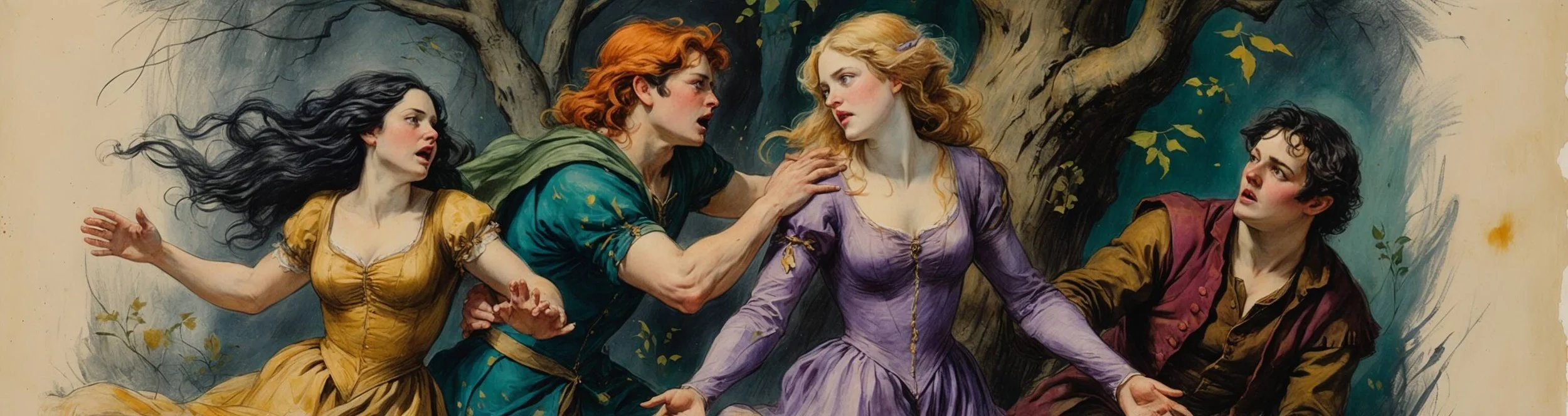
Scene Profile – At a Glance
- Location: The wood, the same night, through to the hour before dawn.
- What Happens: Puck reports Titania’s love for the ass. Oberon discovers that Puck anointed the wrong man and charms Demetrius himself, so that both men now love Helena. The four lovers quarrel; the men go off to fight; Puck leads them astray in a fog until all four sleep, then applies the antidote to Lysander.
- Key Characters: Oberon and Puck; Demetrius, Hermia, Lysander and Helena.
- Dramatic Function: The play’s climax: the lovers’ confusion reaches its height in a four-way quarrel, and the fairies begin to put it right. Everything that will be found asleep in Act 4 is laid down here.
- Famous Quote:
"Shall we their fond pageant see?
Lord, what fools these mortals be!"
(Puck, Act 3, Scene 2) - Why It Matters: The longest scene in the play turns the flower’s mistake into a night of accusation, betrayal and near-violence, and shows the fairies watching it as a show before they end it.
Scene Summary
Oberon wonders what Titania has woken to, and Puck reports: his mistress is in love with a monster. He describes the workmen’s rehearsal, the ass’s head he fixed on Bottom, the panic of the other players, and Titania waking to love an ass. Oberon is delighted, and asks whether the Athenian’s eyes have been anointed too. Puck says they have. Demetrius and Hermia enter, and Puck realises this is the woman but not the man.
Hermia is accusing Demetrius of murdering Lysander in his sleep, since nothing else could have taken him from her side; Demetrius says he would rather give Lysander’s carcass to his hounds, then admits he does not know whether he is dead or alive. Hermia leaves, refusing to see him again, and Demetrius lies down to sleep. Oberon rounds on Puck for laying the juice on a true lover’s eyes, sends him to fetch Helena, and squeezes the flower on Demetrius himself. Puck returns with Helena and Lysander at her heels, still wooing her, and settles down with Oberon to watch: two at once will woo one, and Lord, what fools these mortals be.
Demetrius wakes, sees Helena and worships her as a goddess. Helena, certain that both men have joined forces to mock her, upbraids them. Lysander gives up Hermia to Demetrius; Demetrius says his love for Hermia is gone. Hermia arrives, having found Lysander by his voice in the dark, and asks why he left her; he tells her he hates her and loves Helena. Helena now decides that Hermia is in on the conspiracy too, and reminds her, in a long speech, of their childhood friendship – two girls on one cushion sewing one flower, like a double cherry on one stem – which Hermia is tearing apart to join with men in scorning her.
Hermia, bewildered, says she scorns nobody. The two men quarrel over Helena and challenge each other. Hermia clings to Lysander, who shakes her off as a cat, a burr, a serpent, and tells her plainly that he hates her. Hermia turns on Helena as a thief of love; Helena calls her a puppet; and Hermia, taking this as a jibe at her height, threatens to scratch Helena’s eyes out. Helena appeals to the men for protection, admits she told Demetrius of the elopement, and asks to be allowed to go back to Athens. The men insult Hermia as a dwarf, a bead, an acorn, and go off together to fight. Helena runs; Hermia is left amazed.
Oberon accuses Puck of wilful mischief; Puck answers that he anointed an Athenian, as he was told, and that he is enjoying the jangling. Oberon orders him to cover the night with fog, to lead the two men apart by mimicking each one’s voice until they fall asleep exhausted, and then to crush a second herb into Lysander’s eye to restore his sight; when they wake, the night will seem a dream, and the couples will return to Athens rightly paired. Oberon himself will go to Titania, get the Indian boy, and release her. Puck warns that dawn is near and the ghosts are returning to their graves; Oberon replies that they are spirits of another sort, who may walk in daylight, but that they should hurry.
Puck leads Lysander and Demetrius through the dark, each following the other’s voice, until both collapse and sleep. Helena arrives, exhausted, and lies down; Hermia, torn by briers and unable to crawl further, lies down too. Puck counts four sleepers, squeezes the antidote into Lysander’s eye, and speaks the country proverb over them: Jack shall have Jill, and all shall be well.
The Wrong Athenian
The scene opens with the fairy plot’s one complete success and its one complete failure reported within forty lines of each other. Puck’s account of Titania and the ass is a triumph, told with relish; then the wrong lovers walk on, and Oberon sees at once what has gone wrong.
Original
What hast thou done? Thou hast mistaken quite
And laid the love-juice on some true-love's sight:
Of thy misprision must perforce ensue
Some true love turned and not a false turned true.
(Oberon, Act 3, Scene 2)
Shakespeare Retold (Modern Verse)
What have you done? You’ve gone and got it wrong
By spreading love-juice where one’s love is strong:
It’s sure to follow on from your mistake
One hate will turn to love, one love to fake.
The diagnosis is exact. Oberon meant to turn a false love true, Demetrius back to Helena; Puck has turned a true love false, Lysander away from Hermia. Puck’s reply – that fate over-rules, and for every man who keeps his oath a million break theirs – is a shrug, and Oberon does not accept it. He sends Puck for Helena and charms Demetrius himself, which means that for the rest of the night both men will love the same woman and neither will love Hermia. The fairy king’s attempt at order and chaos has doubled the disorder, and the play lets the audience see the exact moment: a second dose of the same flower, applied to fix the first.
Lord, What Fools These Mortals Be
Puck returns with the news that Helena is at hand, with Lysander pleading after her, and proposes that he and Oberon sit and watch.
Original
Captain of our fairy band,
Helena is here at hand;
And the youth, mistook by me,
Pleading for a lover's fee.
Shall we their fond pageant see?
Lord, what fools these mortals be!
(Puck, Act 3, Scene 2)
Shakespeare Retold (Modern Verse)
Captain of our fairy band,
Helena is close at hand;
And the youth who I mistook
Is pleading with a lover’s look.
Shall we watch their show afar?
Lord, what fools these mortals are!
“Fond” meant foolish as well as loving; a pageant is a show. The lovers are a play, and the fairies are its audience, and the line has become a phrase in its own right for the way human passion looks from above. But the speaker is not wise. He caused the muddle, he is enjoying it, and his next lines say so: two at once will woo one, and those things best please him that befall preposterously. Hazlitt’s description of Puck as a mad-cap sprite who laughs at those he misleads fits the moment exactly. The audience is invited to sit with Puck and laugh, and the audience is mortal too, which is the discomfort the line is built to produce. The magic and illusion of the wood is a theatre, and the lovers are about to give its cruellest performance.
Two at Once Woo One
Demetrius wakes, sees Helena, and goes further than Lysander did: she is a goddess, a nymph, perfect, divine; crystal is muddy beside her eyes; her hand makes snow look like a crow. Helena’s response is the one the play has prepared her for.
Original
O spite! O hell! I see you all are bent
To set against me for your merriment:
If you were civil and knew courtesy,
You would not do me thus much injury.
(Helena, Act 3, Scene 2)
Shakespeare Retold (Modern Verse)
Oh, bloody hell! I see you’re all intent
To make fun of me for your merriment.
If you were nice and not so reprehensive
To me, you wouldn’t be quite so offensive.
She has been told for two acts that nobody could love her, and now two men swear they do, so the only explanation is a conspiracy to mock her. Every protestation makes it worse: Lysander’s tears are cunning, Demetrius’s praise is a trim exploit, and when they offer to hand Hermia from one to the other she calls it idle breath. There is a real cruelty in the scene and it is not the men’s, who are sincere in their enchantment, but the situation’s. Helena is loved by two bewitched men and cannot believe either, and the audience knows she is right not to. The play’s love and folly theme has arrived at its bleakest joke: the flower makes love and cannot make it believable.
The Double Cherry
Hermia arrives, guided through the dark by Lysander’s voice, and hears him say that he hates her. Helena now decides that Hermia is in on the plot, and the speech she makes is the play’s finest description of friendship, spoken as the friendship ends.
Original
We, Hermia, like two artificial gods,
Have with our needles created both one flower,
Both on one sampler, sitting on one cushion,
Both warbling of one song, both in one key,
As if our hands, our sides, voices and minds,
Had been incorporate. So we grow together,
Like to a double cherry, seeming parted,
But yet an union in partition;
Two lovely berries moulded on one stem...
(Helena, Act 3, Scene 2)
Shakespeare Retold (Modern Verse)
We used to be like two gods of the arts,
Sewing a single flower with our needles
Upon a piece of cloth, sat on one cushion,
Both singing out one song in harmony,
As if our hands, our sides, voices and minds
Were one. That’s how we both grew up together,
Much like two cherries, seemingly apart,
But yet connected, though they seem divided;
Like berries bound together on a stem...
Two girls on one cushion, sewing one flower on one sampler, singing one song in one key, so grown together that they were one body with two faces and one heart. The image of the double cherry, seeming parted but one in partition, is the play’s only picture of a bond that is not made by a father, a flower or a duke, and within thirty lines it is a fight about height. Hermia’s answer – that she is amazed, and scorns nobody – is true and useless, because Helena cannot believe anyone. The women do not exchange another friendly word in the play, and neither speaks at all in Act 5. What the gender and patriarchy politics of the ending require is each woman paired with a man, and the double cherry is what that costs; the speech is an elegy for something the plot has to discard.
Little and Low
The quarrel turns physical and personal. Lysander shakes Hermia off as a cat, a burr, a serpent, and tells her in earnest that he hates her; Hermia turns on Helena as a thief of love; and Helena’s word for her, puppet, gives Hermia the insult she needs.
Original
How low am I, thou painted maypole? Speak;
How low am I? I am not yet so low
But that my nails can reach unto thine eyes.
(Hermia, Act 3, Scene 2)
Shakespeare Retold (Modern Verse)
How small am I, you painted maypole? Tell me;
How small am I? I know I’m not so small
That my own nails cannot reach your eyes.
The fight about height is a joke Shakespeare built into the casting: one short dark boy actor, one tall fair one, and a night in which two men switch from the short dark one to the tall fair one for no reason they can name except the women’s bodies, which have not changed. Lysander’s insults – Ethiope, tawny Tartar, dwarf, minimus, bead, acorn – are all about colour and size, and Hermia hears in every word that she is being rejected for what she looks like. Her fury is the fury of a woman who has understood that. Helena, meanwhile, admits at last what she did – she told Demetrius of the elopement – and asks to be let go, and the men, each defending Helena from a woman half her size, go off to fight a duel. The scene’s control and rebellion has passed entirely out of the mortals’ hands, and Oberon, watching, says so.
Fog and Remedy
Oberon’s instructions to Puck are the play’s turn towards its ending: cover the night, separate the rivals by mimicking each one’s voice, wear them out, and put Lysander’s eyes right while they sleep.
Original
When they next wake, all this derision
Shall seem a dream and fruitless vision,
And back to Athens shall the lovers wend,
With league whose date till death shall never end.
(Oberon, Act 3, Scene 2)
Shakespeare Retold (Modern Verse)
So, when they wake up, all of this confusion
Will seem a dream-like, meaningless illusion.
These lovers back to Athens then will start,
And love each other until death do part.
What is promised is not that the night will be undone but that it will be forgotten – it will seem a dream and fruitless vision, and the lovers will go back to Athens paired for life. Puck’s execution of the order is the scene’s last comedy: two men chasing voices through fog, each accusing the other of cowardice, until both lie down on the cold ground; then Helena, praying for daylight; then Hermia, torn with briers, unable to crawl further. Puck counts them, two of both kinds, lays them out in the right pairs, and speaks the antidote over Lysander in the shortest lines in the play. The rhyme that closes the scene is a nursery proverb, Jack shall have Jill, and it is also the play’s theory of order and chaos: whatever the night produced, the morning will sort the couples into the pairs the proverb says they should be. Whether that is a comfort or a cage is a question the play leaves open, and Puck’s own comment on the whole business is that Cupid is a knavish lad who makes poor females mad.
Language and Technique
- Bird simile: Puck compares the fleeing workmen to wild geese eyeing the fowler and choughs rising at a gunshot: a country image that turns panic into a picture, and tells the audience Puck enjoyed it.
- Hyperbole of praise: Demetrius’s waking speech – crystal is muddy, her hand turns snow to a crow – is love-poetry inflated past belief, which is why Helena cannot believe it. The flower produces clichés.
- The double cherry: Helena’s image of two berries on one stem, and the heraldic image of two coats crowned with one crest, describe union in partition: two bodies, one heart. It is the play’s most careful metaphor, and it is spoken during a quarrel.
- Insults of size and colour: Ethiope, tawny Tartar, dwarf, minimus, bead, acorn, painted maypole: the lovers’ abuse is entirely physical, and it exposes what the flower has changed and what it has not.
- Fog and voices: Puck’s chase is staged in the dark with two men following voices that are not each other’s: the play’s most literal picture of love as pursuit of something that is never where it seems.
- Short lines for spells: Oberon’s charm over Demetrius and Puck’s antidote over Lysander are in lines of three or four stresses, some of two words; the fairies’ magic has its own metre, and it gets shorter as it gets more powerful.
- The proverb: “Jack shall have Jill; / Nought shall go ill”: the scene ends on a nursery rhyme, and the plainness after five hundred lines of passion is the point.
Key Quotes from Act 3, Scene 2
Quote 1
My mistress with a monster is in love.
(Puck, Act 3, Scene 2)
Shakespeare Retold (Modern Verse)
Titania, with a monster, is in love.
Quote Analysis: Puck’s report in one line, delivered with pleasure. The modern verse keeps the bluntness. Everything Oberon wanted has happened, and the next forty lines will reveal everything he did not want.
O Helena, goddess, nymph, perfect, divine!
To what, my love, shall I compare thine eyne?
(Demetrius, Act 3, Scene 2)
Shakespeare Retold (Modern Verse)
Oh Helena, you goddess, golden dove!
What shall I match your eyes to, oh my love?
Quote Analysis: Demetrius, waking under the flower, and outdoing Lysander at once. Four nouns of worship in a line, and then the question every bad sonnet asks. The modern verse keeps the pile-up. It is the speech that convinces Helena the whole thing is a joke.
Am not I Hermia? Are not you Lysander?
I am as fair now as I was erewhile.
Since night you loved me; yet since night you left me:
Why, then you left me – O, the gods forbid! –
In earnest, shall I say?
(Hermia, Act 3, Scene 2)
Shakespeare Retold (Modern Verse)
Am I not Hermia? Aren’t you Lysander?
I’m just as beautiful now as before.
Last night you loved me; yet at dawn, you left me:
So have you really left me – God forbid! –
For real, shall I say?
Quote Analysis: Hermia’s questions, which the play cannot answer. She is as fair as she was; he loved her at nightfall; the only thing that has changed is invisible. The modern verse keeps the bewilderment and the gods forbid. Lysander’s reply is that he hates her, by his life.
But we are spirits of another sort:
I with the morning's love have oft made sport,
And, like a forester, the groves may tread,
Even till the eastern gate, all fiery-red,
Opening on Neptune with fair blessed beams,
Turns into yellow gold his salt green streams.
(Oberon, Act 3, Scene 2)
Shakespeare Retold (Modern Verse)
But we are spirits made a different way:
For often I’ve enjoyed the break of day,
And, like a woodman, through the trees I wander
Until the red horizon, glowing yonder,
Forms sunbeams on the ocean to behold,
And turns the salt-green water into gold.
Quote Analysis: Oberon’s distinction between his fairies and the damned ghosts that must be home by dawn: he has walked with the morning and watched the sun turn the sea gold. The modern verse keeps the eastern gate and the salt green streams. It is the play’s clearest statement that its fairies are benevolent, and it is spoken by the man who has just drugged his wife.
O weary night, O long and tedious night,
Abate thy hour! Shine comforts from the east,
That I may back to Athens by daylight,
From these that my poor company detest:
And sleep, that sometimes shuts up sorrow's eye,
Steal me awhile from mine own company.
(Helena, Act 3, Scene 2)
Shakespeare Retold (Modern Verse)
Oh, tedious and never-ending night,
Enough already! Dawn, come to the east,
Then I’ll return to Athens in the light,
Escaping from these folk who like me least.
And sleep, that often takes away one’s sorrow,
Take me away from me until tomorrow.
Quote Analysis: Helena, the last of the lovers to give up, asking for daylight and for sleep to take her away from herself. The modern verse keeps the exhaustion. Of the four she has been on stage longest and been hurt most, and her prayer is simply to stop being Helena for a while.
And the country proverb known,
That every man should take his own,
In your waking shall be shown:
Jack shall have Jill;
Nought shall go ill;
The man shall have his mare again, and all shall be well.
(Puck, Act 3, Scene 2)
Shakespeare Retold (Modern Verse)
And that country proverb known
Says that man shall have his own,
And, waking up, this will be shown:
‘Jack will have Jill
There’ll be no ill;
The man will have his girl again, and all will turn out well.’
Quote Analysis: Puck’s closing rhyme, a nursery saying laid over four sleeping bodies. Jack and Jill, the man and his mare: the pairing of the ending is announced as folk wisdom. The modern verse keeps the proverb. Whether it is a promise or a shrug depends on how much the audience trusts Puck.
Key Takeaways
- The mistake is doubled: Oberon fixes Puck’s error by charming Demetrius too, so that both men love Helena and Hermia is loved by nobody.
- The fairies watch it as a play: Lord, what fools these mortals be: Puck and Oberon sit as audience to the lovers’ quarrel, and the theatre audience sits with them.
- Helena cannot believe she is loved: Two men worship her and she takes it for a conspiracy; the flower can make love but not trust.
- Friendship is the casualty: The double cherry speech is the play’s picture of a bond outside marriage, and the scene destroys it in thirty lines.
- Puck sorts the sleepers: Fog, mimicry, exhaustion and the antidote lay the four out in the right pairs; the morning will call it a dream.
Study Questions and Analysis
Why does Hermia accuse Demetrius of murdering Lysander?
Because she cannot imagine any other reason for his absence. Hermia woke alone from her nightmare, went looking for Lysander, and has found instead the man who was hunting him. Lysander was as true to her as the sun to the day, so he cannot have left her of his own will; therefore Demetrius, who hates him, must have killed him in his sleep. She would sooner believe the earth bored through and the moon fallen into the antipodes than that Lysander abandoned her.
It cannot be but thou hast murdered him;
So should a murderer look, so dead, so grim.
(Hermia, Act 3, Scene 2)
Shakespeare Retold (Modern Verse)
It cannot be but that you murdered him;
You look much like a murderer, so grim.
The accusation is wrong and the reasoning is sound, which is the scene’s pattern: every lover draws the right conclusion from false premises. Hermia’s confidence in Lysander is the confidence of a woman who has not yet been told that he hates her, and the audience, who watched the flower go on, hears the whole speech as dramatic irony. Her curses on Demetrius – dog, cur, serpent, adder – are also the first of the animal insults that will be turned on her by the end of the scene. Demetrius, for his part, is not guilty of anything, and lies down to sleep, which is what lets Oberon charm him; the theme of love and folly in this scene runs on people being blamed for what a flower did.
What does “Lord, what fools these mortals be” mean?
That from a fairy’s height, human lovers are ridiculous. Puck has brought Helena into the clearing where Demetrius sleeps with the love-juice on his eyes, with Lysander pleading after her; he knows that when Demetrius wakes two men will woo one woman, and he invites Oberon to sit and watch the fond pageant – fond meaning foolish as well as loving, pageant meaning show. The lovers are a play and the fairies are its audience.
The line is quoted as wisdom and the speaker is not wise. Puck caused the confusion, is enjoying it, and says in the next breath that the things that please him best are those that befall preposterously. Hazlitt (1817) used exactly this trait to distinguish him from The Tempest’s Ariel: “Puck is a mad-cap sprite, full of wantonness and mischief, who laughs at those whom he misleads.” The audience is invited to share the laugh, and cannot do so comfortably, because the audience is mortal too. A student can argue that the line states the play’s comic view of love and folly – passion seen from outside is absurd – and that the play immediately complicates it by making the absurdity hurt, as Helena’s next speech shows.
Why does Helena think everyone is mocking her?
Because she has decided she is unlovable, and two men are now telling her she is a goddess. Rejected twice by Demetrius in one night, she found Lysander asleep, woke him, and heard him swear love to her; now Demetrius wakes and outdoes him. The only explanation that fits what Helena believes about herself is a conspiracy: the two rivals for Hermia have joined forces to make sport of her. When Hermia arrives and is plainly bewildered, Helena concludes that she is in on it too.
If you were men, as men you are in show,
You would not use a gentle lady so;
To vow, and swear, and superpraise my parts,
When I am sure you hate me with your hearts.
(Helena, Act 3, Scene 2)
Shakespeare Retold (Modern Verse)
If you were men, as men you seem to be,
You wouldn’t treat a lady thus, like me;
Declaring love and praising all my parts
When I am sure you hate me with your hearts.
The misreading is the scene’s engine, and it is not stupid. Helena has evidence on her side – both men loved Hermia an hour ago, and their praise is so overblown that it sounds like parody – and she has the play’s own theory of love against her, since she said in Act 1 that love looks with the mind and not the eyes, and her mind has judged her insufficient. Catherine Belsey (1993) observed that the lovers are virtually indistinguishable and their love oddly impersonal; Helena is the one lover who feels that impersonality from the receiving end, and cannot accept a love that seems to have no reason. The theme of dreams and reality is at work too: the men’s devotion is real and produced by magic, and Helena’s refusal to believe it is the sanest response available.
What is the meaning of Helena’s “double cherry” speech?
It is a description of the friendship between the two women, made at the moment Helena believes Hermia has betrayed it. She reminds Hermia of their school days: two girls on one cushion, sewing one flower on one sampler, singing one song in one key, as if their hands, sides, voices and minds had been one body. They grew together like a double cherry, two berries on one stem, seeming parted but one in partition, or like two coats of arms under one crest. And Hermia, she says, is tearing that ancient love apart to join with men in scorning her.
The speech is the play’s only account of a bond that was not made by a father, a duke or a flower, and the plot has no use for it. Within thirty lines the two women are fighting about height; they do not exchange another kind word, and in Act 5 neither speaks. Shirley Nelson Garner, in a 1981 essay, read this as the comedy’s design rather than its accident: the play’s movement towards order is a movement towards satisfying men’s needs, and its cost is the breaking of women’s bonds with each other. A gentler reading is that the speech is simply the play’s most beautiful memory, given to Helena so that the audience feels what the night is destroying. Either way it is the passage most set for study, and an essay on gender and patriarchy in the play should notice that its finest image of union is between two women, and that the ending has no place for it.
Why do Hermia and Helena fight about height?
Because Helena calls Hermia a puppet, and Hermia hears in the word a comparison of their statures. Hermia is short and dark, Helena tall and fair, and once the insult is out both women use it: Hermia calls Helena a painted maypole and threatens to reach her eyes with her nails, Helena begs the men to protect her from someone so much lower than herself, and Lysander and Demetrius join in with dwarf, minimus, bead and acorn. Hermia’s cry – little again, nothing but low and little – is the sound of a woman hearing the same word from everyone.
O, when she's angry, she is keen and shrewd!
She was a vixen when she went to school;
And though she be but little, she is fierce.
(Helena, Act 3, Scene 2)
Shakespeare Retold (Modern Verse)
Oh, when she’s angry, she’s a piece of work!
She was a vicious fox when back in school;
And even though she’s little, she is fierce.
The joke has a practical origin: Shakespeare’s company had one short boy actor and one tall one, and the play was written to fit them. But the play makes the joke carry weight. Lysander loved the short dark woman and then the tall fair one, and the only reasons he can give for the change are the women’s bodies, which have not altered; so the quarrel about height is a quarrel about what love looks at. Hermia’s fury is the fury of someone who has understood that she is being rejected for what she looks like, and Helena’s famous line about her – though she be but little, she is fierce – has become Hermia’s epitaph because it is fair. She has lost a father, a city, a lover and a friend in one night, and the only thing left to her is to fight. The scene’s control and rebellion theme has come down to fingernails.
Why does Lysander turn on Hermia so violently?
Because the flower has made him love Helena, and the play’s logic is that love displaced becomes loathing. Lysander said as much when he left Hermia sleeping in Act 2, Scene 2 – a surfeit of the sweetest things brings the deepest loathing – and here he acts it out. Hermia clings to him and he shakes her off as a cat, a burr, a serpent, a loathed medicine, a hated potion; then, asked whether he is joking, he says by his life that he hates her and never wants to see her again.
The violence is verbal, but the scene lets it come close to more. Demetrius taunts Lysander with being held back by a woman; Lysander asks whether he should hurt her, strike her, kill her dead, and says that although he hates her he will not harm her so. Catherine Belsey noticed that the play does not ignore the trace of violence within love when the other person fails to conform to the lover’s image, and the scene is her evidence. What the audience knows, and Hermia cannot, is that the hatred is the flower’s – Puck will crush the antidote into Lysander’s eye before dawn – which makes the cruelty more bearable and no less real. The night’s magic and illusion does not invent Lysander’s words; it only makes him say them to the wrong woman.
How does Oberon put things right?
With fog, mimicry, exhaustion and a second herb. He tells Puck to cover the stars with a fog as black as Acheron, to lead the two men apart by imitating each one’s voice so that they chase each other without meeting, and to keep it up until sleep with leaden legs creeps over them. Then Puck is to crush a herb into Lysander’s eye that takes away all error and restores his ordinary sight. When the lovers wake, the night will seem a dream and a fruitless vision, and they will go back to Athens in pairs that will last till death. Oberon himself will go to Titania, get the Indian boy, and release her.
Then crush this herb into Lysander's eye;
Whose liquor hath this virtuous property,
To take from thence all error with his might,
And make his eyeballs roll with wonted sight.
(Oberon, Act 3, Scene 2)
Shakespeare Retold (Modern Verse)
Then crush this herb into Lysander’s eye,
Whose nectar has the trait to purify,
Removing all the errors of sedation,
Reverting him to normal observation.
Two things in the plan deserve attention. The first is that the remedy is applied only to Lysander: Demetrius, charmed by Oberon on purpose, keeps the juice on his eyes and will marry Helena under it. The second is that the night is not to be undone but forgotten; the lovers are to remember it as a dream. That is the play’s method of restoring order and chaos: not by explaining what happened but by arranging that nobody will be sure it did. Peter Holland (1994) noted that the play’s dreams are mostly things that really happened and were afterwards called dreams, and Oberon’s speech here is where that policy is announced.
What does Oberon mean by “spirits of another sort”?
That his fairies are not ghosts. Puck has warned that dawn is coming and that at its approach the damned spirits – suicides buried at crossroads, the drowned – troop home to their graves, having wilfully exiled themselves from daylight. Oberon answers that he and his kind are different: he has hunted with the morning and walked the groves until the sun rose over the sea. They can bear the light, and so they must hurry only for the plot’s sake, not for their own.
The distinction mattered to an audience for whom fairies and ghosts were both live beliefs, and the play is careful to place its fairies on the harmless side of the line. Reginald Scot’s Discoverie of Witchcraft (1584), which Shakespeare seems to have used for Robin Goodfellow, treated such spirits as nursery tales, and the play’s fairies are benevolent throughout: they bless, they repair, they do not damn. The speech is also one of the loveliest pieces of magic and illusion in the play, with its eastern gate opening fiery-red on Neptune and turning the salt green streams to gold, and it is spoken by a king who has just drugged his wife into loving a donkey. The play keeps both facts in view.
What does “Jack shall have Jill” mean, and is the ending really happy?
It is a country proverb – every man shall take his own, Jack shall have Jill, the man shall have his mare again – and Puck speaks it over the four sleeping lovers after applying the antidote to Lysander. It promises that when they wake the pairs will be right: Lysander with Hermia, Demetrius with Helena. The plainness is deliberate; after five hundred lines of accusation and worship, the play ends the night on a nursery rhyme.
Whether the rhyme is a comfort or a shrug is the question critics have argued. Northrop Frye, in Anatomy of Criticism (1957), described the comedy’s movement into the green world and back as the ritual triumph of life and love over the waste land, and on that reading the proverb is the sound of the return. C. L. Barber (1959) called the pattern release into clarification, the night’s licence teaching the lovers something about their own fancies. Against both stands the fact that one of the pairs is made by a flower nobody removes, and that Puck’s own comment, two lines earlier, is that Cupid is a knavish lad who makes poor females mad. A student can hold the readings together: the ending restores order and chaos, and the play lets Puck tell us what the order was made of.