A Midsummer Night’s Dream: Act 4, Scene 1 – Analysis
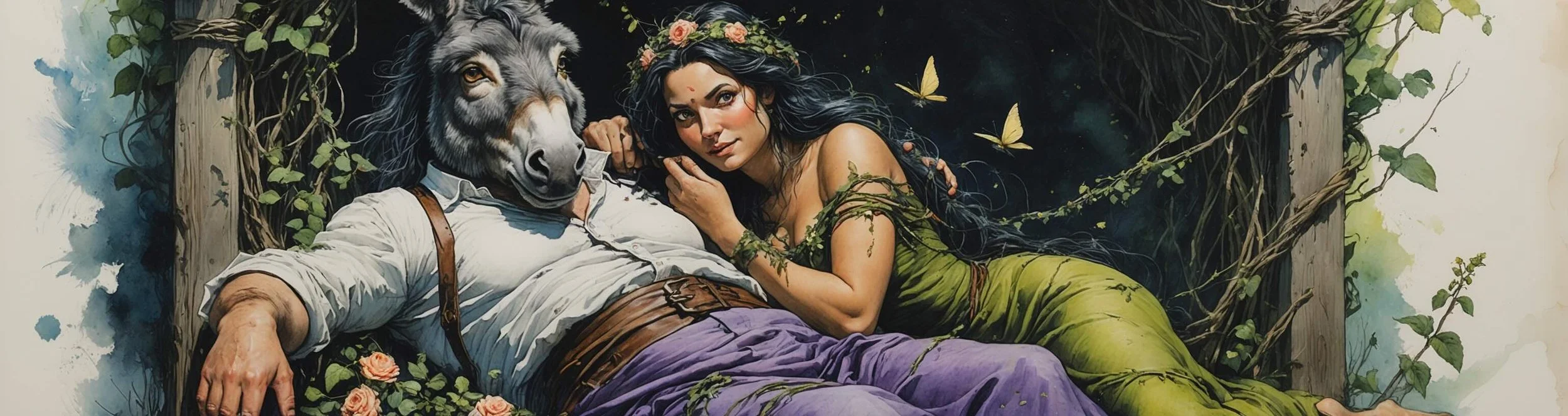
Scene Profile – At a Glance
- Location: The wood, at dawn; the lovers lie asleep where Puck left them.
- What Happens: Titania dotes on Bottom and sleeps with him in her arms. Oberon, who now has the changeling boy, releases her and has the ass’s head removed. Theseus’s hunting party finds the lovers, Demetrius declares his love for Helena, and Theseus overrules Egeus. Bottom wakes alone and tries to describe his dream.
- Key Characters: Titania and Bottom; Oberon and Puck; Theseus, Hippolyta and Egeus; Lysander, Hermia, Demetrius and Helena.
- Dramatic Function: The night ends and the play’s three plots are resolved in turn: the fairy king and queen reconciled, the lovers correctly paired and the law set aside, and Bottom restored to himself with a memory he cannot put into words.
- Famous Quote:
"My Oberon! What visions have I seen!
Methought I was enamoured of an ass."
(Titania, Act 4, Scene 1) - Why It Matters: Everything the wood did is undone or ratified here, and the characters who lived through it agree to call it a dream; Bottom, who was inside it, is the only one who tries to say what it was.
Scene Summary
Titania sits Bottom down on her flowery bed, strokes his cheeks, sticks roses in his hair and kisses his long ears. Bottom sends Peaseblossom to scratch his head and Cobweb to kill a bee and bring him the honey-bag, and asks Mustardseed to help with the scratching, since he is marvellous hairy about the face. Offered music, he asks for the tongs and the bones; offered food, he asks for oats and a bottle of hay. Then he grows sleepy, and Titania sends the fairies away and winds him in her arms, comparing herself to the woodbine twining the honeysuckle and the ivy ringing the elm.
Oberon enters with Puck and looks at the sleeping pair. He has begun to pity Titania’s dotage: he met her earlier gathering flowers for the fool, taunted her, and when she begged his patience asked for the changeling boy, which she gave him at once. Now that he has the boy he will undo the charm. He squeezes the antidote, Dian’s bud, on her eyes, and she wakes crying that she has had visions and dreamed she was in love with an ass. Oberon shows her Bottom asleep beside her; she asks how it came about and says her eyes loathe his face. Oberon has Puck remove the ass’s head, calls for music to deepen the sleep of the five mortals, and takes his queen’s hand to dance. They are friends again, and will dance tomorrow at midnight in Theseus’s house to bless the wedding. Puck hears the morning lark, and the fairies leave, Titania asking to be told how she came to be found sleeping among mortals.
Horns sound. Theseus, Hippolyta and Egeus arrive with a hunting party; their May morning observance is done and Theseus wants his bride to hear the music of his hounds. Hippolyta remembers hunting with Hercules and Cadmus in Crete, where the baying of the hounds was such a musical discord, such sweet thunder; Theseus boasts of his own hounds’ breeding. Then they see the sleepers. Egeus identifies his daughter, Lysander, Demetrius and Helena, and Theseus, remembering that this is the day of Hermia’s answer, has the huntsmen wake them with horns.
Lysander, half asleep, confesses that he and Hermia came to the wood to escape the Athenian law. Egeus demands the law on his head. But Demetrius says that Helena told him of the elopement, that he followed in fury with Helena following him, and that his love for Hermia has melted like snow, so that he now wants only Helena, to whom he was betrothed before he ever saw Hermia. Theseus declares that he will overbear Egeus’s will: the two couples shall be married in the temple alongside him, the hunt is cancelled, and everyone will go to Athens for a feast. The lovers, left alone, cannot tell whether they are awake; the night seems small and far off, Hermia sees everything double, Helena has found Demetrius like a jewel that is and is not hers. They agree that the duke was really there, and go, resolving to recount their dreams on the way.
Bottom wakes, calling for his cue and for his fellow actors, and finds himself alone. He has had a most rare vision, a dream past the wit of man to say what it was; he begins three times to say what he was and what he had, and stops each time. The eye of man has not heard, the ear has not seen, the hand cannot taste nor the tongue conceive what his dream was. He will have Peter Quince write a ballad of it called Bottom’s Dream, because it has no bottom, and he will sing it at the end of the play before the duke, perhaps at Thisbe’s death.
The Bower
The scene opens on the image Oberon wanted: the fairy queen in love with a monster. What Shakespeare gives us is a love scene, and it is played straight on one side.
Original
Come, sit thee down upon this flowery bed,
While I thy amiable cheeks do coy,
And stick musk-roses in thy sleek smooth head,
And kiss thy fair large ears, my gentle joy.
(Titania, Act 4, Scene 1)
Shakespeare Retold (Modern Verse)
Come here and sit down on this bed of flowers,
While I caress your cheeks that I adore,
And stick sweet roses in your hair for hours,
And kiss your massive ears, my love amour.
Titania’s four lines are a love poem, and the fact that the beloved has a donkey’s head does not lower the quality of the verse. Bottom’s side of the exchange is a gentleman at his ease: he sends one fairy to scratch his head, another to fetch honey with instructions not to break the bag, calls them all monsieur, and when offered music asks for the tongs and the bones and when offered food for a bottle of hay. He is not enchanted and not alarmed. He treats a fairy queen’s devotion as a pleasant social occasion and falls asleep in the middle of it. Hazlitt heard in Titania’s speeches to him a certain cloying sweetness, and the sweetness is deliberate: she is not pretending. Her last image before she sleeps, the woodbine entwisting the honeysuckle and the ivy ringing the elm, is a woman winding herself round a man, and it is the love and folly theme’s most complete picture of dotage – tender, absurd and, for the moment, entirely happy.
Oberon’s Pity
Oberon watches, and the speech he makes is the play’s only account of how the fairy quarrel actually ended. It happened offstage, and it happened while Titania was drugged.
Original
When I had at my pleasure taunted her
And she in mild terms begged my patience,
I then did ask of her her changeling child;
Which straight she gave me, and her fairy sent
To bear him to my bower in fairy land.
(Oberon, Act 4, Scene 1)
Shakespeare Retold (Modern Verse)
When I had teased her to my heart’s content
And she had begged that I desist with it,
I asked she cede her Indian boy to me,
Which she gave straightaway, and sent her fairy
To take him to my room in fairy land.
He met her gathering flowers for Bottom, taunted her at his pleasure, and when she begged his patience in mild terms asked for the changeling, which she gave him straight. The pity he speaks of begins after he has what he wanted. Titania’s great refusal in Act 2, made for the sake of a dead friend, has been overturned by a woman too enchanted to remember why she refused, and Oberon describes the transaction with satisfaction and a little tenderness for the flowers in her hair. The play does not comment. It gives Oberon a beautiful speech – the dew on the flowers like tears bewailing their own disgrace – and lets the audience notice what the beauty is describing. The control and rebellion contest of the fairy plot is over, and the king has won it by the same means the lovers were confused by.
Dian’s Bud
The release is a spell of four short lines, and Titania’s waking is a single line that has become famous.
Original
OBERON: There lies your love.
TITANIA: How came these things to pass?
O, how mine eyes do loathe his visage now!
(Act 4, Scene 1)
Shakespeare Retold (Modern Verse)
OBERON: Your lover’s lying there.
TITANIA: Why’s this so wonky?
Oh, how my eyes detest the sight of him now!
She thinks she dreamed; Oberon tells her, in three words, that she did not, and points. Her visions happened; the ass is lying beside her. She asks twice how it came about and is told to wait, and the play never shows Oberon telling her. Peter Holland observed that her love, the image she ascribes to a dream, lies rather solidly beside her, and the line marks the scene’s shift into the play’s larger policy: what happened in the wood is to be remembered as a dream by everyone it happened to. Then the reconciliation is danced rather than spoken. Oberon takes his queen’s hand, the ground rocks under the sleepers, and the pair who could not meet without quarrelling agree to bless a wedding tomorrow at midnight. Of all the play’s dreamers, Titania is the only one who was wronged, and the only one who is never told; the dreams and reality theme rests, at this moment, on a husband deciding what his wife will remember.
Musical Discord
Horns, and the court arrives in the wood for the first time. The hunting talk between Theseus and Hippolyta has no plot in it, and it is one of the scene’s most admired passages.
Original
I was with Hercules and Cadmus once,
When in a wood of Crete they bayed the bear
With hounds of Sparta: never did I hear
Such gallant chiding: for, besides the groves,
The skies, the fountains, every region near
Seemed all one mutual cry: I never heard
So musical a discord, such sweet thunder.
(Hippolyta, Act 4, Scene 1)
Shakespeare Retold (Modern Verse)
I was with Hercules and Cadmus once,
When in a wood in Crete they trapped a bear
With Spartan hunting dogs: I’ve never heard
Such fearless barking: all around the forest,
The skies, the fountains, everywhere nearby
Seemed like it barked in harmony. I’ve not heard
Such wild music, such a thunderous sound.
Hippolyta has more to say here than anywhere in the play, and what she says is a memory of another life: hunting bears in Crete with Hercules and Cadmus, the whole landscape one mutual cry. Theseus answers with a breeder’s boast about his own hounds. Hazlitt thought even Titian never painted a hunting-piece so fresh, and the passage does something quieter as well. The Amazon and her conqueror are talking, for once, as equals about a thing they both know, and the phrase Hippolyta finds for the noise of the hunt – a musical discord, sweet thunder – is also the play’s account of itself. Four lovers, a fairy quarrel and a workmen’s rehearsal have made a night of discord, and the morning is about to hear it as music. The scene’s order and chaos is announced by hounds.
The Law Overruled
The huntsmen wake the lovers with horns, and the court that sentenced Hermia in Act 1 stands over her asleep beside the man she fled with. Egeus demands the law. Demetrius answers him.
Original
But, my good lord, I wot not by what power, –
But by some power it is, – my love to Hermia,
Melted as the snow, seems to me now
As the remembrance of an idle gaud
Which in my childhood I did dote upon...
(Demetrius, Act 4, Scene 1)
Shakespeare Retold (Modern Verse)
But, my good lord, I don’t know what has caused it –
But something’s done it – for my love for Hermia
Has melted like the snow, and now it seems
Much like a little trinket I remembered
From childhood that once I used to love...
He does not know by what power his love for Hermia has melted like snow and become a childhood toy he once doted on; he only knows that Helena is now the whole faith and pleasure of his heart, and that he was betrothed to her before he saw Hermia. The audience knows the power, and knows that it is still on his eyes. Theseus, who said in Act 1 that the law could by no means be extenuated, overbears Egeus’s will in a line, without explanation, and orders a triple wedding. The change is the lovers’, not the law’s: the duke bends because the feelings have altered, and the feelings altered because of a flower. Egeus says nothing further, and in this text is not heard of again. The control and rebellion of fathers, stated at full strength in the first scene, is set aside in the last scene of the wood by a ruler who has been told a story he has no way to check.
Bottom’s Dream
The lovers go, agreeing to call the night a dream, and the stage is left to the one mortal who was inside it. Bottom wakes calling for his cue.
Original
I have had a most rare vision. I have had a dream, past the wit of man to say what dream it was...
(Bottom, Act 4, Scene 1)
Shakespeare Retold (Modern Verse)
I had the most peculiar vision. I’ve had a dream beyond the ability of man to say what the dream was...
He begins three times – methought I was, methought I was, methought I had – and stops each time, because what he was and had cannot be said. Then he garbles St Paul, with every sense attached to the wrong organ: the eye has not heard, the ear has not seen, the hand cannot taste. The source is the first letter to the Corinthians, on the things God has prepared for those who love him, and Bottom has put a night in a fairy’s bower where the mysteries of heaven should be. It is comic because he is inarticulate and moving because he is inarticulate about something real: the lovers only dreamed, and Bottom was there. His solution is a ballad, to be called Bottom’s Dream because it has no bottom, and sung at Thisbe’s death to make it the more gracious. The joke of the title is that a dream without a bottom is bottomless and the dreamer is Bottom; the seriousness is that he alone of the mortals admits the night was past the wit of man to say. The play’s theme of dreams and reality is handed, at its deepest point, to a weaver.
Language and Technique
- Comic register clash: Titania speaks in tender verse (“my gentle joy”); Bottom answers in prose about scratching, honey-bags and hay. The gap between the two registers is the scene’s first joke, and it is never closed.
- Plant imagery: Woodbine and honeysuckle entwisting, ivy enringing the elm: Titania’s image of embrace is a climbing plant on a tree, love as something that winds and clings.
- Spell metre: Oberon’s release is four lines of trochaic rhyme – “Be as thou wast wont to be” – the fairies’ short magic line, used for undoing as it was for doing.
- Sound of the hunt: Hippolyta’s “musical discord” and “sweet thunder” are oxymorons; Theseus’s hounds are “matched in mouth like bells”. The court describes noise as music, which is what the play asks its audience to do with the night.
- Melting and sickness: Demetrius’s love for Hermia melts like snow and is an idle gaud; his love for Helena is health returning after sickness. The images make a magical change sound like natural recovery.
- Double vision: “Methinks I see these things with parted eye, / When every thing seems double”: Hermia’s line for waking is the audience’s for the whole play – two worlds, one stage.
- Scrambled scripture: The eye hath not heard, the ear hath not seen: Bottom’s mixed-up senses are a comic garbling of St Paul, and the garbling says exactly what he means – that the experience was beyond the senses.
Key Quotes from Act 4, Scene 1
Quote 1
Sleep thou, and I will wind thee in my arms.
Fairies, begone, and be all ways away.
So doth the woodbine the sweet honeysuckle
Gently entwist; the female ivy so
Enrings the barky fingers of the elm.
O, how I love thee! How I dote on thee!
(Titania, Act 4, Scene 1)
Shakespeare Retold (Modern Verse)
Then sleep, and I will wrap you in my arms.
Fairies, clear off and don’t come back again.
Just like the woodbine wraps the honeysuckle,
I’ll wrap my arms around you; ivy, too,
Enwraps itself around an elm tree’s bark.
Oh, how I love you! How I dote on you!
Quote Analysis: Titania’s last speech before the charm is lifted. The woodbine and the ivy make her embrace a plant’s, gentle and inescapable, and the final line puts the play’s two words for love side by side: love, and dote. The modern verse keeps both. The next voice heard is Oberon’s.
Be as thou wast wont to be;
See as thou wast wont to see:
Dian's bud o'er Cupid's flower
Hath such force and blessed power.
(Oberon, Act 4, Scene 1)
Shakespeare Retold (Modern Verse)
Go back to how you used to be
And see things like you used to see:
Diana’s sap beats Cupid’s flower
With more force and holy power.
Quote Analysis: The antidote, in the fairies’ spell-metre. Dian’s bud – chastity’s flower – over Cupid’s: the release is a moral allegory in four lines, the chaste goddess undoing the love god’s arrow. The modern verse keeps the chant. Oberon uses the same herb Puck used on Lysander; nobody uses it on Demetrius.
Egeus, I will overbear your will;
For in the temple by and by with us
These couples shall eternally be knit...
(Theseus, Act 4, Scene 1)
Shakespeare Retold (Modern Verse)
Egeus, I will overrule your wishes;
For later on with us, within the temple,
These couples shall be wed eternally...
Quote Analysis: The line that undoes Act 1. Theseus, who could by no means extenuate the law, overrules the father in a sentence and gives no reason. The modern verse keeps the brevity. Egeus does not reply, and in this text is not heard of again.
HERMIA: Methinks I see these things with parted eye,
When every thing seems double.
HELENA: So methinks:
And I have found Demetrius like a jewel,
Mine own, and not mine own.
(Act 4, Scene 1)
Shakespeare Retold (Modern Verse)
HERMIA: To me, it’s like my eyes are out of focus,
And everything is doubled.
HELENA: I’m the same.
And, like a jewel, I’ve found Demetrius;
He’s mine but owned by someone else.
Quote Analysis: The lovers waking, in three voices. Hermia sees double; Helena has found Demetrius like a jewel she owns and does not own. The modern verse keeps the doubleness and the jewel. Helena’s phrase is exact: Demetrius is hers by a spell that was never removed.
I will get Peter Quince to write a ballad of this dream: it shall be called Bottom's Dream, because it hath no bottom; and I will sing it in the latter end of a play, before the duke...
(Bottom, Act 4, Scene 1)
Shakespeare Retold (Modern Verse)
I will get Peter Quince to write a ballad about this dream: it will be called ‘Bottom’s Dream’, because it doesn’t have a bottom; and I will sing it towards the end of the play, in front of the duke...
Quote Analysis: Bottom’s plan for his vision: a ballad, a title with a pun in it, and a slot in the play. The modern verse keeps the title and the logic. Having failed to say what the dream was, he will have it written down and sung, which is what a playwright does with the things past the wit of man to say.
Key Takeaways
- Bottom is at home in fairyland: Scratched, fed and kissed, he treats the fairy queen’s bower as a good inn; he is the one mortal the night does not frighten.
- Oberon wins by the flower: He gets the changeling from a drugged wife, then pities her; the fairy quarrel is settled by the same magic that confused the lovers.
- Titania is never told: She wakes thinking she dreamed, is shown the ass, and asks how it happened; the play does not show her being answered.
- Theseus bends the law: The duke who could not extenuate the law overbears Egeus in a line, because Demetrius says his love has changed.
- Only Bottom tries to say it: The lovers agree to call the night a dream; Bottom, who was inside it, admits it cannot be put into words and plans a ballad anyway.
Study Questions and Analysis
How does Oberon get the changeling boy?
By asking for him while Titania is enchanted. Oberon tells Puck that he met the queen behind the wood, gathering flowers for Bottom, taunted her at his pleasure, and when she begged his patience in mild terms asked for the child, which she gave him at once and sent a fairy to carry to his bower. The great refusal of Act 2, made for the sake of the boy’s dead mother, is overturned in a moment by a woman who no longer remembers why she made it. The transfer happens offstage; the play reports it.
And now I have the boy, I will undo
This hateful imperfection of her eyes...
(Oberon, Act 4, Scene 1)
Shakespeare Retold (Modern Verse)
And now I have the boy, I will remove
The spell that I have cast upon her eyes...
Critics divide on how to weigh this. Louis Montrose (1983) read the fairy plot as the play’s clearest case of a woman’s power being brought under a husband’s control, with the flower as the instrument and the boy as the prize; on that reading Oberon’s pity is the winner’s. A gentler view notes that Oberon does release her as soon as he has what he wants, that the play never shows the boy again, and that the reconciliation is danced as if between equals. What the text does not do is let Titania choose. The theme of control and rebellion in the fairy plot is resolved by a transaction she cannot remember making, and a student should notice that the play gives Oberon the beautiful speech and Titania the silence.
Why does Oberon pity Titania, and what is Dian’s bud?
He says the pity began when he saw her dotage close up – the flowers she had wound round Bottom’s hairy temples, the dew on them like tears – and that he now has the boy, so the charm has done its work. Dian’s bud is the second herb he mentioned in Act 2, Scene 1, the antidote to love-in-idleness; the name makes it the flower of Diana, goddess of chastity, whose power over Cupid’s flower the spell invokes. Puck has already used it on Lysander; Oberon uses it now on Titania.
The allegory is neat and the sequence is worth noticing. Oberon pities Titania after he has been paid, not before, and the pity is for a state he created. The play does not condemn him; it gives him some of its loveliest lines and a genuine tenderness towards the flowers in her hair. But it does let the audience see the order of events, and Titania’s waking question, how came these things to pass, goes unanswered on stage. The magic and illusion of the play is undone as easily as it was done, by a husband with a herb, and the ease is part of the point: nothing in the wood was ever out of the fairy king’s hands except the mistake Puck made.
Why does the play stop for a conversation about hunting dogs?
Because the court has to arrive in the wood from a different world, and the hunting talk is how the play shows it. Theseus wants Hippolyta to hear the music of his hounds from a mountain top; Hippolyta remembers hunting bears in Crete with Hercules and Cadmus, when the whole landscape seemed one mutual cry, a musical discord and sweet thunder; Theseus describes the breeding of his own pack, slow but matched in mouth like bells. Nothing in the exchange advances the plot, and it is one of the scene’s most admired passages.
My hounds are bred out of the Spartan kind,
So flewed, so sanded, and their heads are hung
With ears that sweep away the morning dew...
(Theseus, Act 4, Scene 1)
Shakespeare Retold (Modern Verse)
My dogs are thoroughbreds of Spartan hounds,
So fleshy-jawed, sand-coloured, and their heads
Have ears that brush the dew off morning grass...
Hazlitt, in 1817, wrote that even Titian never made a hunting-piece of a gusto so fresh and lusty and so near the first ages of the world as this, and the freshness is the point: after a night of fairies the play needs daylight, and it supplies it with dogs. The passage also gives Hippolyta her longest speech and her only memory. The Amazon queen speaks of a life before Theseus, with heroes, and speaks as his equal about a sport they share; it is the closest the play comes to showing the marriage it began with as anything but a conquest. The phrase she finds, a musical discord, is the play’s own description of its order and chaos: the night’s confusions heard from the morning as harmony.
Why does Theseus overrule Egeus?
Because Demetrius no longer wants Hermia. Egeus, finding his daughter asleep beside Lysander, demands the law on Lysander’s head; Demetrius replies that his love for Hermia has melted like snow, that Helena is now the only object of his heart, and that he was betrothed to Helena before he ever saw Hermia. Theseus hears him out and overbears Egeus’s will in a single line: the two couples shall be married with him in the temple that morning. No reason is given, and Egeus does not answer.
The reversal is worth setting beside Act 1, Scene 1, where Theseus told Hermia the law could by no means be extenuated. Nothing in the law has changed; what has changed is Demetrius, and Demetrius has changed because of a flower that is still on his eyes. The duke bends the law to the lovers’ feelings without knowing what made the feelings, which is either good sense or good luck. R. W. Dent (1964) denied Theseus the wisdom usually credited to him, and the moment supports the doubt: the ruler who lectures on imagination in Act 5 is, in Act 4, ratifying a fairy’s arrangements as if they were his own judgment. For an essay on control and rebellion the scene is decisive: the father’s absolute claim is dismissed the moment it stops being convenient.
Why is Demetrius left under the spell?
Because nobody removes it. Puck applied the antidote to Lysander, whose enchantment was a mistake; Oberon applies it to Titania, whose enchantment has served its purpose; Demetrius, charmed by Oberon on purpose so that he would love Helena, is never released. He goes to the temple with the juice on his eyes, and his speech to the duke – that he does not know by what power his love changed, and that he was always Helena’s really – is a story told by a man who cannot tell the difference.
And all the faith, the virtue of my heart,
The object and the pleasure of mine eye,
Is only Helena. To her, my lord,
Was I betrothed ere I saw Hermia...
(Demetrius, Act 4, Scene 1)
Shakespeare Retold (Modern Verse)
For now my dedication and my heart,
The object and the apple of my eye,
Is solely Helena. My lord, to her
I was engaged, prior to meeting Hermia.
Catherine Belsey, in her essay for the Folger edition (1993), put the difficulty plainly: Demetrius still has the love-juice on his eyes, and yet the play gives no indication of a difference between this marriage and the others. That is the point rather than a flaw. The play has suggested since Helena’s speech in Act 1 that love looks with the mind and not the eyes, and Demetrius cannot distinguish the feeling a flower gave him from the feeling he had before; nor, the play implies, could anyone. The one marriage the fairies made directly is indistinguishable from the ones they merely restored, and the theme of love and folly in the play ends on that equivalence.
Do the lovers believe the night really happened?
They cannot decide, and they settle for calling it a dream. Left alone after the duke has gone, they compare impressions: the night seems small and far off, like mountains turned to clouds; Hermia sees everything double, with parted eye; Helena has found Demetrius like a jewel that is and is not hers; Demetrius asks whether they are sure they are awake. They test it by the one thing they all remember – the duke was here and told them to follow him – and, satisfied, go off to recount their dreams on the way.
Peter Holland (1994) built a reading of the play on the observation that its dreams are mostly real events afterwards called dreams: the lovers’ night happened, and the word dream is how they manage it. Oberon told Puck in Act 3 that when they woke all this derision would seem a dream and a fruitless vision, and the lovers obligingly do as he said. Hermia’s parted eye is the play’s own condition, two worlds seen at once, and her last words in the play are spoken in this exchange; she and Helena are silent in Act 5. The theme of dreams and reality is not that the wood was unreal but that the morning agrees to treat it so.
What is Bottom’s Dream?
Bottom’s name for the night he spent as the fairy queen’s beloved with a donkey’s head. He wakes alone, calls for his cue and his fellows, and then tries to say what happened: a most rare vision, a dream past the wit of man to say what dream it was. Three times he begins, methought I was, methought I had, and stops. Then he mixes up the senses – the eye has not heard, the ear has not seen, the hand cannot taste – and decides to have Quince write a ballad of it, called Bottom’s Dream because it has no bottom, to be sung at the end of the play before the duke.
The eye of man hath not heard, the ear of man hath not seen, man's hand is not able to taste, his tongue to conceive, nor his heart to report, what my dream was.
(Bottom, Act 4, Scene 1)
Shakespeare Retold (Modern Verse)
The eyes of man haven’t heard, the ears of man haven’t seen, a man’s hand never tasted, his tongue never felt, nor his heart has revealed, what my dream was.
The source is 1 Corinthians 2:9, on the things God has prepared for those who love him, which eye has not seen nor ear heard; Shakespeare’s audience heard it in church, and Bottom has attached each sense to the wrong organ and put a night in a fairy’s bower where the mysteries of heaven should be. Frank Kermode (1961) treated the speech as the centre of the play, and Marjorie Garber (1974) read the Pauline echo as the play giving Bottom’s experience a weight he cannot articulate. The comedy is the inarticulacy; the seriousness is that he is the one mortal who was actually inside the fairy world, and the only one honest enough to say it was beyond words. The pun in the title – a bottomless dream, dreamed by Bottom – is his own, and the plan to sing it at Thisbe’s death is the play’s theme of art and theatre in a sentence: what cannot be said gets performed.