Henry V: Act 3, Scene 3 – Analysis
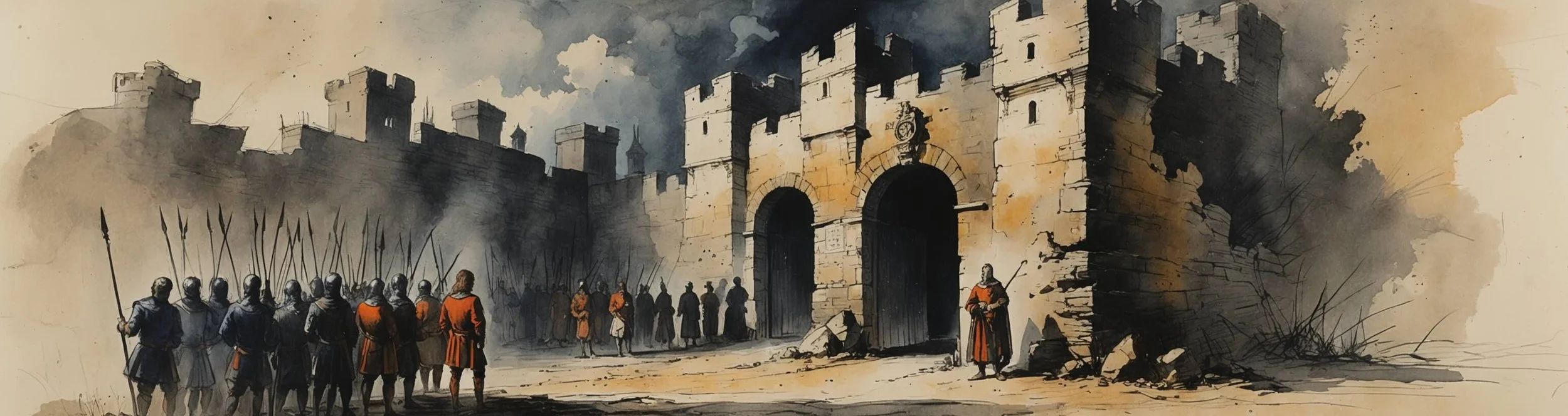
Scene Profile – At a Glance
- Location: Before the gates of Harfleur. The Governor and citizens stand on the walls.
- What Happens: King Henry delivers his ultimatum: yield now, or watch his uncontrollable soldiers rape, burn and slaughter – infants on pikes, fathers dashed against walls. The Governor, abandoned by the Dauphin, yields – and Henry orders: “Use mercy to them all.”
- Key Characters: King Henry V, the Governor of Harfleur and Exeter.
- Dramatic Function: The war’s first victory – won entirely by words. The most terrifying speech in the play empties a threat so completely that it never needs performing.
- Famous Quote:
"Use mercy to them all."
(King Henry V, Act 3, Scene 3) - Why It Matters: Fifty lines of imagined atrocity followed by instant mercy: no scene poses the play’s question – hero-king or monster of rhetoric, or both? – in starker form.
Scene Summary
The breach has not decided Harfleur; this parley will. Henry addresses the Governor on the walls with the terms of a man who claims to be at the end of his patience: this is “the latest parle we will admit” – yield to “our best mercy”, or defy us “to our worst”.
What follows is the most terrible speech in the play. If the battery begins again, Henry will not leave “the half-achieved Harfleur” until she lies buried in her own ashes. The gates of mercy will shut; the “fleshed soldier, rough and hard of heart”, will range with bloody hand and a conscience “wide as hell”, mowing virgins and infants like grass. And – the speech’s most chilling turn – none of it will be Henry’s fault: “What is it then to me…?” War is impious, soldiers in their spoil are as unstoppable as the Leviathan; you, Harfleur, “yourselves are cause” if your daughters are defiled, your fathers’ silver beards dashed against the walls, your “naked infants spitted upon pikes” while mad mothers howl like the wives of Jewry at Herod’s slaughtermen. What say you? Yield, or be “guilty in defence”.
The Governor answers with plain facts: the Dauphin, entreated for succour, replies that his powers are “yet not ready” – and so, expectation ended, Harfleur yields “our town and lives to thy soft mercy”. Henry’s response takes four words to reverse fifty lines: open your gates – and to Exeter, “Use mercy to them all.” The town is garrisoned, winter and sickness are pressing, and the weakened army will retire toward Calais – the road that leads, though no one yet knows it, to Agincourt.
The Ultimatum
Henry’s opening move is to declare his own mercy a perishable commodity – available now, gone the moment the guns resume.
Original
If I begin the battery once again,
I will not leave the half-achieved Harfleur
Till in her ashes she lie buried.
The gates of mercy shall be all shut up...
(King Henry V, Act 3, Scene 3)
Shakespeare Retold (Modern Verse)
If I begin this onslaught once again,
I will not leave half-conquered Harfleur till
This town lies under ashes of itself.
The mercy that I’m offering will vanish...
The structure is a closing window: “our best mercy” on one side of the choice, Harfleur “in her ashes… buried” on the other, and the gates of mercy – the phrase is Biblical – shutting between them. Note what the speech carefully does not promise: restraint. Henry’s claim is the opposite – that after another assault he could not restrain his men if he wished, that command itself expires at the sack of a city. Militarily this reflected real doctrine: a town that forced a storming forfeited protection, and every commander of the age said so at walls like these. What Shakespeare adds is the extremity of the imagining – and the question of what it costs a “mirror of all Christian kings” to speak it this well.
What Is It Then to Me?
The speech’s core is not the violence but the accounting: before a blow falls, the guilt has been transferred to the victims.
Original
What is't to me, when you yourselves are cause,
If your pure maidens fall into the hand
Of hot and forcing violation?
(King Henry V, Act 3, Scene 3)
Shakespeare Retold (Modern Verse)
Why should I care when you’ve caused this yourselves
And you have let your virgins be mishandled
By angry men, then violently raped?
“You yourselves are cause” – the town’s resistance, not the invader’s assault, will own every atrocity. It is the play’s signature manoeuvre at its most naked: the sin laid on Canterbury before the war, the guilt served on the Dauphin with the tennis balls, and now an entire city made “guilty in defence”. The rhetorical machinery is visible – three “What is’t to me” questions in sequence, each washing the King’s hands a little whiter while the imagined horrors grow – and its very visibility is the interpretive crux. Either Henry believes his own theology of siege (the law said as much), or he is performing an inevitability he could interrupt – and the speech is engineered so that Harfleur, and the audience, cannot tell. What can be said with certainty is that it works: the city falls to grammar.
The Yield – and the Mercy
The Governor’s answer is the quietest surrender in Shakespeare – and it turns the scene’s terror inside out in a breath.
Original
Our expectation hath this day an end:
The Dauphin, whom of succours we entreated,
Returns us that his powers are yet not ready
To raise so great a siege. Therefore, great king,
We yield our town and lives to thy soft mercy.
(the Governor, Act 3, Scene 3)
Shakespeare Retold (Modern Verse)
Our hope of rescue has today been ended:
The Dauphin, whom we begged to come to help us,
Replied his army isn’t yet prepared
To fight a siege this large. And so, great king,
We hand our town and lives to your kind mercy.
No defiance, no pathos – just the arithmetic of abandonment: the Dauphin’s powers are “yet not ready”, expectation has “this day an end”, and Harfleur commends itself to the invader’s “soft mercy”. The adjective is the Governor’s small masterstroke – naming the mercy soft invites it to be – and Henry honours the invitation instantly: gates opened, Exeter installed, “use mercy to them all”. The whiplash is the scene’s meaning. The atrocities existed only in language, and language, having won, withdraws them; the same voice that spitted infants on pikes now orders universal clemency. The generous reading: the threats were mercy’s instrument, sparing both sides a storming. The dark reading: a man who can imagine that speech and deliver it flawlessly has shown us something no subsequent mercy erases. The play – as at every such fork – pays for both readings and keeps the receipt.
Language and Technique
- Apocalyptic imagery: Impious war “arrayed in flames like to the prince of fiends” – the sack is painted as hell itself, with the King as its reluctant gatekeeper.
- Rhetorical questions as absolution: Three “What is’t to me?” questions transfer the guilt before the crime – interrogative grammar doing the work of a legal waiver.
- Biblical allusion: Herod’s massacre of the innocents and the Leviathan lend the threats the authority of scripture – atrocity framed in the town’s own religious imagination.
- The unplayable stage direction: Everything terrible in the scene happens in the future tense – the speech is a battle fought entirely in the listeners’ imaginations, which is why it wins.
- Four words of reversal: “Use mercy to them all” – after fifty lines of horror, the shortest sentence in the scene does all the governing.
Key Quotes from Act 3, Scene 3
Quote 1
Original
Your naked infants spitted upon pikes,
Whiles the mad mothers with their howls confused
Do break the clouds, as did the wives of Jewry
At Herod's bloody-hunting slaughtermen.
(King Henry V, Act 3, Scene 3)
Shakespeare Retold (Modern Verse)
Your naked babies skewered on a spike,
While mothers howl in fury and in heartbreak
And cry to heaven, like the Jewish wives did
When Herod ordered all male children killed.
Quote Analysis: The ultimatum’s furthest reach: infants on pikes, mothers howling like “the wives of Jewry” at Herod’s slaughtermen. The allusion is precise and deliberate – Herod’s massacre was the medieval stage’s byword for atrocity, played every year in the mystery cycles – so Henry is threatening Harfleur with the most famous crime in its own religious culture, and casting his soldiers as its perpetrators. That a Christian king reaches for Herod as his warning image is the speech’s self-indictment, whether or not the character notices it.
Original
We may as bootless spend our vain command
Upon the enraged soldiers in their spoil
As send precepts to the Leviathan
To come ashore.
(King Henry V, Act 3, Scene 3)
Shakespeare Retold (Modern Verse)
We’d have as much success issuing orders
To angry soldiers ransacking the town
As asking for the monster of the deep
To come ashore.
Quote Analysis: The heart of Henry’s disclaimer: commanding soldiers mid-sack would be as “bootless” as sending written orders – “precepts” – to the Leviathan to come ashore. The image concedes something enormous: that the army, once “fleshed”, is a sea-monster beyond its master’s voice – the hive of Canterbury’s obedient bees dissolved into a beast no king commands. As law, the claim had real standing; as self-portrait, it is the play’s most powerful admission that the machine Henry rides cannot always be steered – remember it when the prisoner order comes at Agincourt.
Original
Use mercy to them all.
(King Henry V, Act 3, Scene 3)
Shakespeare Retold (Modern Verse)
Be merciful to these folk.
Quote Analysis: Four words that reverse the scene: mercy, total and immediate, the instant surrender makes it affordable. The order is genuine – Exeter is to fortify and “use mercy to them all” – and it matches the historical Henry’s actual conduct at Harfleur closely enough to be documentary. Yet its very speed is the crux: mercy this available was always available, which means the Herod speech was an instrument – terror deployed precisely so that this sentence could be spoken instead of performed. The King’s defenders and prosecutors quote the same four words.
Key Takeaways
- The city falls to words: Harfleur is taken by a speech – the play’s clearest demonstration that language is Henry’s heaviest weapon.
- Guilt is transferred before the crime: “You yourselves are cause” – the ultimatum performs the play’s signature move at city scale: whatever happens, it is not the King’s fault.
- The threats were real law: A stormed town forfeited protection under the period’s law of siege – Henry’s horror-catalogue tracks doctrine, which sharpens rather than settles the moral question.
- Mercy arrives at speaking speed: The instant clemency proves the threats never needed performing – and forces the question of what it cost to perform them verbally.
Study Questions and Analysis
What is Henry actually threatening – and does he mean it?
The full catalogue of a city’s sack, delivered in the future tense: mercy’s gates shut, the “fleshed soldier” ranging free, and then the specifics:
Original
If not, why, in a moment look to see
The blind and bloody soldier with foul hand
Defile the locks of your shrill-shrieking daughters;
Your fathers taken by the silver beards...
(King Henry V, Act 3, Scene 3)
Shakespeare Retold (Modern Verse)
But if you don’t, soon you are going to see
The filthy hands of blind and blooded soldiers
Grab all your screaming daughters by the hair;
Your fathers grabbed and dragged by their grey beards...
Daughters defiled, fathers’ heads dashed to the walls, infants on pikes – nothing in Shakespeare exceeds it, and the question of sincerity is the scene’s engine. The case that he means it: the law of siege genuinely withdrew protection from towns that forced a storming, commanders genuinely lost control of storming troops, and Henry’s own disclaimers (“What rein can hold licentious wickedness…?”) state that reality. The case that it is theatre: the mercy that follows surrender arrives instantly and completely, proving the outcome Henry wanted was always this one – the speech as a weapon calibrated to make its own fulfilment unnecessary. Stephen Greenblatt’s verdict in Shakespearean Negotiations (1988) – that the play “deftly registers every nuance of royal hypocrisy, ruthlessness, and bad faith” – was written with this speech prominently in view; the counter-reading answers that a threat which empties a siege without a massacre is mercy by other means. The text sustains both, in full, on purpose.
How does Henry shift the blame for the imagined atrocities?
With the same instrument the play has shown since Act 1: responsibility relocated by rhetorical question. The speech’s middle section is a run of them:
Original
What is it then to me, if impious war,
Arrayed in flames like to the prince of fiends,
Do, with his smirched complexion, all fell feats
Enlinked to waste and desolation?
(King Henry V, Act 3, Scene 3)
Shakespeare Retold (Modern Verse)
Why should I care if this ungodly war
Comes dressed in flames, appearing like the devil,
And, with a blackened face, commits cruel actions
That lead to your destruction and despair?
What is it to me if impious war, dressed like the devil, does its fell feats? What is’t to me, “when you yourselves are cause”, if your maidens fall? The grammar does the moral work: war is personified as an independent fiend, the soldiers become forces of nature (the Leviathan, wickedness careering downhill), and the only human agents left holding a choice are the citizens – who are thereby “guilty in defence”. It is Canterbury’s “sin upon my head” and the tennis-balls transfer performed at the scale of a city, and no scene displays the technique more openly. For essays on language and power, set this speech beside the night debate of Act 4, Scene 1: Williams will use precisely the same logic of accountability against the King – if the cause be not good, the reckoning is his – and Henry, on the receiving end for once, will answer only half of it.
Why does the Governor surrender – and why so quietly?
Because the strategic facts have already decided, and Shakespeare lets him state them with dignity instead of terror: the Dauphin, “whom of succours we entreated”, has answered that his powers are not ready to raise so great a siege; expectation has ended; the town yields to the King’s “soft mercy”. Nothing in the reply mentions the atrocities at all – a restraint that reads as the Governor’s quiet verdict on them: Harfleur falls not because of Henry’s imagery but because France abandoned it.
The Dauphin’s failure is the detail to hold. The prince of the tennis balls, so lavish with defiance at a distance, cannot produce an army when a real city calls – the play’s first hard evidence for the Constable’s later verdict on his “hooded valour”, and the beginning of the pattern (French division, French delay) that will lose Agincourt. And the quietness itself is dramaturgy: after fifty lines of imagined apocalypse, the plain prose facts of an abandoned garrison are what actually move history. The scene’s loudest speech wins the town; its quietest one explains why.
Is "Use mercy to them all" a contradiction of the threats?
It is their completion – and that is precisely what makes the scene so useful for essays. The threats and the mercy are one policy with two faces: terror priced the resistance, mercy rewards the surrender, and the sequence – ultimatum, yield, clemency – is the entire transaction Henry designed. Theodor Meron, in Henry’s Wars and Shakespeare’s Laws (1993), shows that this tracks the period’s law of siege exactly: a town taken by storm forfeited protection, a town that yielded on summons was owed clemency – and the historical Henry at Harfleur threatened like this and then, on surrender, protected like this. The speech is doctrine spoken at maximum voltage.
But legality and comfort are different things, and the play knows it. The mercy proves the King controlled events throughout – which retroactively converts the Herod speech from confession of helplessness into an instrument wielded by a man in full command. That is the crux to name: Henry’s defence (I could not restrain a storming army) and Henry’s practice (I never needed to, because words did the storming) cannot both be the whole truth. The gentlest king in the scene is the one who imagined the babies on pikes – and the play, having shown us both sentences, declines to choose between them. The strongest essays quote them side by side and keep the tension live.
How does this scene fit the play’s larger pattern?
It is the pattern, at city scale. Every element recurs: the responsibility transfer (Canterbury, the Dauphin, now Harfleur; Williams will attempt it back); the victory won by language where force had stalled (the breach failed – the parley succeeds); the instant modulation of register (terror to clemency in four words, as it will run brotherhood to prisoner-killing at Agincourt); and the mercy that doubles as strategy (“when lenity and cruelty play for a kingdom, the gentler gamester is the soonest winner”, as Henry will formulate it two scenes later).
Norman Rabkin, in his 1977 essay Rabbits, Ducks, and Henry V, argued that the play’s deepest design is to sustain two irreconcilable Henrys – ideal king and frightening operator – in a single figure, “virtually daring us to choose”; and the Harfleur ultimatum is the exhibit his argument returns to, because nowhere else are the two Henrys so plainly the same speech. For structure, note also what the scene opens: the march to Calais announced in its last lines is the road to Agincourt, and the sickness “growing upon our soldiers” is the beginning of the odds the Crispin’s Day speech will glory in. The play’s most terrible speech and its most famous one stand at either end of the same weakening column.