Henry V: Act 3, Scene 2 – Analysis
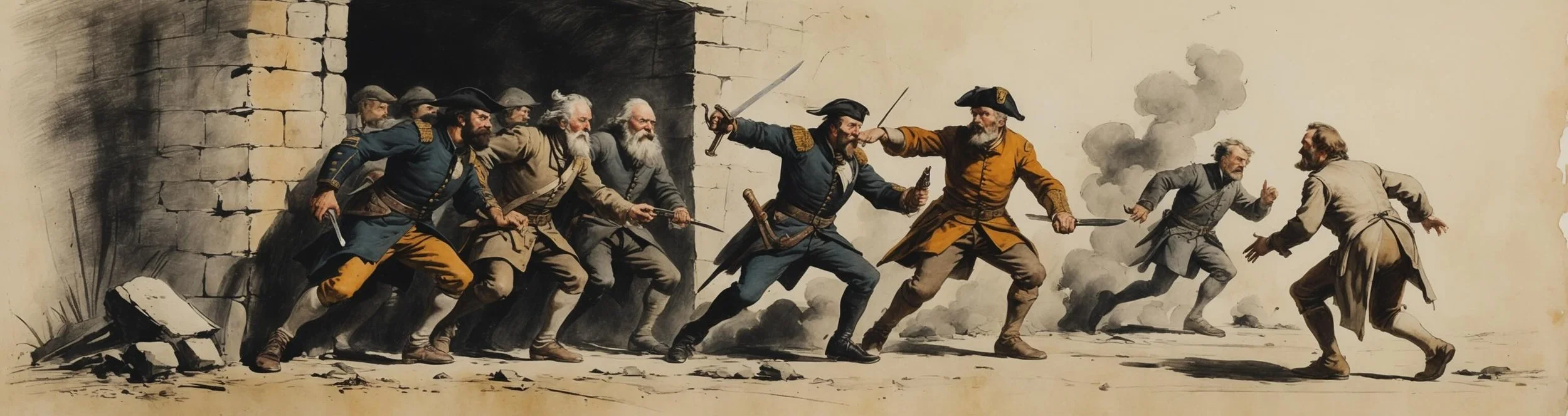
Scene Profile – At a Glance
- Location: Before the walls of Harfleur, at the breach.
- What Happens: While the assault rages, Pistol, Nym and Bardolph hang back until Fluellen beats them forward. The Boy audits his three masters – and then the four captains of Henry’s army – English, Welsh, Irish and Scots – argue about the disciplines of war until Macmorris explodes: “What ish my nation?”
- Key Characters: The Boy, Pistol, Nym, Bardolph, Fluellen, Gower, Macmorris and Jamy.
- Dramatic Function: The breach speech answered from below – by men who would rather be in a London alehouse – and the play’s one meeting of its four nations, in four accents, mid-siege.
- Famous Quote:
"Of my nation! What ish my nation? Ish a villain, and a bastard, and a knave, and a rascal. What ish my nation? Who talks of my nation?"
(Macmorris, Act 3, Scene 2) - Why It Matters: The Boy’s audit of Eastcheap and Macmorris’s national outburst are two of the play’s sharpest documents – on false valour, and on what “Britain” even means in Henry’s army.
Scene Summary
The breach speech gets its echo: Bardolph, safely behind the front rank, bellows “On, on, on, on, on! To the breach, to the breach!” – and goes nowhere. Nym declines: the knocks are “too hot”, and he has “not a case of lives”. Pistol agrees in song – knocks come and go, God’s vassals drop and die – and the Boy wishes himself in a London alehouse, trading “all my fame for a pot of ale and safety”. Fluellen arrives and beats the whole crew forward: “Up to the breach, you dogs!”
Left alone, the Boy files the play’s most clear-eyed character report. He serves three “swashers” who together “do not amount to a man”: Bardolph is “white-livered and red-faced” – looks fierce, fights not; Pistol has “a killing tongue and a quiet sword”; Nym scorns even prayers lest words make him seem a coward, and has broken no head but his own, against a post, drunk. They steal anything and “call it purchase” – a lute-case, a fire-shovel – and want the Boy pocket-picking too. His stomach turns: he must leave them and “seek some better service”.
Then the captains. Fluellen, dragged toward the mines, protests they are dug against “the disciplines of the war”; Gower introduces Captain Macmorris, the Irish engineer – “an ass”, by Fluellen’s instant verdict – and Captain Jamy, the Scot, “a marvellous falourous gentleman”. Macmorris rages that the retreat has been sounded with the work undone – “the town is beseeched… and there ish nothing done”; Jamy vows service or the ground; and when Fluellen begins “there is not many of your nation–”, Macmorris detonates: “Of my nation! What ish my nation?… Who talks of my nation?” Gower separates them, a parley sounds – Harfleur is ready to talk – and the quarrel is postponed, unresolved, for ever.
To the Alehouse
The breach speech promised tigers; the next scene delivers these.
Original
Would I were in an alehouse in London! I would give all my fame for a pot of ale and safety.
(the Boy, Act 3, Scene 2)
Shakespeare Retold (Modern Verse)
I wish I was in a pub in London! I would give all my glory for a pint of ale and safety.
The Boy’s wish is the honest heart of the scene: all his fame for a pot of ale and safety – the exact inversion of the King’s economy, where honour outbids life itself. Around him the swashers perform courage without practising it: Bardolph roars “On, on!” while standing still, Pistol sets cowardice to music, and Nym produces the scene’s driest logic – he has “not a case of lives” to spend. Shakespeare places this directly after “Once more unto the breach” so the two scenes read as call and response: the mask of war the King prescribed, and the men who decline to wear it. The parody does not cancel the heroism – Fluellen’s cudgel gets everyone to the breach in the end – but it prices it: some men charge for England and Saint George; others are beaten there.
The Boy’s Audit
The play’s youngest character delivers its most precise accounting of false valour.
Original
As young as I am, I have observed these three swashers. I am boy to them all three...
(the Boy, Act 3, Scene 2)
Shakespeare Retold (Modern Verse)
Though I am young, I’ve observed these three boastful swordsmen. I’m a servant-boy to all three of them, but all...
What follows is a triple portrait of cowardice, each entry a small masterpiece: Bardolph “white-livered and red-faced” – the face promising what the liver withholds; Pistol’s “killing tongue and a quiet sword” – he “breaks words, and keeps whole weapons”; Nym, silent on principle, whose “few bad words are matched with as few good deeds”. The thefts are itemised – a lute-case carried twelve leagues and sold for three halfpence – and the moral drawn plainly: they want to make him a pickpocket, and his “weak stomach” must cast their villainy up. The audit matters because it is disinterested: the Boy loves no king and serves no theme; he simply watches, and what he sees anticipates every judgement the play will later confirm – Bardolph hanged, Nym hanged, Pistol cudgelled home. Innocence, in this play, is the best intelligence.
What Ish My Nation?
Henry’s army contains four nations, and the play assembles them exactly once – mid-siege, in four accents, quarrelling.
Original
Of my nation! What ish my nation? Ish a villain, and a bastard, and a knave, and a rascal. What ish my nation? Who talks of my nation?
(Macmorris, Act 3, Scene 2)
Shakespeare Retold (Modern Verse)
From my nation! What is my nation? It’s a villain, and a bastard, a scoundrel and a scallywag. What is my nation? Who talks about my nation?
Fluellen’s half-sentence – “there is not many of your nation–” – never reaches its verb, and Macmorris’s eruption has been argued over ever since: is he denying that Ireland is a nation, disowning the slander he expects, or refusing to let a Welshman speak of Ireland at all? The grammar permits every reading, which is why the line has become the founding text for discussions of nationality in Shakespeare. Around it stands the tableau: English Gower keeping the peace, Welsh Fluellen citing Roman discipline, Scots Jamy vowing service, Irish Macmorris doing the actual digging and raging at the wasted work. The “British” army exists – and it is four accents held together by a war, bristling at every seam. The parley that interrupts the quarrel does not resolve it; nothing in the play does.
Language and Technique
- Parodic echo: Bardolph’s “On, on, on, on, on!” replays the breach speech as noise – heroic rhetoric one scene old, already degraded to a coward’s cover.
- Song against siege: Pistol answers the assault in jingling rhyme – “sword and shield, in bloody field” – ballad courage from a man avoiding the battle it describes.
- The plain prose of truth: The Boy’s soliloquy is the scene’s moral centre, and it is written in the flattest prose in the play – observation without a single flourish.
- Four accents, one army: Welsh “look you”, Irish “ish”, Scots “gud feith” and plain English share one scene – the union audible, and audibly under strain.
- The interrupted sentence: Fluellen’s “there is not many of your nation–” breaks off for ever – the play’s most consequential unfinished clause.
Key Quotes from Act 3, Scene 2
Quote 1
Original
The plain-song is most just: for humours do abound:
Knocks go and come; God's vassals drop and die;
And sword and shield,
In bloody field,
Doth win immortal fame.
(Pistol, Act 3, Scene 2)
Shakespeare Retold (Modern Verse)
That statement of truth is right, for fear is everywhere:
Hits come and go; God’s people fall and die;
A sword and shield,
In a battlefield
Does win immortal fame.
Quote Analysis: Pistol’s battle-hymn of avoidance: knocks come and go, God’s vassals drop and die – and sword and shield in bloody field win “immortal fame”. The couplet-and-jingle form is the joke: he sings the war instead of fighting it, converting the breach into a ballad while standing clear of both. The Boy’s later verdict – a killing tongue and a quiet sword – is this quote turned into analysis; quote them together and the character is complete.
Original
Up to the breach, you dogs! Avaunt, you cullions!
(Fluellen, Act 3, Scene 2)
Shakespeare Retold (Modern Verse)
Go to the gap, you dogs! Go on, you scoundrels!
Quote Analysis: Fluellen’s entrance in one line: the breach speech reduced to a cudgel and nine words. Where the King offered tigers, fathers and Saint George, the Welsh captain offers dogs, cullions and blows – and it is Fluellen’s version that actually moves the swashers forward. The pairing is the play’s joke about motivation: eloquence for the willing, discipline for the rest – and the army that takes Harfleur needs both.
Original
By the mess, ere theise eyes of mine take themselves to slomber, ay'll de gud service, or ay'll lig i' the grund for it; ay, or go to death; and ay'll pay 't as valourously as I may, that sall I suerly do, that is the breff and the long.
(Jamy, Act 3, Scene 2)
Shakespeare Retold (Modern Verse)
I swear by Sunday mass, before these eyes of mine go off to sleep, I’ll do a good job, or else I’ll lie dead in the ground for it; yes, I’ll do that or die; and I’ll do it as courageously as I can, I surely will, and that is the long and short of it. But truthfully, I would
Quote Analysis: Captain Jamy’s vow – good service or lie in the ground for it, paid “as valourously as I may” – is the Scot’s one substantial speech in the play, and it is entirely honourable: no bombast, no grievance, just service and the grave, “the breff and the long” of it. Amid the scene’s quarrels the line quietly does the union’s work – a Scots voice pledging death for Harry’s cause – and its plainness shames the swashers more effectively than any rebuke.
Key Takeaways
- The breach speech gets audited: One scene after “Once more unto the breach”, the play shows who charges – and who has to be beaten forward.
- The Boy sees everything first: His audit of the three swashers – cowards, thieves, “not… a man” among them – is the verdict the plot will spend three acts confirming.
- Four nations, one quarrel: The army’s single all-Britain scene is an argument – the union of crowns audible as four accents that barely keep the peace.
- “What ish my nation?” stays open: Macmorris’s question is never answered, by him or the play – which is precisely why it has become the most discussed line in the scene.
Study Questions and Analysis
How does this scene answer the "Once more unto the breach" speech?
Point by point, from below. The King’s oration asked every man to disguise fair nature with hard-favoured rage; the very next scene opens on men declining the disguise:
Original
Pray thee, corporal, stay: the knocks are too hot; and, for mine own part, I have not a case of lives...
(Nym, Act 3, Scene 2)
Shakespeare Retold (Modern Verse)
I beg you, corporal, stay back: the hits are too violent; and, as for me, I don’t have endless lives....
Nym’s arithmetic – he has “not a case of lives” to spend – is unanswerable on its own terms, and each swasher supplies a different evasion: Bardolph shouts the charge without joining it, Pistol sets it to music, the Boy prices fame at one pot of ale. The parody is structural, not incidental: Shakespeare wrote the two scenes as a pair, and the cudgel that finally drives the crew forward – Fluellen’s, not the King’s rhetoric – completes the point. Eloquence moves the willing; the rest are moved by discipline; and the army that takes Harfleur is made of both. For essays on war or class, this is the play’s own footnote to its most famous battle-cry – printed on the facing page, in prose.
What does the Boy’s soliloquy tell us – and why does it matter?
It is the play’s first full audit of the Eastcheap crew, delivered by their servant: three “swashers” who together “do not amount to a man”. Bardolph’s red face advertises a courage his white liver cancels; Pistol “breaks words, and keeps whole weapons”; Nym’s strong-silent act covers a record of one broken head – his own, against a post, drunk. They steal everything and “call it purchase”, and they want the Boy trained to men’s pockets – at which his “weak stomach” revolts: he must leave them and seek better service.
It matters three ways. As character analysis, it is definitive – nothing any swasher does afterwards contradicts a word. As prophecy, it is exact: Bardolph and Nym hang, Pistol is beaten home a thief, and the “better service” the Boy seeks leads him to the luggage-camp where the French kill him – the play’s honest observer paying its highest price. And as a device, it establishes the play’s most trustworthy voice: when the Boy speaks again at Agincourt (“so full a voice… so empty a heart”), the audience already knows his eye is the one to believe. Two soliloquies, both audits, both true – a child doing the play’s clearest moral bookkeeping.
Who are the four captains, and what do they represent?
Gower (English), Fluellen (Welsh), Macmorris (Irish) and Jamy (Scots) – the only scene in Shakespeare where the four nations of the British Isles stand on stage together, and they do so as officers of one army besieging a French town. Each is given a professional identity along with his accent: Gower the steady regimental voice, Fluellen the learned disciplinarian, Macmorris the engineer actually digging the mines, Jamy the volunteer with his plain vow of service or death.
Michael Neill, in his 1994 essay Broken English and Broken Irish, reads the quartet as the play’s working model of the composite “Britain” that England was anxiously imagining in 1599 – a union tested aloud, in dialect, at the exact moment an English army was fighting in Ireland. The scene’s honesty is what keeps it studied: the union works (all four captains serve, and serve well) and it chafes (the one conversation they attempt collapses into a national quarrel within twenty lines). Henry’s later claim to Fluellen – “I am Welsh, you know” – and the leek scenes complete the theme, but this is its foundation text: the band of brothers, heard in four accents, arguing.
What does Macmorris mean by "What ish my nation?"
Nobody knows for certain – and that is precisely the line’s power. Fluellen gets as far as “there is not many of your nation–” and Macmorris explodes before the sentence can incriminate itself: “Of my nation! What ish my nation? Ish a villain, and a bastard, and a knave, and a rascal. What ish my nation? Who talks of my nation?” The syntax genuinely supports at least three readings: that he is pre-empting an expected slur (whatever you were about to say about the Irish, it slanders us); that he is questioning whether “nation” is even a category he owns – an Irishman serving an English king against France; or that he is refusing a Welshman’s right to pronounce on Ireland at all.
Christopher Highley, in Shakespeare, Spenser, and the Crisis in Ireland (1997), places the line in its charged moment: written while Essex’s army was in Ireland fighting Tyrone’s rebellion – the campaign the Act 5 Chorus cheers – so that an Irish captain’s loyalty, and his prickliness about his “nation”, sat as close to the audience’s nerves as any line in the play. For essays, the crux is a gift: quote the question, lay out the readings, and note that the play – interrupted by Harfleur’s parley – leaves it hanging for ever. Some questions Shakespeare answers by silence; this one he preserves by it.
Why is Fluellen so obsessed with "the disciplines of the war"?
Because for Fluellen, war is a learned profession with a syllabus – the Roman wars – and everything from mining to conversation should conform to it. His first grievance in the scene is textbook-based:
Original
To the mines? Tell you the duke, it is not so good to come to the mines; for, look you, the mines is not according to the disciplines of the war...
(Fluellen, Act 3, Scene 2)
Shakespeare Retold (Modern Verse)
To the tunnels? Tell the duke I don’t think it wise to go to the tunnels, because, listen, the tunnels are not a tactic one should use in war. The...
The mines are dug wrong – the “concavities” insufficient, the enemy countermining four yards under – and his instinct even mid-siege is to request “a few disputations… touching or concerning the disciplines of the war” with a colleague who has throats to cut. The comedy is real: pedantry under fire, the classical library carried to a burning breach. But the play backs him steadily. His discipline is what drives the swashers to the breach; his standards later condemn Pistol and endorse Bardolph’s hanging; and his professional judgement – on the bridge, on the mines – is never shown to be wrong. Fluellen is the play’s argument that the union’s strength lies in men who take service seriously, accent and all – ridiculous in manner, right in matter, and (as Henry says of him watching this very quality) full of “care and valour”, though “a little out of fashion”.