Henry V: Act 3, Scene 1 – Analysis
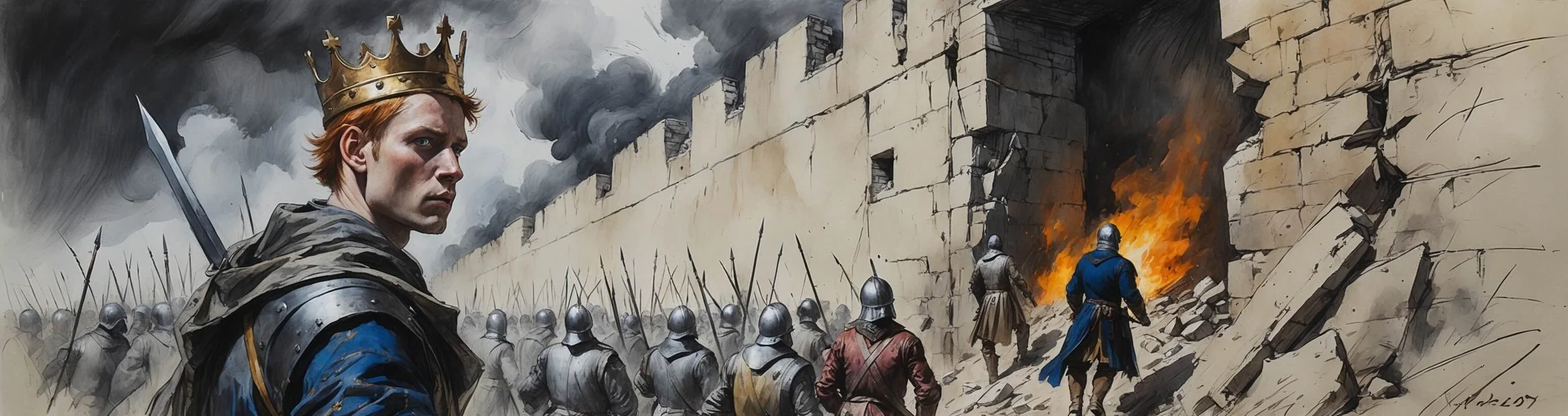
Scene Profile – At a Glance
- Location: Before the walls of Harfleur, at the breach blasted in the town’s defences.
- What Happens: One speech, mid-assault: King Henry rallies his exhausted army back into the breach – teaching them to wear the mask of war, invoking their fathers, ennobling the yeomen, and loosing them with “God for Harry, England, and Saint George!”
- Key Characters: King Henry V, with Exeter, Bedford, Gloucester and the army.
- Dramatic Function: The play’s first great battle oration – thirty-four lines with no reply, no interruption and no scene around them: pure royal voice, applied to failing momentum.
- Famous Quote:
"Once more unto the breach, dear friends, once more;
Or close the wall up with our English dead."
(King Henry V, Act 3, Scene 1) - Why It Matters: “Once more unto the breach” is one of the most famous speeches in English – and, read closely, it is a lesson in acting: courage taught as a costume the body can be commanded to wear.
Scene Summary
The scene is a single speech. The assault on Harfleur has stalled; the breach in the walls has been tried once and not carried; and the King, entering with scaling-ladders under the alarum, asks his “dear friends” for one more attempt – or, failing that, to “close the wall up with our English dead”.
The speech’s centre is a lesson in transformation. In peace, nothing so becomes a man as “modest stillness and humility”; but when war’s blast blows, “imitate the action of the tiger” – stiffen the sinews, summon up the blood, disguise fair nature with hard-favoured rage. The instructions grow anatomical: lend the eye a terrible aspect, let it pry through the head’s “portage” like a brass cannon, let the brow overhang the face as a cliff overhangs the wasteful ocean; set the teeth, stretch the nostril, hold hard the breath.
Then the ancestry. The “noblest English” are blood of “fathers of war-proof” – Alexanders who fought in these very French fields from morning to evening; dishonour not your mothers, but prove your fathers begot you. And the yeomen – commoners – are lifted with them: limbs “made in England”, the “mettle of your pasture”, for none is “so mean and base, / That hath not noble lustre in your eyes”. He sees them straining like “greyhounds in the slips” – the game is afoot – and the speech releases them on its cry: “God for Harry, England, and Saint George!”
Once More
The two most famous opening lines in English battle-rhetoric – and their grimness is usually forgotten.
Original
Once more unto the breach, dear friends, once more;
Or close the wall up with our English dead.
(King Henry V, Act 3, Scene 1)
Shakespeare Retold (Modern Verse)
Once more, attack the gap into the city;
Get in, or block the gap with English corpses.
“Once more” concedes failure: the breach has been attempted, and the attempt has broken. The alternative Henry offers is not victory but a use for corpses – if you cannot pass the wall, plug it with our dead. The address, though, is “dear friends”: the intimacy of the Crispin’s Day “brothers” a year early, spoken to exhausted men being asked to run at gunfire again. The whole art of the speech is in that combination – brutal honesty about what is being asked, wrapped in a warmth that makes refusing it unthinkable. It is worth saying plainly for essays: the famous line is a request to re-enter a killing zone, and its beauty is what gets men to do it.
Imitate the Action of the Tiger
The speech’s core is not a call to courage but a course in performing it.
Original
But when the blast of war blows in our ears,
Then imitate the action of the tiger;
Stiffen the sinews, summon up the blood,
Disguise fair nature with hard-favoured rage...
(King Henry V, Act 3, Scene 1)
Shakespeare Retold (Modern Verse)
But when we hear the trumpet blown for war,
We have to act as though we are a tiger;
Tense up your muscles, fire up your courage,
Hide your civility with fearsome rage...
Every verb is theatrical: imitate the tiger, disguise fair nature, lend the eye an aspect – and then the body is drilled item by item, sinews, blood, eyes, brow, teeth, nostrils, breath, like an actor preparing a part. The premise is startlingly honest: these men are not tigers – peace-time humility is their “fair nature” – and courage is a costume the will can order the body to wear until the body obeys. That is either the most practical battlefield psychology in Shakespeare or the play’s deepest confession about its hero: the King who teaches rage-as-mask is the supreme wearer of masks himself. Both readings run through the same lines – and the next scene, where Bardolph parrots the charge and no one moves without a cudgel, tests the teaching at once.
Nobles and Yeomen
The speech divides the army in two – and dignifies each half in its own currency.
Original
And teach them how to war. And you, good yeoman,
Whose limbs were made in England, show us here
The mettle of your pasture; let us swear
That you are worth your breeding...
(King Henry V, Act 3, Scene 1)
Shakespeare Retold (Modern Verse)
And teach them how to fight. Good common men,
Whose limbs were made in England, demonstrate
The strength of where you’re from; and let’s commit
To prove your life is worthy; I don’t doubt it...
The “noblest English” get ancestry: fathers like “so many Alexanders” who fought these fields before them – prove your mothers honest by fighting as your fathers did. The yeomen get the land itself: limbs “made in England”, the “mettle of your pasture” – worth measured not in pedigree but in country. And then the bridge between the classes, the speech’s most quietly radical line: none is “so mean and base, / That hath not noble lustre in your eyes”. Nobility relocated from blood to bearing – the first draft of Crispin’s Day’s “be he ne’er so vile, / This day shall gentle his condition”. The speech ends with all ranks fused into a single image – greyhounds in the slips, one leash, one quarry – and one cry that names king, country and saint in a single breath.
Language and Technique
- Imperatives in volley: The speech is built of commands – stiffen, summon, disguise, lend, set, stretch, hold – grammar drilling the body into battle-readiness line by line.
- The tiger simile: Courage as imitation of an animal – not be brave but act brave – makes the speech a lesson in performance, the play’s master theme in miniature.
- Anatomical blazon: Eyes, brow, teeth, nostrils, breath – the soldier’s face is assembled feature by feature into a war-mask, a catalogue technique usually reserved for beauty.
- Ancestry as argument: Fathers like Alexanders, mothers to be vindicated, limbs made in England – lineage and landscape both conscripted as reasons to charge.
- The triple cry: “God for Harry, England, and Saint George!” – deity, king, nation and saint compressed into one shout: the war’s whole justification, sized for a battlefield.
Key Quotes from Act 3, Scene 1
Quote 1
Original
Then lend the eye a terrible aspect;
Let pry through the portage of the head
Like the brass cannon...
(King Henry V, Act 3, Scene 1)
Shakespeare Retold (Modern Verse)
Then fill your eyes with wild ferocity;
Stare piercingly from portholes in your head
That look like cannons, frowning with your brow...
Quote Analysis: The war-mask at its most detailed: the eye lent a “terrible aspect”, prying through the “portage” – the portholes – of the head like a brass cannon. The soldier’s face is re-engineered as a weapon-platform, feature by feature, and the artillery simile makes the transformation literal: men asked to become the siege-guns beside them. Quote it to show how far the speech’s “imitation” goes – not just feeling fierce, but rebuilding the body as ordnance.
Original
I see you stand like greyhounds in the slips,
Straining upon the start. The game's afoot:
Follow your spirit, and upon this charge
Cry 'God for Harry, England, and Saint George!'
(King Henry V, Act 3, Scene 1)
Shakespeare Retold (Modern Verse)
I see you stand like greyhounds on a leash,
Straining to start to run. The hunt is on:
Follow your gut instinct, and as you charge,
Shout, ‘God help Harry, England and Saint George!’
Quote Analysis: The release: the army seen as greyhounds “in the slips” – the handler’s leash – straining upon the start, and the hunting cry that follows: the game’s afoot. After thirty lines of building the war-mask, Henry declares it already built – “I see you stand…” – conferring the readiness he has been manufacturing. The final cry fuses God, king, country and saint into one shout, and gave the language a phrase (“the game is afoot”) that outlived even the speech.
Original
Fathers that, like so many Alexanders,
Have in these parts from morn till even fought
And sheathed their swords for lack of argument...
(King Henry V, Act 3, Scene 1)
Shakespeare Retold (Modern Verse)
Fathers matching Alexander the Great,
Who’ve fought round here from morning until night
And sheathed their swords only when all were dead...
Quote Analysis: The ancestral claim: fathers like “so many Alexanders”, fighting in these very French fields from morning till evening, sheathing their swords only “for lack of argument” – no one left to fight. The hyperbole is affectionate and outrageous (every dead English soldier a world-conqueror), and it plants a comparison the play will pick up strangely: in Act 4, Fluellen’s “Alexander the Pig” speech will compare Henry himself to Alexander – by way of the friend Alexander killed. The heroic simile of this speech has a long, dark echo.
Key Takeaways
- Courage is taught as costume: The speech’s verbs – imitate, disguise, lend – make bravery a performance the will can order: the play’s theme of kingship-as-acting, applied to every soldier.
- Failure is the premise: “Once more” means the breach has already beaten them – the most famous rally in English is a second attempt.
- Class is bridged, briefly: Nobles get ancestors, yeomen get England, and “noble lustre” is found in the meanest eye – Crispin’s Day’s promise, drafted at Harfleur.
- The next scene is the control test: Bardolph parroting the charge and Fluellen’s cudgel show exactly who the speech moves – and who it does not.
Study Questions and Analysis
What is the breach speech actually asking the soldiers to do?
Physically: to re-enter a gap in a fortified wall that has already repelled them once, under fire – or die filling it. Psychologically: to manufacture, on command, the state of mind that makes the first thing possible. The speech is a step-by-step manual:
Original
Now set the teeth and stretch the nostril wide,
Hold hard the breath and bend up every spirit
To his full height.
(King Henry V, Act 3, Scene 1)
Shakespeare Retold (Modern Verse)
Now grit your teeth and flare your nostrils wide,
And hold your breath and summon up your strength
As mighty as you can.
Teeth set, nostrils stretched, breath held, spirit bent up “to his full height” – the body is drilled into ferocity one component at a time, on the theory that the feeling will follow the posture. What the speech never does is minimise the danger or promise success: its second line offers the men’s corpses as building material, and its honesty is part of its power – soldiers are shrewd audiences, and Henry never insults them with safety. The request is enormous, the wrapping is “dear friends”, and the machinery in between – tiger, cannon, ancestors, greyhounds – exists to make the enormous feel briefly natural. It works in the scene; the play’s next scene shows on whom it does not.
Is the speech about courage – or about acting?
Both, inseparably – and the vocabulary is explicit. Peace-time man’s true nature is “modest stillness and humility”; war requires him to imitate the tiger, disguise fair nature, lend the eye a terrible aspect – three verbs of performance in four lines. Courage, in this speech, is not a quality the soldiers have but a role they can be directed into: the King as director, the army as cast, the breach as stage.
James L. Calderwood, in Metadrama in Shakespeare’s Henriad (1979), read the whole cycle as drama about precisely this – power as performance, kingship as the supreme role – and the breach speech is the theory taught downward: the master performer instructing twelve thousand amateurs in his own art. The reading cuts two ways, and essays should keep both edges. Generously: this is profound practical psychology – modern soldiers still recognise the technique – and a king honest enough to admit that ferocity is manufactured. Sceptically: if rage is a costume here, what else in this play is? The speech quietly licenses the question that Williams, the ceremony soliloquy and the Chorus’s gaps will keep asking: where, under the performances, is the man? Either way, “disguise fair nature” is the phrase to quote – the play’s whole theatre of power in three words.
How does the speech handle the difference between nobles and common soldiers?
By giving each class its own reason to charge – and then dissolving the line between them. The “noblest English” are addressed through pedigree: blood “fet from fathers of war-proof”, Alexanders who fought these fields; their duty is genealogical – prove your fathers begot you, dishonour not your mothers. The yeomen are addressed through the land itself: limbs “made in England”, the “mettle of your pasture” – England’s soil as their nobility. And then the bridge:
Original
For there is none of you so mean and base,
That hath not noble lustre in your eyes.
(King Henry V, Act 3, Scene 1)
Shakespeare Retold (Modern Verse)
For no one here is so low-born or mean
That their eyes don’t shine with nobility.
None so mean and base without “noble lustre” in his eyes – rank read out of the eye rather than the pedigree, a year before Crispin’s Day promises that shed blood will “gentle” any condition. Jonathan Dollimore and Alan Sinfield, in their 1985 essay in Alternative Shakespeares, read such moments as ideology at work – unity manufactured for the emergency, the social order suspended rhetorically at exactly the moment the state needs commoners to die, and restored the moment it does not. The generous reading answers that the speech means it, and the play’s yeomen – Williams, Bates, the archers of Agincourt – earn every word. Both readings agree on the craft: two audiences, two currencies, one leash of greyhounds by the final line.
Why is "God for Harry, England, and Saint George!" so famous?
Because it compresses the war’s entire justification into six words that can be shouted while running. The cry stacks its authorities in ascending intimacy – God first, then the King (and note: “Harry”, the familiar name, not “the King”), then the nation, then the warrior saint – so that charging soldiers invoke heaven, monarch, home and patron in a single breath. Saint George, England’s dragon-slaying patron, supplies the chivalric finish: every man in the charge is briefly a knight of the old story.
Its fame has been self-renewing: the line became the English battle-cry of memory and quotation – revived in every era that needed it, most famously in wartime productions and Olivier’s 1944 film, where the speech served a nation at war as the play’s first audiences were served in 1599, with Essex’s campaign in Ireland filling the theatres with military feeling. For essays, the useful observation is the cry’s function within the speech: after thirty lines of instruction, ancestry and appeal, everything is cashed into one performative shout – language’s last job before the killing starts. The play’s whole theory of words and war fits inside it.
Does the play undercut this speech?
Deliberately, and at speed – but undercutting is not cancellation, and the sequence rewards precision. The very next scene opens with Bardolph bellowing “On, on, on, on, on! To the breach, to the breach!” – the King’s exhortation already decayed into a coward’s battle-noise – while Nym declines (“the knocks are too hot”), Pistol sings, the Boy wishes for a London alehouse, and Fluellen has to cudgel the lot of them forward: “Up to the breach, you dogs!” The tiger-mask, it turns out, fits some faces and not others; eloquence moves the willing, and discipline moves the rest.
Harold C. Goddard, in The Meaning of Shakespeare (1951), took such juxtapositions as the play’s true voice – the official scene and its low echo printed side by side, with the judgement left to the reader. But note what the parody does not touch: the speech still works on the army that matters, Harfleur still falls, and no one in the play ever mocks the speech itself – only their own inadequacy to it. The strongest essays state the structure exactly: Shakespeare builds the most famous battle-cry in English, then immediately shows its limits – and both the building and the showing are the play. Quote the two scenes together and let the contrast do the arguing.