Henry V: Act 3, Prologue – Analysis
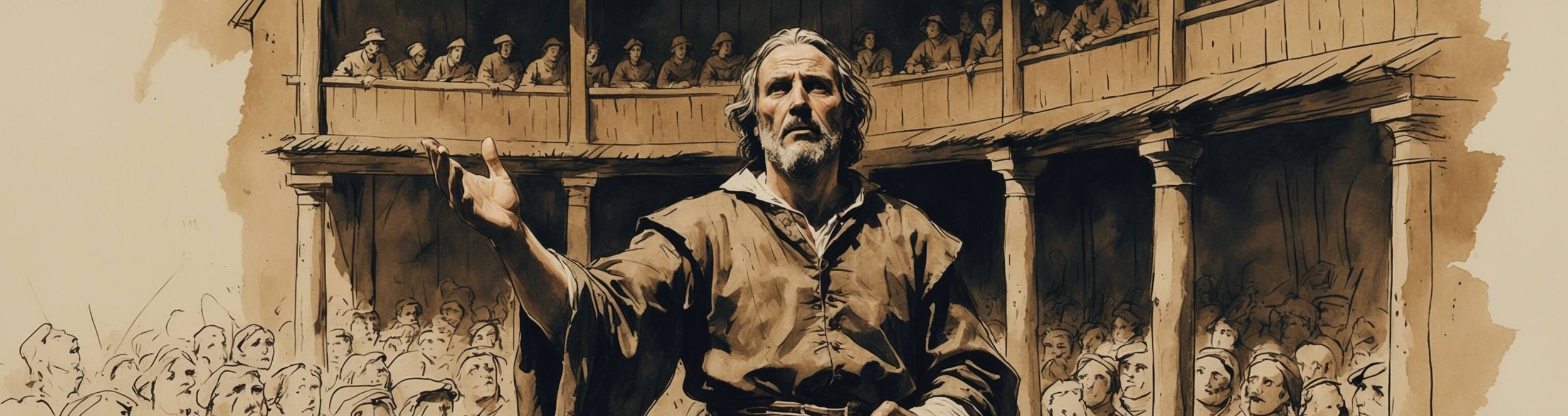
Scene Profile – At a Glance
- Location: The bare stage. The Chorus carries the audience from Southampton to the siege of Harfleur.
- What Happens: The fleet sails – ship-boys in the rigging, sails drawing the huge hulls through the sea – England is left to grandsires, babies and old women; the French offer of Katharine and “petty dukedoms” is refused; and the cannon – with real stage ordnance firing – open on Harfleur.
- Key Characters: The Chorus alone.
- Dramatic Function: The bridge from England to France – the play’s most sustained feat of imagined spectacle, ending in the only Chorus speech punctuated by live gunfire.
- Famous Quote:
"Work, work your thoughts, and therein see a siege;"
(the Chorus, Act 3, Prologue) - Why It Matters: “Work, work your thoughts” is the Chorus’s method stated as a command – and the rejected French offer buried in the speech quietly prices the whole war: Katharine, offered here with dukedoms, will cost France everything by Act 5.
Scene Summary
The Chorus flies the scene from Southampton with “imagined wing”, at the speed of thought. The audience must suppose the King embarked at Hampton pier, the fleet with silken streamers fanning the young sun – and then must climb aboard with their fancies: ship-boys on the hempen tackle, the master’s whistle ordering the confusion, threaden sails bellied by the “invisible and creeping wind”, the great hulls ploughing the furrowed sea. Stand on the shore, says the Chorus, and behold “a city on the inconstant billows dancing” – the fleet itself – bound for Harfleur.
Follow – and leave England behind, “as dead midnight still”, guarded only by grandsires, babies and old women; for who with even one hair on his chin has not followed these “culled and choice-drawn cavaliers” to France? Then the siege: work, work your thoughts, and see the ordnance on their carriages, “fatal mouths gaping on girded Harfleur”.
One beat of diplomacy: the French ambassador returns – the King offers Henry his daughter Katharine, with “some petty and unprofitable dukedoms” for dowry. “The offer likes not” – and the nimble gunner touches the devilish cannon with his linstock. Here the stage itself fires (“alarum, and chambers go off”), and the Chorus exits on its couplet: down goes all before them – still be kind, “and eke out our performance with your mind”.
The Fleet Imagined
The voyage to France is the Chorus’s most sensuous writing – a fleet built entirely of sound and detail.
Original
Play with your fancies, and in them behold
Upon the hempen tackle ship-boys climbing;
Hear the shrill whistle which doth order give
To sounds confused...
(the Chorus, Act 3, Prologue)
Shakespeare Retold (Modern Verse)
Think fancifully and, in those thoughts, bear witness
To cabin boys ascending up the rigging;
Hear the shrill whistle dishing out the orders
Above all the commotion; see the sails...
The instruction is “play with your fancies” – imagination as a game – and the details supplied are exactly the ones that make a scene real: not the admirals but the ship-boys aloft; not trumpets but the bosun’s “shrill whistle” imposing order on “sounds confused”; the sails as “threaden” – woven things, workmanlike – drawing hulls that “breast the lofty surge”. The masterstroke is the view from shore: the fleet as “a city on the inconstant billows dancing” – England afloat, an entire polity committed to unstable water. As ever, the beauty carries the argument: a nation this unanimous, this magnificent in motion, is what the war’s official story requires – and only the Chorus can show it, because no stage could.
England Emptied – and an Offer Refused
Two quieter beats complete the bridge – and both carry more than they announce.
Original
And leave your England, as dead midnight still,
Guarded with grandsires, babies and old women,
Either past or not arrived to pith and puissance...
(the Chorus, Act 3, Prologue)
Shakespeare Retold (Modern Verse)
And that you’re leaving England, calm as midnight,
Protected by the old, the young and women,
Either too old or not mature enough...
England left “as dead midnight still”, guarded by grandsires, babies and old women: the image completes the total mobilisation the Act 2 Chorus began, and its rhetorical question – who with one hair on his chin would not follow? – quietly shames every able-bodied playgoer in the yard. Then, in six lines, the diplomacy the play does not stage: the French King offers Henry Katharine with “some petty and unprofitable dukedoms”, and “the offer likes not”. The refusal detonates the cannon – literally, in the theatre – but its true payload is delayed: the princess rejected here with small dukedoms will be accepted in Act 5 with all France attached. The Chorus mentions her in passing; the play has just told us its ending, and priced the difference in blood.
Language and Technique
- Imperative imagination: “Suppose”, “behold”, “follow”, “work, work your thoughts” – the audience is drilled in imagining as the soldiers will shortly be drilled at the breach.
- Sensory specificity: Ship-boys, whistle, threaden sails, the furrowed sea – small true details do the work of spectacle, the Chorus’s standing method at its best.
- The city afloat: The fleet as “a city on the inconstant billows dancing” – England itself put to sea: one image carrying the scale the stage cannot.
- Stage thunder: The direction “alarum, and chambers go off” fires real ordnance mid-speech – the one moment where the theatre’s poverty is answered with actual noise.
- The buried plot-point: Katharine and the “petty… dukedoms”, offered and refused in six lines – the play’s ending mentioned two acts early, at a price not yet paid.
Key Quotes from Act 3, Prologue
Quote 1
Original
You stand upon the rivage and behold
A city on the inconstant billows dancing;
For so appears this fleet majestical...
(the Chorus, Act 3, Prologue)
Shakespeare Retold (Modern Verse)
You’re standing on the shoreline, witnessing
A city bobbing on the dancing swell;
For this majestic fleet appears this way...
Quote Analysis: The voyage’s crowning image: stand on the “rivage” – the shore – and watch a city dance on the waves. The fleet is not compared to a city for size alone; a city is order, wealth, a whole society – England itself, packed aboard and committed to “inconstant billows”. The adjective does the quiet work: everything solid now rides on instability, the kingdom’s fortune afloat. It is the Chorus’s most beautiful sentence, and its most precarious image – both at once, as usual.
Original
And down goes all before them. Still be kind,
And eke out our performance with your mind.
(the Chorus, Act 3, Prologue)
Shakespeare Retold (Modern Verse)
And everything’s knocked over. Please be kind,
Embellishing our acting with your mind.
Quote Analysis: The exit couplet, with the guns still echoing: “down goes all before them” – walls, resistance, the audience’s last doubts – and then the standing request, renewed: be kind, and “eke out our performance with your mind”. “Eke out” is beautifully humble – to supplement something scanty – the theatre admitting, one more time, that the audience’s imagination is the production’s real budget. Every Chorus speech makes this contract; none closes it with cannon-fire.
Key Takeaways
- The audience is drilled: “Work, work your thoughts” – imagining is made labour, commanded in imperatives, the playgoer conscripted like the soldier.
- England sails entire: The fleet as a dancing city and the island left to grandsires and babies – total commitment, gorgeously imagined, quietly coercive.
- The ending is pre-priced: Katharine plus “petty dukedoms”, refused – the exact settlement of Act 5, offered cheap here and bought dear later.
- Real guns, imagined war: The chambers firing mid-speech are the play’s one concession to spectacle – thunder borrowed to launch a siege the mind must build.
Study Questions and Analysis
What does this Prologue ask the audience to imagine – and how?
A Channel crossing and the opening of a siege – the two least stageable events in the play – assembled from commands. The method peaks at Harfleur:
Original
Work, work your thoughts, and therein see a siege;
Behold the ordnance on their carriages,
With fatal mouths gaping on girded Harfleur.
(the Chorus, Act 3, Prologue)
Shakespeare Retold (Modern Verse)
Embellish all your thoughts and see a siege;
Observe the cannons resting on their carts,
Their muzzles aiming at the walls of Harfleur.
“Work, work your thoughts” – the doubled imperative makes imagination labour, and the audience is put to it like a crew: suppose, behold, hear, follow, grapple your minds to the sternage of this navy. The details supplied are deliberately small and true – ship-boys, a bosun’s whistle, sails of thread – because specificity, not grandeur, is what makes a mind’s image stick; the guns are given “fatal mouths gaping” and the town is “girded” – encircled – in a single participle. This is the Prologue’s wooden-O contract in full operation, and the Act 3 Chorus is its most instructive specimen: where Act 1 asked permission to use imagination, Act 3 simply issues orders to it. The audience that obeys has, by the speech’s end, crossed the sea, abandoned England and aimed a battery – and the play’s first cannon-shot arrives as confirmation of what they built.
What is the French offer – and why does its refusal matter so much?
Katharine, with a dowry of “some petty and unprofitable dukedoms” – France’s first attempt to buy peace, reported and refused in six lines:
Original
Suppose the ambassador from the French comes back;
Tells Harry that the king doth offer him
Katharine his daughter, and with her, to dowry,
Some petty and unprofitable dukedoms.
(the Chorus, Act 3, Prologue)
Shakespeare Retold (Modern Verse)
Suppose the French ambassador returns,
Informing Harry that the king has offered
His daughter Katharine as his wife, and with her
Some small, inconsequential bits of land.
“The offer likes not” – and the next clause is the gunner touching his linstock to the cannon. The compression is the meaning: diplomacy and bombardment separated by a semicolon, the rejected princess and the falling walls made one sentence. And the offer is the play’s ending, previewed at a discount. In Act 5, Henry will accept exactly this bride – but with the whole kingdom of France for dowry and the French King’s throne entailed to their heirs: what was “petty and unprofitable” here becomes “our capital demand” there, and the difference between the two offers is Harfleur, the march, and ten thousand dead at Agincourt. For essays on the wooing scene, this Prologue is the essential footnote: Katharine was on the table before a shot was fired, and the charming courtship of Act 5 concludes a purchase whose first price was named – and refused – here.
Why is England described as left to "grandsires, babies and old women"?
To complete the picture of total national commitment – and to recruit the audience into it. The Act 2 Chorus showed the youth of England on fire and honour’s thought reigning in every man; this one shows the arithmetic’s other side: an island “as dead midnight still”, guarded only by those “either past or not arrived to pith and puissance” – the too-old and the too-young. The nation has not sent an army; it has become one.
Then the turn on the audience: for who is he, “whose chin is but enriched / With one appearing hair”, that will not follow these “culled and choice-drawn cavaliers” to France? In the Globe’s yard in 1599 – with Essex’s army actually in the field in Ireland and London full of recruitment – the question was not rhetorical decoration: every beardless apprentice and able man in the house is challenged by it. The hyperbole is patriotic, and it is also the Chorus doing what the Chorus always does – manufacturing unanimity, describing a consensus so complete that dissent becomes unimaginable. Whether England was ever that united (the play’s next scenes, full of reluctant swashers, suggest otherwise) is exactly the kind of question this speaker’s beautiful assertions are built to pre-empt.
How does this Chorus differ from the play’s other Prologues?
It is the most purely cinematic – and the only one with special effects. The other Choruses argue, apologise, or manage the audience’s judgement; this one almost exclusively shows: a voyage, an emptied island, a battery run out – sustained visual sequence with barely a moral gloss. Its distinctive grammar is the imperative of perception (suppose, behold, hear, see), and its distinctive gift is detail chosen for vividness: of all the Chorus speeches, this is the one critics cite for pure descriptive power. It also uniquely shares its stage with the play’s machinery – “alarum, and chambers go off” – real ordnance firing as the imagined gunner fires, the theatre’s one moment of literal thunder in a play that otherwise runs on words alone.
Joel B. Altman, in his landmark 1991 essay Vile Participation, argued that the Chorus’s deepest function is to make the audience complicit – imagining the war is the first step of endorsing it – and this speech is his case at its purest: we are not asked to admire the siege but to build it, gun by gun, in our own minds, before a single soldier speaks. The audience that has “worked its thoughts” into aiming a battery at Harfleur is already invested when Henry demands the town’s surrender two scenes later – and the play’s hardest questions about that ultimatum land on spectators who helped wheel up the guns.