Henry V: Act 2, Scene 4 – Analysis
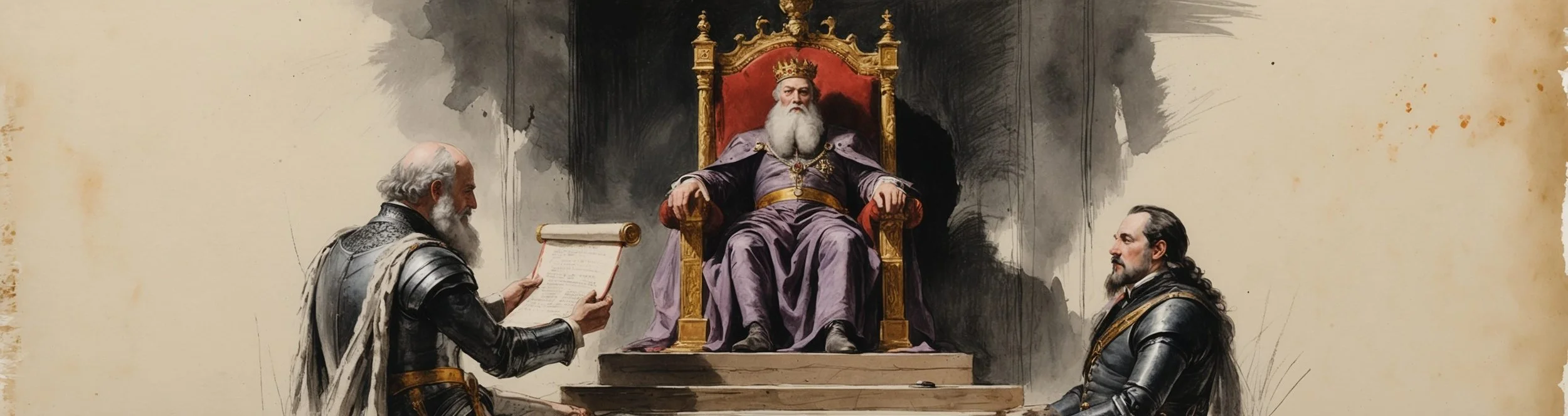
Scene Profile – At a Glance
- Location: The French King’s palace. France hears that the English are coming.
- What Happens: The French court debates the threat – the Dauphin scoffs at England’s “vain, giddy, shallow, humorous youth”, the Constable warns he is wrong – and then Exeter arrives with Henry’s demand: the crown of France, or “bloody constraint”.
- Key Characters: The King of France, the Dauphin, the Constable and Exeter.
- Dramatic Function: The war’s formal declaration delivered to the enemy’s face – and the play’s first French scene, establishing the divided court whose misjudgements will lose Agincourt.
- Famous Quote:
"For, my good liege, she is so idly kinged,
Her sceptre so fantastically borne
By a vain, giddy, shallow, humorous youth,
That fear attends her not."
(the Dauphin, Act 2, Scene 4) - Why It Matters: The scene stages the play’s central argument about Henry – wastrel or Brutus? – inside the enemy’s council, and Exeter’s embassy shows the King’s style of pious menace working by proxy.
Scene Summary
The King of France opens in plain fear: the English come “with full power”, and France must answer royally – towns lined and repaired, the Dukes and the Dauphin dispatched, for England approaches “as fierce / As waters to the sucking of a gulf”, and the “late examples” of English victories lie fatally on French fields.
The Dauphin agrees with the preparations and scorns the premise: defend, certainly – a kingdom should always arm as if war were expected – but with no more fear than if England were “busied with a Whitsun morris-dance”, for she is “so idly kinged”, her sceptre borne by “a vain, giddy, shallow, humorous youth”. The Constable’s correction is immediate: ask the ambassadors who met him – the state, the counsellors, the modesty, the “terrible… constant resolution” – and you will find his wild youth was “but the outside of the Roman Brutus”, folly worn as cover, as gardeners hide with manure the roots that will spring most delicate. The old King sides with fear: remember Crécy, the Black Prince, and the “mountain sire” who stood smiling as his heroic seed mangled the work of nature – Henry is “a stem / Of that victorious stock”.
Then Exeter, for England: lay aside “the borrowed glories” – the crown of France, owed to Henry by gift of heaven, law of nature and of nations; here is the pedigree, “in every branch truly demonstrative”. Or else? “Bloody constraint” – he is coming “in thunder and in earthquake, like a Jove”, and on the French King’s head will fall the widows’ tears, orphans’ cries and dead men’s blood of the war this refusal feeds. For the Dauphin there is a personal parcel: “scorn and defiance… contempt” – the tennis-ball mock will be answered until the caves of France chide the trespass. The Dauphin is unrepentant – he desires “nothing but odds with England” – and Exeter’s last word is a warning about growth: there is a difference between the promise of Henry’s “greener days” and the man who “now… weighs time / Even to the utmost grain”. The King asks for a night to answer; Exeter presses – his master is “footed in this land already”.
Idly Kinged?
The Dauphin’s estimate of Henry is the scene’s central error, delivered with total confidence.
Original
For, my good liege, she is so idly kinged,
Her sceptre so fantastically borne
By a vain, giddy, shallow, humorous youth,
That fear attends her not.
(the Dauphin, Act 2, Scene 4)
Shakespeare Retold (Modern Verse)
For, dear lord, England is so weakly ruled,
Her crown is so ridiculously worn
By a pathetic youth, shallow and foolish
That nobody’s afraid of England.
“Vain, giddy, shallow, humorous” – four adjectives, all obsolete. The Dauphin’s intelligence is not invented; it is out of date: this was Prince Hal’s reputation, deliberately cultivated, now deliberately discarded. The play has already shown the audience two proofs the Dauphin lacks – the bishops’ amazement in Act 1 and the tennis-ball reply his own jest provoked – so his scorn arrives pre-refuted, and the dramatic irony is total. The deeper point is about evidence: the Dauphin judges from the old story because the old story flatters him; his tennis balls were sent to that imaginary playboy, and every subsequent French disaster grows from the same refusal to update. In a play obsessed with performance, the Dauphin is the cautionary case: the man who mistook the costume for the actor.
The Roman Brutus
The Constable’s correction is the shrewdest reading of Henry anyone gives in the entire play – from the enemy’s side of the table.
Original
How terrible in constant resolution,
And you shall find his vanities forespent
Were but the outside of the Roman Brutus,
Covering discretion with a coat of folly...
(the Constable, Act 2, Scene 4)
Shakespeare Retold (Modern Verse)
How fearsome and unwavering his resolve is,
And you’ll see that his youthful days are over,
Like Brutus hid his cunning with a smile,
Disguising smartness acting like a fool...
His evidence is professional – the ambassadors’ report of Henry’s state, counsel, modesty and “terrible” resolution – and his conclusion is exact: the vanities were “but the outside”, like Lucius Junius Brutus, who feigned idiocy under the Tarquins until the moment to strike. The gardening image seals it: discretion hidden under folly as gardeners hide under ordure the roots “that shall first spring and be most delicate”. This is precisely Hal’s own plan from Henry IV – the sun behind clouds – diagnosed from outside by a man who never saw the tavern. Shakespeare gives the play’s truest account of his hero to the enemy commander, and the choice matters: when the French lose, it will not be because no one among them understood Henry, but because the men who did were outvoted by the men who preferred the flattering story.
Exeter’s Embassy
Henry’s demand arrives in Henry’s style – lawful, pious, and armed to the teeth – carried by the plainest voice in his service.
Original
Bloody constraint; for if you hide the crown
Even in your hearts, there will he rake for it:
Therefore in fierce tempest is he coming,
In thunder and in earthquake, like a Jove...
(Exeter, Act 2, Scene 4)
Shakespeare Retold (Modern Verse)
Then violent coercion; hide the crown
Within your hearts, and he will rip it out.
For he is coming like a wild tempest,
With devastation only Jove could wreak...
The demand itself is total – the crown of France, styled “borrowed glories” – and dressed in the full Act 1 wardrobe: God Almighty, law of nature and of nations, a pedigree “in every branch truly demonstrative”. The alternative is Jove in thunder and earthquake – and then, unmistakably, the Harfleur manoeuvre in embryo: deliver the crown and “take mercy / On the poor souls” the war will otherwise swallow, for the widows’ tears and orphans’ cries will be on your head. The blame for English violence is delivered to the French King along with the threat of it – responsibility transferred in the same breath as the ultimatum, exactly as Henry will do at Harfleur’s gates in person. Exeter’s blunt dignity makes him the perfect carrier: the message is menace, but the messenger is all correctness – the mailed fist in a diplomat’s glove.
Language and Technique
- Dramatic irony as structure: Every French judgement of Henry is tested against what the audience has already seen – the Dauphin wrong, the Constable right, and the play’s outcome forecast in who listens to whom.
- The Brutus allusion: Folly worn as political cover – the Constable reaches for Rome’s most famous feigned fool to explain Hal’s tavern years: the play’s reformation theme, stated by the enemy.
- Menace in legal dress: Exeter’s embassy wraps “bloody constraint” in pedigree, heaven and the law of nations – violence arriving with its paperwork in order.
- The transferred bill: Widows’ tears and orphans’ cries pre-charged to the French King’s head – the play’s signature blame-shift, working by ambassador.
- Natural-force imagery: England as waters sucked to a gulf, Henry as Jove, tempest and earthquake – the invasion consistently figured as weather: unanswerable, and nobody’s fault.
Key Quotes from Act 2, Scene 4
Quote 1
Original
The kindred of him hath been fleshed upon us;
And he is bred out of that bloody strain
That haunted us in our familiar paths...
(the King of France, Act 2, Scene 4)
Shakespeare Retold (Modern Verse)
His ancestors have fought us, causing bloodshed,
And he’s descended from those fighting men
That brought us grief upon the fields of France....
Quote Analysis: The old King’s fear has a pedigree of its own: Henry is “bred out of that bloody strain” – the line of Edward III and the Black Prince – that “haunted” France in her own familiar paths. “Fleshed” is a hunting word: hounds given their first taste of the kill. Where the Dauphin sees a playboy, his father sees a bloodline – and the memory of Crécy makes the French King the one man in the scene whose caution needs no correcting. Fear, in this court, is the beginning of wisdom.
Original
He wills you, in the name of God Almighty,
That you divest yourself, and lay apart
The borrowed glories that by gift of heaven...
(Exeter, Act 2, Scene 4)
Shakespeare Retold (Modern Verse)
He tells you, in the name of God Almighty,
That you must abdicate and sign away
The land you borrowed as a gift from heaven...
Quote Analysis: The demand in its full dress: Henry “wills” – not requests – in the name of God Almighty, that France “divest” itself of “borrowed glories”. The financial metaphor runs the whole embassy: the crown is a loan called in, the glories borrowed, the pedigree the paperwork of repossession. Set beside Canterbury’s Salic Law speech, this is the same case compressed for export – and its blend of piety and threat is Henry’s voice precisely, working through an ambassador.
Original
Scorn and defiance; slight regard, contempt,
And any thing that may not misbecome
The mighty sender, doth he prize you at.
(Exeter, Act 2, Scene 4)
Shakespeare Retold (Modern Verse)
Scorn and contempt; a general disregard,
And anything that might not seem demeaning
Unto our mighty king, he sends to you.
Quote Analysis: The Dauphin’s personal delivery: scorn, defiance, slight regard, contempt – a catalogue of disdain, capped with the immaculately diplomatic proviso that Henry prizes him at anything that may not “misbecome / The mighty sender”. The insult is wrapped in courtesy’s own grammar – contempt, but nothing beneath the sender’s dignity – and it answers the tennis balls in kind: mock for mock, with interest accruing until, as Exeter promises, the caves of France return the jest “in second accent of his ordnance”.
Original
Between the promise of his greener days
And these he masters now: now he weighs time
Even to the utmost grain...
(Exeter, Act 2, Scene 4)
Shakespeare Retold (Modern Verse)
From his behaviour as a wild youngster
To how he’s masterful now. He plans his time
Down to the second: you will find this out...
Quote Analysis: Exeter’s closing warning is the play’s theme of transformation stated as intelligence assessment: between “the promise of his greener days” and the man Henry now masters lies a difference his own subjects found “in wonder” – and he now “weighs time / Even to the utmost grain”. The image is of a goldsmith’s scales: a king measuring hours like precious metal. It is the Constable’s Brutus reading confirmed from inside England – and a last chance, formally offered, for the Dauphin to update. He declines it.
Key Takeaways
- Two readings of one king: The Dauphin’s wastrel and the Constable’s Brutus – the play’s central question about Henry, argued in the enemy’s council with the audience holding the answer.
- The best reader is outvoted: The Constable is right about everything – and French policy follows the Dauphin’s vanity instead: Agincourt’s cause, visible two acts early.
- The demand is total and lawful: Exeter asks for the crown itself, with heaven, nature and a pedigree for warrant – Henry’s Act 1 case, delivered to its target.
- The blame arrives before the war: Widows and orphans pre-charged to the French King’s refusal – the play’s great responsibility-transfer, now in export packaging.
Study Questions and Analysis
How does the French court read Henry – and who gets him right?
Three ways, in ascending accuracy. The Dauphin sees the old caricature: England “idly kinged” by a “vain, giddy, shallow, humorous youth” – intelligence a full reign out of date, held because it flatters the man who sent tennis balls to that imaginary wastrel. The Constable reads the evidence instead: the ambassadors’ report of Henry’s state, counsel and “terrible… constant resolution”, from which he deduces the truth – the wild years were “but the outside of the Roman Brutus”, folly covering discretion as gardeners cover spring roots with ordure. And the old King reads history: the bloodline of Crécy and the Black Prince, “a stem / Of that victorious stock” – fear as pattern-recognition.
Harold C. Goddard, in The Meaning of Shakespeare (1951), noted how much work this scene does for the play’s portrait of its hero: the Brutus image is Hal’s own sun-behind-clouds strategy from Henry IV, rediscovered independently by an enemy who never saw the tavern – which is as close as the play comes to certifying that the reformation was a performance, since even strangers can reconstruct the script. For essays, the scene is the cleanest exhibit of dramatic irony in the play’s first half: every French reading is graded against what the audience already knows, and France’s fate is decided by which reading commands policy – the flattering one.
What exactly does Exeter demand – and how does his rhetoric work?
Everything: the crown of France itself, characterised as “borrowed glories” to be laid apart, owed to Henry “by gift of heaven, / By law of nature and of nations”, with a genealogical table enclosed – “in every branch truly demonstrative”. Refusal purchases “bloody constraint”: Henry coming like Jove, in thunder and earthquake. And then the embassy’s masterstroke – the moral invoice:
Original
Deliver up the crown, and to take mercy
On the poor souls for whom this hungry war
Opens his vasty jaws; and on your head
Turning the widows' tears, the orphans' cries
The dead men's blood, the pining maidens groans...
(Exeter, Act 2, Scene 4)
Shakespeare Retold (Modern Verse)
To yield the crown, thus showing mercy on
The poor folk who’ll be eaten by this war
That’s beast-like; and upon your guilty conscience
Will be the widows’ tears, the orphans’ cries,
The dead men’s blood, the girls wailing in mourning...
Deliver the crown, and thereby “take mercy” on the poor souls the war will otherwise devour – because the widows’ tears, orphans’ cries and dead men’s blood will be on the refuser’s head. The structure is pure Henry: the demand is framed so that the demander’s violence becomes the refuser’s guilt, exactly as Canterbury received the sin of the war and Harfleur will be made “guilty in defence”. For essays on language and power, this speech is invaluable precisely because Henry is absent: the method survives translation into another mouth, which proves it is policy, not personality – the house style of Lancastrian power, teachable to ambassadors.
Why does the play keep remembering Crécy?
Because precedent is this war’s deepest argument – on both sides. The French King’s great speech of fear is built on it:
Original
Witness our too much memorable shame
When Cressy battle fatally was struck,
And all our princes captived by the hand
Of that black name, Edward, Black Prince of Wales...
(the King of France, Act 2, Scene 4)
Shakespeare Retold (Modern Verse)
Remember all the shame that fell upon us
When we were fatally attacked at Crécy,
And all our princes then were taken captive
By Edward, Prince of Wales, known as the Black Prince...
Crécy, 1346: the Black Prince destroying French chivalry while his father Edward III – Henry’s great-great-grandfather, the “mountain sire… crowned with the golden sun” – watched smiling from a hill as his “heroical seed” mangled “the work of nature”. For the French King, the memory is a family curse returning: Henry is “a stem / Of that victorious stock”, and fearing him is simply reading the pedigree. The English use the same past oppositely – Canterbury’s Act 1 exhortations and the breach speech’s “fathers of war-proof” invoke Crécy as promise rather than curse. One battle, two inheritances: glory downhill to England, trauma downhill to France. It is the play’s quietest observation about war memory – the same field teaches each nation the lesson it already believed – and it gives the coming Agincourt its frame: not an upset but a recurrence, the “fatal and neglected English” keeping a family appointment.
What passes between Exeter and the Dauphin?
The tennis balls, returned with interest. The Dauphin demands to know what England sends him; Exeter’s answer is a formal catalogue of contempt – “scorn and defiance; slight regard, contempt” – followed by terms: unless his father’s total surrender “sweeten the bitter mock”, Henry will call him to “so hot an answer” that the “caves and womby vaultages of France” will echo his joke back at him “in second accent of his ordnance” – the mock returned as cannon-fire. The Dauphin, incorrigible, wishes only “odds with England” and stands by his gift: “the Paris balls”. Exeter’s reply gives the play one of its best lines of quiet menace – Henry will “make your Paris Louvre shake for it”.
The exchange completes the tennis-ball plot’s first arc and confirms its meaning: the jest has become a formal count in a war indictment, exactly as Henry promised in Act 1 – his “mock” converted to gun-stones, now itemised by ambassador. It also finishes the scene’s character work: the Dauphin, twice corrected – by the Constable’s analysis and Exeter’s warning about Henry’s “greener days” – doubles down twice. The play’s French catastrophe needs a human cause, and this scene supplies it: not French weakness, but one prince’s unteachable vanity, placed where policy is made.
How does this scene close Act 2 – and set up Act 3?
It moves the war from paperwork to geography. Act 2 has been all preparation and portent – the Chorus’s traitors, Eastcheap’s departures, Southampton’s executions – and this scene lands the play in France for the first time, with the demand delivered face to face and Exeter’s closing intelligence making the timetable brutal: answer quickly, “for he is footed in this land already”. The invasion is no longer coming; it has arrived, and the Act 3 Chorus’s fleet and Harfleur’s guns follow directly.
Structurally, the scene also completes the play’s opening symmetry: Act 1 built the English case for war in an English council; Act 2 ends by testing it in the French one – same claim, same pedigree, now with the threats attached and the audience watching the receiving end. Norman Rabkin, in his 1977 essay Rabbits, Ducks, and Henry V, located the play’s doubleness precisely in such paired perspectives: the demand that sounded like law in Westminster sounds like extortion in Rouen, and both scenes are played straight. An essay tracking the claim’s journey – Canterbury’s syllogisms, Exeter’s ultimatum, Harfleur’s “guilty in defence” – will find this scene the hinge where justification becomes force.