Henry V: Act 2, Scene 3 – Analysis
Scene Profile – At a Glance
- Location: London, before the Boar’s Head tavern in Eastcheap. The men are leaving for the war.
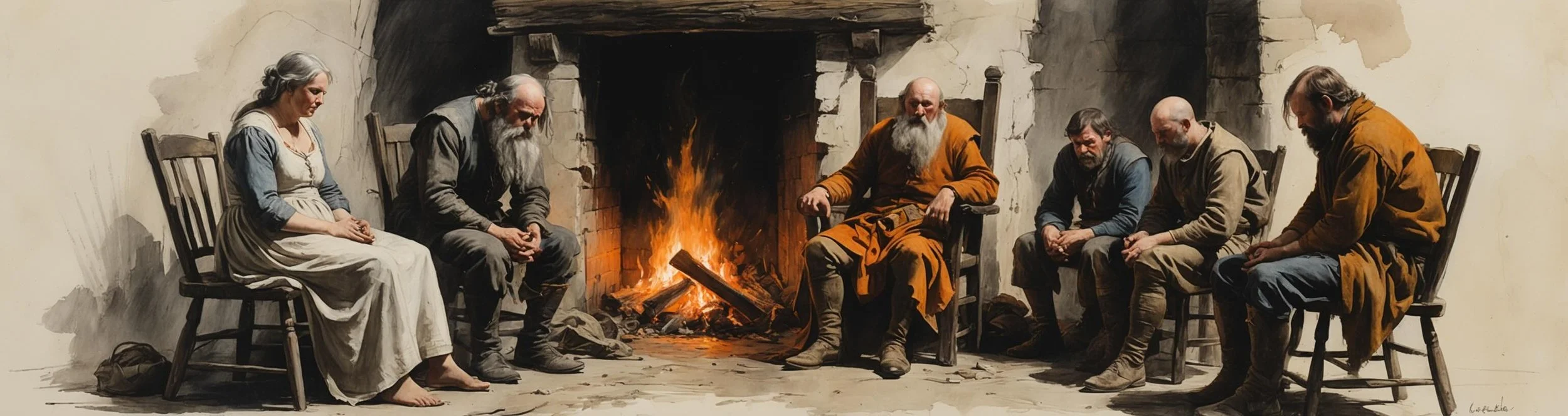
- What Happens: The Hostess describes Falstaff’s death – the fumbled sheets, the babbled green fields, the cold creeping upward – in the most celebrated death-report in Shakespeare. Then Pistol kisses his wife, issues his business advice, and leads the crew to France “like horse-leeches”.
- Key Characters: The Hostess (Mistress Quickly), Pistol, Nym, Bardolph and the Boy.
- Dramatic Function: The death of Falstaff – the greatest character not in the play – reported in prose that has broken hearts for four centuries, and the tavern world’s farewell to England.
- Famous Quote:
"there was but one way; for his nose was as sharp as a pen, and a' babbled of green fields."
(the Hostess, Act 2, Scene 3) - Why It Matters: Shakespeare kills the most beloved character he ever created – offstage, in a mistress’s rambling prose – and the play’s glorious war marches away from the deathbed. Nothing in Henry V is more quoted, or more quietly devastating.
Scene Summary
The Hostess wants to walk her new husband as far as Staines; Pistol refuses – his “manly heart doth yearn” – and rallies the crew: Bardolph, be blithe; Nym, rouse thy vaunting veins; Boy, bristle thy courage up – “for Falstaff he is dead, / And we must earn therefore.” Bardolph wishes he were with him, “wheresome’er he is, either in heaven or in hell”.
The Hostess corrects him with the speech that has immortalised her: Falstaff is not in hell – he is “in Arthur’s bosom”, if ever man went there. He made “a finer end”, parting “even just between twelve and one, even at the turning o’ the tide”: she saw him fumble with the sheets, play with flowers, smile upon his fingers’ ends – his nose “as sharp as a pen” as he “babbled of green fields”. He cried out “God, God, God!”, and she – to comfort him – told him not to trouble himself with such thoughts yet. She felt his feet, his knees, and “so upward and upward, and all was as cold as any stone”. The crew add their memories: he cried out of sack – ay, that he did; of women – that he did not (the Boy insists otherwise: devils incarnate); and once saw a flea on Bardolph’s nose and called it a black soul burning in hell-fire – to which Bardolph’s epitaph: the fuel that fed that fire is all the riches he earned in the great man’s service.
Then the war resumes its claim. Nym asks “shall we shog?”; Pistol kisses his wife, delivers his household commandments – trust none, “oaths are straws”, let “Pitch and Pay” be the word – and calls the crew to France: “like horse-leeches, my boys, / To suck, to suck, the very blood to suck!” The Boy’s dry rider – “And that’s but unwholesome food, they say” – closes Eastcheap’s London life for ever.
The Finer End
The most famous death in Shakespeare happens offstage, and is reported by a woman getting her words wrong – perfectly.
Original
I saw him fumble with the sheets and play with flowers and smile upon his fingers' ends, I knew there was but one way; for his nose was as sharp as a pen, and a' babbled of green fields.
(the Hostess, Act 2, Scene 3)
Shakespeare Retold (Modern Verse)
I saw him fumbling with the sheets, pretending he was playing with flowers, smiling as he looked at his fingertips, I knew that he was dying; for his face was gaunt, his nose drawn out like a pen, and he mumbled about green fields.
Every detail is a deathbed commonplace of the age – the plucking at sheets, the sharpened nose – and every detail is transfigured by where the dying mind went: flowers, fingers’ ends, green fields. Falstaff, the great creature of taverns and midnight, dies babbling of meadows – childhood, or Psalm 23’s green pastures, or both – and the Hostess’s malapropism “Arthur’s bosom” (for Abraham’s) sends him to an English heaven by mistake: king Arthur’s, where old England keeps its heroes. The comedy and the grief are the same substance. She tells him not to think of God yet – the tenderest wrong advice in the language – and her creeping inventory of the cold, feet to knees, “upward and upward”, lets the audience feel death arrive by touch. Four centuries of critics have agreed that nothing else like it exists: an unlettered woman’s run-on prose achieving what no elegy could.
Cold as Any Stone
The report’s ending is its masterpiece – grief measured out in repetition.
Original
a' bade me lay more clothes on his feet: I put my hand into the bed and felt them, and they were as cold as any stone; then I felt to his knees, and they were as cold as any stone, and so upward and upward, and all was as cold as any stone.
(the Hostess, Act 2, Scene 3)
Shakespeare Retold (Modern Verse)
he asked me to lay more blankets over his feet: I put my hand into his bed and felt them, and they were stone cold; then I felt his knees, and they were stone cold, and so I continued moving upwards and his whole body was stone cold.
The triple “cold as any stone” is the rhetoric of a woman who has no rhetoric: repetition standing in for everything she cannot say, the sentence itself creeping “upward and upward” with the cold it reports. What follows on stage is just as eloquent: the crew’s scattered memories – sack, women, the flea on Bardolph’s nose called “a black soul burning in hell-fire” – are Eastcheap’s funeral rites, jokes doing the work of psalms. And Bardolph’s two lines may be the truest mourning in the play: he wishes himself with Falstaff “either in heaven or in hell”, and reckons his whole wage for years of service was the drink that kept his nose alight – “that’s all the riches I got”. The men who will shortly be hanged, cudgelled and killed for the King’s war spend their last London scene loving the man the King threw away.
Pitch and Pay
Grief gets a dozen lines; then the war – and business – resumes.
Original
Look to my chattels and my movables:
Let senses rule; the word is 'Pitch and Pay:'
Trust none;
For oaths are straws, men's faiths are wafer-cakes,
And hold-fast is the only dog, my duck...
(Pistol, Act 2, Scene 3)
Shakespeare Retold (Modern Verse)
Look after my belongings and possessions.
Let reason guide you; get paid before you work.
Trust no one,
Commitment is as weak as straws or wafers,
And only trust yourself, my dear....
Pistol’s farewell to his wife is a merchant’s memorandum: guard the chattels and movables, cash only – “Pitch and Pay” – trust none, for “oaths are straws, men’s faiths are wafer-cakes”, and let the bulldog grip of “hold-fast” be her creed. It is comic, and it is a worldview: in Pistol’s England, faith is confectionery and only possession is real – which is precisely how he will treat the war, sucking France “like horse-leeches”. The scene’s tonal engineering deserves naming in any essay: the tenderest prose in Shakespeare and the crassest business advice share sixty lines, and the play refuses to referee. Eastcheap mourns like this – jokes, kisses, theft-plans and heartbreak in one breath – and its unsentimental grief shames the official world’s eloquence by costing something.
Language and Technique
- Malapropism as elegy: “Arthur’s bosom” for Abraham’s – the Hostess’s error relocates Falstaff to an English folk-heaven, wronger and truer than the scripture she reached for.
- The felt detail: Sheets, flowers, fingers’ ends, a nose sharp as a pen – death rendered entirely through what a watcher at the bedside saw and touched.
- Repetition as grief: “Cold as any stone… cold as any stone… all was as cold as any stone” – the unlettered mourner’s figure: saying it again because nothing else can be said.
- Tonal whiplash: Deathbed prose into leech-imagery and kiss-and-inventory farewells – the scene’s emotional range is its meaning: this world grieves and grifts in the same breath.
- The famous emendation: “A’ babbled of green fields” rests on the most celebrated editorial repair in Shakespeare – the Folio’s “a Table of green fields” made sense by Lewis Theobald in 1733.
Key Quotes from Act 2, Scene 3
Quote 1
Original
Nay, sure, he's not in hell: he's in Arthur's bosom, if ever man went to Arthur's bosom.
(the Hostess, Act 2, Scene 3)
Shakespeare Retold (Modern Verse)
I’m sure he’s not in hell: he’s in Arthur’s – I mean Abraham’s – bosom, if ever a man went to Arthur’s – Abraham’s – bosom.
Quote Analysis: The Hostess’s opening ruling, and the scene’s thesis: wherever bad men go, Falstaff is not there – he is in “Arthur’s bosom”, the malapropism that has outlived a thousand correct quotations of Abraham. Her certainty – “if ever man went” there – is theology by loyalty: he made “a finer end”, and fine ends earn heaven. The play never contradicts her. Whatever the new King’s chaplains might rule, the last word on Falstaff’s soul belongs to the woman who held his feet.
Original
Bardolph, be blithe: Nym, rouse thy vaunting veins:
Boy, bristle thy courage up; for Falstaff he is dead,
And we must earn therefore.
(Pistol, Act 2, Scene 3)
Shakespeare Retold (Modern Verse)
Bardolph, be happy. Nym, arouse your blood.
Boy, fire up your courage, for Falstaff now is dead,
And we must earn our keep without his help.
Quote Analysis: Pistol’s rallying couplets do the scene’s cruellest arithmetic in four lines: Falstaff is dead, therefore “we must earn” – the great heart converted, in the same breath, into a vacancy in the household economy. The comedy of “vaunting veins” and bristled courage should not hide what the sentence admits: Falstaff was their living as well as their love, and Eastcheap cannot afford to mourn long. The war, for this crew, is a job opening.
Original
Let us to France; like horse-leeches, my boys,
To suck, to suck, the very blood to suck!
(Pistol, Act 2, Scene 3)
Shakespeare Retold (Modern Verse)
Let’s go to France, like parasitic leeches
To suck their blood, to suck and suck their blood!
Quote Analysis: The mission statement: to France “like horse-leeches” – to suck, to suck, the very blood to suck. Pistol’s image is honest where the official war-rhetoric is not: he names the campaign’s attraction for men with nothing – plunder – without one word about crowns, claims or Saint George. The Boy’s deadpan rider (leech-food is “unwholesome… they say”) is the scene’s conscience in nine words, and the pair of lines together are the play’s low-life answer to Canterbury: this, too, is why nations go to war.
Key Takeaways
- Falstaff dies offstage, and owns the play’s heart: The most beloved character Shakespeare created is dismissed in a report – and the report outshines every trumpet in the play.
- The Hostess’s errors are the eloquence: Arthur’s bosom, God not to be thought of “yet”, cold counted stone by stone – wrong words carrying true grief.
- The King’s absence is present: No one names Henry here – but the Hostess said it in Scene 1: “the king has killed his heart”. The reformation’s bill, paid in Eastcheap.
- Grief and greed share the exit: From green fields to horse-leeches in thirty lines – the crew mourns, kisses, and leaves to loot: the war’s recruiting truth, from below.
Study Questions and Analysis
Why does Falstaff die offstage – and why is he in this play at all?
The Epilogue to Henry IV Part 2 had promised the audience more: “our humble author will continue the story, with Sir John in it”. The promise was broken – Falstaff never appears in Henry V – and his death is delivered by report in this single scene. Why Shakespeare changed course is one of the oldest puzzles in the canon: explanations range from the practical (the departure of Will Kemp, the company’s great clown, from the Chamberlain’s Men around 1599) to the structural – and the structural case is compelling. Samuel Johnson judged in 1765 that Shakespeare could contrive no adventures suitable to Falstaff in the new play – a comic gravity that size would bend the epic around itself, and the King’s play could not survive his old tempter stealing it.
But absence is not omission: the death scene makes Falstaff’s ghost load-bearing. His broken heart indicts the reformation the play celebrates; his crew carries his memory to France, where Fluellen’s “Alexander the Pig” comparison will name what happened – the King “turned away the fat knight” – at the moment of Henry’s greatest triumph. Falstaff dead does work Falstaff living never could: he is the play’s standing question about what the perfect king cost, asked once, here, in a woman’s prose, and echoing to Agincourt.
What makes the Hostess’s account of the death so celebrated?
Its method: grief rendered entirely through observed, touched, mistaken detail, in the voice of a woman with no idea she is delivering one of the great speeches in English. The centre is pure bedside witness:
Original
A' made a finer end and went away an it had been any christom child; a' parted even just between twelve and one, even at the turning o' the tide...
(the Hostess, Act 2, Scene 3)
Shakespeare Retold (Modern Verse)
He died peacefully and departed as if he was a newly baptised child. He died somewhere between twelve and one, just as the tide was turning. Then after...
The “christom child” (her word for chrisom, a newly baptised infant) makes the fat old sinner die innocent; the tide-turn timing places the death in folk-belief, where souls leave on the ebb; and then the details no elegy would dare – the fumbled sheets, the smile at his own fingers’ ends, the nose “sharp as a pen”, the babbled green fields. Her comfort – telling a dying man not to think of God yet – is doctrinally disastrous and humanly perfect; her inventory of the cold, “upward and upward”, lets us feel the death arrive. The speech proves a rule worth stating in any essay on register: the play’s Layer of high eloquence – Chorus, King, bishops – never once achieves this. Shakespeare reserved his most affecting writing for prose, error and a hostess – and placed it in his most rhetorical play, where the contrast is the point.
Did the King kill Falstaff?
The play has already returned its verdict, in the Hostess’s own words one scene earlier: “The king has killed his heart” (Act 2, Scene 1). Nym adds there that “the king hath run bad humours on the knight”; Pistol, that “his heart is fracted and corroborate”. Eastcheap is unanimous about the cause of death: the rejection – “I know thee not, old man” at the coronation that closed Henry IV Part 2 – broke him, and this scene shows the breakage completed. No one on stage disputes it; no one mentions the King at the deathbed at all, which is its own kind of verdict.
A. C. Bradley, in his 1909 essay The Rejection of Falstaff, made the case that has framed the debate ever since – “our hearts go with Falstaff to the Fleet” – arguing that Shakespeare made the rejection dramatically necessary and emotionally unforgivable at once: the new reign required it, and the audience’s love refuses to ratify it. This scene is where the price is paid on stage. For essays on kingship, the pairing is essential: Act 1’s bishops celebrate the reformation as a miracle of grace; Act 2’s tavern counts its cost in a dead man’s cold feet. Both scenes describe the same event – the making of the perfect king – and the play, characteristically, files both reports without reconciling them.
What do the famous details – green fields, the tide, "cold as any stone" – actually mean?
Each is a period deathbed sign, transfigured. Plucking at the sheets and a face sharpening were recognised tokens of approaching death; dying at the ebb tide was coastal folk-belief (the soul goes out with the water); the upward-creeping cold is clinical observation made liturgy by repetition. The green fields are the speech’s glory: a dying London reprobate babbling of meadows – childhood memory, or the “green pastures” of Psalm 23, the psalm read at deathbeds – either way, Falstaff’s mind escaping to innocence as his body chills. The Boy’s report that he cried out of sack and women completes the portrait: the old appetites confessed at the door of death, and the Hostess loyally editing the record (“A’ could never abide carnation”) even as she gives it.
One textual footnote is worth any student’s knowing, flagged honestly: “a’ babbled of green fields” is not quite what the earliest text prints. The Folio reads “a Table of green fields” – nonsense that the editor Lewis Theobald, in 1733, repaired with the most celebrated emendation in Shakespeare: babbled. Nearly every modern edition – and this one – accepts it. The most quoted phrase in the scene is, in that precise sense, a collaboration between Shakespeare and his best reader – a fact examiners reward, because it shows the text of Shakespeare is itself an edited, argued-over thing.
How does the scene move from the deathbed to the war – and why so fast?
In a single beat: Nym’s “Shall we shog?” – and the scene pivots from Arthur’s bosom to embarkation, kisses and business:
Original
Come, let's away. My love, give me thy lips.
Look to my chattels and my movables:
(Pistol, Act 2, Scene 3)
Shakespeare Retold (Modern Verse)
Come on, let’s go. My love, give me your lips.
Look after my belongings and possessions.
Pistol’s farewell compresses the whole tonal method: a kiss for his love, then the padlock – “look to my chattels and my movables” – then the creed (“trust none… hold-fast is the only dog”), then France imagined as a body to leech. The speed is not callousness but economics: as Pistol said at the scene’s top, Falstaff is dead “and we must earn therefore” – the crew’s patron is gone, and the war is the only employment left. That is the scene’s quiet contribution to the play’s recruiting picture: the Chorus’s youth of England on fire, honour’s thought in every man – and here the actual marchers: a widow-to-be walking her husband to the corner, a boy with misgivings, and three men going to France because the man who fed them died. Both accounts are true; the play prints them side by side; and essays that quote the horse-leeches against the Chorus’s “English Mercuries” are using the contrast exactly as Shakespeare built it.