Julius Caesar: Act 3, Scene 3 – Analysis
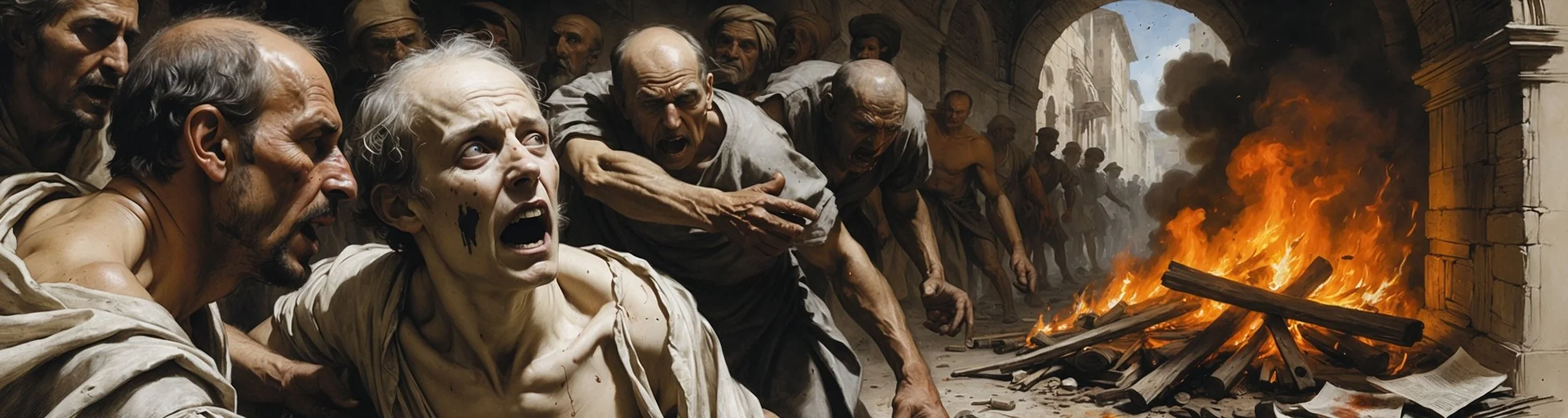
Scene Profile – At a Glance
- Location: A street in Rome.
- What Happens: Cinna the poet is stopped by a mob on his way to Caesar's funeral. When he gives his name, the crowd mistakes him for Cinna the conspirator and tears him apart, even after he protests he is the poet.
- Key Characters: Cinna the poet and a mob of Roman citizens.
- Dramatic Function: This short scene shows the riot Antony started in action, proving how blind and deadly the inflamed crowd has become.
- Famous Quote:
"Tear him for his bad verses, tear him for his bad verses."
(Fourth Citizen, Act 3, Scene 3) - Why It Matters: An innocent man is murdered for having the wrong name. It is the human cost of Antony's oration, shown in less than forty lines.
Scene Summary
Cinna the poet sets out into the streets of Rome, uneasy after dreaming that he feasted with Caesar. He says he has no real reason to leave his house, yet something draws him out. Almost at once a gang of citizens, stirred up by Caesar's funeral, surrounds him and fires questions at him about his name, his home, and his business.
Cinna answers cleverly, even cheekily, but when he gives his name as Cinna the crowd turns on him: a conspirator shares that name. He protests that he is Cinna the poet, not the plotter, but the mob no longer cares. They decide to "tear him for his bad verses" and drag him off, then scatter to burn the houses of Brutus, Cassius, and the other conspirators.
A Bad Dream and an Uneasy Walk
The scene opens quietly, with Cinna alone and afraid. He has dreamed of feasting with the dead Caesar, an omen heavy with bad luck, and he senses he should stay indoors. Yet he goes out anyway, pulled by a force he cannot name.
Original
I have no will to wander forth of doors,
Yet something leads me forth.
(Cinna the Poet, Act 3, Scene 3)
Shakespeare Retold (Modern Verse)
I have no reason I should leave my house
But something draws me on.
This small moment sets the dread of the scene. Like Caesar before him, Cinna has a warning – a dream, a bad feeling – and like Caesar he ignores it and walks into danger. Shakespeare uses the parallel to suggest that Rome itself has become a place where omens come true, and where no one can step outside without being caught up in the violence Antony has unleashed.
Killed for a Name
The citizens question Cinna rapidly, almost playfully, and he matches their wit. The mood is light, even comic – until he tells them his name. The single word changes everything, and the crowd's good humour turns instantly to murder.
Original
Tear him to pieces; he's a conspirator.
(First Citizen, Act 3, Scene 3)
Shakespeare Retold (Modern Verse)
Tear him to pieces! He's one of the traitors!
Cinna's frantic cry that he is "Cinna the poet" makes no difference. The mob does not want the truth; it wants a victim, and any Cinna will do. When one citizen jokes that they should tear him for his bad verses instead, the line is grotesquely funny and deeply chilling at once. The crowd has stopped caring about guilt or innocence; it has become a blind appetite for blood. This is exactly what Antony meant when he set "mischief" loose and let it "take what course it will".
Language and Technique
- Prose for the mob: The crowd's quick-fire questions and Cinna's replies are in plain prose, the everyday speech of the street, which makes the sudden violence feel real and close.
- Black comedy: The joke about tearing Cinna "for his bad verses" is genuinely funny, and that is what makes it horrifying – the mob laughs while it kills.
- Dramatic parallel: Cinna, like Caesar, ignores a warning dream and walks to his death, linking the two killings.
- Repetition: The drumbeat of "tear him, tear him" turns the crowd into a single, chanting creature with no individual conscience.
Key Quotes from Act 3, Scene 3
Quote 1I am not Cinna the conspirator.
(Cinna the Poet, Act 3, Scene 3)
Shakespeare Retold (Modern Verse)
I am not Cinna the traitor!
It is no matter, his name's Cinna; pluck but his name out of his heart, and turn him going.
(Fourth Citizen, Act 3, Scene 3)
Shakespeare Retold (Modern Verse)
It doesn't matter, for his name is Cinna. Pluck his name from his heart and send him packing.
Key Takeaways
- The riot turns deadly: The scene shows the violence Antony unleashed in the Forum now killing an innocent bystander.
- Cinna dies for his name: The mob knows he is the wrong man and murders him anyway, for sharing a conspirator's name.
- The crowd has lost all reason: Quick wit and honest protest mean nothing once the mob wants a victim.
- Comedy makes it worse: The joke about "bad verses" shows how casually the crowd now treats a killing.
Study Questions and Analysis
What is the purpose of such a short, violent scene?
At under forty lines, the murder of Cinna is one of the shortest scenes in the play, and its brevity is the point. Shakespeare does not need long speeches here; he needs a single, shocking image of what Antony's oration has produced. The riot the audience heard threatened at the end of the previous scene is now shown in action, claiming an innocent victim.
The scene also acts as a bridge. It marks the end of Rome's political order and the beginning of the chaos that will fill the rest of the play. By killing a poet – a harmless man of words – the mob shows that reason, art, and innocence count for nothing now. The brutality is deliberately disproportionate, and it leaves the audience in no doubt about the human cost of the conspirators' actions and Antony's revenge.
Why does the mob kill Cinna even after he explains who he is?
The horror of the scene is that the crowd kills Cinna knowing he is the wrong man. He clearly explains that he is Cinna the poet, not Cinna the conspirator, and a citizen openly admits "it is no matter". The mob has passed beyond logic into pure appetite for violence; it does not want justice, it wants a target.
I am Cinna the poet, I am Cinna the poet.
(Cinna the Poet, Act 3, Scene 3)
Shakespeare Retold (Modern Verse)
I am Cinna the poet, I am Cinna the poet!
The repeated, desperate protest only feeds the crowd's cruelty, turning his name into a joke about his poetry. The scene is the play's sharpest study of mob mentality: a group that, stirred to fury, loses every individual conscience and acts as one mindless creature. It directly fulfils Antony's prophecy of "domestic fury and fierce civil strife", and shows that once a crowd is inflamed, it cannot be reasoned back.
How does this scene connect to Caesar's death?
Shakespeare deliberately echoes Caesar's murder in Cinna's. Like Caesar, Cinna has an ominous dream and a bad feeling, and like Caesar he ignores the warning and goes out anyway, only to be killed. The parallel suggests a Rome where omens are no longer idle: the city has become a place where to step outside is to risk death.
There is also a grim irony in the contrast. Caesar, the most powerful man in Rome, is killed by a small group of noblemen for political reasons they dress up as principle. Cinna, a nobody, is killed by a faceless crowd for no reason at all beyond his name. Together the two deaths frame the collapse of order: first the great are murdered by the few, then the innocent are murdered by the many. The killing of Caesar has opened the door to a violence that now falls on anyone.
What does the dark humour of the scene achieve?
The scene is unsettlingly funny in places. The citizens' rapid-fire questions, Cinna's quick replies, and especially the line about tearing him "for his bad verses" all carry a genuine comic snap. Shakespeare is not trying to lighten the horror; he is sharpening it.
The comedy works because it shows how casually the mob now treats a human life. A man is about to be torn apart, and the crowd is making jokes. That gap between the lightness of the talk and the savagery of the act is deeply disturbing, and it tells us something true about how ordinary people behave in a mob: cruelty can wear a grin. By making us almost laugh and then recoil, Shakespeare implicates the audience in the crowd's mood for a moment, which is far more powerful than simple horror would be.