Julius Caesar: Act 4, Scene 1 – Analysis
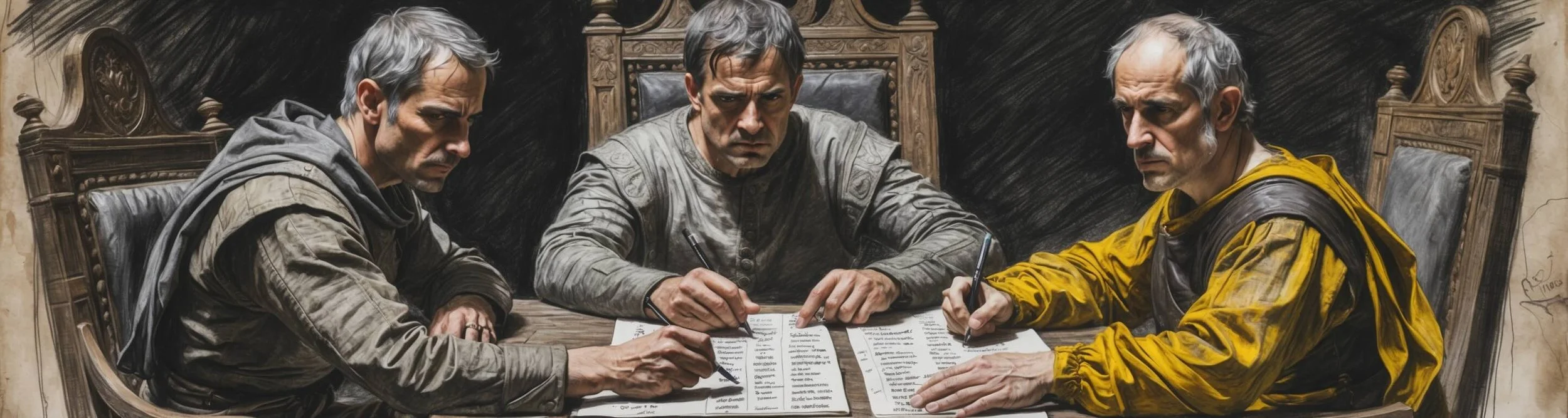
Scene Profile – At a Glance
- Location: A house in Rome.
- What Happens: Antony, Octavius and Lepidus, now ruling Rome together, draw up a death-list of their enemies. Once Lepidus leaves, Antony dismisses him as a mere errand-boy and turns to planning war against Brutus and Cassius.
- Key Characters: Mark Antony, Octavius, and Lepidus.
- Dramatic Function: It shows what victory has made of Antony. The man who mourned Caesar now coolly trades lives, exposing the new regime as no better than the one it replaced.
- Famous Quote:
This is a slight unmeritable man,
Meet to be sent on errands:...
(Antony, Act 4, Scene 1) - Why It Matters: The proscription and Antony's contempt for his own ally reveal the ruthlessness of the new order and set the alliances for the war to come.
Scene Summary
The scene opens on the new rulers of Rome – Antony, Octavius and Lepidus – seated at a table, marking the names of men who must die. They trade away even their own relatives: Lepidus agrees to his brother's death, and in return Antony agrees that his own nephew, Publius, will die too.
Antony sends Lepidus off to fetch Caesar's will, so they can find ways to reduce the money it promises the people. The moment Lepidus is gone, Antony turns on him, telling Octavius that Lepidus is a worthless man fit only for errands and should never have been given a share of the world. Octavius defends him as a brave soldier, but Antony compares him to a horse or a beast of burden – a tool to be used and then turned loose. They then agree to join forces and plan their campaign against Brutus and Cassius, who are raising armies.
The Death-List
The scene begins with a chilling piece of business: three men sitting at a table, deciding who lives and who dies. This is the proscription – a list of political enemies marked for execution – and Shakespeare stages it as a cold, almost casual exchange. The very first line sets the tone.
Original
These many, then, shall die; their names are pricked.
(Antony, Act 4, Scene 1)
Shakespeare Retold (Modern Verse)
Then, all these men will die; we’ve marked their names.
What makes the moment so disturbing is the ease of it. There is no debate about justice, no soul-searching of the kind Brutus agonised over before killing Caesar. Lives are simply "pricked" off on a list, including the lives of family. Antony consents to his nephew's death with a grim pun – "with a spot I damn him" – as if the dot of ink were the death itself. The triumph that began with one man's murder has become a machine for murdering many.
Antony's Contempt for Lepidus
The instant Lepidus is sent away on his errand, Antony drops the mask of partnership. He tells Octavius bluntly that the third member of their alliance is not worth his place, a man fit only to be ordered about.
Original
This is a slight unmeritable man,
Meet to be sent on errands: is it fit,
The three-fold world divided, he should stand
One of the three to share it?
(Antony, Act 4, Scene 1)
Shakespeare Retold (Modern Verse)
He is a weak and undeserving man,
Just suited running errands. Is it right,
If all the world were split in three, he’d be
One of the three to share it?
This is a new Antony. In Act 3 he wept over Caesar's body and swore loyalty to his memory; here he is a hard-headed politician, weighing allies by their usefulness alone. The contempt is striking because Lepidus is, in theory, his equal – one of three men dividing the entire Roman world between them. Antony treats that partnership as a convenience, to be discarded the moment it stops serving him. It tells us the alliance is built on nothing but advantage, and will not last.
The Beast of Burden
When Octavius defends Lepidus as a "tried and valiant soldier", Antony brushes the point aside with a long, withering comparison: Lepidus is no more than a useful animal, to be fed, trained, and then set loose when his work is done.
Original
He shall but bear them as the ass bears gold,
To groan and sweat under the business,
Either led or driven, as we point the way;
(Antony, Act 4, Scene 1)
Shakespeare Retold (Modern Verse)
He does them like a donkey hauling gold,
By sweating, groaning, struggling at each task,
And only does a task as we direct him;
The image is deliberately demeaning. A donkey carries gold without owning any of it, labours under a load it does not understand, and is driven where its master points. Antony's plan is to use Lepidus for the dirty, unpopular work – the "slanderous loads" of blame – and then cast him off. The small, quiet menace in this is that Octavius is listening. The young man who will one day become the Emperor Augustus is learning how power really works, and watching Antony reveal exactly how he treats his friends.
Language and Technique
- The verb "prick": Names are "pricked" on the list – a small, businesslike word for marking a man for death, which makes the killing sound like bookkeeping.
- Animal imagery: Lepidus is reduced to an "ass" and a "horse", a creature to be fed, driven and turned loose – stripping him of any human dignity.
- Dramatic irony: Antony schemes against an ally in front of Octavius, who will one day turn on Antony himself – a betrayal the audience can already sense coming.
- Cold understatement: Family members are condemned in a line or two, the horror left for the audience to feel rather than spelled out.
Key Quotes from Act 4, Scene 1
Quote 1He shall not live; look, with a spot I damn him.
But, Lepidus, go you to Caesar's house;
(Antony, Act 4, Scene 1)
Shakespeare Retold (Modern Verse)
He will not live; I’ve marked him down for death.
But, Lepidus, go down to Caesar’s house,
And though we lay these honours on this man,
To ease ourselves of divers slanderous loads,
(Antony, Act 4, Scene 1)
Shakespeare Retold (Modern Verse)
And, though we spread the burden on this man
To ease the challenges that face us both,
Listen great things: – Brutus and Cassius
Are levying powers: we must straight make head:
(Antony, Act 4, Scene 1)
Shakespeare Retold (Modern Verse)
Let’s talk of greater things. Brutus and Cassius
Are building up their army. We must stop them.
Key Takeaways
- The proscription is cold-blooded: The triumvirs mark men for death, including their own relatives, as a matter of routine business.
- Antony has changed: The grieving friend of Act 3 is now a hard, calculating politician who uses people and discards them.
- The alliance is shallow: Antony's contempt for Lepidus shows the triumvirate is built on convenience, not trust, and will not hold.
- War is coming: The scene ends by turning towards the campaign against Brutus and Cassius, launching the play's second half.
Study Questions and Analysis
What is the proscription, and why is this scene so disturbing?
The proscription is a list of political enemies marked for execution, drawn up by the three rulers of Rome after Caesar's death. Shakespeare stages it as a quiet, businesslike transaction: names are "pricked" off, and the men trade away even their own relatives. Lepidus consents to his brother's death; Antony, in exchange, condemns his nephew Publius.
What makes it so chilling is the absence of feeling. There is no debate about guilt or justice, no agonising of the kind Brutus went through before the assassination. The horror is left entirely to the audience. The scene works as a grim answer to the question the conspirators raised in Act 2: was killing Caesar worth it? Here we see the Rome that the assassination has produced – not a restored republic, but a regime that kills by checklist.
How has Antony changed since Act 3?
The change is one of the play's sharpest ironies. In Act 3 Antony wept over Caesar's corpse, swore vengeance, and used his funeral speech to turn the people against the conspirators – a performance of grief and loyalty. Here, only an act later, he is a cold administrator of death, trading lives and despising the very ally he depends on.
Harley Granville-Barker, in his Prefaces to Shakespeare (1947), observed how unsentimentally Shakespeare lets the politician emerge from behind the mourner, so that the man who moved a crowd to tears now calculates the worth of his colleagues like livestock. The scene does not announce the change; it simply shows it, and trusts the audience to remember the earlier Antony. The effect is to complicate any simple view of him: the eloquent friend and the ruthless triumvir are the same man.
Why does Antony treat Lepidus with such contempt?
Antony judges Lepidus purely by his usefulness, and finds him wanting in everything but the capacity to take orders and absorb blame. He calls him "a slight unmeritable man", fit only for errands, and compares him to a donkey carrying gold or a horse trained to obey.
Do not talk of him,
But as a property.
(Antony, Act 4, Scene 1)
Shakespeare Retold (Modern Verse)
Don’t think of him as
Anything but a worker.
The word "property" is the key: to Antony, Lepidus is a thing to be used, not a partner to be respected. Octavius's mild defence – that Lepidus is a brave soldier – is swept aside. The contempt matters for two reasons. It shows the alliance is hollow, held together only by shared interest, and it reveals Antony's character: brilliant, but cold and self-serving once the immediate crisis has passed.
What does the scene reveal about Octavius?
Octavius says little, but what he says is telling. He defends Lepidus as "a tried and valiant soldier", showing a fairness or at least a caution that Antony lacks, and he listens carefully as Antony explains how to use and discard an ally. He is the junior partner here, but an attentive one.
For an audience aware of Roman history, the scene carries heavy dramatic irony. This quiet young man will eventually push Antony aside, defeat him, and become the Emperor Augustus – the very kind of single ruler the conspirators killed Caesar to prevent. Shakespeare plants the seed of that future here: Octavius is watching Antony reveal exactly how power treats its friends, and the lesson will not be wasted. The republic the conspirators died for is, by this scene, already gone for good.