Julius Caesar: Act 3, Scene 2 – Analysis
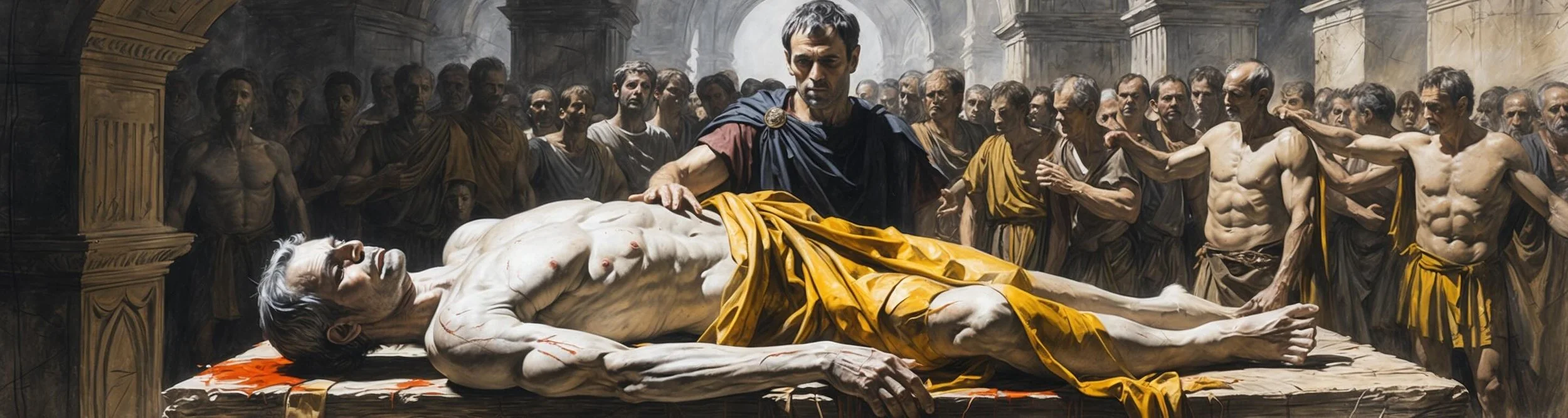
Scene Profile – At a Glance
- Location: The Forum in Rome.
- What Happens: Brutus tells the crowd why Caesar had to die, and wins their approval. Then Antony speaks over the body, reads Caesar's will, and turns the same crowd into a murderous mob hunting the conspirators.
- Key Characters: Brutus, Mark Antony, Cassius, and the Roman crowd.
- Dramatic Function: The funeral orations decide the fate of Rome. Antony's speech destroys the conspirators' cause and drives Brutus and Cassius out of the city.
- Famous Quote:
"Friends, Romans, countrymen, lend me your ears;
I come to bury Caesar, not to praise him."
(Antony, Act 3, Scene 2) - Why It Matters: This is the most famous lesson in rhetoric in all of Shakespeare, showing how a clever speaker can swing a whole crowd from one side to the other.
Scene Summary
The angry crowd demands an explanation for Caesar's death. Brutus sends Cassius to address one group while he speaks to the other. Standing in the pulpit, Brutus explains in plain prose that he loved Caesar but loved Rome more, and that Caesar's ambition would have made slaves of them all. The crowd is convinced, cheering Brutus and even calling for him to be made the new Caesar.
Brutus then makes a fatal mistake. He leaves before Antony speaks, telling the people to stay and hear Caesar's funeral honoured, and trusting that Antony will keep to their agreement. As Antony climbs into the pulpit, the crowd is still firmly on Brutus's side and suspicious of anything Antony might say.
Antony's speech slowly turns them. He claims only to bury Caesar, repeatedly calling Brutus "an honourable man" until the phrase curdles into sarcasm. He reminds them of Caesar's kindness, shows them the wounds in the bloodied mantle, and dangles Caesar's will in front of them without reading it. By the time he reveals that Caesar has left money and land to every citizen, the crowd is weeping and furious.
The people erupt into a riot, seizing the body, gathering fire, and rushing off to burn the conspirators' houses. Antony watches his work take hold. A servant brings news that Octavius has arrived in Rome and that Brutus and Cassius have fled the city like madmen. Antony goes to join Octavius, the new power in Rome.
Brutus Makes His Case
Brutus speaks first, and crucially he speaks in prose, not verse – plain, balanced, reasonable sentences that match his plain, reasonable self-image. His whole argument rests on a single idea: that he acted out of love for Rome, not hatred of Caesar.
Original
Not that I loved Caesar less, but that I loved Rome more. Had you rather Caesar were living and die all slaves, than that Caesar were dead, to live all free men?
(Brutus, Act 3, Scene 2)
Shakespeare Retold (Modern Verse)
it's not that I did not love Caesar, but that I loved Rome more. Would you prefer he lived but we all die slaves, or Caesar dead, we all live as free men?
It is a powerful, honest appeal, and it works: the crowd is won over. But Brutus's strength is also his weakness. He argues to the head, offering reasons and asking the people to judge him wisely, as if they were a court. He never touches their hearts. When Antony does exactly that a few minutes later, Brutus's careful logic is swept away, because a crowd is moved by feeling far more easily than by argument.
The Honourable Man
Antony begins on the back foot, facing a crowd that loves Brutus, and he is bound by his promise not to attack the conspirators. So he attacks them without seeming to, hiding his real meaning inside a phrase of apparent praise that he repeats until it turns poisonous.
Original
For Brutus is an honourable man;
So are they all, all honourable men –
Come I to speak in Caesar's funeral.
(Antony, Act 3, Scene 2)
Shakespeare Retold (Modern Verse)
For Brutus is an honourable man,
Just like them all, all honourable men –
I've come to speak at Caesar's funeral.
Each time Antony calls Brutus "honourable", he sets it beside a fact that makes the word ring false – Caesar filled Rome's treasury, wept for the poor, refused the crown three times. He never says Brutus is lying; he lets the crowd reach that conclusion themselves. This is the genius of the speech. By keeping the letter of his promise while shattering its spirit, Antony stays technically loyal to the conspirators even as he destroys them, and the repeated word becomes the sharpest weapon in the play.
The Will and the Mantle
Words alone are not enough; Antony also gives the crowd things to see and want. He produces Caesar's will and refuses to read it, working them into a frenzy of curiosity, then shows them the torn, bloodstained cloak Caesar was wearing when he died, naming each wound and each killer.
Original
This was the most unkindest cut of all;
For when the noble Caesar saw him stab,
Ingratitude, more strong than traitors' arms,
Quite vanquished him:...
(Antony, Act 3, Scene 2)
Shakespeare Retold (Modern Verse)
This cut here was the cruellest cut of all,
Because, when Caesar saw the stab from Brutus,
The pain from his ungratefulness hurt more,
And that's what killed him;...
Antony singles out Brutus's wound as "the most unkindest cut of all", insisting it was Brutus's betrayal, not the blade, that truly killed Caesar. The mantle turns abstract politics into a thing the crowd can touch and grieve over, and the will promises them money and gardens. Between the two, Antony gives the people both a reason to be angry and a reward for that anger. He has learned what Brutus never grasped: that a crowd is ruled through its emotions and its pockets, not its reason.
The Mob Unleashed
By now Antony barely needs to push. He pretends to hold the crowd back even as he winds them up, insisting he is "no orator" while delivering the most effective speech in the play, until the people no longer need leading at all.
Original
but were I Brutus,
And Brutus Antony, there were an Antony
Would ruffle up your spirits and put a tongue
In every wound of Caesar that should move
The stones of Rome to rise and mutiny.
(Antony, Act 3, Scene 2)
Shakespeare Retold (Modern Verse)
If I were Brutus,
And he was me, you'd hear an Antony
Who'd whip you up in fury, putting tongues
In every wound of Caesar that would move
The heart and soul of Rome to mutiny.
The false modesty is brilliant. Antony claims that a real orator like Brutus could stir the very stones of Rome to riot – while doing precisely that himself. He even tells the crowd plainly that he means to "stir" them, daring them to notice, and they do not. Within moments they snatch up the body and run off to burn the conspirators' houses. The transformation is complete: the same people who cheered Brutus now want him dead, and Rome has slid into the chaos Antony foresaw over the corpse.
Language and Technique
- Prose against verse: Brutus argues in measured prose; Antony sways the crowd in flowing verse – the difference in sound mirrors the difference between reason and feeling.
- Verbal irony: Antony repeats "honourable man" until praise becomes its opposite, letting the crowd hear the accusation he never openly makes.
- Repetition (refrain): The looping return to Brutus's "honour" and to Caesar's "ambition" hammers both ideas until they collapse under their own weight.
- Props as persuasion: The bloody mantle and the sealed will are physical objects that do the work of a hundred arguments, giving the crowd something to see and to crave.
- Rhetorical questions: Antony asks "Was this ambition?" again and again, inviting the crowd to answer "no" for themselves so the conclusion feels like their own.
Key Quotes from Act 3, Scene 2
Quote 1The evil that men do lives after them;
The good is oft interred with their bones;
So let it be with Caesar.
(Antony, Act 3, Scene 2)
Shakespeare Retold (Modern Verse)
The bad things people do live on post death;
But they take good things with them to their grave.
And so it is with Caesar.
You all did see that on the Lupercal
I thrice presented him a kingly crown,
Which he did thrice refuse: was this ambition?
(Antony, Act 3, Scene 2)
Shakespeare Retold (Modern Verse)
You all saw on the day of Lupercal
Three times I offered him a crown of kings,
And three times he refused. Is that ambition?
But here's a parchment with the seal of Caesar;
I found it in his closet, 'tis his will:
(Antony, Act 3, Scene 2)
Shakespeare Retold (Modern Verse)
But here's a document with Caesar's wax seal.
I found it in his closet. It's his will.
O, what a fall was there, my countrymen!
Then I, and you, and all of us fell down,
Whilst bloody treason flourished over us.
(Antony, Act 3, Scene 2)
Shakespeare Retold (Modern Verse)
Oh, what a fall it was, my countrymen!
Then me and you and all of us fell down,
Whilst bloody treason triumphed over us.
I am no orator, as Brutus is;
But, as you know me all, a plain blunt man,
That love my friend;...
(Antony, Act 3, Scene 2)
Shakespeare Retold (Modern Verse)
I am no orator, like Brutus is,
But, as you know, I am a man of candour
Who loved his friend,...
Now let it work. Mischief, thou art afoot,
Take thou what course thou wilt!
(Antony, Act 3, Scene 2)
Shakespeare Retold (Modern Verse)
Now let that work. There's mischief in the air;
Do what you will.
Key Takeaways
- Two speeches decide everything: Brutus wins the crowd with reason, then Antony wins it back with feeling – and feeling proves far stronger.
- "Honourable man" turns to poison: Antony repeats the phrase about Brutus until it means the opposite, attacking the conspirators without breaking his promise.
- The will and the mantle do the work: Physical proof and the promise of reward move the crowd where pure argument cannot.
- Brutus's fairness destroys him: Letting Antony speak, and leaving before he does, hands Antony the stage and the city.
- Rome falls into chaos: The scene ends in riot, Brutus and Cassius are driven out, and Antony joins Octavius as the new power.
Study Questions and Analysis
Why does Brutus speak in prose while Antony speaks in verse?
The choice of prose and verse is one of the scene's most telling effects. Brutus addresses the crowd in carefully balanced prose, full of measured antitheses and rhetorical questions. It is dignified and clear, and it suits his image of himself as a reasonable man laying out reasonable grounds for a hard act.
Romans, countrymen, and lovers! Hear me for my cause, and be silent, that you may hear: believe me for mine honour, and have respect to mine honour, that you may believe:...
(Brutus, Act 3, Scene 2)
Shakespeare Retold (Modern Verse)
Romans, countrymen and lovers, listen in silence so you hear me well. Believe me against my honour, and, respecting it, you must believe me.
Antony, by contrast, speaks in verse, which carries a music and emotional pull that prose cannot. The rhythm sweeps the crowd along where Brutus's logic only persuades them for a moment. Many critics read the contrast as Shakespeare's verdict on the two men: Brutus appeals to the mind and loses; Antony appeals to the heart and wins. The form of each speech is itself an argument about how power over a crowd really works.
How does Antony turn the crowd without openly attacking Brutus?
Antony is bound by his agreement not to blame the conspirators, so he works by implication rather than accusation. He praises Brutus as "honourable" again and again, but always pairs the praise with a fact that contradicts it: Caesar enriched Rome, wept for the poor, refused a crown. The audience and the crowd are left to notice the contradiction and draw the obvious conclusion, so that Antony never has to say the word "liar".
The method is so effective because it makes the crowd feel they are thinking for themselves. Harley Granville-Barker, in his Prefaces to Shakespeare (1947), admired the speech as a precisely engineered piece of stagecraft, built to move a particular audience step by step from hostility to fury. Antony reads his listeners moment by moment, advancing when they soften and pulling back when he has gone too far. By the end, he has kept his promise to the letter while breaking it completely in spirit, and the crowd believes the rebellion is their own idea.
Why does Antony use Caesar's will and the bloody mantle?
Antony understands that a crowd is moved by what it can see and what it can gain, not by argument. The mantle and the will are his two great props, and he uses them in sequence to take the crowd from grief to greed to rage.
To every Roman citizen he gives,
To every several man, seventy-five drachmas.
(Antony, Act 3, Scene 2)
Shakespeare Retold (Modern Verse)
To every Roman citizen he gives,
To each and every man, seventy-five drachmas.
The bloodied cloak lets him stage the murder in front of the crowd, naming each wound and each killer so the abstract crime becomes a vivid, personal injury. The will then turns mourning into self-interest: Caesar loved them so much that he left them money and gardens, while the conspirators have given them nothing. By appealing to both the heart and the purse, Antony binds the crowd to Caesar's memory and against his killers. It is a far shrewder reading of human nature than Brutus's appeal to principle.
What does the crowd's behaviour reveal about the Roman people?
The crowd is one of the most important "characters" in the scene, and its swift change of heart is alarming. At the start they are ready to make Brutus the new Caesar; minutes later they are screaming for his death. They are loyal, emotional, and dangerously easy to lead – exactly the qualities the opening scene of the play warned us about with the tribunes and the holiday crowd.
Shakespeare presents the people as a force that decides who rules but cannot rule itself. They respond to whoever speaks last and best, which makes oratory, not justice, the real power in Rome. M. W. MacCallum, in Shakespeare's Roman Plays and Their Background (1910), noted how seriously the play treats the populace as a political player while also showing its fickleness. The riot that follows the speech – in which an innocent man, Cinna the poet, will be torn apart in the next scene – shows the frightening cost of a crowd whose feelings have been deliberately inflamed.
Is Antony sincere in his grief for Caesar?
This is one of the scene's richest questions, because the answer is almost certainly "both". Antony's love for Caesar is real – his private soliloquy over the body in the previous scene, when no one is watching, shows genuine devotion and rage. The grief he displays in the Forum is not faked from nothing; it draws on feeling he truly has.
Yet that same grief is coldly weaponised. Antony uses his real tears to manipulate the crowd, pausing for effect, displaying the body, timing the will for maximum impact. The remarkable thing is that Shakespeare lets both be true at once: a man can mourn sincerely and exploit his mourning at the same moment. This doubleness is what makes Antony so compelling and so dangerous. He is not a simple hypocrite; he is a genuine mourner who has also become a ruthless political operator, and the scene refuses to let us separate the two.
How does this scene compare with Brutus's view of human nature?
The two orations stage a clash of beliefs about people. Brutus assumes the crowd is rational and honourable, like himself: tell them the truth, give them good reasons, and they will judge wisely. He even leaves the Forum before Antony speaks, trusting the people to weigh both sides fairly, as a fair-minded man would.
Then none have I offended. I have done no more to Caesar than you shall do to Brutus.
(Brutus, Act 3, Scene 2)
Shakespeare Retold (Modern Verse)
Then I've offended no one. I've done no more to Caesar than you'd do to me if I wronged.
Antony assumes the opposite: that people are ruled by feeling and self-interest, and can be steered by anyone who knows how to play on them. The scene proves Antony right and Brutus tragically wrong. Brutus's misjudgement is not stupidity but a kind of moral blindness – he cannot see meanness in others because there is none in himself. It is the same flaw that let Cassius recruit him and that will eventually destroy him, and it makes him both admirable and doomed.
What is the dramatic importance of this scene in the play as a whole?
The Forum scene is the hinge of the entire tragedy. Up to this point the conspirators hold the advantage: Caesar is dead, the city is theirs, and Brutus has even won the crowd's approval. By the end of the scene that advantage is gone. Antony has turned the people, Brutus and Cassius are fleeing for their lives, and the road to civil war is open.
It also shifts the play's centre of gravity. The first half is about the decision to kill Caesar; from here on the play is about the consequences, and Antony, barely seen before Act 3, becomes a leading force. Caesar himself is more powerful dead than alive: his will, his wounds, and his name now do more to shape Rome than he managed in life. The scene proves the grim truth of Antony's earlier prophecy over the body – that the murder would unleash chaos rather than restore the republic the conspirators hoped to save.
How does Antony use rhetorical questions and false modesty?
Two of Antony's favourite tools are the rhetorical question and the show of modesty, and both work by making the crowd do his arguing for him. He repeatedly asks "Was this ambition?", offering evidence of Caesar's generosity and then leaving the people to answer. Because they reach the conclusion themselves, they hold it more firmly than if Antony had simply told them.
The false modesty works the same way. By insisting he is "no orator" and only a "plain blunt man", Antony makes his polished speech sound like plain honest feeling, which lowers the crowd's guard. Harley Granville-Barker, in his Prefaces to Shakespeare (1947), praised the speech precisely as a performance – every pause, repetition, and apparent stumble carefully placed to control the audience's response. The deepest irony is that Antony's claim not to stir the crowd is itself the thing that stirs them most. He hides his skill so well that the people never realise they are being led, which is exactly why the leading succeeds.