Julius Caesar: Act 3, Scene 1 – Analysis
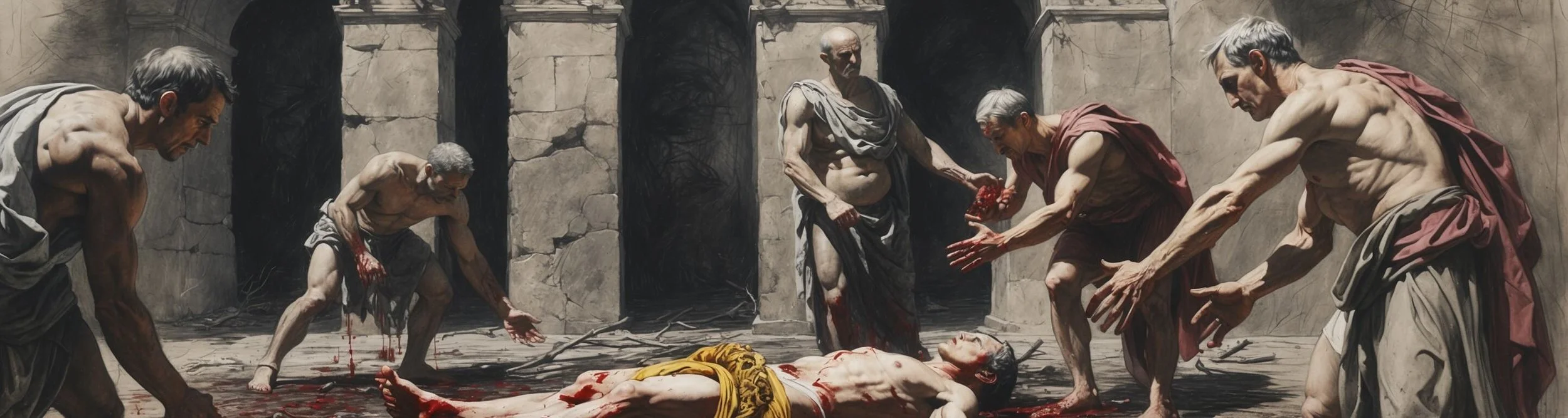
Scene Profile – At a Glance
- Location: Rome, before the Capitol, with the Senate sitting above.
- What Happens: Caesar ignores fresh warnings and reaches the Senate. The conspirators surround him with a petition, then stab him to death. Antony returns, makes a wary peace with the killers, and is left alone to vow revenge.
- Key Characters: Julius Caesar, Brutus, Cassius, Casca, and Mark Antony.
- Dramatic Function: This is the turning point of the play. The murder is carried out, and Antony's grief sets up the revenge that fills the second half.
- Famous Quote:
"Et tu, Brute! Then fall, Caesar."
(Caesar, Act 3, Scene 1) - Why It Matters: Caesar's death does not bring the freedom the conspirators imagine. Within minutes Antony is plotting their downfall, and civil war becomes certain.
Scene Summary
Caesar makes his way to the Capitol through a crowd. The soothsayer is there, and Artemidorus tries to press a letter on him that names the conspirators, but Caesar refuses to read anything that concerns himself first and brushes the man aside. The plotters grow nervous when a senator, Popilius, seems to wish their "enterprise" well, but he says nothing to Caesar, and the murder goes ahead. Trebonius draws Antony away outside.
In the Senate, Metellus Cimber kneels and begs Caesar to lift his brother's banishment. Brutus and Cassius join the plea, but Caesar refuses grandly, declaring himself "constant as the northern star". As the conspirators crowd close, Casca strikes first, and the others stab in turn. Caesar fights until he sees Brutus among them, says "Et tu, Brute!", and dies at the base of Pompey's statue.
The killers smear their hands and swords in Caesar's blood, planning to walk to the marketplace crying "peace, freedom and liberty". Antony's servant arrives, and Antony himself follows under a promise of safety. He grieves openly over the body, shakes each bloody hand, and asks permission to speak at the funeral. Cassius distrusts him, but Brutus grants it, on the condition that Antony will not blame the conspirators.
Left alone with the corpse, Antony drops the calm mask. He apologises to Caesar for seeming gentle with "these butchers" and prophesies that civil war will tear Italy apart. A messenger brings news that Octavius, Caesar's heir, is near Rome; Antony sends him word to wait until he has tested the mood of the people in the marketplace.
The Warnings Brushed Aside
The scene opens with one last chance for Caesar to save himself. The soothsayer is still there, Artemidorus holds a letter that names every conspirator, and he begs Caesar to read it first because it touches him most nearly. Caesar's answer is fatally proud.
Original
What touches us ourself shall be last served.
(Caesar, Act 3, Scene 1)
Shakespeare Retold (Modern Verse)
The notes concerning me will be read last.
It sounds like selflessness – a ruler who puts the public's business before his own. In fact it is the same blindness that has run through the play. Caesar cannot imagine that a private warning might matter more than his public dignity, and the one document that could save his life is the one he sets aside. The audience, who can see the danger closing in, watches him refuse the very thing that would tell him to run.
Constant as the Northern Star
Inside the Senate, Metellus Cimber kneels to beg for his banished brother, and Brutus and Cassius join him. The plea is really a way of getting the conspirators close to Caesar, but Caesar reacts to it with the proudest speech of his life, comparing himself to the one fixed star in a sky full of moving lights.
Original
But I am constant as the northern star,
Of whose true-fixed and resting quality
There is no fellow in the firmament.
(Caesar, Act 3, Scene 1)
Shakespeare Retold (Modern Verse)
But I'm as steady as the sky's North Star,
That sits unmoving each and every night;
There's nothing in the heavens that's more stable.
The irony is brutal. Caesar boasts that he alone cannot be moved, that he stands above ordinary men who can be swayed by flattery and tears – and these are the last full sentences he speaks before he is cut down. His refusal to bend, presented here as greatness, is exactly the inflexibility that makes him impossible to warn. The "constant" star is about to fall.
The Bloody Hands
Casca strikes first, the others follow, and when Caesar sees Brutus among his attackers he gives up the fight with "Et tu, Brute!" and dies. In the stunned silence that follows, Brutus does something extraordinary: he turns the murder into a ritual, telling the conspirators to bathe their hands in Caesar's blood and carry their red swords through the streets.
Original
Stoop, Romans, stoop,
And let us bathe our hands in Caesar's blood
Up to the elbows, and besmear our swords:
(Brutus, Act 3, Scene 1)
Shakespeare Retold (Modern Verse)
Bow down now, Romans,
And let us wipe our hands in Caesar's blood
Up to our elbows and smear it on our swords.
Brutus means this as something noble. He wants the killing to look like a sacrifice for Rome, not a butchery, and the blood becomes a kind of badge of liberty. But the image is horrifying, and the audience cannot help seeing what Brutus cannot: men dripping with the blood of a friend, telling themselves they are saviours. The gap between how the conspirators see the act and how it actually looks is the wound the rest of the play presses on.
Antony's Pact and His Vow
Antony returns under a promise of safety and plays his hand with great care. He grieves over the body, shakes each killer's bloody hand, and asks only to speak at the funeral. Cassius smells the danger, but Brutus, sure of his own honour, agrees. The moment the conspirators leave, Antony's true intent breaks out over the corpse.
Original
Cry 'Havoc', and let slip the dogs of war;
That this foul deed shall smell above the earth
With carrion men, groaning for burial.
(Antony, Act 3, Scene 1)
Shakespeare Retold (Modern Verse)
Declare, 'Carnage!' unleashing vicious soldiers,
And this foul deed will stink to highest heaven
By piled-up rotting corpses seeking graves.
This is the speech that turns the play. Antony predicts not justice but chaos – civil war so savage that mothers will smile at their butchered children because cruelty has become normal. "Cry havoc, and let slip the dogs of war" is a command to unleash total destruction, and it tells us that Caesar's death has settled nothing. The conspirators thought they were ending tyranny; Antony knows they have started a war.
Language and Technique
- Dramatic irony: Caesar's boast that he is "constant as the northern star" comes seconds before he is killed – the audience hears the fall inside the boast.
- Image of the fixed star: Caesar compares himself to the one unmoving star, turning his pride into a single, memorable picture of inflexible greatness.
- Ritual and blood imagery: Brutus reframes murder as sacrifice by having the men "bathe" their hands in blood – an image that means nobility to him and horror to us.
- Hunting metaphor: Antony calls Caesar a "hart" brought down by hunters, punning on "hart" and "heart" to mourn both the man and the loss to the world.
- Apostrophe: Alone, Antony speaks directly to the dead body ("O, pardon me, thou bleeding piece of earth"), a device that lets us hear his real feelings burst out.
Key Quotes from Act 3, Scene 1
Quote 1These couchings and these lowly courtesies
Might fire the blood of ordinary men,
And turn pre-ordinance and first decree
Into the law of children.
(Caesar, Act 3, Scene 1)
Shakespeare Retold (Modern Verse)
This stooping, bowing down, and flattery
Might stir and influence the common man
And turn the laws that should be sacrosanct
To loosely followed rules.
Liberty! Freedom! Tyranny is dead!
Run hence, proclaim, cry it about the streets.
(Cinna, Act 3, Scene 1)
Shakespeare Retold (Modern Verse)
We're free at last! The tyrant has been killed!
Let's run and shout about it in the streets!
O mighty Caesar! Dost thou lie so low?
Are all thy conquests, glories, triumphs, spoils,
Shrunk to this little measure? Fare thee well.
(Antony, Act 3, Scene 1)
Shakespeare Retold (Modern Verse)
Is that you lying there, oh mighty Caesar?
Have all your glories won in victory
Just boiled down to this? Goodbye, god bless.
Our hearts you see not; they are pitiful;
And pity to the general wrong of Rome –
As fire drives out fire, so pity pity –
Hath done this deed on Caesar.
(Brutus, Act 3, Scene 1)
Shakespeare Retold (Modern Verse)
But you can't see our hearts are full of pity,
And pity all the wrong that Rome has suffered,
Like fire kills fire, Rome's pity pities Caesar,
And pity's done this deed to him.
How many ages hence
Shall this our lofty scene be acted over
In states unborn and accents yet unknown!
(Cassius, Act 3, Scene 1)
Shakespeare Retold (Modern Verse)
How many years from now
Will this surreal scene be acted out
In states and languages not yet created!
O, pardon me, thou bleeding piece of earth,
That I am meek and gentle with these butchers!
Thou art the ruins of the noblest man
That ever lived in the tide of times.
(Antony, Act 3, Scene 1)
Shakespeare Retold (Modern Verse)
Forgive me, bleeding corpse, becoming dust,
That I am soft and gentle with these butchers.
You are the ruins of the finest man
That ever lived in all eternity.
Key Takeaways
- The assassination happens here: The conspirators kill Caesar in the Senate, the act the whole first half of the play has been building towards.
- Caesar's pride helps kill him: His refusal of the warning letter and his "northern star" boast show the inflexibility that leaves him defenceless.
- "Et tu, Brute!" is the heart of it: Caesar stops fighting only when he sees Brutus, making the murder a betrayal by a friend, not just a political act.
- Brutus misjudges Antony: Against Cassius's warning, Brutus lets Antony live and speak, the decision that loses the conspirators Rome.
- Revenge is already coming: Antony's soliloquy promises civil war and "the dogs of war", so the murder settles nothing.
Study Questions and Analysis
Why does Caesar refuse to read Artemidorus's letter?
Artemidorus holds the one piece of paper that could save Caesar's life – a letter naming the conspirators – and he begs Caesar to read it first because it concerns him most nearly. Caesar refuses on a point of principle: his own affairs must come last, after the public's business. On the surface this is admirable, the mark of a ruler who does not put himself before Rome.
But Shakespeare frames it as the final, fatal example of Caesar's blindness. The same pride that makes him dismiss the soothsayer and ignore Calpurnia's dream makes him too grand to read a private warning. The moment is unbearably ironic for an audience who can see the danger: Caesar's public dignity is precisely what kills him. It is the last of a long chain of ignored warnings, and it confirms that Caesar's downfall comes as much from his character as from the daggers.
What is the significance of "Et tu, Brute!"?
The three Latin words – "and you, Brutus?" – are the most famous in the play, and they change the meaning of the murder. Caesar fights his attackers until he sees Brutus among them; only then does he give up and die. The line turns a political assassination into a personal betrayal: it is not the wound that defeats Caesar but the discovery that the man he loved and trusted is one of the killers.
Et tu, Brute! Then fall, Caesar.
(Caesar, Act 3, Scene 1)
Shakespeare Retold (Modern Verse)
And you as well, Brutus? Then Caesar dies.
"Then fall, Caesar" suggests that Caesar chooses to stop resisting: with Brutus against him, life is no longer worth defending. The line also seals Brutus's tragedy. He has told himself the killing is an act of public duty, free of personal malice, yet Caesar's dying words insist on the intimacy of the betrayal. For all Brutus's high principles, the man on the floor sees only that his friend has stabbed him.
Why is the bloody-hands ritual so important?
After the murder, Brutus tells the conspirators to kneel and smear their hands and swords in Caesar's blood, then walk to the marketplace crying "peace, freedom and liberty". The gesture is meant to transform the killing: instead of a furtive stabbing, it becomes a public act of liberation, almost a religious sacrifice. Brutus wants Rome to see clean motives behind the blood.
The trouble is that the image works against him. To an audience, men washing in a friend's blood look like murderers, not saviours, and the ritual exposes the self-deception at the heart of Brutus's idealism. M. W. MacCallum, in Shakespeare's Roman Plays and Their Background (1910), saw Brutus as a man whose nobility constantly trips over reality, and this is a clear example: his attempt to dignify the murder only makes it more grotesque. Antony will seize on exactly this bloodiness when he displays the mangled body to the crowd.
Was Brutus right to let Antony speak at the funeral?
This is the decision that loses the conspirators everything, and Shakespeare makes sure we see the warning Brutus ignores. Cassius, who reads people far better than Brutus does, begs him not to allow it.
You know not what you do: do not consent
That Antony speak in his funeral:
(Cassius, Act 3, Scene 1)
Shakespeare Retold (Modern Verse)
You don't know what you're doing. Don't allow
That Antony to speak at Caesar's funeral.
Brutus overrules him, confident that speaking first himself, and making Antony praise the conspirators' permission, will keep the crowd on side. The mistake is characteristic. Brutus assumes others share his honesty, so he cannot imagine Antony breaking the spirit of the agreement while keeping its letter. Ernest Schanzer, in The Problem Plays of Shakespeare (1963), stressed that Brutus's errors flow directly from his virtues: his trust, his fairness, his belief that good intentions are obvious to everyone. The decision is wrong politically, but it is exactly what a man of Brutus's character would do.
How does Antony manage to survive his meeting with the conspirators?
Antony walks into a room full of armed men who have just killed his closest friend, and he leaves it alive and trusted – a remarkable piece of nerve and judgement. He begins by grieving openly, even inviting the conspirators to kill him too "by Caesar" if that is their plan, which flatters their sense of themselves as principled men rather than thugs. Then he shakes each bloody hand in turn, binding himself to them in a gesture they cannot easily refuse.
Crucially, he gives Brutus what Brutus wants: a show of reason and good faith. He says he only seeks to understand why Caesar was dangerous, and asks for the funeral as a friend's natural right. By appearing reasonable, he disarms the idealistic Brutus completely, while Cassius's sharper instincts are overruled. It is a masterclass in saying what each listener needs to hear, and it sets up the far greater manipulation he will perform on the crowd in the next scene.
What does Antony's soliloquy reveal about what comes next?
Once he is alone with the body, Antony abandons the calm reasonableness he showed the conspirators and lets out a prophecy of total war. He foresees "domestic fury and fierce civil strife" sweeping Italy, with cruelty so common that mothers will smile at their butchered infants. The speech tells the audience that Caesar's death has not restored order but destroyed it.
The famous image is of war as a pack of hunting dogs let loose by Caesar's avenging spirit. It transforms Antony from a grieving friend into a deliberate agent of revenge, and it warns us that the political calm at the end of the scene is an illusion. Everything that follows – the turning of the crowd, the proscriptions, the battles of the final acts – is contained in this single speech. Dramatically, it ensures we watch the funeral oration of the next scene knowing that Antony intends not to mourn but to destroy.
How does Shakespeare build tension before the murder?
The first part of the scene is a study in suspense. Shakespeare crowds the stage with near-misses: the soothsayer is present, Artemidorus's letter is waved away, and then Popilius wishes the conspirators' "enterprise" well, making Cassius fear the plot is discovered. For a few lines the whole plan hangs in the balance, and Cassius even vows to kill himself if they are exposed.
Casca, be sudden, for we fear prevention.
(Cassius, Act 3, Scene 1)
Shakespeare Retold (Modern Verse)
Casca, be quick; I fear we've been found out.
Brutus, calmer than Cassius, reads Popilius's smile correctly and steadies the group. The effect of all this is to wind the tension tight before the release of the killing. By delaying the murder behind a string of false alarms, Shakespeare makes the audience almost wish for it, then delivers it with sudden, shocking speed once Metellus kneels and Casca strikes.
How does this scene present the theme of fate against free will?
The scene can be read both ways, and Shakespeare keeps the question open. On one hand, everything seems fated: the soothsayer's earlier warning comes true to the day, the omens of the previous scenes are fulfilled, and Caesar walks to his death as if drawn by something he cannot resist. The sheer number of ignored warnings can feel less like coincidence than destiny closing in.
On the other hand, the murder is plainly the result of human choices. Caesar chooses pride over caution; the conspirators choose to strike; Brutus chooses to let Antony speak. Ernest Schanzer, in The Problem Plays of Shakespeare (1963), argued that the play deliberately refuses to settle whether men or the stars are in charge, and this scene is the clearest case. Caesar's death is at once foretold and entirely man-made. Even Brutus's words over the body – that all men know they will die, the only question is when – hold the two ideas together: death is certain, but how and why remain human matters.