Julius Caesar: Act 4, Scene 3 – Analysis
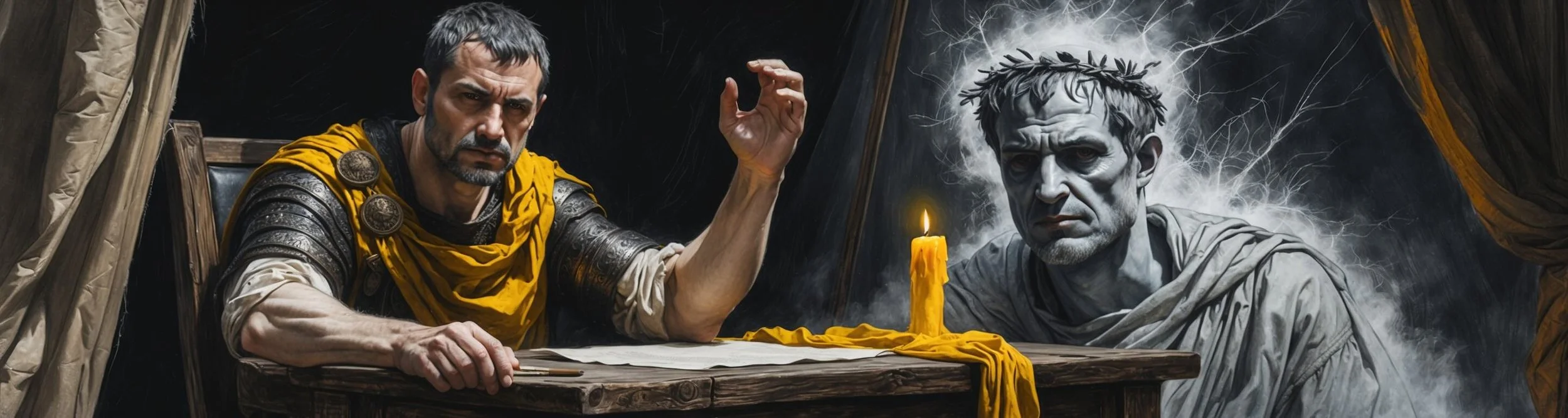
Scene Profile – At a Glance
- Location: Inside Brutus's tent, in the camp near Sardis.
- What Happens: Brutus and Cassius have a furious quarrel, then reconcile. Brutus reveals that his wife Portia is dead. They argue over strategy before agreeing to march to Philippi, and that night Brutus is visited by the Ghost of Caesar.
- Key Characters: Brutus, Cassius, Messala, Lucius, and the Ghost of Caesar.
- Dramatic Function: It tests and repairs the central friendship, delivers the news of Portia's death, settles the fatal decision to march to Philippi, and foreshadows defeat through the Ghost.
- Famous Quote:
There is a tide in the affairs of men,
Which, taken at the flood, leads on to fortune;...
(Brutus, Act 4, Scene 3) - Why It Matters: The quarrel, the grief and the Ghost together turn the play towards its tragic end, and the choice to march to Philippi seals the conspirators' fate.
Scene Summary
Inside the tent, Brutus and Cassius finally have it out. Cassius accuses Brutus of unfairly punishing a man he had spoken up for; Brutus hits back, accusing Cassius of corruption – of having "an itching palm" and selling offices for gold. The argument escalates into threats and insults, with Cassius eventually baring his chest and inviting Brutus to kill him. The storm passes as quickly as it came, and the two men shake hands and make peace.
Brutus then explains why he has been so on edge: his wife Portia is dead, having taken her own life in his absence. A poet bursts in to urge the generals to stop fighting, and is sent away. Over wine, Brutus, Cassius and Messala turn to strategy. Cassius wants to wait for the enemy; Brutus insists they march to Philippi to meet Octavius and Antony, and his view prevails.
As night falls, the others leave and Brutus prepares to rest. He kindly lets his servant boy Lucius fall asleep over his lute, and settles down to read. Suddenly the Ghost of Caesar appears, naming itself Brutus's "evil spirit" and promising to meet him at Philippi before vanishing. Shaken, Brutus wakes his men, finds none of them saw anything, and sends word to Cassius to move his army ahead at dawn.
The Quarrel: "An Itching Palm"
The famous quarrel begins over what looks like a small matter of military discipline but quickly cuts to the heart of who these men are. Cassius is angry that Brutus condemned an officer for taking bribes, ignoring Cassius's letters of support. Brutus turns the charge around, accusing Cassius himself of corruption.
Original
Let me tell you, Cassius, you yourself
Are much condemned to have an itching palm;
To sell and mart your offices for gold
To undeservers.
(Brutus, Act 4, Scene 3)
Shakespeare Retold (Modern Verse)
Now let me tell you, Cassius, you yourself
Are often criticised for taking kickbacks,
For selling access to your seat of power
To those who don’t deserve it.
An "itching palm" is a hand greedy for money – the image of a corrupt official who cannot keep his fingers still around gold. The accusation cuts deep because it strikes at the very justification for killing Caesar. Brutus reminds Cassius that they shed Caesar's blood "for justice' sake"; if they now sully their hands with bribes, the whole noble pretext collapses. For Brutus, honour is everything, and the quarrel is really a clash between his rigid idealism and Cassius's more pragmatic, compromised conduct of a war that has to be paid for somehow.
The Reconciliation
The argument rises to a terrible pitch – Cassius, wounded beyond bearing, bares his chest and offers Brutus his dagger, daring his friend to strike him down as he struck Caesar. The gesture breaks the fever. Brutus refuses, and the anger collapses into something gentler, with Brutus comparing his own temper to a flint that sparks and then goes cold.
Original
O Cassius, you are yoked with a lamb
That carries anger as the flint bears fire;
Who, much enforced, shows a hasty spark,
And straight is cold again.
(Brutus, Act 4, Scene 3)
Shakespeare Retold (Modern Verse)
Oh Cassius, you’re encumbered to a lamb
That’s full of anger, as a flint sparks fire,
Which, when it’s struck, kicks off a rapid spark
But then goes cold again.
The image is touching and exact: Brutus calls himself a "lamb", gentle by nature, whose anger is like the spark struck from a flint – sudden, fierce, and quickly spent. The reconciliation matters because it shows the genuine love beneath the friction. These are not enemies but friends whose nerves are frayed by grief and war. Cassius's relief is heartfelt, and the handshake that follows restores the bond the previous scene showed cooling. Yet the speed of the swing, from death-threats to tenderness, also hints at how brittle they have both become.
Portia's Death
Only now does the true cause of Brutus's irritability emerge. When Cassius reproaches him for his earlier coldness, Brutus reveals the grief he has been carrying.
Original
No man bears sorrow better. Portia is dead.
(Brutus, Act 4, Scene 3)
Shakespeare Retold (Modern Verse)
No man bears sorrow better. Portia is dead.
The bare, flat statement is devastating precisely because it withholds emotion. Portia, Brutus's wife, has killed herself in his absence by swallowing fire, unable to bear his absence and the growing power of Octavius and Antony. Brutus reports it almost without inflection, and James keeps the line word-for-word identical to Shakespeare, because no modernising could improve on its terrible plainness. The moment reveals the private cost of Brutus's public choices: his devotion to Rome has cost him his marriage and his wife's life, and his stoic refusal to weep is both admirable and a little chilling.
"There Is a Tide": The March to Philippi
With grief set aside, the leaders turn to strategy, and here the play's fate is decided. Cassius, the experienced soldier, argues they should let the enemy come to them and wear themselves out. Brutus overrules him, insisting they march to meet Octavius and Antony at Philippi.
Original
There is a tide in the affairs of men,
Which, taken at the flood, leads on to fortune;
Omitted, all the voyage of their life
Is bound in shallows and in miseries.
(Brutus, Act 4, Scene 3)
Shakespeare Retold (Modern Verse)
The strength of men can ebb and flow, like tides do,
And they succeed if, at high tide, they act;
But, if they don’t, they’ll journey through their life
Stuck in the mud of low tide, in despair.
This is one of the most quoted speeches in all of Shakespeare. Brutus argues that there are moments in life when fortune is at the "flood", and a person must seize the chance or be left stranded in "shallows and miseries" forever. The argument is stirring and persuasive – and tragically wrong. Cassius's caution was the better military judgement, and by overruling him Brutus marches them both to defeat. The bitter irony is that the most inspiring statement of seizing the moment in the play leads directly to disaster: Brutus's confidence in his own reasoning, the same quality that let Cassius recruit him, here destroys them.
Language and Technique
- The "itching palm": A vivid image of greed – a hand that itches for money – turns an abstract charge of corruption into something physical and contemptible.
- Tide and sea imagery: Brutus's "tide in the affairs of men" makes opportunity feel like a force of nature that must be caught before it ebbs.
- Understatement: "Portia is dead" lands so hard because it refuses to dramatise grief – the plainness is the power.
- The Ghost: The supernatural visitor brings the play's questions of fate and conscience on stage in a single eerie figure, naming itself Brutus's "evil spirit".
- Quiet domestic detail: Brutus's gentleness with the sleepy boy Lucius softens him just before the Ghost, deepening the sense of a good man facing his doom.
Key Quotes from Act 4, Scene 3
Quote 1I had rather coin my heart,
And drop my blood for drachmas, than to wring
From the hard hands of peasants their vile trash
By any indirection:...
(Brutus, Act 4, Scene 3)
Shakespeare Retold (Modern Verse)
I would rather sell my heart
And spill my blood for coins instead of stealing
The little those hard-working peasants have
By those deceptive means.
For I am armed so strong in honesty
That they pass by me as the idle wind,
Which I respect not.
(Brutus, Act 4, Scene 3)
Shakespeare Retold (Modern Verse)
For I’m so sure of my integrity,
That threats you make just blow past on the wind
And I ignore them.
When Caesar lived, he durst not thus have moved me.
(Cassius, Act 4, Scene 3)
Shakespeare Retold (Modern Verse)
When Caesar lived, he wouldn’t dare to tempt me.
Why, farewell, Portia. We must die, Messala:
With meditating that she must die once,
I have the patience to endure it now.
(Brutus, Act 4, Scene 3)
Shakespeare Retold (Modern Verse)
Well, goodbye Portia. All of us will die.
Because I pondered that one day she’d die,
I have the fortitude to bear it now.
How ill this taper burns! Ha! Who comes here?
I think it is the weakness of mine eyes
That shapes this monstrous apparition.
(Brutus, Act 4, Scene 3)
Shakespeare Retold (Modern Verse)
This candle burns so poorly. Wait, who’s coming?
I think my eyes are failing me right now
By showing me this monstrous apparition.
Why, I will see thee at Philippi, then.
(Brutus, Act 4, Scene 3)
Shakespeare Retold (Modern Verse)
Well, I’ll see you at Philippi again, then.
Key Takeaways
- The quarrel exposes both men: Brutus's rigid honour clashes with Cassius's practicality, and the argument cuts to the heart of why they killed Caesar.
- Love survives the storm: The swift reconciliation shows real affection beneath the friction, but also how strained both men have become.
- Portia's death is the hidden cause: Brutus's irritability springs from a private grief he reveals only late, showing the personal cost of his public choices.
- Brutus's fatal decision: By insisting on marching to Philippi against Cassius's advice, Brutus seals their defeat.
- The Ghost foreshadows doom: Caesar's spirit names itself Brutus's "evil spirit" and promises Philippi, turning the play firmly towards its tragic end.
Study Questions and Analysis
What is the quarrel between Brutus and Cassius really about?
On the surface, the argument is about money and discipline: Cassius is angry that Brutus punished an officer he had defended, and Brutus accuses Cassius of corruption and of refusing to send him gold. But underneath these grievances lies a deeper clash of character. Brutus is an idealist who believes the cause must stay morally pure; Cassius is a pragmatist who knows wars are won with money raised by whatever means come to hand.
The quarrel keeps circling back to Caesar's murder, because that is what binds and divides them. Brutus insists they killed Caesar "for justice' sake", and cannot bear the thought that their hands are now dirtied by bribes. For him the assassination only makes sense if the conspirators remain spotless; for Cassius, survival comes first. The argument is really these two visions of their shared crime colliding, and the strain of grief and war pushes both men past their limits.
Why does the reconciliation happen so quickly?
The speed of the swing from death-threats to embraces is striking, and it tells us how deep the bond between the two men really runs. Cassius's gesture of baring his breast and offering Brutus his dagger is the turning point: it forces both men to confront how much they would lose. Brutus cannot strike, and the anger drains out of them both at once.
Brutus explains his own part in the row with an unusually gentle self-portrait, calling himself a lamb whose anger sparks and dies like fire from a flint. The reconciliation is genuine, but its very speed is part of the tragedy. These are men worn thin by grief, guilt and the pressure of a losing war, and their emotions have become volatile. The same brittleness that let the quarrel flare so fiercely lets it collapse just as fast, and the friendship they restore here is the last good thing they share before Philippi destroys them both.
How does Brutus react to the news of Portia's death?
Brutus reacts with extraordinary restraint. He announces Portia's death in a single flat line, and when Messala later breaks the news as though for the first time, Brutus answers with Stoic philosophy: since everyone must die, he has the patience to endure it. There are no tears, no outburst – only reasoned acceptance.
Readers have long divided over what this control means. To some it is the height of Roman virtue, a man mastering unbearable grief through philosophy. To others it is disturbingly cold, even inhuman. The puzzle is sharpened by a textual oddity: Brutus tells Cassius privately that Portia is dead, then appears to hear the news afresh from Messala. Some editors think Shakespeare wrote two versions and never cut one; others argue the double telling is deliberate, letting us see Brutus grieve once in private and then perform his composure in public. Either way, the scene leaves us weighing admiration against unease.
Why does Brutus insist on marching to Philippi?
Cassius, the more experienced soldier, wants to stay put and let the enemy exhaust themselves marching to find them. Brutus disagrees, arguing that the people between the armies are unwilling allies who may join the enemy, and that their own forces are at their peak and can only decline. He frames the decision in his famous image of the tide.
On such a full sea are we now afloat;
And we must take the current when it serves,
Or lose our ventures.
(Brutus, Act 4, Scene 3)
Shakespeare Retold (Modern Verse)
And we now find ourselves floating at high tide
And so we have to act when timing’s right
Or lose the fight.
The argument is eloquent, but it is also the fatal mistake of the play. Cassius's caution was the sounder strategy, and by overruling him Brutus leads them to defeat. The deep irony is that Brutus's confidence in his own judgement – the very quality Cassius admired and exploited when recruiting him – is what destroys them. As so often in the play, Brutus does the wrong thing for high-minded reasons, and his moral authority over Cassius proves to be a curse rather than a blessing.
What is the significance of Caesar's Ghost?
The Ghost is the play's most direct touch of the supernatural, and its meaning is deliberately uncertain. It appears as Brutus sits alone at night, names itself his "evil spirit", and promises to meet him at Philippi before vanishing.
Thy evil spirit, Brutus.
(Ghost, Act 4, Scene 3)
Shakespeare Retold (Modern Verse)
Your evil spirit, Brutus.
It can be read in several ways at once. As an omen, it foretells Brutus's death at Philippi, where it duly reappears. As a sign of guilt, it suggests that the murdered Caesar still haunts the conscience of the man who killed him. And it may be wholly internal – the Ghost calls itself Brutus's spirit, and none of his sleeping men see it, hinting it could be the projection of a guilty, exhausted mind. M. W. MacCallum, in Shakespeare's Roman Plays and Their Background (1910), stressed how Caesar's power grows after his death, his spirit dominating the second half of the play more completely than the living man ever did. The Ghost makes that idea visible: Caesar, though dead, is still shaping events and drawing his killers towards their end.
Why does Shakespeare include the scene with the poet?
Just after the reconciliation, a poet forces his way into the tent, urging the generals to stop quarrelling because he is old and wise enough to advise them. He is brushed off with irritation and sent away. The episode is brief and comic, and easy to overlook, but it serves real purposes.
Love, and be friends, as two such men should be;
For I have seen more years, I'm sure, than ye.
(Poet, Act 4, Scene 3)
Shakespeare Retold (Modern Verse)
Two men like you should always be good friends;
I’m older, and this old man comprehends.
First, it releases tension: after the high emotion of the quarrel, grief and reconciliation, the clumsy intruder gives the audience a moment to breathe. Second, his unwanted advice to "love, and be friends" gently mocks the very reconciliation we have just watched, reminding us how fragile it is. And the generals' shared annoyance at him – Cassius defending the man, Brutus dismissing him – quietly seals their renewed friendship by uniting them against an outsider. It is a small scene doing several jobs at once.
How is Brutus's character revealed in his treatment of Lucius?
In the quiet stretch before the Ghost appears, Brutus shows a tenderness we have not seen in the political scenes. He asks his young servant Lucius to play music, then, seeing the boy is exhausted, will not wake him to take back the instrument, and gently covers for his tiredness rather than scolding him.
This domestic gentleness is carefully placed. It humanises Brutus at the very moment the play is about to confront him with the supernatural and, beyond that, with defeat and death. By showing his kindness to a sleepy boy, Shakespeare reminds us that Brutus is, at heart, a good and gentle man, which makes his tragedy more painful: this is not a villain but a decent person undone by his own high principles. The contrast between the loving master here and the man who helped stab Caesar deepens the play's central question of how a good man can do a terrible thing.
Why is the quarrel scene considered one of the play's finest?
Critics have long admired this scene as a masterpiece of dramatic construction and feeling. It moves through a complete emotional arc – rage, threat, reconciliation, grief, then strategy and the supernatural – without ever feeling forced, and it deepens both central characters far beyond their public roles as conspirators.
Harley Granville-Barker, in his Prefaces to Shakespeare (1947), praised the quarrel as a study in how two very different temperaments collide and then recover, the dramatist letting the argument run its full natural course before the tenderness breaks through. What makes it great is partly that the stakes are personal rather than political: for once these men are not performing for a crowd but speaking as friends, and we see the human beings beneath the historical figures. The scene also turns the play decisively towards tragedy, gathering the quarrel, Portia's death, the fatal decision and the Ghost into a single movement that points straight at Philippi. It is the emotional heart of the second half, and one of the most psychologically rich passages Shakespeare ever wrote for two men alone on stage.