Julius Caesar: Act 5, Scene 1 – Analysis
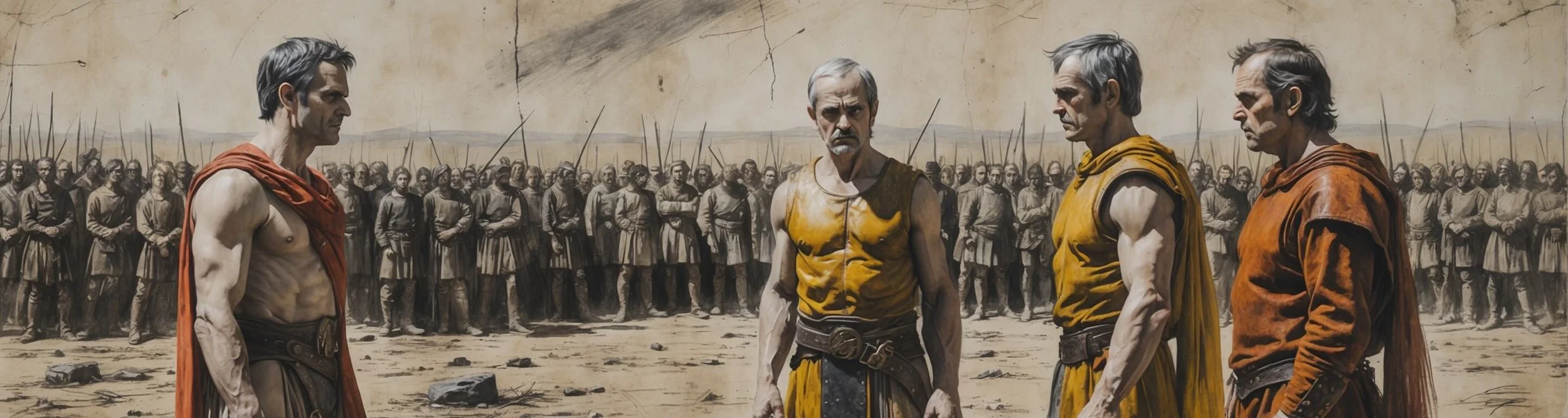
Scene Profile – At a Glance
- Location: The plains of Philippi, before the battle.
- What Happens: The two armies meet. Octavius and Antony trade bitter insults with Brutus and Cassius at a parley. It is Cassius's birthday, and bad omens have shaken his old scepticism. He and Brutus say a solemn farewell in case they never meet again.
- Key Characters: Brutus, Cassius, Mark Antony, and Octavius.
- Dramatic Function: The last calm before the battle that ends the play. It sets the two sides against each other and prepares us for the deaths to come.
- Famous Quote:
"For ever, and for ever, farewell, Cassius!"
(Brutus, Act 5, Scene 1) - Why It Matters: Cassius's change of heart about omens, and the farewell with Brutus, cast a shadow of doom over the battle before a single blow is struck.
Scene Summary
On the plains of Philippi, Octavius and Antony learn that the enemy has come down to meet them rather than holding the hills. Antony is confident he understands the conspirators' minds. A messenger announces that Brutus and Cassius are advancing in battle order, and the two commanders briefly argue over which wing each will take.
When Brutus and Cassius arrive, both sides agree to talk before they fight. The parley quickly turns sour. Antony accuses the conspirators of fine words hiding foul deeds, reminding them how they grinned and bowed before stabbing Caesar. Cassius reminds Brutus that, had he had his way, Antony would not be alive to insult them now. Octavius draws his sword and swears not to sheathe it until Caesar's wounds are avenged. The leaders part with threats ringing.
Left alone with their officers, Cassius confides in Messala that it is his birthday, and that he has lost his old faith in the philosophy of Epicurus. Ominous birds – ravens and crows in place of eagles – now seem to him a sign of defeat. Brutus and Cassius then turn to each other and discuss what they will do if the battle is lost. Brutus rejects suicide on principle, yet refuses to be led in chains through Rome. Sensing this may be the end, the two old friends say a moving, final farewell, and march off to fight.
Words Before Blows
The scene opens with a war of words. When the armies meet, both sides choose to parley first, and Antony seizes the chance to throw the murder back in the conspirators' faces. He paints a vivid, contemptuous picture of the assassination: men who flattered and fawned over Caesar even as they readied their daggers.
Original
You showed your teeth like apes, and fawned like hounds,
And bowed like bondmen, kissing Caesar's feet;
Whilst damned Casca, like a cur, behind
Struck Caesar on the neck. O you flatterers!
(Antony, Act 5, Scene 1)
Shakespeare Retold (Modern Verse)
You grinned like apes and fawned like dogs and hounds,
Bowing like servants, kissing Caesar's feet,
Whilst that damn Casca, like a mutt, behind
Stabbed Caesar through the neck. You flatterers!
Antony's anger is genuine, but it is also tactical. By recalling the false smiles that preceded the stabbing, he reframes the noble "liberators" as treacherous flatterers. The exchange also lets Cassius land a quiet, bitter truth: he reminds Brutus that this whole confrontation could have been avoided. Had Brutus listened and let Cassius kill Antony alongside Caesar, there would be no Antony here to taunt them now. The mistakes of Act 2 echo in every insult.
Cassius Changes His Mind
Once the enemy has gone, the mood shifts from public bluster to private foreboding. Cassius takes Messala aside and admits something remarkable for him: he no longer trusts the calm, rational philosophy he has lived by. He has always been an Epicurean, a man who dismissed omens and signs – and now he finds himself reading the sky for warnings.
Original
You know that I held Epicurus strong
And his opinion: now I change my mind,
And partly credit things that do presage.
(Cassius, Act 5, Scene 1)
Shakespeare Retold (Modern Verse)
You know I like the teachings of Epicurus
And his opinions. Now I've changed my mind
And pay attention more to warning signs.
This is a telling moment of character. The sharp, sceptical Cassius of Act 1, who mocked the idea that the stars rule men, is gone; in his place is a tired man who watches eagles abandon his army and ravens gather overhead, and reads his own death in them. His loss of nerve matters dramatically, because Cassius has been the engine of the conspiracy from the start. When its sharpest mind begins to expect defeat, the cause already feels lost.
The Final Farewell
The scene's heart is the parting of the two friends. Knowing the battle may destroy them, Brutus and Cassius coolly discuss the worst. Brutus, true to his principles, says he thinks suicide cowardly – yet in the same breath swears he will never be dragged through Rome as a captive. Aware that this conversation may be their last, the two men say goodbye.
Original
For ever, and for ever, farewell, Cassius!
If we do meet again, why, we shall smile;
If not, why then, this parting was well made.
(Brutus, Act 5, Scene 1)
Shakespeare Retold (Modern Verse)
Forever and forever goodbye, Cassius.
If we do meet again, then we will smile;
If not, well then we've said a fond farewell.
After a play full of suspicion and political calculation, this is a moment of pure human warmth. The repeated "for ever, and for ever" has the rhythm of a funeral bell, and both men echo each other's words almost exactly, as though rehearsing a ritual. The friendship that survived the bitter quarrel of Act 4 is sealed here, just before death separates them. It is one of the most tender exchanges in the play, and its tenderness is precisely what makes the coming slaughter so painful.
Language and Technique
- Bee imagery: Cassius mocks Antony's "honeyed words" as robbing the bees of Hybla, then turns the image to a sting – sweet talk that hides a threat.
- Animal insults: The conspirators are "apes", "hounds", and a "cur" – Antony uses grovelling animals to strip the murderers of their dignity.
- Bird omens: Eagles give way to ravens, crows, and kites – scavengers whose shadows form a "canopy most fatal" over the doomed army.
- Repetition: "For ever, and for ever, farewell" repeats to slow the moment down and lend the parting the weight of finality.
- Dramatic irony: The friends say goodbye "in case" they do not meet again; the audience knows they will not.
Key Quotes from Act 5, Scene 1
Quote 1In your bad strokes, Brutus, you give good words:
Witness the hole you made in Caesar's heart,
Crying 'Long live! hail, Caesar!'
(Antony, Act 5, Scene 1)
Shakespeare Retold (Modern Verse)
You perfume your bad actions with sweet words.
Witness the hole you made in Caesar's heart,
Declaring, 'Long live Caesar!'
Now, Brutus, thank yourself:
This tongue had not offended so to-day,
If Cassius might have ruled.
(Cassius, Act 5, Scene 1)
Shakespeare Retold (Modern Verse)
This is your fault now, Brutus!
This man could not offend us here today
If I had got my way.
This morning are they fled away and gone;
And in their steads do ravens, crows and kites,
Fly o'er our heads and downward look on us,
As we were sickly prey:...
(Cassius, Act 5, Scene 1)
Shakespeare Retold (Modern Verse)
This morning they'd all flown away and left us,
And in their place were ravens, crows and kites,
All flying overhead, observing us,
Like we were wounded prey....
For ever, and for ever, farewell, Brutus!
If we do meet again, we'll smile indeed;
If not, 'tis true this parting was well made.
(Cassius, Act 5, Scene 1)
Shakespeare Retold (Modern Verse)
Forever and forever goodbye, Brutus.
If we do meet again, we'll smile indeed;
If not, it's true: this was a fond farewell.
Key Takeaways
- The last calm before battle: This scene sets the two armies against each other at Philippi, where the play will end.
- Old mistakes return: Cassius reminds Brutus that sparing Antony was a fatal error – and now Antony stands before them, triumphant.
- Cassius loses his nerve: The sceptic who once mocked omens now reads defeat in the birds overhead.
- Friendship endures: Brutus and Cassius part with a tender, formal farewell that survives all their earlier quarrels.
- Doom is foreshadowed: The omens and the goodbye tell the audience the battle is lost before it begins.
Study Questions and Analysis
Why does the scene begin with a war of words rather than fighting?
The parley before the battle is a deliberate piece of staging. Shakespeare lets the four leaders confront each other face to face one last time, turning a military encounter into a moral argument about the assassination. Antony accuses the conspirators of hiding murder behind noble words; Cassius and Brutus defend themselves; Octavius vows revenge. The audience hears the case for and against the killing rehearsed once more before the swords decide it.
The exchange also sharpens the contrast between the two camps. The Caesarians are united and aggressive, while the conspirators are already on the back foot, defending a deed done years before. By having them quarrel in words first, Shakespeare reminds us that this war is the direct consequence of Act 3 – the daggers in the Capitol have led, by a straight line, to two armies on a plain.
What does Cassius's quarrel with Brutus about Antony reveal?
Cassius's bitter aside – that Antony would not be insulting them now "if Cassius might have ruled" – reopens the conspiracy's founding mistake. In Act 2, Cassius argued that Antony should die with Caesar; Brutus refused, wanting the killing to look like a noble sacrifice rather than a slaughter.
Now, Brutus, thank yourself:
This tongue had not offended so to-day,
If Cassius might have ruled.
(Cassius, Act 5, Scene 1)
Shakespeare Retold (Modern Verse)
This is your fault now, Brutus!
This man could not offend us here today
If I had got my way.
The line crystallises a pattern that runs through the tragedy: Brutus's idealism repeatedly overrules Cassius's harder political sense, and each time the result is disaster. Sparing Antony, allowing him to speak at the funeral, choosing to march to Philippi rather than wait – Brutus wins every argument and loses the war. Many readers see in this the play's quiet verdict on high principle in politics: that Brutus's nobility, untempered by realism, is exactly what destroys his cause.
Why is Cassius's change of mind about omens so significant?
Cassius has been the play's voice of cool rationalism. In Act 1 he insisted that "the fault, dear Brutus, is not in our stars, / But in ourselves" – men make their own fates, and signs in the heavens mean nothing. As an Epicurean he held that the gods do not meddle in human affairs. So his admission here, that he now "partly credit things that do presage", marks a profound reversal.
You know that I held Epicurus strong
And his opinion: now I change my mind,
And partly credit things that do presage.
(Cassius, Act 5, Scene 1)
Shakespeare Retold (Modern Verse)
You know I like the teachings of Epicurus
And his opinions. Now I've changed my mind
And pay attention more to warning signs.
The reversal feeds the play's unresolved debate between fate and free will. The earlier Cassius argued for human responsibility; the dying Cassius reads doom in the sky. Shakespeare never tells us which Cassius is right – the omens do seem to come true, yet the defeat can equally be traced to ordinary human blunders. By having his great rationalist crack at the end, Shakespeare leaves the question open: are these men destroyed by destiny, or by themselves?
How does the farewell between Brutus and Cassius affect the audience?
The farewell is one of the most emotionally charged moments in the play, and its power comes partly from contrast. We have watched these two men manipulate, quarrel, and accuse each other; now, facing death, they speak with simple tenderness. The near-identical wording, each echoing the other, makes their long friendship audible.
For ever, and for ever, farewell, Cassius!
If we do meet again, why, we shall smile;
If not, why then, this parting was well made.
(Brutus, Act 5, Scene 1)
Shakespeare Retold (Modern Verse)
Forever and forever goodbye, Cassius.
If we do meet again, then we will smile;
If not, well then we've said a fond farewell.
Dramatic irony deepens the effect. The men hedge their goodbye – "if we do meet again" – but the audience knows they will not, and that both will die within hours. The repeated "for ever, and for ever" tolls like a bell. Shakespeare is preparing us for the double tragedy of the next scenes, and ensuring that when Cassius and Brutus fall, we feel the loss not of two political schemers but of two friends who loved each other to the end.
What is the significance of it being Cassius's birthday?
Cassius's casual mention that "this is my birth-day" carries a heavy weight of irony, which Shakespeare draws out in the next scene when Cassius dies on the very day he was born. The neat circularity – "where I did begin, there shall I end" – gives his death a shape of fate, as though his whole life has run its appointed course.
It also colours the farewell. A birthday is normally a marker of life and continuation; here it becomes a memento mori, a reminder of mortality. Coming alongside his loss of faith in Epicurean philosophy and his reading of the death-omens, the detail builds a sense that Cassius half-expects to die. Shakespeare gathers several small touches – the birthday, the birds, the abandoned philosophy – to wrap the practical, sceptical Cassius in an atmosphere of doom he can no longer argue away.
What does Brutus's view on suicide tell us about his character?
When Cassius asks what Brutus will do if they lose, Brutus gives a revealing, self-contradictory answer. On principle, he says, he once blamed Cato for killing himself and thinks such a death "cowardly and vile"; a man should bear what the gods send with patience. Yet in almost the same breath he swears he will never be led "bound to Rome" as a prisoner.
No, Cassius, no: think not, thou noble Roman,
That ever Brutus will go bound to Rome;
He bears too great a mind....
(Brutus, Act 5, Scene 1)
Shakespeare Retold (Modern Verse)
No, Cassius, no. Don't think, you noble Roman,
That Brutus ever would be chained in Rome.
I am too smart for that....
The contradiction is characteristic of Brutus, whose principles never quite fit the world he has to act in. He condemns suicide as a philosopher, then commits it as a Roman aristocrat who cannot endure disgrace. M. W. MacCallum, in Shakespeare's Roman Plays and Their Background (1910), saw Brutus as a man whose Stoic ideals are always in tension with his Roman pride. The contradiction is not carelessness on Shakespeare's part; it is the very texture of a character whose high-minded reasoning keeps colliding with the hard choices of politics and war.
How does this scene prepare for the end of the play?
Almost everything in the scene is shaped to make the coming defeat feel inevitable. The omens, Cassius's loss of nerve, the birthday, the farewell – each adds to a gathering sense of doom. By the time the armies march off, the audience expects catastrophe, and the scene's job is to make that expectation feel earned rather than merely announced.
It also resets the play's emotional centre. With Caesar dead, the tragedy in its final act becomes the tragedy of Brutus and Cassius, and this scene draws our sympathy back to them. We are reminded of their friendship, their courage, and their flaws just before they are tested to destruction. When Cassius dies in the next scene and Brutus in the last, the groundwork laid here ensures their falls land with full tragic weight.