Julius Caesar: Act 5, Scene 2 – Analysis
Scene Profile – At a Glance
- Location: The field of battle at Philippi, during the fighting.
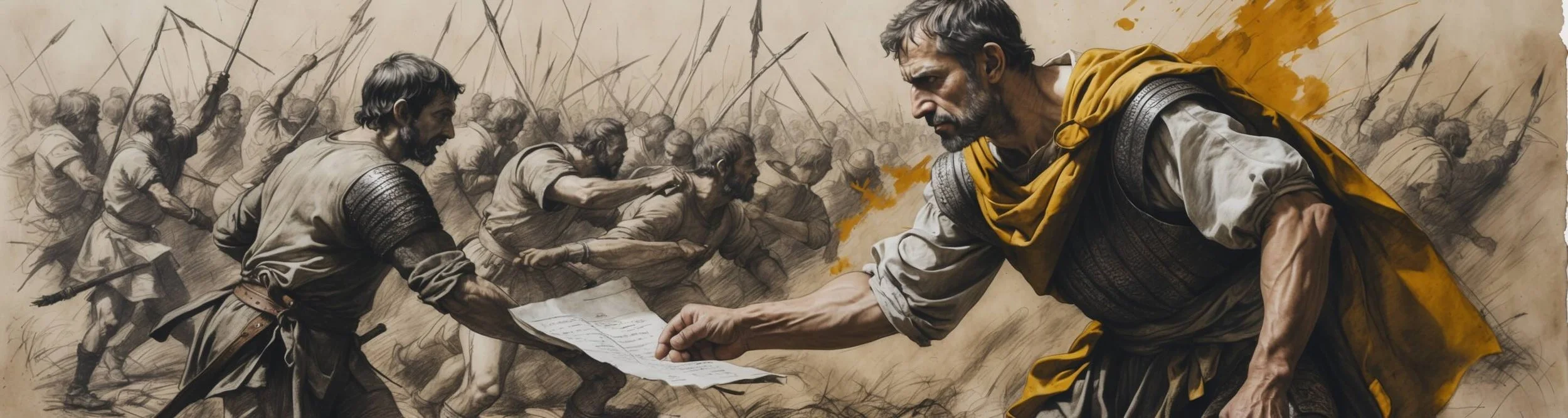
- What Happens: In the heat of the battle, Brutus sends Messala with urgent orders to attack Octavius's wing at once, having spotted a weakness there.
- Key Characters: Brutus and Messala.
- Dramatic Function: A brief, fast command scene that launches the battle and sets up the fatal confusion of the next.
- Famous Quote:
"Ride, ride, Messala, ride, and give these bills..."
(Brutus, Act 5, Scene 2) - Why It Matters: Brutus's early success against Octavius is exactly what goes wrong: his eager attack will leave Cassius's wing exposed and lead to disaster.
Scene Summary
The battle has begun. Brutus rushes in with Messala and gives him orders to carry to the legions on the other side of the field. Sensing that Octavius's soldiers look unready, Brutus urges an immediate, all-out attack and sends Messala galloping off to deliver the command.
Seize the Moment
This is the shortest scene in the play – barely a handful of lines – and its whole force is in its speed. Brutus has spotted a chance: Octavius's wing looks cold and hesitant, and he wants to strike before the moment passes. The scene is pure command, the language clipped and breathless to match the urgency of battle.
Original
Ride, ride, Messala, ride, and give these bills
Unto the legions on the other side.
(Brutus, Act 5, Scene 2)
Shakespeare Retold (Modern Verse)
Ride, ride, Messala, ride, and give these orders
To all our soldiers on the other side!
The repeated "ride, ride" captures a man acting on instinct in the chaos of war. But the scene carries a sting the audience will only feel in the next one: Brutus's eagerness is a mistake. By throwing his whole force forward to exploit Octavius's weakness, he leaves Cassius's wing unsupported and exposed to Antony. The very decisiveness that looks like good generalship here is what dooms his ally. In a play obsessed with timing and misjudgement, Brutus once again acts too soon.
Language and Technique
- Repetition: "Ride, ride, Messala, ride" repeats the command to convey breathless urgency and a mind racing in the heat of battle.
- Imperatives: The whole scene is orders – "ride", "give", "let them set on", "let them all come down" – the verb-led grammar of command under pressure.
- Dramatic irony: Brutus's confident attack reads as good sense, but the audience soon learns it is the blunder that exposes Cassius.
Key Quotes from Act 5, Scene 2
Quote 1Let them set on at once; for I perceive
But cold demeanour in Octavius' wing,
And sudden push gives them the overthrow.
(Brutus, Act 5, Scene 2)
Shakespeare Retold (Modern Verse)
Have them attack at once, for I perceive
Octavius' soldiers lacking readiness,
And, with a sudden strike, we will defeat them.
Ride, ride, Messala: let them all come down.
(Brutus, Act 5, Scene 2)
Shakespeare Retold (Modern Verse)
Ride, ride, Messala! Have them all attack!
Key Takeaways
- The battle begins: This tiny scene launches the fighting at Philippi with a single urgent order.
- Brutus attacks early: Spotting weakness in Octavius's wing, he commits everything to an immediate charge.
- Speed is the keynote: The repeated "ride, ride" and the clipped commands convey the chaos and pace of war.
- A fatal success: Brutus's attack succeeds against Octavius but leaves Cassius exposed to Antony – the seed of the coming disaster.
Study Questions and Analysis
Why is this scene so short?
At roughly six lines, this is the briefest scene in the play, and its brevity is the point. Shakespeare uses it to convey the speed and confusion of battle. Rather than staging a long set-piece of fighting, he gives us a single, breathless snapshot: a commander glimpsing an opening and shouting orders before the moment is lost. The clipped scene mimics the experience of war, where decisions are made in seconds and there is no time for the careful deliberation we have seen elsewhere in the play.
Structurally, the scene also works as a hinge. It launches the battle whose consequences fill the rest of the act, and it plants the cause of the coming catastrophe. By keeping it short and fast, Shakespeare hurries the audience from the foreboding of the previous scene straight into the action, so that Cassius's despairing death in the next scene seems to follow almost without pause.
What does the scene reveal about Brutus as a commander?
The scene shows Brutus as decisive and quick to read a battlefield, but it also reveals the same flaw that has dogged him throughout: he acts on his own judgement, fast and unilaterally, without weighing the wider consequences. He sees a weakness in Octavius's wing and commits everything to exploiting it.
Let them set on at once; for I perceive
But cold demeanour in Octavius' wing,
And sudden push gives them the overthrow.
(Brutus, Act 5, Scene 2)
Shakespeare Retold (Modern Verse)
Have them attack at once, for I perceive
Octavius' soldiers lacking readiness,
And, with a sudden strike, we will defeat them.
The decision is not foolish in itself – Brutus is right that Octavius is vulnerable, and he does overrun that wing. The problem is the pattern. Just as he overruled Cassius on sparing Antony and on letting Antony speak at the funeral, here he acts boldly on his own reading of the situation, and again the result is disaster for his side. The play repeatedly shows Brutus's confidence in his own judgement leading to ruin, and this scene is a swift, military example of it.
How does this scene set up the death of Cassius?
This scene is the direct cause of the tragedy that follows. Brutus's all-out attack on Octavius succeeds, but in throwing his whole force forward he loses contact with Cassius's wing, which Antony then surrounds and overwhelms. The very order we hear shouted here – "let them all come down" – is what leaves Cassius exposed.
In the next scene, Cassius, cut off and watching his camp burn, wrongly believes the battle is entirely lost and that his friend Titinius has been captured. In despair he has himself killed. The dramatic irony is sharp: at the very moment Cassius gives up, Brutus is winning his part of the field. Cassius dies needlessly, on a misreading, and the chain of events that kills him begins with the eager command given in this short, urgent scene.