Julius Caesar: Act 5, Scene 3 – Analysis
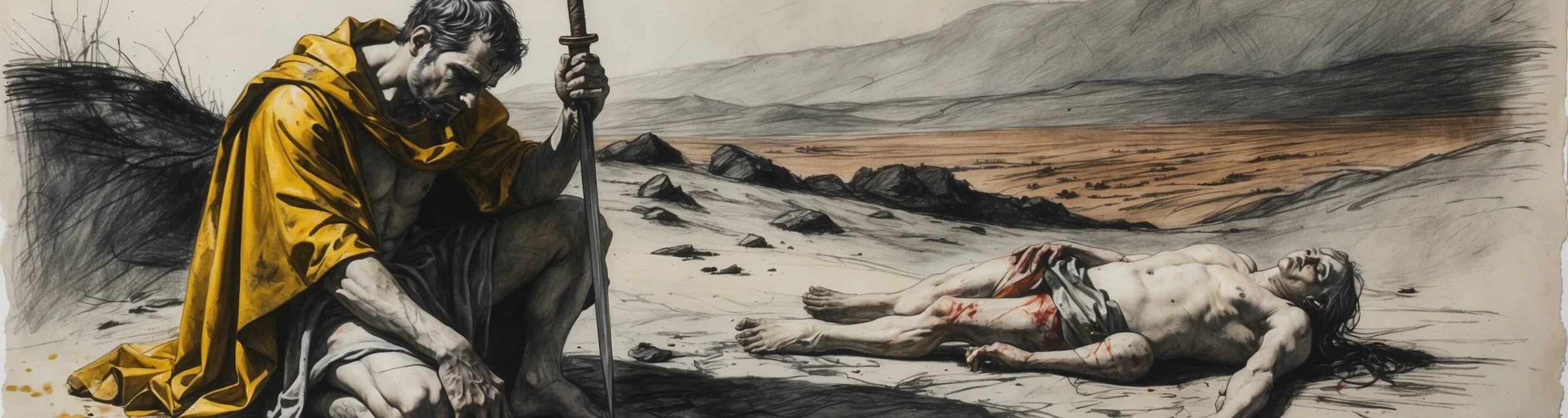
Scene Profile – At a Glance
- Location: Another part of the battlefield at Philippi.
- What Happens: Cassius's wing is failing. He sends Titinius to check whether nearby troops are friends, and his servant Pindarus wrongly reports Titinius captured. In despair, Cassius has Pindarus kill him. Titinius, finding Cassius dead, kills himself too.
- Key Characters: Cassius, Brutus, Titinius, Messala, and Pindarus.
- Dramatic Function: The first of the play's great endgame deaths, caused entirely by a tragic misreading rather than by defeat.
- Famous Quote:
"The sun of Rome is set! Our day is gone;"
(Titinius, Act 5, Scene 3) - Why It Matters: Cassius dies on a mistake, killed by the same sword that killed Caesar – a death soaked in irony that begins the conspiracy's collapse.
Scene Summary
On his part of the field, Cassius sees his own soldiers fleeing and even kills one of his fleeing standard-bearers. Titinius brings worse news: Brutus attacked too early, and while he gained the upper hand over Octavius, Cassius's own forces are now hemmed in by Antony. Pindarus urges Cassius to retreat further.
Cassius, whose eyesight is poor, sends Titinius to ride to a body of troops nearby and find out whether they are friends or enemies, while Pindarus climbs a hill to watch. Pindarus reports that Titinius has been surrounded by horsemen and taken, and that the men are shouting in triumph. Believing his best friend captured and the day lost, Cassius decides to die.
He reminds Pindarus of an old oath and orders him to strike. With the same sword that ran through Caesar, Pindarus kills Cassius, who dies declaring Caesar revenged. Pindarus flees. Moments later Titinius returns, alive and crowned with victory – the troops were friends after all. Finding Cassius dead, Titinius mourns him, lays the garland on his head, and kills himself with Cassius's sword. Brutus arrives, grieves over the two bodies, calls Cassius "the last of all the Romans", and turns to prepare for a second fight.
A Fatal Misreading
The engine of the scene is a mistake. Cassius cannot see well, so he relies on Pindarus to report what is happening on the field. When Titinius rides to the distant troops, Pindarus misinterprets a joyful welcome as a hostile capture, and Cassius believes him.
Original
Titinius is enclosed round about
With horsemen, that make to him on the spur;
Yet he spurs on. Now they are almost on him.
(Pindarus, Act 5, Scene 3)
Shakespeare Retold (Modern Verse)
Titinius is surrounded totally
By mounted horsemen charging straight at him,
But he is charging back. They're almost on him.
The horsemen are friends, riding to greet Titinius with a victory wreath, and their shouts are cheers of welcome. But filtered through Pindarus's poor vantage and Cassius's despair, every detail reads as catastrophe. The whole tragedy of the scene turns on this gap between what is happening and what Cassius believes is happening. He has lost his nerve already – the omens of the previous scene have prepared him to expect the worst – and so he accepts the false report without question. A man who once trusted only reason now dies because he could not see clearly and would not wait to be sure.
Killed by Caesar's Sword
Convinced that all is lost and that he has watched his best friend taken before his eyes, Cassius resolves to die. He calls Pindarus, reminds him of an oath sworn long ago, and frees him in exchange for one last service: to hold the sword while Cassius runs onto it.
Original
Now be a freeman: and with this good sword,
That ran through Caesar's bowels, search this bosom.
(Cassius, Act 5, Scene 3)
Shakespeare Retold (Modern Verse)
I grant you now your freedom; with this sword
That I stabbed Caesar with, find where my heart is.
The detail of the sword is everything. Cassius dies by the very weapon he used to kill Caesar, and his last words – "Caesar, thou art revenged, / Even with the sword that killed thee" – name the irony aloud. The play's moral logic closes like a trap: the instrument of the murder becomes the instrument of the murderer's death. It is as if Caesar's spirit, which Brutus will speak of later, is indeed walking the field and turning the conspirators' swords back on themselves. Cassius, the man who began the plot, is the first of its makers to fall to it.
The Last of the Romans
The cruelty of the scene is sealed when Titinius returns alive, only to find Cassius dead on a misunderstanding. Unable to bear it, Titinius crowns the dead man with the victory wreath meant for him and kills himself with the same sword. When Brutus arrives and sees the bodies, his grief turns into the play's great elegy for the old Roman virtues.
Original
The last of all the Romans, fare thee well!
It is impossible that ever Rome
Should breed thy fellow.
(Brutus, Act 5, Scene 3)
Shakespeare Retold (Modern Verse)
The last of all the Romans, fond farewell.
It is impossible that Rome will ever
Breed men as good as you.
Brutus speaks of Cassius as the end of a breed – the last true Roman of the old republican stamp. The grief is genuine, but Brutus does not linger; he sends the body away for a private burial so it will not dishearten the living, and immediately turns to fight again. The moment captures the play's elegiac note: the world of the republic is dying with these men, and the future belongs to Octavius and Antony. Even as he mourns, Brutus knows his own end is near, and the scene ends with him marching grimly back into a battle he cannot win.
Language and Technique
- Dramatic irony: The audience knows Titinius is safe and the troops are friends, even as Cassius decides to die believing the opposite.
- Sunset imagery: Cassius's death is figured as the sun setting in red – "the sun of Rome is set" – blood and dusk merging into one image of the day's end.
- Symbolism of the sword: The weapon that killed Caesar kills Cassius, making the murder weapon an agent of poetic justice.
- Circularity: Cassius dies on his birthday, "where I did begin, there shall I end" – his life completing a perfect, fatal circle.
- Elegy: Brutus's "last of all the Romans" lifts the scene from a battlefield death into a lament for a whole vanishing world.
Key Quotes from Act 5, Scene 3
Quote 1This day I breathed first: time is come round,
And where I did begin, there shall I end;
My life is run his compass.
(Cassius, Act 5, Scene 3)
Shakespeare Retold (Modern Verse)
My birthday; I first breathed this day. But now
I'm back to where I started, and will end;
My life has run its course.
Caesar, thou art revenged,
Even with the sword that killed thee.
(Cassius, Act 5, Scene 3)
Shakespeare Retold (Modern Verse)
Caesar, you've got revenge.
And even with the sword that you were killed by.
But Cassius is no more. O setting sun,
As in thy red rays thou dost sink to-night,
So in his red blood Cassius' day is set;
The sun of Rome is set! Our day is gone;
(Titinius, Act 5, Scene 3)
Shakespeare Retold (Modern Verse)
But Cassius is dead. Oh, setting sun,
Just as your sinking rays glow red at dusk,
So with his red blood, Cassius' day is over.
The sun of Rome has set. Our day is done;
O Julius Caesar, thou art mighty yet!
Thy spirit walks abroad and turns our swords
In our own proper entrails.
(Brutus, Act 5, Scene 3)
Shakespeare Retold (Modern Verse)
Oh Julius Caesar, you're remaining strong;
Your spirit walks with us and turns our swords
To slash our stomachs open.
Key Takeaways
- Cassius dies on a mistake: He kills himself believing Titinius captured and the day lost, when in fact the troops were friends.
- The same sword: Cassius dies by the very blade that killed Caesar, sealing the play's sense of poetic justice.
- A double suicide: Titinius, finding Cassius dead, crowns him and kills himself too.
- Caesar's spirit walks: Brutus reads the deaths as Caesar's revenge, turning the conspirators' swords on themselves.
- The republic's last men: Brutus calls Cassius "the last of all the Romans", mourning a vanishing world.
Study Questions and Analysis
Why does Cassius kill himself?
Cassius kills himself because he believes the battle is lost and that his closest friend, Titinius, has been captured before his eyes. Both beliefs are false. His own wing is failing and his camp is on fire, so he sends Titinius to find out whether the nearby troops are friend or foe, with Pindarus watching from a hill. Pindarus misreads a joyful welcome as a hostile capture, and Cassius, unable to see for himself, takes the report as proof that all is lost.
His decision is also prepared by everything that has gone before. The omens of the previous scene, his abandoned Epicurean philosophy, and the sense that it is his birthday and his life has run its circle have all primed him to expect death. He does not test the report or wait for confirmation; he accepts the worst at once. Cassius dies, in the end, not because the battle is lost but because despair and poor sight combine to make him believe it is.
What is the significance of Cassius dying by Caesar's sword?
The detail is one of the play's strongest pieces of poetic justice. Cassius asks Pindarus to kill him with the very sword that "ran through Caesar's bowels", and dies declaring Caesar avenged. The murder weapon becomes the instrument of the murderer's death, so that the killing of Caesar seems to come full circle.
Now be a freeman: and with this good sword,
That ran through Caesar's bowels, search this bosom.
(Cassius, Act 5, Scene 3)
Shakespeare Retold (Modern Verse)
I grant you now your freedom; with this sword
That I stabbed Caesar with, find where my heart is.
The symbolism feeds the play's larger suggestion that Caesar grows more powerful in death than he was in life. Brutus will shortly say that Caesar's spirit "walks abroad" turning their swords against them, and Cassius's death is the first clear sign of it. Whether we read this as literal supernatural revenge or as the natural consequence of the conspirators' choices, the effect is the same: the deed they thought would free Rome destroys them, weapon for weapon.
How does dramatic irony shape this scene?
Dramatic irony is the scene's central device. The audience knows what Cassius cannot: that Titinius is safe, that the shouting troops are friends bringing a victory wreath, and that Brutus has actually beaten Octavius on the other wing. We watch Cassius decide to die on the strength of a report we know to be false, which makes his death agonising rather than merely sad.
The irony deepens when Titinius returns. He arrives alive and crowned with the very garland of victory that, misread from a distance, helped convince Cassius the day was lost. Finding his friend dead on a misunderstanding, Titinius takes his own life. The gap between truth and belief, which the audience can see and the characters cannot, turns a military setback into a needless double tragedy and gives the scene its peculiar, bitter power.
What role does Pindarus play in Cassius's death?
Pindarus is the unwitting cause of the catastrophe and then its reluctant instrument. As Cassius's bondman, he is the eyes Cassius lacks: sent up the hill to watch, he misreads the scene below and reports Titinius captured. His mistake, made in good faith from a poor vantage, sets the suicide in motion.
He is then forced to do the killing himself, in payment of an old oath. Crucially, Pindarus takes no pleasure in his freedom; he says he would rather not have been freed at such a price and flees the country at once, never wanting to be seen by a Roman again. His role underlines the scene's theme of misjudgement: a loyal servant, doing his best, becomes the agent of his master's needless death. Even the smallest figures in this final act are caught in the machinery of error and consequence.
What does Brutus mean by calling Cassius "the last of all the Romans"?
Brutus's elegy treats Cassius not just as a friend but as the end of a type. By "the last of all the Romans" he means the last man of the old republican spirit – the breed of Romans who valued liberty above a single ruler and who would die rather than live as subjects.
The last of all the Romans, fare thee well!
It is impossible that ever Rome
Should breed thy fellow.
(Brutus, Act 5, Scene 3)
Shakespeare Retold (Modern Verse)
The last of all the Romans, fond farewell.
It is impossible that Rome will ever
Breed men as good as you.
The line carries the play's deep streak of nostalgia. With Cassius dead and Brutus soon to follow, the world of the republic is passing, and what comes after is the empire of Octavius. M. W. MacCallum, in Shakespeare's Roman Plays and Their Background (1910), read the play's sympathies as lying with the old Roman virtues even as it shows them failing in practice. Brutus's grief here is partly for Cassius and partly for a whole vanishing ideal – though there is irony too, since the "noblest Roman" title will be transferred to Brutus himself by Antony at the play's close.
How does Cassius's death reflect his character?
Cassius dies as he has lived: quickly, decisively, and on the strength of his own reading of events – which here proves disastrously wrong. The same impulsiveness that made him a dangerous conspirator makes him a hasty suicide. He does not wait, does not check, does not hope; he acts.
His death also completes the arc of his collapsing nerve. The cool rationalist of Act 1, who scorned omens and believed men master their own fates, has by now changed his mind about the heavens and is half-expecting to die. Some readers find his end fitting – the manipulator undone by his own dark imaginings – while others find it deeply pathetic, a brave man destroyed by a misunderstanding he had no chance to correct. Shakespeare allows both responses, giving Cassius a death that is at once ironic, avoidable, and genuinely moving.