Julius Caesar: Act 5, Scene 5 – Analysis
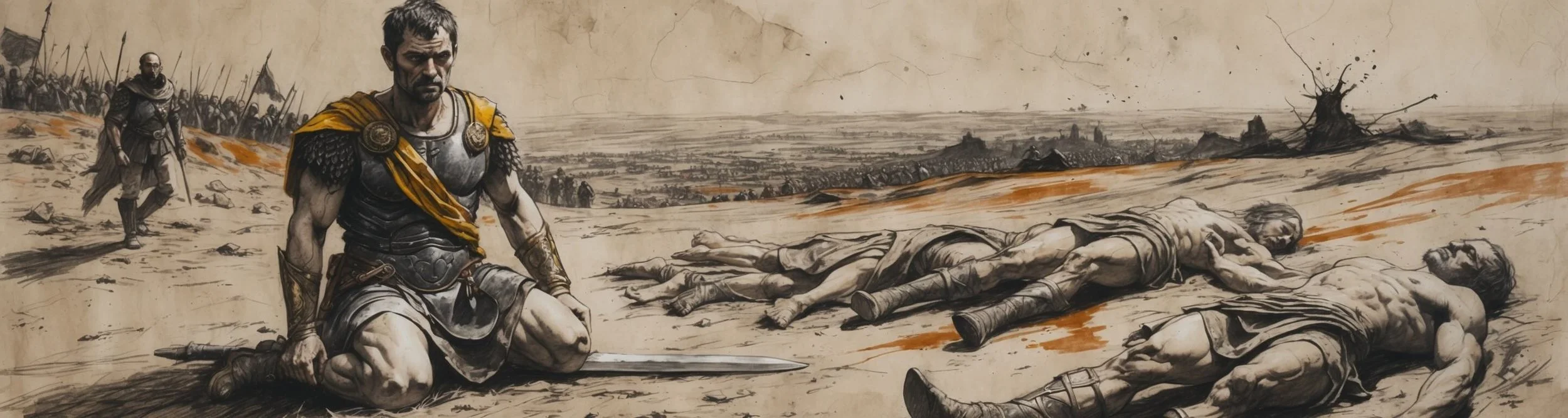
Scene Profile – At a Glance
- Location: Another part of the battlefield at Philippi, near the end of the day.
- What Happens: The battle is lost. Brutus asks several friends in turn to help him die; all refuse. At last Strato holds the sword while Brutus runs onto it. Antony and Octavius arrive, and Antony delivers a famous tribute over Brutus's body before Octavius closes the play.
- Key Characters: Brutus, Mark Antony, Octavius, Strato, and Volumnius.
- Dramatic Function: The play's climax and resolution – the death of its true protagonist and the verdict pronounced over him.
- Famous Quote:
"This was the noblest Roman of them all:"
(Antony, Act 5, Scene 5) - Why It Matters: Brutus's death completes Caesar's revenge, and Antony's tribute settles how we are to remember the man who killed him – as honest, not envious.
Scene Summary
With the battle lost, Brutus rests with the last of his friends. He quietly asks Clitus, then Dardanius, to kill him; both refuse in horror. He confides to Volumnius that the ghost of Caesar has appeared to him twice and that he knows his time has come, then asks Volumnius to hold his sword while he runs onto it. Volumnius also refuses.
As the enemy closes in, Brutus says farewell to his companions, telling them he is glad that in all his life he has found no man untrue to him. He sends them ahead and stays behind with Strato, who finally agrees to hold the sword. Brutus runs onto it, declaring that he killed Caesar with far less willingness than he now kills himself, and dies.
Antony and Octavius arrive to find Brutus dead. Strato explains how his master died. Antony pronounces Brutus "the noblest Roman of them all", the only conspirator who acted not from envy but for the common good. Octavius promises Brutus an honourable burial and orders the field to rest, closing the play.
A Death No Friend Will Give
The scene's first movement is a series of refusals. Brutus, certain the end has come, turns to one friend after another and asks each to hold the sword for him. Clitus and Dardanius recoil; the request is too terrible. The repeated asking shows both Brutus's resolve and the love his men bear him – they would rather die themselves than strike him down.
Original
The ghost of Caesar hath appeared to me
Two several times by night; at Sardis once,
And, this last night, here in Philippi fields:
I know my hour is come.
(Brutus, Act 5, Scene 5)
Shakespeare Retold (Modern Verse)
The ghost of Caesar has appeared to me
Two different times at night; at Sardis once,
And last night in the fields of Phillipi.
I know my days are over.
Brutus reads his death as settled by something larger than the battle. Caesar's ghost, seen twice, has told him his hour is come, and he accepts it with a kind of weary calm. The supernatural detail ties his end to Cassius's: both men feel Caesar's presence pulling them down, the murdered man somehow steering their deaths. For Brutus, suicide is not panic but the fulfilment of a fate he has sensed approaching since the ghost first appeared. He meets it composed, almost relieved.
Brutus Runs on His Sword
At last Strato agrees to do what the others would not. Brutus says his farewells, takes a moment of strange contentment in having been loyally served all his life, and runs onto the held sword. His final words look straight back to the murder that set the whole tragedy in motion.
Original
Caesar, now be still:
I killed not thee with half so good a will.
(Brutus, Act 5, Scene 5)
Shakespeare Retold (Modern Verse)
Caesar, rest; I'm through.
I was just half as sure when killing you.
The dying couplet is heavy with meaning. Brutus tells the dead Caesar to "be still" – to stop haunting him – now that the debt is being paid. More striking is the admission that he kills himself far more willingly than he killed Caesar. The murder, he confesses, was done with a divided, reluctant heart; his own death he embraces. It is a final flash of the conscience that has tormented him throughout, and it confirms that Brutus never took pleasure in the assassination – that he acted, as he saw it, against his own feelings, for Rome.
The Noblest Roman
When the victors arrive, the play delivers its verdict. Antony, who has every reason to hate the man who led Caesar's killers, looks down at the body and speaks not in triumph but in tribute.
Original
This was the noblest Roman of them all:
All the conspirators save only he
Did that they did in envy of great Caesar;
He only, in a general honest thought
And common good to all, made one of them.
(Antony, Act 5, Scene 5)
Shakespeare Retold (Modern Verse)
He was the noblest Roman of them all.
Except for him, all of the other henchmen
Did what they did to Caesar out of envy.
He was the only honest man who thought
About the greater good of everyone.
Antony draws the play's sharpest distinction. The other conspirators, he says, acted out of envy of Caesar; Brutus alone acted from honest conviction and the common good. Coming from the man who once roused a mob against the killers, this is a remarkable concession, and it fixes how posterity is meant to remember Brutus – not as a traitor but as a flawed idealist. Octavius then closes the play on a note of order restored, promising Brutus honourable burial and turning to "part the glories of this happy day", a phrase that quietly announces the cold new world the survivors will rule.
Language and Technique
- Repetition and ritual: Brutus asks friend after friend to hold the sword, and the repeated refusals build the scene's emotional pressure towards his death.
- The ghost: Caesar's spirit, "seen" twice, links Brutus's suicide to fate and to the murdered man's enduring power over the living.
- Rhyming couplet: Brutus dies on a rhyme – "still" and "will" – giving his last words a sealed, final, almost epitaph-like ring.
- Eulogy: Antony's tribute uses balanced antithesis (envy against honesty) to weigh Brutus against the other conspirators and lift him above them.
- Closing order: Octavius's measured final speech restores calm and authority, the conventional Shakespearean tragic ending after the bloodshed.
Key Quotes from Act 5, Scene 5
Quote 1My heart doth joy that yet in all my life
I found no man but he was true to me.
(Brutus, Act 5, Scene 5)
Shakespeare Retold (Modern Verse)
My heart is full of joy that through my life
I only met men who were true to me.
I shall have glory by this losing day
More than Octavius and Mark Antony
By this vile conquest shall attain unto.
(Brutus, Act 5, Scene 5)
Shakespeare Retold (Modern Verse)
I'll have more glory on this day, defeated,
Than Antony and Octavius will garner
From their pathetic, vile victory.
For Brutus only overcame himself,
And no man else hath honour by his death.
(Strato, Act 5, Scene 5)
Shakespeare Retold (Modern Verse)
No one defeated Brutus, but himself,
And no one else gets credit for his death.
His life was gentle, and the elements
So mixed in him that Nature might stand up
And say to all the world 'This was a man!'
(Antony, Act 5, Scene 5)
Shakespeare Retold (Modern Verse)
He led a gentle life and all his traits
Were so well balanced, nature could stand up
And say to all the world, 'This was a man!'
Key Takeaways
- Brutus chooses death: Rather than be captured, he asks friend after friend to help him die, until Strato holds the sword.
- Caesar's revenge is complete: Brutus dies confessing he killed Caesar with far less will than he kills himself, the ghost finally laid to rest.
- Loyalty to the last: Brutus takes comfort that no man was ever untrue to him – a pointed contrast with Caesar's fate.
- Antony's verdict: He names Brutus "the noblest Roman of them all", the only conspirator who acted for the common good, not from envy.
- Order restored: Octavius closes the play with an honourable burial and the calm of the victors who now rule Rome.
Study Questions and Analysis
Why does Brutus ask several people to help him die?
Brutus turns to friend after friend – Clitus, Dardanius, Volumnius – because in the Roman code a noble suicide was often an assisted one, with a trusted companion holding the sword. He is determined not to be taken alive and led in triumph through Rome, a humiliation he has already sworn to avoid in Act 5, Scene 1. Asking his friends is both practical and a test of the bond between them.
The repeated refusals serve a dramatic purpose. Each friend's horror at the request deepens our sense of how loved Brutus is, and how unbearable it is for those around him to lose him. It also slows the scene down, building emotional pressure towards the moment Strato finally agrees. By the time Brutus runs on the sword, we have felt the weight of the act through the reluctance of everyone he asks, which makes his death more moving than a sudden stroke would be.
What is the meaning of Brutus's last words?
Brutus dies addressing the dead Caesar, and his final couplet ties his suicide directly to the assassination that began the tragedy.
Caesar, now be still:
I killed not thee with half so good a will.
(Brutus, Act 5, Scene 5)
Shakespeare Retold (Modern Verse)
Caesar, rest; I'm through.
I was just half as sure when killing you.
"Be still" asks the haunting ghost to rest now that the debt is paid. The second line is the more revealing: Brutus admits he kills himself far more willingly than he killed Caesar. The murder, he confesses, was done with a reluctant, divided heart, against his own affection for the man. It is the last expression of the conscience that has tormented him throughout, and it confirms that Brutus never relished the assassination but undertook it, as he believed, as a painful duty to Rome. He dies, in a sense, more at peace with his own death than he ever was with Caesar's.
Is Brutus's suicide noble or a failure?
The play allows both readings, and much of its final power comes from holding them together. On one reading, the suicide is the dignified end of a man who would rather die free than be paraded as a captive – an assertion of will that even his enemies respect. Strato's line that "Brutus only overcame himself" frames it as a kind of victory, denying the conquerors any honour by his death.
On another reading, it is the last in a chain of misjudgements: Brutus has lost the battle through his own errors, just as Cassius did, and his death seals the failure of a cause built on idealism that could not survive contact with political reality. M. W. MacCallum, in Shakespeare's Roman Plays and Their Background (1910), saw Brutus as a genuinely noble man whose virtues were precisely what unfitted him for the brutal world of practical politics. The suicide can be read as the logical end of that tragedy: a good man, defeated by a world too harsh for his goodness, choosing the one honourable exit left to him. Shakespeare does not force a choice, which is why Brutus's death feels both heroic and deeply sad.
Why does Antony call Brutus "the noblest Roman of them all"?
Antony's tribute draws a clear line between Brutus and the other conspirators. The rest, he says, killed Caesar out of envy of his greatness; Brutus alone acted from honest conviction and concern for the common good.
This was the noblest Roman of them all:
All the conspirators save only he
Did that they did in envy of great Caesar;
He only, in a general honest thought
And common good to all, made one of them.
(Antony, Act 5, Scene 5)
Shakespeare Retold (Modern Verse)
He was the noblest Roman of them all.
Except for him, all of the other henchmen
Did what they did to Caesar out of envy.
He was the only honest man who thought
About the greater good of everyone.
Coming from the man who turned a mob against Caesar's killers, the praise is striking and, some argue, generous to a fault. Whether Antony fully believes it or is also performing magnanimity in victory is left open. M. W. MacCallum (1910) took the tribute largely at face value, reading it as Shakespeare's own estimate of Brutus's essential nobility. Others note that Antony, ever the politician, gains by appearing gracious. Either way, the eulogy fixes Brutus's reputation for the audience: he is to be remembered as a flawed idealist, not a common traitor, and the closing word of the play is, fittingly, one of respect.
How does the appearance of Caesar's ghost affect our reading of the ending?
Brutus's mention of Caesar's ghost, seen at Sardis and again at Philippi, gives his death a sense of fate fulfilled. It links his suicide to Cassius's and to the play's recurring idea that the murdered Caesar is more powerful dead than alive, his spirit "walking abroad" to turn the conspirators' swords against themselves.
The ghost keeps the play's central question – fate or free will – alive to the very end. If Caesar's spirit really drives these deaths, then the conspirators were doomed from the moment they struck, and no human choice could save them. Yet the same deaths can be explained entirely by ordinary causes: bad tactics, despair, misread signals. Shakespeare never resolves which it is. By having Brutus feel his hour fixed by the ghost, while also showing the human errors that defeat him, the play lets the audience read the ending either as cosmic justice or as the natural wreck of a misguided cause – and leaves the choice to us.
Why does the play end with Octavius rather than Antony?
Giving the last word to Octavius is a quiet but pointed choice. Antony delivers the great emotional tribute, but it is Octavius – the younger, colder, more calculating man – who actually closes the action, ordering the burial and dismissing the troops. The arrangement looks ahead beyond the play to history: it is Octavius, not Antony, who will eventually rule Rome alone as the emperor Augustus.
His final phrase, the order to "part the glories of this happy day", carries a chill. The day has been one of mournful, needless death, yet the victor calls it "happy" and turns straight to dividing the spoils. After the warmth of Antony's eulogy, this brisk practicality announces the new order: the idealism of Brutus is gone, and the future belongs to efficient power politics. By closing on Octavius, Shakespeare reminds us that the republic the conspirators died to save is finished, and that the men who inherit Rome are of a harder, more pragmatic kind.