Rhetoric and Manipulation
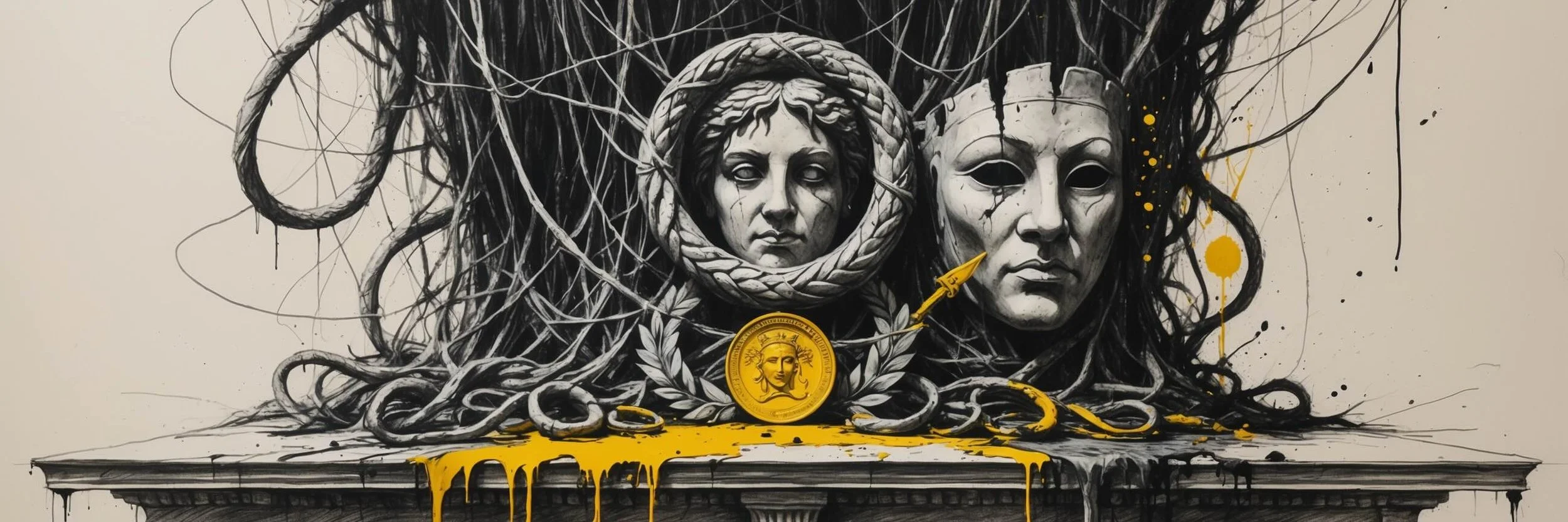
Theme Profile – At a Glance
- Focus: Words as the play's real weapons. Every turning point in Julius Caesar is won by persuasion, not by force.
- Key Characters: Mark Antony, Brutus, Cassius, Decius Brutus, and Julius Caesar – the prize the others talk over.
- The Core Tension: Brutus believes words should serve the truth. Antony and Cassius know words serve whoever uses them best.
- Key Manifestations: Cassius's seduction of Brutus (Act 1, Scene 2); Brutus's orchard soliloquy (Act 2, Scene 1); Decius's flattery (Act 2, Scene 2); the rival funeral orations (Act 3, Scene 2); the mob and Cinna the poet (Act 3, Scene 3).
- Famous Quote:
"Friends, Romans, countrymen, lend me your ears..."
(Act 3, Scene 2) - The Outcome: The better speaker wins Rome in an afternoon. The chaos his words release consumes the republic – and the man who says least inherits everything.
The Seduction of Brutus
The play's first act of manipulation is its quietest. Cassius needs Brutus – not for his sword, but for his name, which can lend an assassination the appearance of principle. So in A1S2, while the crowd offstage cheers Caesar, Cassius goes to work on the one man whose reputation for honour can sanctify the deed.
Original
Why, man, he doth bestride the narrow world
Like a Colossus, and we petty men
Walk under his huge legs and peep about
To find ourselves dishonourable graves.
(Act 1, Scene 2)
Shakespeare Retold (Modern Verse)
Why, man, he’s standing over all he reigns,
Much like a giant, whilst we minions
Walk under his huge legs and scurry round
To find ourselves a wretched place to die.
Everything in the pitch is built for its audience. The Colossus image turns Caesar's pre-eminence into something physically humiliating – grown men reduced to scuttling between a statue's legs. The word "dishonourable" is aimed precisely: Cassius cannot move Brutus with envy, so he reframes envy as honour's duty. He plays the name-game next – why should "Caesar" be sounded more than "Brutus"? – flattering his man with the thing Brutus most distrusts in others.
What makes the scene a study in manipulation rather than mere persuasion is what Cassius does when Brutus leaves. Alone on stage, he congratulates himself that even the noblest nature can be worked on, and resolves to throw forged letters – apparently from ordinary Romans – through Brutus's window that night. The grass-roots clamour that finally moves Brutus to act is a fiction Cassius writes himself. The republic's most principled defender is recruited by counterfeit public opinion.
Brutus Persuades Himself
The strangest manipulation in the play happens with no manipulator in the room. Alone in his orchard in A2S1, Brutus reasons his way to murder – and the reasoning is a masterclass in how a good mind argues itself into what it has already decided. He concedes that Caesar has never yet let passion overrule reason. The case must therefore be built on what Caesar might become.
Original
Then, lest he may, prevent. And, since the quarrel
Will bear no colour for the thing he is,
Fashion it thus; that what he is, augmented,
Would run to these and these extremities:
And therefore think him as a serpent's egg
Which, hatched, would, as his kind, grow mischievous,
And kill him in the shell.
(Act 2, Scene 1)
Shakespeare Retold (Modern Verse)
In case he does, he must be stopped. But since
He’s not yet where we fear that he will get to,
The logic’s this: extrapolating him,
He will become the thing that we all fear.
And so, let’s think he’s like a serpent’s egg now,
That, when it’s hatched, will grow to someone dangerous,
And so we’ll kill him in the shell.
The give-away is the verb. "Fashion it thus" is the language of the workshop, not the courtroom – Brutus is not weighing a case but making one, and he knows it. The argument requires Caesar to be punished for a crime he has not committed, on the strength of a metaphor: the serpent's egg justifies killing the man for what the species might do. It is the same trick Cassius played on him, now turned inward – the private conscience talked over by its own public voice. From this point the play's question is no longer whether Brutus is honest, but whether honesty that argues this way is any protection at all.
Two Funerals for One Body
A3S2 stages the play's great experiment: one corpse, one crowd, two speakers – and the republic as the prize. Brutus speaks first, and on his own terms the speech is a success. It is prose: balanced, reasonable, addressed to the listeners' judgement.
Original
If then that friend demand why Brutus rose against Caesar, this is my answer: – Not that I loved Caesar less, but that I loved Rome more. Had you rather Caesar were living and die all slaves, than that Caesar were dead, to live all free men?
(Act 3, Scene 2)
Shakespeare Retold (Modern Verse)
If you then demand to know why I killed Caesar, this is why: it’s not that I did not love Caesar, but that I loved Rome more. Would you prefer he lived but we all die slaves, or Caesar dead, we all live as free men?
The speech asks the crowd to judge – "censure me in your wisdom" – and for a moment they do, entirely in Brutus's favour. But the crowd's way of agreeing exposes everything: they cry that Brutus should be Caesar. They have absorbed the conclusion and missed the principle altogether. Brutus has won the verdict without transmitting a single idea.
Then he makes the play's most catastrophic rhetorical decision: satisfied that reason has done its work, he leaves the platform – and the crowd – to Mark Antony. Antony speaks in verse, not prose; to feeling, not judgement. He produces no argument Brutus need fear, and he does not have to. Where Brutus offered the crowd a proposition, Antony hands them evidence and lets them convict: the refused crown, the tears for the poor, the torn cloak, the will. Every conclusion appears to be the crowd's own. By the time he finishes, the men who wanted to crown Brutus are burning the conspirators' houses. Nothing about Caesar has changed between the two speeches – only the language used over his body.
What the Words Unleash
The play does not let Antony's triumph stand as a celebration. The moment the crowd stampedes off to riot, Antony stays behind and tells us exactly what he has done.
Original
Now let it work. Mischief, thou art afoot,
Take thou what course thou wilt!
(Act 3, Scene 2)
Shakespeare Retold (Modern Verse)
Now let that work. There’s mischief in the air;
Do what you will.
"Take thou what course thou wilt" is the abdication hidden inside the achievement. Antony has aimed the crowd, but he has not steered it, and the next scene shows what an unsteered crowd does: it tears Cinna the poet to pieces for having the same name as a conspirator. The wittiest manipulation in the play produces, within minutes, the death of a man for a pun.
From there the costs compound. The mob's fury hardens into the proscription lists of A4S1, where the new rulers trade the lives of their own relatives across a table – persuasion replaced by the plain arithmetic of power. And the play's last irony is reserved for the winner. Antony, the supreme talker, ends the play deferring to Octavius – the one major figure who never makes a speech. In a play where words decide everything, the future belongs to the man who barely uses them.
"Those who mean well themselves think well of others, and fall a prey to their security. That humanity and sincerity which dispose men to resist injustice and tyranny render them unfit to cope with the cunning and power of those who are opposed to them."
— William Hazlitt, Characters of Shakespeare's Plays, 1817
Key Quotes on Rhetoric and Manipulation
Quote 1
Friends, Romans, countrymen, lend me your ears;
I come to bury Caesar, not to praise him.
The evil that men do lives after them;
The good is oft interred with their bones...
(Act 3, Scene 2)
Shakespeare Retold (Modern Verse)
Friends, Romans, countrymen, lend me your ears.
I’m here to bury Caesar, not to praise him.
The bad things people do live on post death;
But they take good things with them to their grave.
Quote Analysis: The most famous opening in Shakespeare is a series of camouflages. "Friends" comes first – before Romans, before countrymen – placing Antony on the crowd's level before he says anything else. "I come to bury Caesar, not to praise him" disarms the audience Brutus has just won: this is not a eulogy, it promises, merely a funeral duty. Each claim is technically honoured and totally false. The speech buries no one and praises constantly – it simply does its praising through evidence rather than assertion, so the crowd never notices it is being argued with.
He was my friend, faithful and just to me:
But Brutus says he was ambitious;
And Brutus is an honourable man.
(Act 3, Scene 2)
Shakespeare Retold (Modern Verse)
He was my friend, loyal and kind to me,
But Brutus says that Caesar was ambitious,
And Brutus is an honourable man.
Quote Analysis: The refrain that takes the conspiracy apart. The trick is in the word "but": personal testimony – my friend, faithful and just – set against Brutus's claim, with the claim left standing. Antony never says Brutus is wrong; he arranges for the evidence and the verdict to disagree, then politely repeats the verdict. With each return, "honourable man" carries more of the crowd's own doubt, until the word means its opposite. It is irony used as a siege engine – the conditions of Antony's permission to speak forbade him to blame the conspirators, and the refrain blames them with their own praise.
The fault, dear Brutus, is not in our stars,
But in ourselves, that we are underlings.
(Act 1, Scene 2)
Shakespeare Retold (Modern Verse)
The fault has not been preordained, dear Brutus;
The fault is ours, for we’re subservient.
Quote Analysis: Cassius's most quoted line is also his most cunning. On its surface it is a stirring claim about free will – men are not fated to be small; they choose it. But watch what the sentence does to its listener: if Caesar's dominance is nobody's destiny, then enduring it is a choice, and the choice is shameful. The line converts patience into self-betrayal. "Dear Brutus" completes the work, wrapping the challenge in intimacy. It is the play's manipulation in miniature: a noble sentiment, precisely aimed, that makes inaction feel like dishonour.
I am no orator, as Brutus is;
But, as you know me all, a plain blunt man,
That love my friend...
(Act 3, Scene 2)
Shakespeare Retold (Modern Verse)
I am no orator, like Brutus is,
But, as you know, I am a man of candour
Who loved his friend...
Quote Analysis: The lie is the technique. Antony delivers this disclaimer near the climax of the most devastating piece of oratory in the play – the plain blunt man has just inventoried Caesar's wounds and is about to read the will. Denying rhetorical skill is itself a rhetorical figure, and an old one: it lowers the crowd's guard precisely when the speech is working hardest. The contrast with Brutus completes the damage. Brutus really did speak plainly, and is branded the orator; Antony performs plainness, and is believed. In this play, even sincerity is a style that can be worn.
Key Takeaways
- Words Are the Play's Weapons: The assassination is talked into being, justified in speech, and avenged from a platform. Every sword in the play is sent by a sentence.
- The Honest Speaker Loses: Brutus addresses the crowd's judgement and wins five minutes of agreement. Antony addresses their feelings and wins Rome.
- Manipulation Begins at Home: Before anyone deceives the crowd, Brutus deceives himself. His orchard soliloquy builds a case for murder out of a metaphor.
- Released Words Cannot Be Recalled: The oration's triumph becomes a riot, a poet's murder, and the proscription lists. The play's final irony: the future belongs to Octavius, the man who barely speaks.
Study Questions and Analysis
Why does Antony's funeral speech succeed where Brutus's fails?
The contest of the two orations in A3S2 is the most studied rhetorical duel in English drama, and the verdict was delivered early. William Hazlitt, in his 1817 Characters of Shakespeare's Plays, put it flatly: "Mark Antony's speech over the dead body of Caesar has been justly admired for the mixture of pathos and artifice in it: that of Brutus certainly is not so good."
The classical frame helps explain why. Brutus builds his case on logos and ethos – reasoned argument resting on his own known integrity. He speaks in prose, in balanced antitheses, and asks the crowd to judge him rationally. Antony works through pathos: grief displayed, evidence accumulated, feeling cued. He never disputes Brutus's claim directly – his permission to speak forbade it – so he produces items the claim cannot survive.
I thrice presented him a kingly crown,
Which he did thrice refuse: was this ambition?
Yet Brutus says he was ambitious;
And, sure, he is an honourable man.
(Act 3, Scene 2)
Shakespeare Retold (Modern Verse)
Three times I offered him a crown of kings,
And three times he refused. Is that ambition?
Yet Brutus says that Caesar was ambitious,
And surely he’s an honourable man.
The question "was this ambition?" hands the crowd the work of conviction – each listener supplies the answer and believes it his own. Harley Granville-Barker, in his 1927 Prefaces to Shakespeare, drew attention to the practical stagecraft beneath the duel: the crowd's interruptions are built into the structure of Antony's speech, which advances in stages timed to the listeners' temperature, where Brutus's address is a finished essay read aloud. And the conditions matter as much as the talent. Brutus speaks first and leaves; Antony speaks last, with the body, the mantle and the will as exhibits. Brutus handed his enemy the stage, the props and the final word – a failure of political judgement before it was ever a failure of style.
How does Cassius win Brutus over to the conspiracy?
Cassius's campaign in A1S2 is the play's tutorial in manipulation, and Shakespeare lets the audience watch every move. He works on Brutus through the only door that will open – honour. Envy of Caesar would repel Brutus, so Cassius translates envy into duty: great Caesar is a Colossus only because little men consent to walk under him. He flatters Brutus with Rome's good opinion, plays the name-game – why should "Caesar" be sounded more than "Brutus"? – and salts the conversation with the offstage shouts of a crowd apparently crowning the man.
Then, in soliloquy, Cassius tells us exactly what he has done.
Well, Brutus, thou art noble; yet, I see,
Thy honourable metal may be wrought
From that it is disposed: therefore it is meet
That noble minds keep ever with their likes;
For who so firm that cannot be seduced?
(Act 1, Scene 2)
Shakespeare Retold (Modern Verse)
Well, Brutus, you are noble. But I see
Your honourable nature can be changed
From what it does believe. And so it is
That noble minds prefer to stick together,
And where’s the man whose thoughts cannot be changed?
The metallurgy metaphor – noble "metal" wrought from its natural shape – is as honest a description of manipulation as the play offers, and the rhetorical question that closes it ("who so firm that cannot be seduced?") generalises the technique to everyone, the audience included. The campaign's final stroke is the forged letters thrown in at Brutus's window, manufacturing the popular demand that Brutus's republicanism needs before it will move. William Hazlitt caught the asymmetry in 1817: "Cassius was better cut out for a conspirator. His heart prompted his head." Critics have long noted the irony that follows from it – Cassius's reading of men is consistently right, yet at every practical decision he defers to Brutus, whose readings are consistently wrong. The manipulator's one blind spot is the man he created.
Does Brutus manipulate himself?
The orchard soliloquy of A2S1 is the evidence, and it has troubled readers for two centuries. Brutus opens with the conclusion – "It must be by his death" – and only then assembles the reasoning. He concedes the case's central weakness himself: he has never known Caesar's emotions to overrule his reason. The argument must therefore run on hypotheticals – what Caesar, "augmented," might become – and on the serpent's egg metaphor, which licenses killing the man for the species' nature. "Fashion it thus," he says: the verb of a craftsman shaping material, not a judge weighing proof.
Samuel Taylor Coleridge, in his notes on the play (collected in the 1836 Literary Remains), found the speech "singular" and confessed he could not "see into Shakespeare's motive" – he could not square the weakness of the reasoning with the nobility of the reasoner. Later criticism has tended to answer that the discord is the point. M. W. MacCallum, in his 1910 Shakespeare's Roman Plays and their Background, read Brutus as an idealist whose devotion to abstractions blinds him to the particular men and facts in front of him – the soliloquy shows the abstraction machine running on empty premises. Harold Bloom, in his 1998 Shakespeare: The Invention of the Human, hears in Brutus an early draft of the inward, self-auditing hero Shakespeare would perfect in Hamlet two years later – a man overheard persuading himself.
The deeper reading is that Brutus is the play's most important victim of rhetoric. Cassius supplies the flattery and the forged letters, but the decisive manipulation happens in Brutus's own sentences, where a feared future is quietly promoted into a present fact. The play's warning is not only that clever men can deceive us; it is that the language of principle can deceive the principled. On this question the soliloquy stays genuinely contested: whether Brutus is corrupted by Cassius, by Rome's republican mythology, or by the seductions of his own eloquence, the play declines to say.
What part does flattery play in Caesar's death?
Decius Brutus gets Caesar to the Senate on the Ides of March, and he does it with a theory of flattery that he announces to the conspirators in advance. The boast is one of the play's coldest exhibitions of technique.
But when I tell him he hates flatterers,
He says he does, being then most flattered.
(Act 2, Scene 1)
Shakespeare Retold (Modern Verse)
But when I tell him he hates flattery,
He says he does, yet he is always flattered.
The insight is that the most effective flattery targets a man's vanity about being unflatterable. In A2S2 Decius performs the trick under the audience's eyes. Calpurnia's dream – Caesar's statue running blood while Romans bathe in it – has frightened Caesar into staying home. Decius does not dispute the dream; he reinterprets it. The blood becomes "reviving blood," the bathing a sign that Rome draws its life from Caesar. Same images, opposite meaning – and he finishes with the spur of the offered crown and the gentle suggestion that staying home looks like fear. Caesar, who has just declared himself constant as the northern star, reverses his decision within thirty lines.
Marjorie Garber, in her 2004 Shakespeare After All, stresses how much of the play is a war of interpretation: omens, dreams and documents mean whatever the most confident reader present says they mean. The dream scene is her case in miniature – Calpurnia reads it rightly and is overruled; Decius reads it falsely and is believed, because his reading flatters its audience. Caesar dies, in this light, not because the conspirators' swords were unstoppable but because the better story won. It is the same lesson the Forum scene teaches an act later, rehearsed in private on the play's most powerful man.
Why does Antony use Caesar's body, mantle and will as props?
Because evidence persuades crowds where argument cannot. Brutus gave the crowd propositions; Antony gives them things – a torn cloak, a wounded corpse, a sealed document – and lets the things do the accusing. The hinge of the oration is the moment he stops talking about Caesar and starts showing him.
If you have tears, prepare to shed them now.
You all do know this mantle: I remember
The first time ever Caesar put it on...
(Act 3, Scene 2)
Shakespeare Retold (Modern Verse)
If you have tears, prepare to shed them now.
You all do know this cloak. I can remember
The first time ever Caesar put it on.
The first line is stage-direction delivered to an audience – Antony cues the tears before supplying their cause. Then the mantle is made to tell a story: the summer evening it was first worn, the named rents where each conspirator's dagger went through. None of this is evidence in any forensic sense – Antony was not present at the killing and cannot know which tear was Cassius's – but as theatre it is irresistible. Coppélia Kahn, in her 1997 Roman Shakespeare: Warriors, Wounds, and Women, reads the display within the Roman cult of the wounded body: wounds are Rome's most authoritative text, and Antony appoints himself their translator, making the dumb body speak his script. The will works the same way from the other direction – it is persuasion as property, a bequest to every citizen, and Antony withholds it twice to make the crowd demand what he most wants to give. The props complete the inversion of the two funerals: Brutus asked the crowd to think and went unheard; Antony asks them only to look, and the looking does the thinking for them.
What does the killing of Cinna the poet show about words and the mob?
A3S3 is the shortest scene in the play and its bleakest joke. The crowd Antony has set loose finds a man named Cinna. He is the wrong Cinna – a poet, not a conspirator – and he tells them so. It makes no difference.
Tear him for his bad verses, tear him for his bad verses.
(Act 3, Scene 3)
Shakespeare Retold (Modern Verse)
Chop him up for his dreadful poetry!
The line is the play's rhetoric brought to its terminus. In A1S2 words were instruments of precise persuasion; by A3S3 they have detached from meaning altogether. The mob needs only the name – "pluck but his name out of his heart," one citizen offers, as though identity were a label that could be torn off – and when the name is explained away, any pretext serves, even literary criticism. A man dies for a homonym. That the victim is a poet, a professional user of language, completes the irony with a shudder: the crowd that words created now kills the wordsmith.
The scene reads as a deliberate, miniature parody of Antony's method. He, too, made things mean what he needed – the wounds, the mantle, the will; the mob, his creation, applies the same freedom without the skill. William Hazlitt observed in 1817 that Shakespeare shows in this play "the same penetration into political character and the springs of public events as into those of everyday life," and the Cinna scene is that penetration at its most pitiless: a demonstration that rhetoric's endpoint, once feeling is fully unmoored from fact, is violence that no longer needs a reason – only a sound.
Is the play celebrating rhetoric or warning against it?
Both readings have strong textual support, and the play is careful never to settle the question.
The case for celebration is real. Shakespeare lavishes his finest technique on Antony's oration – it is the most virtuosic sustained speech he had yet written – and the play invites the audience to relish every turn of it. We watch the crowd being played and enjoy the playing; the theatre itself is implicated, since Antony's methods (props, timing, cued emotion) are the dramatist's own. A play that hated rhetoric would not make its rhetorician this good.
The case for warning is the plot. Every act of brilliant persuasion in the play produces catastrophe: Cassius's seduction delivers the assassination, Decius's flattery delivers Caesar to the daggers, Antony's oration delivers the riot, the poet's murder and the proscriptions. M. W. MacCallum, writing in 1910, saw the tragedy rooted in idealism unfitted for political reality; Marjorie Garber, in 2004, locates it in interpretation itself – a world where every sign means what the strongest reader says it means is a world that cannot hold still. And the ending votes with its feet. The supreme talker, Antony, is already being eclipsed by Octavius, the play's least rhetorical figure, whose few words are flat, exact and obeyed. The republic of speakers becomes an empire of silence.
The deeper reading is that the play separates two things its characters confuse: the power of language and the authority of truth. Rhetoric in Julius Caesar works – on Brutus, on Caesar, on the crowd, on everyone – but nothing it wins survives the winning. Brutus's honour, Caesar's life, Antony's mastery and the republic itself are all spent by the play's end, and what remains standing is force organised by a man who wastes no words on persuasion. Whether that is rhetoric's defeat or merely its final, quietest victory is the question Shakespeare leaves with the audience – which has itself, for five acts, been Antony's willing crowd.