Lady Anne
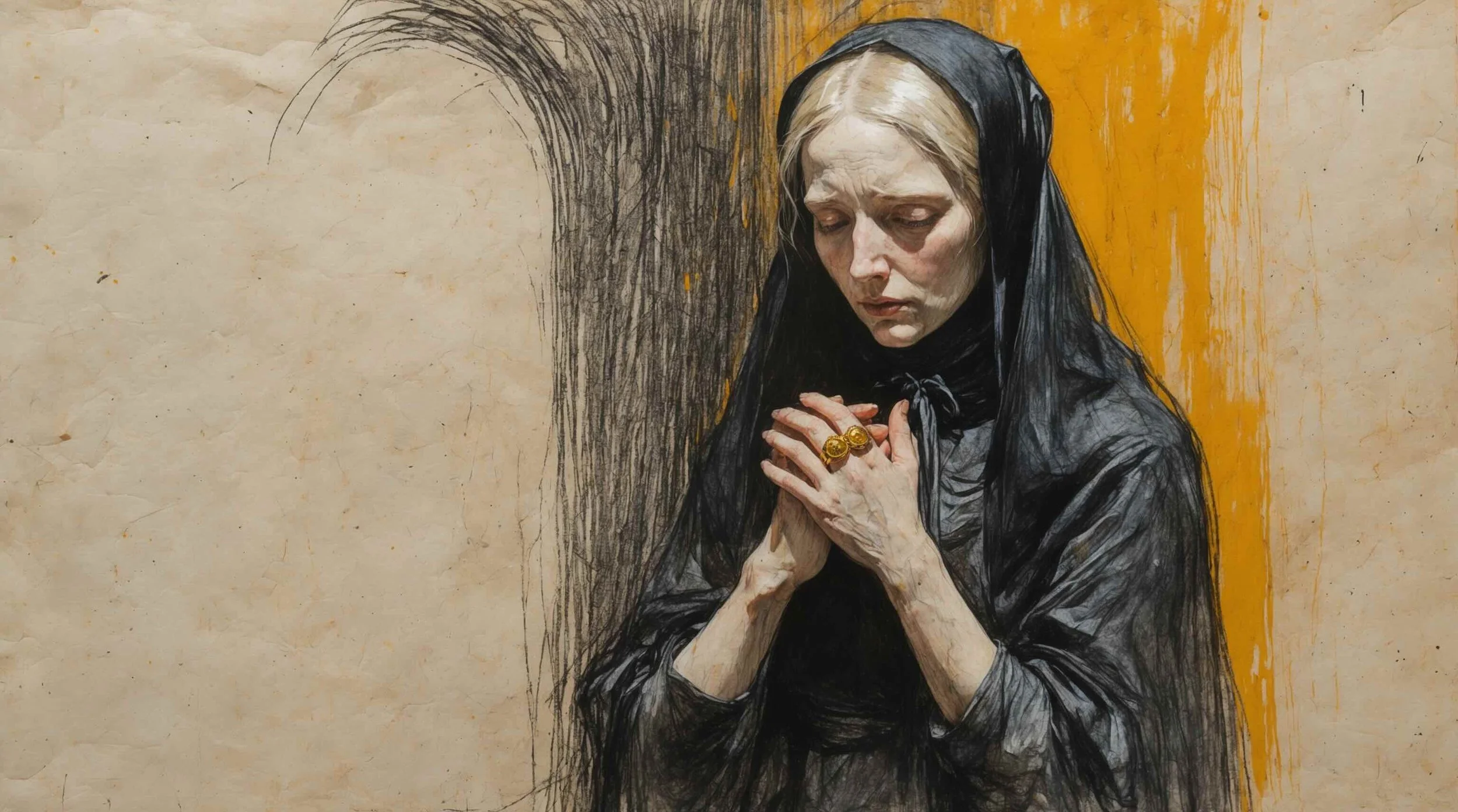
Character Profile – At a Glance
- Role: Anne Neville, widow of Prince Edward of Lancaster and daughter-in-law of the murdered Henry VI. Richard killed both men. She curses him, marries him, and is quietly disposed of when he needs a new wife.
- Key Traits: Eloquent, grief-stricken and furious. She has the best curses in Act 1 and no power to enforce them. Later, sleepless and clear-eyed about what she has done.
- The Core Conflict: Anne knows exactly what Richard is and marries him anyway. Her tragedy is that she can see the trap, describe it, curse it, and still walk into it.
- Key Actions: Follows the corpse of Henry VI and curses his killer (A1S2). Spits at Richard, is offered his sword, cannot use it, and accepts his ring. Learns she is to be crowned and wishes the crown were red-hot steel (A4S1). Recalls her own curse and admits it has fallen on her. Is reported sick, then dead (A4S2, A4S3). Returns as a ghost to tell Richard she never slept a quiet hour beside him (A5S3).
- Famous Quote:
"Arise, dissembler! Though I wish thy death,
I will not be thy executioner."
(Act 1, Scene 2) - The Outcome: Dies offstage, almost certainly at Richard’s order, so that he can court his niece. Her ghost curses him on the eve of Bosworth and blesses Richmond.
Cursed the Heart That Had the Heart to Do It
Anne enters walking behind a coffin, and her first speech is a lament that turns, line by line, into a curse. She addresses the dead king, then the wounds in his body, then the man who made them. She does not yet know that the man is about to walk on.
Original
If ever he have wife, let her be made
More miserable by the life of him
Than I am made by my young lord and thee!
(Act 1, Scene 2)
Shakespeare Retold (Modern Verse)
And if he has a wife, let her become
More miserable by spending life with him
Than I am losing my husband and you!
The curse on the killer’s wife is the most famous line she speaks, because within two hundred lines she will be that wife. Shakespeare plants it deliberately, and Anne herself will dig it up in A4S1 and read it back to us. The whole arc of her part is contained in this one wish.
What the speech also establishes is that Anne can talk. The lament is formal, built on repetition and paradox – a "key-cold figure", "bloodless remnant of that royal blood" – and it shows a woman who commands the high style of grief. That matters, because the scene that follows is a contest of language and rhetoric, and she loses it to a better talker.
Blush, Blush, Thou Lump of Foul Deformity
When Richard stops the funeral, Anne does not retreat. She calls him a devil, a minister of hell, a lump of deformity, a hedgehog and a toad. She points at the corpse and says that Henry’s wounds have opened and are bleeding again because his murderer is in the room.
Original
O gentlemen, see, see dead Henry’s wounds
Open their congealed mouths and bleed afresh!
Blush, blush, thou lump of foul deformity;
For ’tis thy presence that exhales this blood
From cold and empty veins where no blood dwells.
(Act 1, Scene 2)
Shakespeare Retold (Modern Verse)
Oh gentlemen, observe how Henry’s wounds
Have opened up again and bleed anew!
You ought to be ashamed, you hunched-back lump;
These cuts have started bleeding as you’re here,
Spewing from cold and empty bloodless veins.
The bleeding corpse is an old belief – that a murdered body bleeds afresh in the presence of its killer – and Shakespeare uses it to give Anne’s accusation physical proof. Everyone on stage can see it. Richard does not deny it. He simply changes the subject.
This is Anne at full strength. She has the facts, the corpse, the moral weight of a widow and a daughter-in-law, and a vocabulary of abuse to match Richard’s own. The scene has been constructed so that she cannot lose. When she does lose, the audience is meant to feel the ground shift.
Arise, Dissembler
The turning point is the sword. Richard kneels, bares his chest, hands her his weapon and tells her to kill him – while admitting, in the same breath, that he killed both Henry and her husband. Anne raises the sword. She lowers it. She raises it again. She drops it.
Original
Arise, dissembler! Though I wish thy death,
I will not be thy executioner.
(Act 1, Scene 2)
Shakespeare Retold (Modern Verse)
Get up, you cheat! Although I wish you dead,
I will not be your executioner.
"Dissembler" is the right word and she knows it. She is not deceived about what Richard is; she calls him a liar in the very line in which she spares him. What she cannot do is kill a kneeling man, and Richard has calculated that she cannot. Everything after this is a formality: the exchange about his heart and her fear that both heart and tongue are false, the ring, the errand to Crosby House.
Critics have argued for four hundred years about why she yields, and the play is careful not to say. It is manipulation and deceit performed at such a pace that no one motive is allowed to settle. What is certain is that Anne’s surrender is a failure of the hand, not the mind. She sees everything and does nothing, and that is a more frightening picture of how tyranny works than simple deception would be.
Never Yet One Hour in His Bed
Anne disappears for two acts. When she returns in A4S1, on her way to visit the princes in the Tower, she meets Queen Elizabeth and the Duchess of York and is told that she is to be crowned that afternoon. Her reaction is to wish the crown were red-hot steel. Then she remembers her curse.
Original
Lo, ere I can repeat this curse again,
Within so small a time, my woman’s heart
Grossly grew captive to his honey words,
And proved the subject of mine own soul’s curse,
Which hitherto hath held my eyes from rest...
(Act 4, Scene 1)
Shakespeare Retold (Modern Verse)
Now look at me! Before I’d cursed again,
My woman’s heart, within so little time,
Was captivated by his charming words,
And thus became the victim of my own curse,
Which has, thus far, prevented me from sleeping...
This is the most honest speech in the play, and one of the saddest. Anne does not blame Richard for her marriage; she blames her "woman’s heart", which was won by "honey words" before she could finish cursing him. She has become, in her own phrase, the subject of her own curse, and the curse has kept her awake ever since.
The detail of the sleepless bed is worth holding on to. Richard’s "timorous dreams", which will finally break over him in the ghost scene, have been keeping his wife awake for the whole of his rise. Anne is the only living character who knows that Richard is afraid, and the knowledge does her no good at all. It is a small window on to the theme of conscience and guilt, seen from the side of the bed where nobody looks.
"Richard should woo less as a lover than as an actor — to shew his mental superiority, and power of making others the play-things of his purposes."
— William Hazlitt, Characters of Shakespear’s Plays, 1817
Key Quotes
Quote 1
O, cursed be the hand that made these holes!
Cursed the heart that had the heart to do it!
Cursed the blood that let this blood from hence!
(Act 1, Scene 2)
Shakespeare Retold (Modern Verse)
God damn him that impaled you with these stab wounds!
And damn the heart that had the heart to do this!
And damn the blood that made your blood flow from you!
Quote Analysis: Three curses in three lines, each built on the same word turned against itself: the hand that made the holes, the heart that had the heart, the blood that let the blood. This is Anne’s style at its most formal, and it is not idle. Curses in this play come true. The hand, the heart and the blood she curses are Richard’s, and by Act 5 all three have failed him.
ANNE: I would I knew thy heart.
RICHARD: ’Tis figured in my tongue.
ANNE: I fear me both are false.
RICHARD: Then never was man true.
ANNE: Well, well, put up your sword.
(Act 1, Scene 2)
Shakespeare Retold (Modern Verse)
ANNE: I wish I knew your heart.
RICHARD: It is as I have told you.
ANNE: I fear that both are false.
RICHARD: Then no man speaks the truth.
ANNE: Well, put your sword away.
Quote Analysis: The exchange in which the scene is decided, and it is decided in half-lines. Anne wants to know his heart; he says it is written on his tongue; she says both are false; he says then no man is true. Each of her lines is a doubt and each of his is a deflection, and the deflections are quicker. "Put up your sword" is surrender disguised as instruction. She has not said yes, but she has stopped saying no, and Richard needs nothing more.
O would to God that the inclusive verge
Of golden metal that must round my brow
Were red-hot steel, to sear me to the brains!
(Act 4, Scene 1)
Shakespeare Retold (Modern Verse)
I wish to God that that encircling crown
Of gold that I must wear upon my head
Was made of red-hot steel to burn my brains out!
Quote Analysis: Anne’s response to being told she will be queen. The crown is a circle of metal that must "round" her brow, and she asks that it be heated until it burns through to the brain. It is the language of execution, not coronation, and it tells us how she understands her position. She is not a queen. She is a woman being fitted for a device.
Richard, thy wife, that wretched Anne thy wife,
That never slept a quiet hour with thee,
Now fills thy sleep with perturbations.
(Act 5, Scene 3)
Shakespeare Retold (Modern Verse)
Richard, your wife, your suffering Anne, your wife,
That never slept a peaceful hour with you,
Now fills your dreams with anguish and disruption.
Quote Analysis: Anne’s ghost, the last but one of the eleven to visit Richard’s tent. She names herself twice as his wife, as if to make sure the word lands, and her complaint is domestic: she never slept a quiet hour beside him, and now she will see to it that he does not sleep either. Of all the ghosts she is the only one who shared his bed, and her curse is the intimate one. The sleeplessness she described in A4S1 has come home.
Key Takeaways
- The Curse She Lives Out: Anne curses whoever becomes the killer’s wife, and then becomes her. The play makes her notice.
- Seeing Is Not Enough: She knows Richard is a dissembler and says so as she spares him. Her failure is of the hand, not the eye.
- The Sleepless Bed: In A4S1 she reveals that Richard’s nightmares have kept her awake throughout his rise. She knows his fear before anyone else does.
- Disposed Of: Richard spreads a rumour that she is sick, and she is dead within two scenes. Her ghost returns to wish him the same sleeplessness she suffered.
Study Questions and Analysis
Why does Lady Anne give in to Richard?
The play deliberately refuses to give one answer, and any good essay should say so. Anne has every reason to refuse and no plausible reason to accept, and Richard himself is astonished that it worked. What Shakespeare shows is a sequence of pressures, none of them sufficient on its own.
First, exhaustion. Anne has cursed for a hundred lines and Richard has absorbed every curse without flinching. Second, flattery: he insists her beauty caused the killings, and although she rejects the idea, she does not reject the compliment. Her fiercest answer is telling:
If I thought that, I tell thee, homicide,
These nails should rent that beauty from my cheeks.
(Act 1, Scene 2)
Shakespeare Retold (Modern Verse)
If I believed you, murderer, I tell you
My fingernails would make my cheeks look ugly.
She would tear her face if she believed him. She does not tear her face. Third, the sword: a kneeling man who admits his crimes and begs to die cannot be struck by a woman brought up to think of herself as gentle, and Richard knows it. Fourth, and least often noticed, her position. Her husband and father-in-law are dead, her father Warwick is dead, and the family that killed them now rules England. The most powerful man in the room is offering her protection.
William Hazlitt, in Characters of Shakespear’s Plays (1817), read the scene as a display of Richard’s "mental superiority" rather than a love scene, which puts the weight on his performance rather than her weakness. Jean E. Howard and Phyllis Rackin’s Engendering a Nation (1997) place Anne among the play’s women, who are given eloquence and denied any means of acting on it; on that reading, Anne’s surrender is what the play’s world does to a woman with no male protector left. Jan Kott’s Shakespeare Our Contemporary (1964) went further: in a world where history is a machine, Anne is simply the first person to recognise which way it is turning.
What is the significance of Anne’s curse in Act 1, Scene 2?
It is the first of the play’s great curses and the first to come true. Richard III is a play in which what people wish aloud tends to happen, usually to the person who wished it, and Anne sets the pattern. Before she has even seen Richard she curses his hand, his heart and his blood, wishes him a monstrous child and a miserable wife, and pours out on him more harm than she can wish on wolves, spiders and toads:
More direful hap betide that hated wretch
That makes us wretched by the death of thee
Than I can wish to wolves – to spiders, toads,
Or any creeping venomed thing that lives!
(Act 1, Scene 2)
Shakespeare Retold (Modern Verse)
Worse curses on the hated, wretched man –
Who’s made us wretched by the death of you –
Than I can wish on wolves or toads or spiders
Or any living thing that’s poisonous!
The wife she wishes miserable is herself. Shakespeare could have let the irony sit quietly, but he does something more painful: in A4S1 Anne quotes the curse back word for word and recognises that she is its subject. The play’s treatment of prophecy and curses works like this throughout. Queen Margaret’s curses in A1S3 are fulfilled one by one, and each victim remembers Margaret as it happens. Anne’s curse is the small, domestic version of the same machinery.
Wolfgang Clemen’s A Commentary on Shakespeare’s Richard III (1968) treats the play’s curses as a structural device, a way of announcing the shape of the action in advance so that the audience watches for its fulfilment. E. M. W. Tillyard’s Shakespeare’s History Plays (1944) saw the curses as the voice of providence, the mechanism by which God’s plan for England is made audible. A more sceptical reading would notice that the curses are spoken by women who have no other power, and that their fulfilment is the only justice the play allows them.
Why does Henry VI’s corpse bleed when Richard appears?
Because of a belief, still widely held in Shakespeare’s day, that a murdered body would bleed afresh in the presence of its murderer. The idea was old enough to have been used as evidence in courts, and an Elizabethan audience would have taken it as a kind of proof. Anne certainly does. She turns to the gentlemen carrying the coffin and asks them to look.
Foul devil, for God’s sake hence, and trouble us not,
For thou hast made the happy earth thy hell,
Filled it with cursing cries and deep exclaims.
(Act 1, Scene 2)
Shakespeare Retold (Modern Verse)
Foul devil, bugger off; for God’s sake, leave us,
For you have made our happy earth your hell,
By filling it with shrieks and wretched wailing.
The theatrical effect is precise. Richard has just arrived and Anne has just accused him; before he can answer, the corpse answers for her. It is the one moment in the scene when the evidence is on her side, and it changes nothing. Richard does not dispute the bleeding; he says she knows no charity and moves on to her beauty. The play is showing us that in this world proof is not power, and that a man who refuses to be shamed cannot be.
There is a second, longer echo. The bleeding wounds are described as mouths – "congealed mouths" that open and speak – and the image of the dead accusing the living returns in A5S3, when eleven ghosts file through Richard’s tent. Henry VI is among them. What Anne could not make him hear in Act 1, the dead say to him directly in Act 5.
How does Anne’s speech in Act 4, Scene 1 change our view of her?
It gives her back her intelligence. In A1S2 Anne is a woman who is outtalked; in A4S1 she is a woman who understands exactly what happened to her and can describe it without self-pity. She quotes her own curse from memory, notes that it fell on her within "so small a time", and then tells us what marriage to Richard has actually been like.
For never yet one hour in his bed
Did I enjoy the golden dew of sleep,
But with his timorous dreams was still awaked.
(Act 4, Scene 1)
Shakespeare Retold (Modern Verse)
For in his bed, I haven’t had an hour
Where I’ve enjoyed recuperating sleep;
Instead, I lie awake, hearing his nightmares.
The speech does two things at once. It completes Anne’s arc, from curser to cursed, and it opens a door on to Richard’s. Nowhere else before Act 5 does the play tell us that Richard has bad dreams. Anne knows because she lies beside him. The information is offered almost in passing, and it is the first crack in the surface of a man who has seemed, to everyone including the audience, to have no inside at all.
Madonne M. Miner’s essay "Neither mother, wife, nor England’s queen" (in The Woman’s Part, 1980) reads the women of the play as figures who are defined entirely by their relationships to men and then stripped of those relationships one by one. Anne in A4S1 is a wife who has learned what the title means. Her final sentence – that he hates her for her father and will shortly be rid of her – is a prediction, and like every prediction in this play it is accurate.
What does Anne’s fate reveal about the women in Richard III?
That they see clearly and can do nothing. Anne, Queen Elizabeth, the Duchess of York and Queen Margaret are between them the most perceptive characters in the play. They read Richard correctly from the start, they curse him accurately, and they are proved right in every particular. None of it stops him. Anne’s own summary of her position in A4S1 is a model of the pattern:
Besides, he hates me for my father Warwick,
And will, no doubt, shortly be rid of me.
(Act 4, Scene 1)
Shakespeare Retold (Modern Verse)
He hates me for my father, Earl of Warwick,
And surely, soon, he will get rid of me.
She is right. In the next scene Richard tells Catesby to spread a rumour that she is sick; by A4S3 she has "bid this world good night"; and Richard is already planning to marry his brother’s daughter. Anne’s death is not staged, explained or mourned. It happens between scenes, as an administrative matter.
Phyllis Rackin, in "Engendering the Tragic Audience: The Case of Richard III" (1993), argues that the play invites its spectators to enjoy Richard’s power over women in the first half and then, in the second, transfers its sympathy to the women whose curses come true. Linda Charnes’s Notorious Identity (1993) reads the women’s laments as the play’s counter-history, a record of the bodies that Richard’s version of events leaves out. Anne, who is on stage for only two scenes, is the clearest case: everything she says is true, and the play lets her say it, and it does not save her.
How does Anne die, and why does the play not show it?
The play never says how she dies, and it does not need to. In A4S2, immediately after ordering the murder of the princes, Richard turns to the question of his wife:
Come hither, Catesby. Rumour it abroad
That Anne, my wife, is very grievous sick;
I will take order for her keeping close.
(King Richard, Act 4, Scene 2)
Shakespeare Retold (Modern Verse)
Come closer, Catesby. Go and spread a rumour
That Anne, my wife, has fallen very ill;
I will ensure that she’s kept out of sight.
A rumour of sickness, an order to keep her out of sight, and then, in the next scene, a single line reporting that she is dead. The audience is left to draw the obvious conclusion, and every audience has. Richard needs a new wife because Richmond is about to claim Elizabeth of York, and Anne is in the way.
The offstage death is a choice, and it is the right one. Shown, Anne’s murder would become a scene about Richard; unshown, it becomes a scene about how easily a person can be removed from a story. The play gives Anne her farewell elsewhere: her ghost, in A5S3, tells Richard that she never slept a quiet hour beside him and wishes him the same. Her last act is to bless Richmond as "thy adversary’s wife" – the only time in the play that Anne’s name is spoken on the side that wins.
Is Lady Anne a weak character?
Weak is the wrong word, though it is the one most students reach for. Anne has more eloquence than almost anyone in the play, and the courage to abuse a murderer to his face in front of witnesses. What she lacks is the capacity to act on what she knows, and the play treats that as a tragedy rather than a fault.
The case for weakness rests on the speed of her surrender. The case against it rests on everything she says: the curse, which is accurate; the accusation over the corpse, which is true; the recognition in A4S1, which is complete. A weak character is one who does not understand her situation. Anne understands hers better than anyone, including Richard, who has to be told by his own dreams what she already knew.
It is worth noticing how she leaves the wooing scene. Richard asks her to bid him farewell; she tells him it is more than he deserves, and then gives him this:
But since you teach me how to flatter you,
Imagine I have said farewell already.
(Act 1, Scene 2)
Shakespeare Retold (Modern Verse)
But since you’ve taught me how to flatter you,
Imagine I have said farewell already.
That is not the exit of a woman who has been fooled. It is the exit of a woman who knows she has been flattered, says so, and goes anyway. In performance the wooing scene depends on the actress holding her ground for as long as the text allows, because Richard’s triumph is worth nothing if Anne is easy. The part is a test of how much resistance an audience can watch collapse and still believe. Played well, the answer is: almost all of it.