Queen Elizabeth
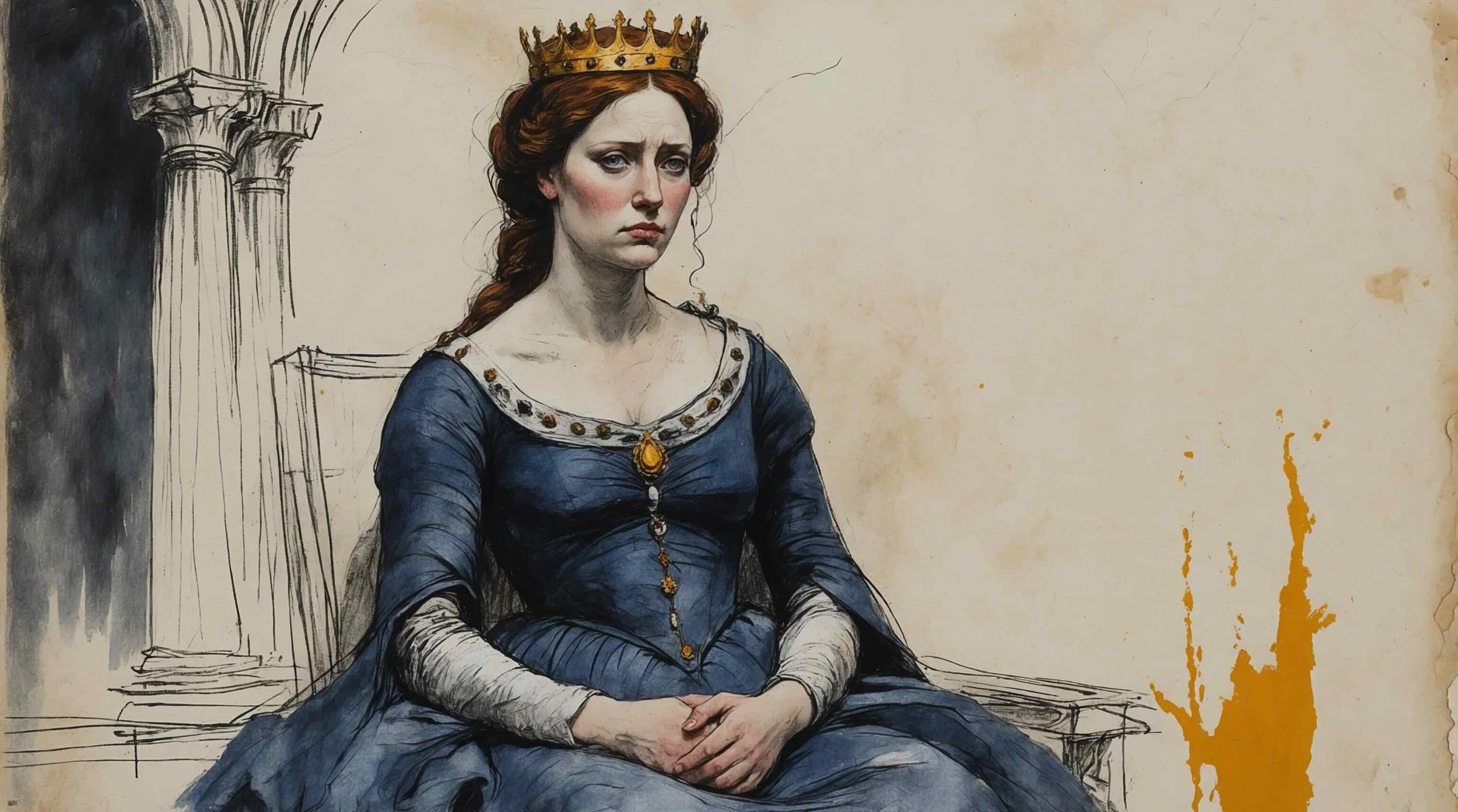
Character Profile – At a Glance
- Role: Elizabeth Woodville, wife of King Edward and mother of the two princes. A commoner by birth whose marriage raised her family to power, and the target of Richard’s hatred from the first scene.
- Key Traits: Anxious, sharp and quick to see danger. She begins as a queen defending her relatives and ends as a mother with nothing left to defend. She learns to curse, and learns to bargain.
- The Core Conflict: Elizabeth loses everything the play can take from her – husband, brother, sons, title – and then has to face Richard across a table and decide what to do with the one thing she has left: her daughter.
- Key Actions: Fears for her future as Edward sickens (A1S3). Is accused by Richard of turning the King against Clarence, and answers him. Mourns Edward’s death (A2S2). Flees to sanctuary with her younger son (A2S4). Is barred from the princes in the Tower (A4S1). Asks Queen Margaret to teach her to curse (A4S4). Confronts Richard over the murder of her sons and is asked for her daughter’s hand. Sends word that the daughter will marry Richmond (A4S5).
- Famous Quote:
"O thou well skilled in curses, stay awhile,
And teach me how to curse mine enemies!"
(Act 4, Scene 4) - The Outcome: Survives. Her daughter marries Richmond, unites the houses of York and Lancaster, and becomes the first Tudor queen. Elizabeth is the only one of Richard’s enemies who ends the play with something gained.
Small Joy Have I in Being England’s Queen
Elizabeth’s first scene shows what her position actually is. King Edward is dying, her son is a child, and the man who will govern during his minority hates her. Then Richard walks in and accuses her, in front of the court, of turning the King against Clarence. She has done no such thing, and says so, and then says something truer.
Original
I had rather be a country servant maid
Than a great queen with this condition,
To be so baited, scorned, and stormed at.
Small joy have I in being England’s queen.
(Act 1, Scene 3)
Shakespeare Retold (Modern Verse)
I’d rather be a servant in the country
Than be a great queen in this situation
Who gets wound up, abused, and shouted at.
I get so little joy as England’s queen.
The complaint is worth taking seriously. Elizabeth was born a gentlewoman, not a princess, and the play’s nobles never let her forget it. Richard calls her "my Lady Grey", her first husband’s name, and treats her brothers and sons as upstarts. Her power is entirely borrowed from a sick husband, and everyone in the room can count the days.
What the scene establishes is that Elizabeth can see the shape of what is coming and cannot stop it. She asks the right questions – what will become of her if the King dies? – and gets no answers. It is the play’s first study in power and ambition from the point of view of someone who has some and is about to lose it.
Why Grow the Branches When the Root Is Gone?
When King Edward dies, Elizabeth enters with her hair down – the stage direction for a woman in extremity – and the play gives her the first of its great laments. It is formal, patterned and enormous, and it is worth reading closely because the pattern is the meaning.
Original
Edward, my lord, thy son, our king, is dead!
Why grow the branches when the root is gone?
Why wither not the leaves that want their sap?
(Act 2, Scene 2)
Shakespeare Retold (Modern Verse)
Edward, my lord, your son, our king, is dead!
Why bother growing branches when the root’s gone?
Why don’t leaves wither when they’re starved of water?
The tree is a family. Edward was the root; his children are the branches; without him they will wither. Elizabeth is grieving for a husband and at the same time predicting, accurately, the death of her sons. The Duchess of York, who has lost two sons, answers that she has more cause to grieve, and Clarence’s children join in, and the scene becomes a competition in loss.
Modern audiences sometimes find the laments stiff. Shakespeare’s audience would have heard something else: a ritual, like a church service, in which grief is shared out and given a shape. The formality is a kind of dignity, and it is the only kind the play allows its women. Elizabeth’s answer to the Duchess – "give me no help in lamentation" – is a queen refusing to have her grief managed.
Teach Me How to Curse Mine Enemies
By A4S4 the sons are dead. Elizabeth and the Duchess sit on the ground outside the palace, and Queen Margaret, who has cursed them both in Act 1 and watched every curse come true, comes to enjoy the view. Elizabeth’s response is not to fight her but to ask for lessons.
Original
O thou well skilled in curses, stay awhile,
And teach me how to curse mine enemies!
(Act 4, Scene 4)
Shakespeare Retold (Modern Verse)
Oh, wait a while, you master of the curses,
And teach me how to curse my enemies!
It is one of the strangest and most moving requests in Shakespeare. Margaret cursed Elizabeth to outlive her glory and die "neither mother, wife, nor England’s queen", and Elizabeth has now remembered the curse and confirmed it. What she asks for is Margaret’s weapon, the only one that has worked against Richard.
Margaret’s answer is practical: stay awake, starve, think your dead children were sweeter than they were, and your enemy worse. Then she leaves, and Elizabeth turns to the Duchess and says the words are windy attorneys that ease the heart and help nothing else. She has learned the lesson and seen through it at the same time. The play’s treatment of prophecy and curses is never simpler than the people who use it.
Under What Title Shall I Woo for Thee?
Then Richard arrives, and the scene that follows is the play’s second wooing. He needs to marry Elizabeth’s daughter before Richmond does, and he asks her mother to arrange it. Elizabeth, who has just watched the Duchess curse her own son to his face, chooses a different weapon. She agrees to everything, and then asks how.
Original
What were I best to say? Her father’s brother
Would be her lord? Or shall I say her uncle?
Or he that slew her brothers and her uncles?
Under what title shall I woo for thee,
That God, the law, my honour, and her love
Can make seem pleasing to her tender years?
(Act 4, Scene 4)
Shakespeare Retold (Modern Verse)
What should I tell her? That her father’s brother
Would like to wed her? Or should I say uncle?
Or him who killed her brothers and her uncles?
What title should I use to court her for you,
That works for God, the law, me and her love
That, being young, she’s going to find appealing?
Every question is a knife. Her father’s brother; her uncle; the man who killed her brothers and her uncles. Richard offers a title, and she asks how long "ever" lasts. He swears, and she takes each oath apart: the George he has dishonoured, the Garter he has stained, the crown he has stolen, the God he has defied. It is the first time in the play that anyone has out-talked him.
Whether she yields is the question the scene leaves open, and it is dealt with below. What is not in doubt is the change in her. The woman who could not stop Richard in A1S3 has learned his methods – delay, redirection, the answer that is not an answer – and uses them on him. It is language and rhetoric fought on his ground, and she does not lose.
"In spite of the eminence of Richard’s character the main business of the play is to complete the national tetralogy and to display the working out of God’s plan to restore England to prosperity."
— E. M. W. Tillyard, Shakespeare’s History Plays, 1944
Key Quotes
Quote 1
Ay me! I see the ruin of my house:
The tiger now hath seized the gentle hind;
Insulting tyranny begins to jut
Upon the innocent and aweless throne.
Welcome destruction, blood, and massacre!
I see (as in a map) the end of all.
(Act 2, Scene 4)
Shakespeare Retold (Modern Verse)
Why me! I see the downfall of my family:
The tiger has attacked the gentle deer,
And tyranny has started to encroach
Upon the weak and innocent young king.
Here come destruction, blood, and massacres!
Like on a map, I see where this will end.
Quote Analysis: Elizabeth has just heard that her brother Rivers and her son Grey have been arrested by Richard and Buckingham on the road to London. She does not need anyone to explain what it means. The tiger and the hind, the tyranny that "begins to jut" upon a child’s throne, the map on which the ending is already drawn: this is a woman reading the future in a single piece of news, and reading it correctly. Her next line is an order to take her younger son to sanctuary.
Pity, you ancient stones, those tender babes
Whom envy hath immured within your walls –
Rough cradle for such little pretty ones!
Rude ragged nurse, old sullen playfellow
For tender princes – use my babies well!
(Act 4, Scene 1)
Shakespeare Retold (Modern Verse)
Take pity, ancient stones, upon the children
Locked up within your walls by someone’s envy –
It’s such an awful place for such sweet children!
You are an awful nurse, and wretched playmate
For tender princes – treat my babies well!
Quote Analysis: Turned away from the Tower where her sons are held, Elizabeth speaks to the building. The stones are asked to be a cradle and a nurse, and the request is absurd, and that is its power: there is no person left to ask. The line "use my babies well" is the last thing she says to the boys, and she says it to a wall. The Tower, in this play, is where things go in and do not come out; Elizabeth knows it, and pleads with it anyway.
Windy attorneys to their client’s woes,
Aery succeeders of intestate joys,
Poor breathing orators of miseries,
Let them have scope! Though what they will impart
Help nothing else, yet do they ease the heart.
(Act 4, Scene 4)
Shakespeare Retold (Modern Verse)
They’re just like lawyers, waffling for their clients
That seek a payment from a will-less death,
They’re merely waffle, focussing on sadness,
So let the words ring out! Though what they say
Won’t help, but it may take the pain away.
Quote Analysis: Spoken to the Duchess of York, immediately after Queen Margaret has left. Elizabeth has begged for a lesson in cursing, received it, and now delivers a verdict on curses in general: they are lawyers who argue for a client already lost, heirs to a joy that has died without a will. They do nothing except ease the heart. The image is bleakly precise, and it marks the moment Elizabeth stops hoping that words can change the world and starts using them to survive in it.
If thou hadst feared to break an oath by him,
Th’ imperial metal, circling now thy head,
Had graced the tender temples of my child,
And both the Princes had been breathing here,
Which now, two tender bedfellows for dust,
Thy broken faith hath made the prey for worms.
(Act 4, Scene 4)
Shakespeare Retold (Modern Verse)
If you were scared to break an oath with God,
The royal crown now resting on your head
Would gently grace the young head of my child,
And both the princes would have been alive,
But now they both lie buried in the dust,
Your broken oaths have left them food for worms.
Quote Analysis: The end of the oath exchange. Richard has tried to swear by his George, his Garter, his crown, himself, the world, his father’s death and God, and Elizabeth has struck each one down. Here she explains why God is the worst of all: a man who had feared God would have kept the peace her husband made, and her brothers and sons would be alive. "Two tender bedfellows for dust" is one of the most tender phrases in the play, and it is spoken as an accusation.
Key Takeaways
- The Queen With Borrowed Power: Elizabeth’s standing depends entirely on a dying husband. Richard’s contempt for her family is the first thing the play shows us.
- She Sees It Coming: In A1S3 and A2S4 she predicts, accurately, the ruin of her house. Seeing is not the same as preventing.
- Learning to Curse: After the princes die she asks Margaret to teach her to curse, and then admits that curses only ease the heart.
- The Second Wooing: She out-argues Richard in A4S4, breaks every oath he offers, and arranges her daughter’s marriage to Richmond instead.
Study Questions and Analysis
Who is Queen Elizabeth and why is she resented at court?
Elizabeth Woodville, called "Lady Grey" by her enemies, married King Edward in 1464 after the death of her first husband, Sir John Grey. She was a widow with two sons, a gentlewoman rather than a princess, and the marriage was a scandal: Edward’s great ally Warwick had been negotiating a French match at the time, and the King had married for love, or lust, without telling him. Her relatives – her brother Rivers, her sons Dorset and Grey – were then raised to high office, and the old nobility never forgave any of them.
Shakespeare compresses all of this into Richard’s sneers. In A1S1 he tells Clarence that the King is ruled by women; in A1S3 he accuses the Queen’s kindred of being made "gentlefolks" overnight. Elizabeth’s reply is direct:
Come, come, we know your meaning, brother Gloucester;
You envy my advancement and my friends’.
God grant we never may have need of you!
(Act 1, Scene 3)
Shakespeare Retold (Modern Verse)
I know what you’re implying, brother Gloucester;
You envy how my friends and I have prospered.
God help us if we ever need your help!
Peter Saccio’s Shakespeare’s English Kings (1977) sets out how much of this the play takes from history and how much it sharpens. The historical Woodvilles were unpopular, but the play makes their unpopularity Richard’s chief weapon: every accusation he plants against the Queen’s party lands because the court already half believes it. Elizabeth’s isolation is not her fault, and the play does not pretend it is; but it is the crack through which Richard gets in.
What is the purpose of the lamentation scenes?
Richard III contains more formal lament than any other play Shakespeare wrote, and Elizabeth leads most of it. In A2S2 she mourns her husband; in A4S1 she is barred from her sons; in A4S4 she sits on the ground with the Duchess and Margaret and they count their dead against each other. To a modern ear the speeches can seem artificial. They are meant to.
Give me no help in lamentation,
I am not barren to bring forth complaints.
All springs reduce their currents to mine eyes,
That I being governed by the watery moon,
May send forth plenteous tears to drown the world!
(Act 2, Scene 2)
Shakespeare Retold (Modern Verse)
I don’t need any help from you to mourn;
I’m not devoid of sources for my sorrow.
All streams should route their water to my eyes,
So, like the tide that’s governed by the moon,
I’ll shed my endless tears to drown the world!
The laments are built on repetition, on balanced phrases and on shared refrains, and they work like liturgy: they give grief a public form and they insist that the audience attend to the cost of what Richard is doing. Each time he removes someone, the women count. By A4S4 the count is a roll-call, and the roll-call is the play’s moral ledger.
Wolfgang Clemen’s A Commentary on Shakespeare’s Richard III (1968) traces the laments to the play’s Senecan inheritance and to the rhetorical training of the grammar school, where set speeches of grief were a standard exercise. Jean E. Howard and Phyllis Rackin’s Engendering a Nation (1997) read them differently: the women’s laments are the play’s alternative to the men’s history, a record of what the chronicles leave out. Both readings agree that the scenes are not filler. They are the sound of the play keeping score.
Why does Elizabeth ask Margaret to teach her to curse?
Because curses are the only thing in the play that has worked. In A1S3 Queen Margaret cursed Elizabeth, Rivers, Dorset, Hastings, Buckingham and Richard, and by A4S4 every curse but the last has been fulfilled. Elizabeth has watched it happen and remembers the prophecy:
O, thou didst prophesy the time would come
That I should wish for thee to help me curse
That bottled spider, that foul bunch-backed toad!
(Act 4, Scene 4)
Shakespeare Retold (Modern Verse)
Oh, you predicted that the day would come
When I would wish for you to help me curse
That bloated spider, that disgusting toad!
The request is a kind of surrender and a kind of strategy at once. Elizabeth is admitting that Margaret was right about everything, including her. She is also recognising that in a world where Richard controls the army, the law and the court, the one weapon left to a woman is the word, and Margaret has the best words.
Madonne M. Miner’s essay "Neither mother, wife, nor England’s queen" (in The Woman’s Part, 1980) takes its title from Margaret’s curse on Elizabeth and argues that the play defines its women entirely through the men they belong to, then strips those men away one by one; the curse is a description of the process. E. M. W. Tillyard’s Shakespeare’s History Plays (1944) read Margaret’s curses as the voice of providence, God’s plan for England made audible. On either reading the moment is the same: Elizabeth has understood that the play’s treatment of fate and free will has been running against her from the start, and she wants to be on the right side of it.
Does Elizabeth give in to Richard in Act 4, Scene 4?
The text can be played either way, and the choice is one of the biggest a production makes. At the end of the scene Elizabeth agrees to go and win her daughter to Richard’s will, and Richard, alone, calls her a "relenting fool, and shallow, changing woman". One scene later Stanley reports that the Queen has "heartily consented" to her daughter marrying Richmond. Either she has changed her mind in the interval, or she never meant what Richard thought she meant.
The evidence for the second reading is in the exchange itself. Elizabeth never once says yes. She asks questions, breaks oaths, and gives answers that commit her to nothing:
QUEEN ELIZABETH: Shall I be tempted of the devil thus?
RICHARD: Ay, if the devil tempt you to do good.
QUEEN ELIZABETH: Shall I forget myself to be myself?
(Act 4, Scene 4)
Shakespeare Retold (Modern Verse)
QUEEN ELIZABETH: Is this how I should let the devil tempt me?
RICHARD: Yes, if the devil tempts you to do good.
QUEEN ELIZABETH: Shall I forget the person that I am?
"Shall I forget myself to be myself?" is a riddle, not a surrender. Her final line, that she will write and let him know her daughter’s mind, promises information rather than consent. Read this way, Elizabeth has done to Richard what he did to Anne: told him what he wanted to hear in order to get out of the room.
Stephen Greenblatt’s Tyrant (2018) reads the scene as the point at which Richard’s technique fails him: he performs the wooing of Anne again, line for line, and the second audience has learned. Jan Kott’s Shakespeare Our Contemporary (1964) would take the darker view, that in the world of the histories everyone eventually yields to power and Elizabeth’s consent is real. The play itself does not say. It is worth noticing, though, that Richard’s verdict on her is the last thing he gets wrong before the ghosts arrive, and that history sided with Elizabeth: her daughter did marry Richmond, and Richard did not live to see it.
What does the oath exchange reveal about language in the play?
That words have run out of things to stand on. Richard tries to swear his good faith and Elizabeth asks what he can swear by. Each oath he offers is something he has already broken:
By nothing, for this is no oath:
Thy George, profaned, hath lost his lordly honour;
Thy Garter, blemished, pawned his knightly virtue;
Thy crown, usurped, disgraced his kingly glory.
(Act 4, Scene 4)
Shakespeare Retold (Modern Verse)
By nothing; this oath isn’t real.
The pendant of St George you’ve desecrated;
You’ve stained the knighthood Order of the Garter;
You stole the crown and brought disgrace upon it.
The George is the badge of St George, the Garter the highest order of knighthood, the crown the thing he stole. Richard moves on to himself, the world, his father’s death and God, and Elizabeth answers each in a half-line: himself is self-misused, the world is full of his wrongs, his father’s death is dishonoured by his life, God’s wrong is most of all. The exchange is a demolition of the idea that Richard’s words can bind him to anything.
This matters because Richard’s whole career has been built on the gap between what he says and what he means. In Act 1 that gap was his strength: he could promise Clarence freedom and Anne love and mean neither. By A4S4 the gap is common knowledge, and a man whose words are known to be worthless cannot make a bargain. Nicholas Brooke’s Shakespeare’s Early Tragedies (1968) observes how the play’s formal rhetoric turns against Richard in its final movement, and this scene is the clearest instance: the stichomythia – the rapid exchange of single lines – that he used to beat Anne is now used to beat him. The play’s study of language and rhetoric ends with the great talker having nothing left to say that anyone will credit.
What is Elizabeth’s role in the ending of the play?
She is the mother of the Tudor dynasty, and the play knows it. Richmond’s last speech announces that he will unite the white rose and the red, and names himself and Elizabeth of York "the true succeeders of each royal house". That Elizabeth is Elizabeth’s daughter, and the union is arranged, off stage, by Elizabeth herself:
Withal say that the Queen hath heartily consented
He should espouse Elizabeth her daughter.
(Stanley, Act 4, Scene 5)
Shakespeare Retold (Modern Verse)
Additionally, say that the Queen agreed
That Richmond weds Elizabeth, her daughter.
It is easy to miss, because Shakespeare gives it two lines in a short scene about Stanley’s son. But it is the political hinge of the play. Richard wanted the daughter to secure his throne; Elizabeth gave her to the man who took it. The woman who could not protect her sons has protected the one child who mattered to the future, and every English monarch since has descended from that choice.
E. M. W. Tillyard’s Shakespeare’s History Plays (1944) saw the play’s ending as the completion of God’s plan for England, with Richmond as the instrument. On that reading Elizabeth is an instrument too, and the play does not give her a scene of triumph. Phyllis Rackin’s Stages of History (1990) points out that the women of the histories are usually written out at exactly the moment their bodies have served the dynasty; Elizabeth’s silence in Act 5 is a case in point. She wins, and the play does not let her say so.
Is Elizabeth a victim or a survivor?
Both, in that order. For four acts Elizabeth is the play’s clearest example of what Richard costs other people. She loses her husband to illness, her brother and one son to the block, two more sons to the Tower, her title to the coronation of Anne, and her freedom to sanctuary. Her own summary of her position, sending Dorset to safety in A4S1, is the bleakest line she speaks:
Go hie thee, hie thee from this slaughter-house,
Lest thou increase the number of the dead,
And make me die the thrall of Margaret’s curse,
Nor mother, wife, nor England’s counted queen.
(Act 4, Scene 1)
Shakespeare Retold (Modern Verse)
Quick, run away, run from this slaughterhouse,
In case you just become another victim
And make me die like Margaret prophesied,
No longer mother, wife, nor Queen of England.
"Nor mother, wife, nor England’s counted queen" is Queen Margaret’s curse quoted back, and Elizabeth is admitting that it has come true. That is the victim. The survivor is the woman of A4S4, who has been through all of it and comes out with a weapon: she knows what Richard is, she knows what he wants, and she knows how to say no while appearing to say yes.
Madonne M. Miner (1980) and Jean E. Howard and Phyllis Rackin (1997) both stress how little agency the play’s women are given; Elizabeth is the exception that tests the rule. She does not curse Richard to his face like the Duchess or stab at him with a sword like Anne. She negotiates, and the negotiation works. Harold C. Goddard, in The Meaning of Shakespeare (1951), saw the play as one in which the meek do finally inherit – not through strength but through endurance. Elizabeth is the character in whom that reading is tested, and the play, quietly, lets her pass.