King Edward IV
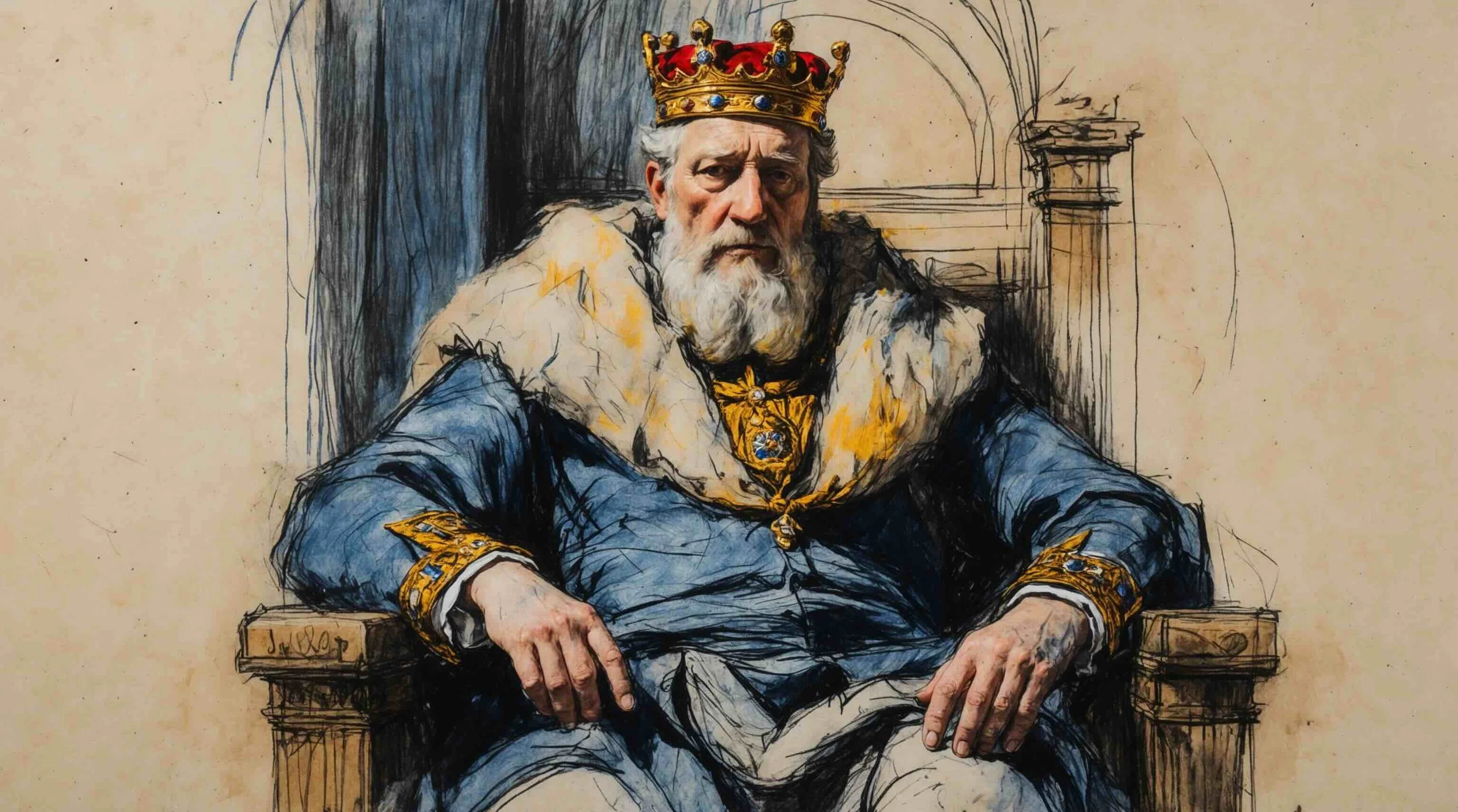
Character Profile – At a Glance
- Role: The eldest of the three York brothers, on the throne as the play opens. Once a formidable soldier and a notorious womaniser, he is now dying, and his death will leave a child king, a divided court and Richard.
- Key Traits: Tired, anxious and well-meaning. He wants to die with his court at peace and works hard, in his one scene, to arrange it. He is also capable of ordering his brother’s death in a rage and forgetting why.
- The Core Conflict: Edward is trying to leave his kingdom in order and has left it to the wrong man. His last act is to discover that Clarence, whom he condemned and then pardoned, is already dead.
- Key Actions: Is reported sick, weak and melancholy (A1S1). Has Clarence sent to the Tower over a prophecy about the letter G. Gathers his quarrelling court and makes them swear friendship (A2S1). Hears from Richard that Clarence is dead. Remembers everything Clarence did for him and asks why no one pleaded for his life. Dies offstage (A2S2).
- Famous Quote:
"Have I a tongue to doom my brother’s death,
And shall that tongue give pardon to a slave?"
(Act 2, Scene 1) - The Outcome: Dies of illness in Act 2, exactly as Queen Margaret cursed him to – "by surfeit", not by war. His sons are murdered in the Tower and his brother takes the crown.
This Son of York
Edward is described long before he appears, and every description is a diagnosis. Richard’s opening speech names him as the "son of York" whose victory has made glorious summer; within a hundred lines the same brother is explaining, to Hastings, that the King has kept an evil diet and consumed his royal person. Hastings has the news from the sickroom.
Original
No news so bad abroad as this at home:
The King is sickly, weak, and melancholy,
And his physicians fear him mightily.
(Hastings, Act 1, Scene 1)
Shakespeare Retold (Modern Verse)
The foreign news is not as bad as here:
The King is sick and weak, and all depressed,
And all his doctors fear he won’t survive.
The play needs Edward to be dying for two reasons. His death will make a child king and a protector necessary, and it will remove the one man Richard cannot manipulate: an elder brother who won the throne in battle and knows what Richard is. Richard’s prayer in A1S1 is exact – Edward "must not die" until Clarence has been dealt with – and the play obliges him.
What Edward has done to himself is also part of the picture. Mistress Shore is mentioned before the King is, and the court Richard describes is one where the Queen’s family and the King’s mistress are "mighty gossips" in the monarchy. Edward has ruled by appetite and favour, and the play’s study of power and ambition begins with a king who has already spent his.
A Good Day’s Work
When Edward finally appears, in A2S1, he is doing something no one else in the play attempts: making peace. He has gathered the two factions of his court – the Queen’s relatives on one side, Hastings and Buckingham on the other – and made them shake hands.
Original
Why, so: now have I done a good day’s work.
You peers, continue this united league.
(Act 2, Scene 1)
Shakespeare Retold (Modern Verse)
Well, there we are: I’ve done a good day’s work.
You all must persevere to keep the peace.
He means it. He speaks of expecting an embassy from his Redeemer and of wanting to leave his friends at peace on earth. The language is that of a man arranging his own deathbed, and there is something moving in the effort: a king who has spent his reign making enemies for his wife’s family now wants the enemies to love each other.
The audience, though, has been in A1S1 and A1S3. It knows that Hastings and Rivers mean nothing by their handshake, that Buckingham’s oath is a lie, and that the one man not yet in the room has arranged the death of another brother that very morning. Edward’s peace is real to Edward and to no one else, and the scene is the play’s bleakest study of appearance and reality: a reconciliation staged for a dying man who is the only person who believes in it.
Take Heed You Dally Not Before Your King
Edward is not a fool. He knows that hands can be shaken without hearts, and he says so, with a warning that turns out to be the truest prophecy in the scene.
Original
Take heed you dally not before your king,
Lest He that is the supreme King of kings
Confound your hidden falsehood and award
Either of you to be the other’s end.
(Act 2, Scene 1)
Shakespeare Retold (Modern Verse)
Make sure you are not lying to your king,
Or else our God, the real King of kings,
Will penalise your lying and declare
That both of you will die for that one sin.
God, he says, will confound hidden falsehood and make each false swearer the other’s destruction. That is precisely what happens. Hastings, Rivers, Grey and Buckingham all die within three acts, and Buckingham dies remembering that he swore falsely in this room. Edward has spoken the play’s rule about prophecy and curses without knowing he was doing it.
Then Richard enters, and outdoes everyone. He declares that he is at odds with no Englishman alive, no more than a newborn infant, and thanks God for his humility. The court is delighted. Edward is delighted. Queen Elizabeth, encouraged, asks the King to extend his grace to Clarence – and Richard, with an expression of outrage, asks who does not know that Clarence is dead.
Who Sued to Me for Him?
The news of Clarence’s death breaks the scene open, and it gives Edward his one great speech. He had ordered the execution and then reversed the order; Richard explains that the reprieve arrived too late. Edward turns on his court.
Original
Have I a tongue to doom my brother’s death,
And shall that tongue give pardon to a slave?
My brother killed no man, his fault was thought,
And yet his punishment was bitter death.
(Act 2, Scene 1)
Shakespeare Retold (Modern Verse)
Would I instruct my brother to be killed
And then order a pardon on a slave?
My brother didn’t kill a man; he thought wrong,
And due to that, his punishment was death.
Stanley has just knelt to beg a pardon for a servant who killed a man in a brawl, and Edward grants it, and the granting is what breaks him. He can pardon a murderer for a nobleman’s asking, and no nobleman asked for his brother. The speech that follows is a catalogue of everything Clarence did for him – deserting Warwick, rescuing him at Tewkesbury, giving him his own clothes on a frozen night – and a demand to know why nobody reminded him.
The answer, which Edward never learns, is that the one man who could have reminded him was the man who arranged the death. But the speech is not only about Richard’s guilt. Edward ends by fearing God’s justice on himself and his house, and he is right to. He signed the warrant. The play’s treatment of conscience and guilt gives him the dignity of knowing it before he dies.
"Each of these great historical tragedies begins with a struggle for the throne, or for its consolidation. Each ends with the monarch’s death and a new coronation."
— Jan Kott, Shakespeare Our Contemporary, 1964
Key Quotes
Quote 1
I every day expect an embassage
From my Redeemer to redeem me hence;
And more in peace my soul shall part to heaven,
Since I have made my friends at peace on earth.
(Act 2, Scene 1)
Shakespeare Retold (Modern Verse)
Each day I now expect to get a message
From God to say my days on earth are done;
And I’ll ascend to heaven peacefully
Because I’ve brought my friends on earth to peace.
Quote Analysis: Edward on his own death, in the language of diplomacy: he is waiting for an ambassador from God to recall him. It is a gentle, courtly image, and it tells us what kind of king he thinks he has been – one who arranges things. The peace he has just brokered is offered as his passport to heaven. That the peace is worthless is not his fault, and the play lets him keep the illusion for another hundred lines.
Is Clarence dead? The order was reversed.
(Act 2, Scene 1)
Shakespeare Retold (Modern Verse)
Is Clarence dead? I had the order cancelled.
Quote Analysis: One line, and it is the sound of a man realising he has killed his brother by accident. Edward had given the order in anger and countermanded it; Richard, who intercepted the countermand, tells him in the next breath that the first order travelled by "a winged Mercury" and the second by "some tardy cripple". The joke is Richard’s, aimed at his own deformity, and it is made over the corpse of the man he murdered, to the man who signed the warrant.
Who sued to me for him? Who (in my wrath)
Kneeled at my feet and bid me be advised?
Who spoke of brotherhood? Who spoke of love?
Who told me how the poor soul did forsake
The mighty Warwick and did fight for me?
Who told me, in the field at Tewksbury,
When Oxford had me down, he rescued me,
And said, "Dear brother, live, and be a king"?
(Act 2, Scene 1)
Shakespeare Retold (Modern Verse)
Who begged his case to me? Who, in my anger,
Kneeled down to ask that I should reconsider?
Who spoke to me about my brotherly love?
Who said the poor soul left his father-in-law,
The Earl of Warwick, just to fight for me?
Who told me, in the battlefield of Tewksbury,
He saved me when the Earl of Oxford held me,
And said, ‘Dear brother, live, and be a king’?
Quote Analysis: The centre of Edward’s great speech. Each question is an accusation, and each is also a memory: Clarence leaving Warwick’s side to fight for his brother, Clarence rescuing him when Oxford had him down at Tewkesbury, Clarence saying "live, and be a king". Edward is reconstructing a debt in public and finding that no one at court thought it worth mentioning. The repeated "Who" is the sound of a king discovering that his courtiers tell him only what he wants to hear.
O God! I fear thy justice will take hold
On me and you, and mine and yours, for this.
(Act 2, Scene 1)
Shakespeare Retold (Modern Verse)
Oh God! I fear you will inflict your justice
On me and you, and all our loved ones, for this.
Quote Analysis: Edward’s last words in the play, and they are a prophecy. God’s justice will fall on him, on his court, and on both their families; and it does – on his sons in the Tower, on Queen Elizabeth’s brothers at Pomfret, on Hastings, on Buckingham. Edward is the first character in the play to see the shape of the coming punishment, and unlike Queen Margaret he includes himself in it. He is carried out to die, and his next appearance is as a corpse being wept over.
Key Takeaways
- The Dying King: Edward is sick before the play starts and dead by Act 2. His weakness is the space in which Richard works.
- The Peacemaker: His one scene is spent making his court swear friendship. Everyone swears; no one means it; Richard arrives and swears most.
- The Brother Who Signed: He ordered Clarence’s death in a rage and reversed it too late. The play lets him remember every reason he should not have.
- The First Prophecy Fulfilled: Margaret cursed him to die by surfeit, not war. He does, and every curse after his follows the same pattern.
Study Questions and Analysis
Who is Edward IV and what has happened before the play begins?
Edward of York was the eldest son of Richard, Duke of York, whose claim to the throne started the Wars of the Roses. He won the crown in battle in 1461, lost it briefly to Warwick and Henry VI in 1470, and won it back for good at Barnet and Tewkesbury in 1471 – the battles in which, in Shakespeare’s version, Henry VI’s son was killed and after which Henry himself was murdered in the Tower. The three Henry VI plays tell that story. Richard III opens twelve years later, with the war won and Edward wearing out.
His brother’s account of his condition in A1S1 is the audience’s first bulletin:
O, he hath kept an evil diet long,
And overmuch consumed his royal person...
(Richard, Act 1, Scene 1)
Shakespeare Retold (Modern Verse)
For ages he has lived unhealthily,
And finally, that has caught up to harm him...
Two things about Edward’s past shape the play. The first is his marriage: he married Queen Elizabeth, a widow with two sons and no royal blood, for love or lust, and raised her family to power over the heads of the old nobility, which is why the court is divided when he dies. The second is his brother Clarence, who changed sides during the war and was forgiven, and whom Edward has now, on the strength of a prophecy about the letter G, sent to the Tower. Peter Saccio’s Shakespeare’s English Kings (1977) sets out how much of this is history and how much is Shakespeare’s compression: the real Edward reigned for twelve more years after Tewkesbury, and the play folds them into a single winter of discontent.
Why does Edward try to make peace in Act 2, Scene 1, and why does it fail?
Because he is dying and knows what his death will mean. A boy of twelve will be king; the boy’s mother’s family and the old nobles hate each other; and the only adult York brother left will be Richard. Edward’s reconciliation is an attempt to build a government that can survive him, and it is the sensible thing to do. It fails because everyone in the room is lying, and the biggest liar arrives last:
I do not know that Englishman alive
With whom my soul is any jot at odds
More than the infant that is born tonight.
I thank my God for my humility.
(Richard, Act 2, Scene 1)
Shakespeare Retold (Modern Verse)
I don’t know any Englishman alive
With whom I am at odds with, any more than
An infant who has just been born tonight.
And thank you, God, for making me so humble.
The audience has heard Richard plan Clarence’s murder, boast of setting the court against itself, and mock the very piety he now performs. "I thank my God for my humility" is the play’s most brazen line, spoken to a man who will be dead within the scene. Edward’s peace is not so much broken as never made; he has extracted oaths from people who regard oaths as breath.
Wolfgang Clemen’s A Commentary on Shakespeare’s Richard III (1968) reads the scene as a set piece of dramatic irony, in which every gesture of reconciliation is undercut by what the audience already knows, and the King is the only person on stage without that knowledge. A. P. Rossiter’s "Angel with Horns" (1961) would add that the audience’s superior knowledge is part of the play’s design: we are invited to enjoy Richard’s performance even as we watch a dying man deceived by it, and the enjoyment is not comfortable.
Is Edward responsible for Clarence’s death?
Partly, and the play is careful to say so. Richard arranged it: he planted the prophecy, urged the King’s hatred with lies, and made sure the reprieve arrived late. But Edward gave the order. The warrant was his, the rage was his, and his own speech admits that no one had to persuade him:
All this from my remembrance brutish wrath
Sinfully plucked, and not a man of you
Had so much grace to put it in my mind.
(Act 2, Scene 1)
Shakespeare Retold (Modern Verse)
All this I had forgotten, plucked by wrath
From my sick memory, whilst none of you
Have had the decency to just remind me.
"Brutish wrath" and "sinfully plucked" are Edward’s own words for what he did, and they are the words of a man who knows that anger does not excuse a death sentence. The blame he lays on the court – that none of them reminded him – is fair as far as it goes, but it is also a king discovering that he surrounded himself with people who would not contradict him.
Harold C. Goddard’s The Meaning of Shakespeare (1951) reads the play as a chain in which every death is shared out among several hands, and Clarence’s is the clearest case: Richard’s plot, Edward’s warrant, the murderers’ daggers and the court’s silence all contribute, and no single person carries the whole weight. E. M. W. Tillyard (1944) would add Queen Margaret’s curse, and note that Edward, who has perjured and killed his way to the throne in the earlier plays, is not an innocent king betrayed. The play lets him feel guilty, which is more than it allows most of its characters, and then it lets him die.
How is Edward’s reputation used against his sons after his death?
Ruthlessly. The case for setting aside Edward’s children is built entirely on Edward’s private life, and it is Richard and Buckingham who build it. In A3S5 Richard instructs Buckingham to tell the citizens about Edward’s "hateful luxury" and "bestial appetite", and to hint that Edward himself was a bastard. At the Guildhall Buckingham does all this, adding a supposed earlier contract of marriage to a Lady Lucy and another by proxy in France, so that the marriage to Elizabeth becomes bigamy and the princes illegitimate. Then, at Baynard’s Castle, he sets the dead king against the living brother:
Ah ha, my lord, this prince is not an Edward!
He is not lulling on a lewd love-bed,
But on his knees at meditation;
Not dallying with a brace of courtesans,
But meditating with two deep divines;
Not sleeping, to engross his idle body,
But praying, to enrich his watchful soul.
(Buckingham, Act 3, Scene 7)
Shakespeare Retold (Modern Verse)
Ah ha, my lord, this prince is not like Edward!
He’s not in bed, adulterous, with someone,
But kneeling in deep prayer and meditation;
Not frolicking about with prostitutes,
But meditating with two righteous priests;
Not fattening himself up in a slumber,
But praying to improve his watchful soul.
Every detail is chosen for contrast: the love-bed against the knees, the courtesans against the divines, the sleeping body against the praying soul. Edward, who is not there to answer, is turned into the standard of vice against which Richard’s staged piety can shine. It is manipulation and deceit at its most efficient, because the slander has a grain of truth: Edward was a womaniser, and everyone in London knew it.
Peter Saccio (1977) notes that the precontract story has some historical basis – Richard’s parliament did declare Edward’s marriage invalid on those grounds – but that Shakespeare, following Hall and Holinshed, presents it as pure invention. The play is not interested in whether the princes were legitimate. It is interested in how easily a dead man’s reputation can be made into a weapon against his children.
What does Edward’s death mean for the structure of the play?
It is the hinge. Everything before it is Richard clearing the ground; everything after it is Richard taking the crown. The citizens who meet in the street in A2S3 understand this better than the court does:
THIRD CITIZEN: Then, masters, look to see a troublous world.
FIRST CITIZEN: No, no, by God’s good grace his son shall reign.
THIRD CITIZEN: Woe to that land that’s governed by a child!
(Act 2, Scene 3)
Shakespeare Retold (Modern Verse)
THIRD CITIZEN: Then, friends, prepare yourselves for troubling times.
FIRST CITIZEN: No, by God’s will, his son shall rule as King.
THIRD CITIZEN: It’s awful when a child rules the country!
The First Citizen’s hope that the son will reign is the official line, and the Third Citizen’s proverb is the truth. A minority means a protector, and the protector is Richard. Shakespeare gives the scene to three anonymous Londoners because they have no stake in the quarrel and can say what everyone else is afraid to.
Jan Kott’s Shakespeare Our Contemporary (1964) describes each of the histories as beginning with a struggle for the throne and ending with the monarch’s death and a new coronation; Richard III contains two such deaths, and Edward’s is the one that starts the machine. E. M. W. Tillyard (1944) saw it differently, as the moment the house of York begins to pay for its crimes in the earlier plays. Either way the play’s treatment of fate and free will turns on this offstage death. Edward does not choose to die; but his dying is what makes every choice that follows possible.
How does Shakespeare’s Edward compare with the historical Edward IV?
The historical Edward was one of the most capable kings of the fifteenth century: a brilliant soldier who never lost a battle, a shrewd manager of money, and a man of famous charm and famous appetites. He died in April 1483, aged forty, of an illness that contemporaries attributed to excess. Shakespeare keeps the appetites and the death and drops almost everything else. His Edward is sick from his first mention and dead by Act 2, and the audience never sees the soldier.
The play does, however, remember the cause of death. Queen Margaret names it in her curse:
Though not by war, by surfeit die your king,
As ours by murder, to make him a king!
(Queen Margaret, Act 1, Scene 3)
Shakespeare Retold (Modern Verse)
May your king die from gluttony, not war,
For he’s now king due to my husband’s murder!
"Surfeit" – excess of food, drink and pleasure – is exactly what Edward dies of, and Margaret’s curse is the first of hers to be paid. Peter Saccio’s Shakespeare’s English Kings (1977) points out that Shakespeare’s telescoping of time makes the death look like a judgement: twelve years of successful rule are compressed into a few weeks of decline, so that the King seems to sicken as soon as the play opens and to die as soon as he is cursed. The real Edward was a victor who lived long enough to grow fat. The play’s Edward is a warning about what power and ambition does to the man who has it and stops fighting for it.
Why does Shakespeare give the dying King only one scene?
Because one scene is enough to show what the play needs: a king who means well, cannot see, and is about to leave the field to a brother who can. Edward is not a character in the sense that Richard or Queen Margaret are characters. He is a condition – the weakness at the top through which the villain climbs – and the play gives him precisely as much life as that condition requires, and then one speech more.
That speech, the lament for Clarence, is the extra. It is not necessary to the plot; the scene could end with Richard’s news and the King’s collapse. Shakespeare instead gives Edward forty lines of memory and self-reproach, and they change how we read the death that follows. Queen Elizabeth’s grief in the next scene is for this man:
Ah! Who shall hinder me to wail and weep,
To chide my fortune, and torment myself?
(Queen Elizabeth, Act 2, Scene 2)
Shakespeare Retold (Modern Verse)
Oh, who on earth can stop my yells and tears,
My curses at my fate, and my self-torment?
Nicholas Brooke’s Shakespeare’s Early Tragedies (1968) observes how the play alternates between Richard’s quick, ironic scenes and the slow, formal scenes of the people he destroys, and Edward’s single appearance belongs to the second kind: it is a ritual of reconciliation followed by a ritual of remorse, and Richard cuts through both. Wolfgang Clemen (1968) treats the King’s speech as the play’s first real expression of guilt, a rehearsal for the one Richard will give in Act 5 and will not be able to finish. Edward, who has done far less harm, is allowed to feel far more. That, in this play, is what it means to be a minor character.