The Duke of Buckingham
Character Profile – At a Glance
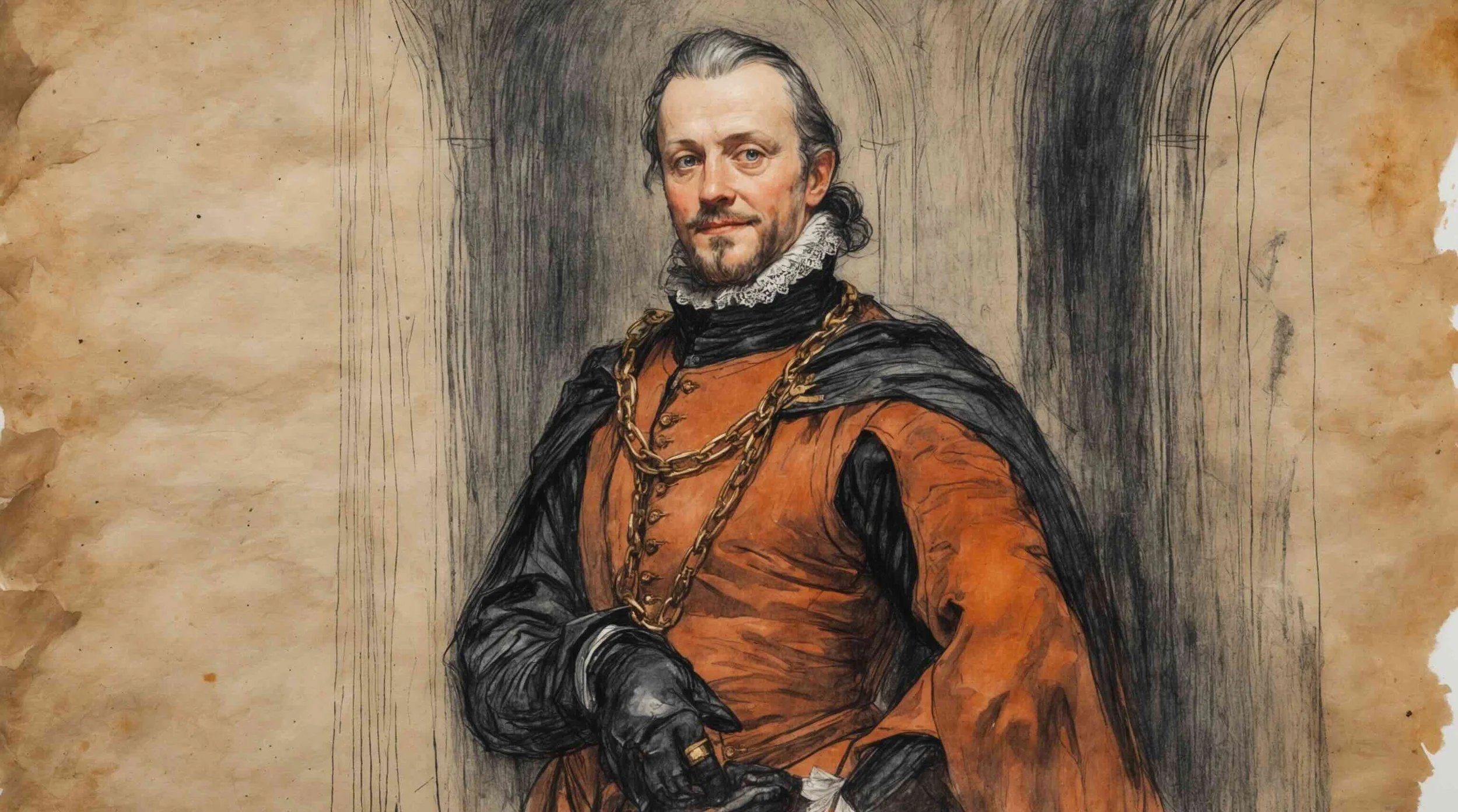
- Role: Henry Stafford, Duke of Buckingham: the ablest politician at court after Richard himself, and the ally Richard chooses. He manages Richard’s rise to the crown, hesitates over the murder of the princes, and is destroyed for it.
- Key Traits: Fluent, confident and quick. A gifted stage-manager who can talk a City crowd, a Lord Mayor or a council into anything. He believes he is Richard’s partner. He is Richard’s instrument.
- The Core Conflict: Buckingham can do everything Richard needs except the one thing that matters most. When he pauses over the killing of two children, the partnership ends, and he discovers that a kingmaker has no protection from the king he made.
- Key Actions: Swears friendship with the Queen’s party at Edward’s deathbed (A2S1). Arranges the arrest of Rivers, Grey and Vaughan on the road from Ludlow. Argues the young Duke of York out of sanctuary (A3S1). Rehearses his acting for the Lord Mayor (A3S5). Reports the silence at the Guildhall and stages the show at Baynard’s Castle (A3S7). Asks for time to think about the princes (A4S2). Is refused his promised earldom and flees. Is captured and executed on All Souls’ Day (A5S1).
- Famous Quote:
"And is it thus? Repays he my deep service
With such contempt? Made I him king for this?"
(Act 4, Scene 2) - The Outcome: Beheaded on Richard’s order after his rebellion fails. His ghost is the last to visit Richard’s tent before Bosworth.
Curses Never Pass the Lips
Buckingham’s first real moment is a refusal to be afraid. In A1S3 Queen Margaret has cursed everyone in the room, one by one, and then exempted Buckingham: his garments are not spotted with her family’s blood. She offers to kiss his hand. He answers with an aristocrat’s contempt for superstition.
Original
Nor no one here; for curses never pass
The lips of those that breathe them in the air.
(Act 1, Scene 3)
Shakespeare Retold (Modern Verse)
Nobody’s implicated, for your curses
Are nothing more than breath within the air.
Margaret warns him against Richard anyway, and he tells the others that her curses have made his hair stand on end – a line usually played for a laugh. It should not be. Everyone Margaret has cursed will die in the order she named them, and Buckingham, who was spared, will die by his own oath instead.
The scene tells us what kind of man he is. Buckingham is a rationalist in a play where the irrational keeps winning. He thinks curses are breath, oaths are formalities and politics is technique, and for three acts the play lets him be right. The theme of prophecy and curses runs beneath his career like a fuse, and he is the last person on stage to notice it burning.
The Deep Tragedian
Richard and Buckingham in A3S5 are two actors warming up. Hastings has just been beheaded on a pretext; the Lord Mayor is on his way; and the two men have to convince him that the execution was necessary. Richard asks whether Buckingham can tremble and change colour on cue. Buckingham’s answer is a professional’s.
Original
Tut, I can counterfeit the deep tragedian,
Speak and look back, and pry on every side,
Tremble and start at wagging of a straw;
Intending deep suspicion, ghastly looks
Are at my service, like enforced smiles;
And both are ready in their offices
At any time to grace my stratagems.
(Act 3, Scene 5)
Shakespeare Retold (Modern Verse)
Pah! I can fake fear like a tragic actor,
And speak and look around as though I’m frightened,
And tremble when a blade of grass is nodding;
Pretending I’m suspicious, looking scared,
Are all skills at my service, like a fake smile;
And both those skills are ready to deploy
At any time to liven up my plans.
The speech is a catalogue of technique: the backward glance, the start at a straw, the ghastly look, the enforced smile, all "at my service" and ready to be deployed. He talks about fear the way a carpenter talks about tools. It is also, though he does not know it, the last time in the play he will be this sure of himself.
The comparison with Richard is the point of the scene. Richard is a great actor because he enjoys it; Buckingham is a competent one because he has studied it. The difference does not show while things are going well. It shows in A4S2, when Richard asks for something that no amount of technique can supply, and Buckingham discovers he has a limit. The play’s treatment of appearance and reality is not that appearances deceive but that some people can keep them up longer than others.
Play the Maid’s Part
A3S7 is Buckingham’s masterpiece and his one scene as director rather than actor. He has been to the Guildhall to persuade the citizens to call for Richard as king, and they have stood like "dumb statues" and said nothing. Undeterred, he arranges the next performance: the Lord Mayor will come to Baynard’s Castle, and Richard will be found at prayer.
Original
And look you get a prayer-book in your hand,
And stand between two churchmen, good my lord –
For on that ground I’ll make a holy descant –
And be not easily won to our requests:
Play the maid’s part, still answer nay, and take it.
(Act 3, Scene 7)
Shakespeare Retold (Modern Verse)
And go and hold a prayerbook in your hand,
And stand between two priests, my noble lord –
So I can talk about your holy nature –
And push back on requests that you be king:
Act virgin-like, say no, but then accept it.
A prayer book, two bishops, a show of reluctance, and a refusal that must be overcome three times. Buckingham then goes out and performs his half – the pleading, the outrage, the threat to crown someone else, the walk-out – and Richard performs his, and the Lord Mayor sees a holy man dragged unwillingly to the throne.
"Play the maid’s part" gives the game away. The whole scene is a courtship in which the bride has arranged her own proposal, and Buckingham knows it, and the audience knows it, and only the Mayor and the citizens do not. It is the play’s fullest demonstration of manipulation and deceit as a public art, and Buckingham is its author. Richard could not have done it alone. He needed someone the City would believe.
Made I Him King for This?
Two scenes later Richard is crowned, and the first thing he asks his kingmaker for is the death of the two princes. Buckingham asks for a moment to think. When he returns he has thought, and he raises instead the earldom of Hereford that Richard promised him. Richard talks over him about Richmond and prophecies, and then says he is not in the giving vein. Buckingham is left alone.
Original
And is it thus? Repays he my deep service
With such contempt? Made I him king for this?
O, let me think on Hastings, and be gone
To Brecknock while my fearful head is on!
(Act 4, Scene 2)
Shakespeare Retold (Modern Verse)
And this is how it is? He pays me back
With deep contempt? I made him king for this?
I’ll leave, recalling Hastings now is dead,
And go to Wales while I still have my head!
"Made I him king for this?" is the question of every enabler in history, asked a scene too late. Buckingham thinks of Hastings, who was executed for hesitating, and runs for Wales. His rebellion fails in a single scene of messengers; his capture is reported in another; and his last appearance is on the way to the block.
What has happened is simple and the play makes no fuss about it. Buckingham was useful, then he was not, and Richard has no category between the two. A partnership in power and ambition of this kind is not a partnership; it is employment, and the employer decides when it ends. Buckingham’s tragedy is that he was clever enough to build the throne and not clever enough to see that there was only one seat on it.
"He is pathologically narcissistic and supremely arrogant. He has a grotesque sense of entitlement, never doubting that he can do whatever he chooses."
— Stephen Greenblatt, Tyrant: Shakespeare on Politics, 2018
Key Quotes
Quote 1
When ever Buckingham doth turn his hate
Upon your Grace
But with all duteous love
Doth cherish you and yours, God punish me
With hate in those where I expect most love!
(Act 2, Scene 1)
Shakespeare Retold (Modern Verse)
If I, the Duke of Buckingham, show hatred
Towards your Grace
And fail to offer love
To you and family, let God punish me
With hatred from the folk I thought would love me!
Quote Analysis: Buckingham’s oath at the dying King’s bedside, where King Edward has gathered his court to make peace. He swears that if he ever turns against Queen Elizabeth’s family, God should punish him with hatred from those he most expects to love him. He is lying, and the play remembers. In A5S1, on the way to execution, he quotes this oath back and recognises that it has been answered to the letter: the friend he trusted most has cut off his head.
No, so God help me, they spake not a word,
But like dumb statues, or breathing stones,
Stared each on other, and looked deadly pale...
(Act 3, Scene 7)
Shakespeare Retold (Modern Verse)
God help me, no, they didn’t speak a word,
But stood like silent statues made of stone,
And stared at one another, deathly pale...
Quote Analysis: The report from the Guildhall. Buckingham has done everything: attacked the legitimacy of Edward’s children, praised Richard’s victories and virtues, and called on the citizens to acclaim him. The citizens said nothing. It is the only moment in the play when ordinary people are asked to endorse Richard, and their answer is silence – a detail Shakespeare took from Thomas More and kept. Buckingham’s solution is to have ten of his own men shout from the back of the hall and call it "general applause".
Give me some little breath, some pause, dear lord,
Before I positively speak in this.
I will resolve you herein presently.
(Act 4, Scene 2)
Shakespeare Retold (Modern Verse)
Give me some breathing space and time, my lord,
Before I give an answer either way.
I’ll share my own opinion with you shortly.
Quote Analysis: The three lines that end Buckingham’s career. Richard has asked him, twice, to agree to the murder of the princes, and this is the reply: not a refusal, only a request for time. Richard hears it as refusal. The word "positively" is doing careful work – Buckingham wants to speak positively, that is, definitely, and is not yet able to – and the hesitation is the most human thing he does in the play. It is also fatal. By the time he returns, Richard has found Tyrrel.
That high All-Seer, which I dallied with,
Hath turned my feigned prayer on my head,
And given in earnest what I begged in jest.
(Act 5, Scene 1)
Shakespeare Retold (Modern Verse)
Our God on high, who I have messed about with,
Has flipped my empty prayers upon my head,
And given me what jokingly I asked for.
Quote Analysis: On All Souls’ Day, the day for the dead, Buckingham walks to execution and finally understands the play he has been in. The oath he swore in A2S1 was a "feigned prayer", a request made in jest; God took it seriously. This is the language of the whole play’s treatment of conscience and guilt: what is said carelessly is remembered exactly. The man who told Margaret that curses never pass the lips now finds that his own did not need to.
Key Takeaways
- The Kingmaker: Buckingham manages every stage of Richard’s rise: the arrests, the sanctuary argument, the Guildhall speech, the show at Baynard’s Castle.
- The Rationalist: He laughs at Margaret’s curses and swears oaths he does not mean. The play proves him wrong on both counts.
- The Limit: He can counterfeit any emotion, but he cannot agree to the murder of two children without pausing. The pause ends everything.
- The Discarded Instrument: Richard refuses him his earldom, and his rebellion collapses in a scene of messengers. He dies quoting his own false oath.
Study Questions and Analysis
Who is Buckingham and why does Richard choose him?
Henry Stafford, second Duke of Buckingham, was one of the richest and best-connected noblemen in England, descended from Edward III on both sides and married, against his will, to one of Queen Elizabeth’s sisters. History records that he resented the Woodville match and threw in with Richard the moment Edward IV died. Shakespeare keeps the resentment and drops the marriage, so that Buckingham’s hostility to the Queen’s family looks like principle rather than injury.
Richard chooses him because he is the one man at court who can do what Richard cannot: be believed. Richard is known, feared and physically marked; Buckingham is handsome, plausible and of impeccable blood. When the Queen’s relatives need to be separated from the young Prince on the road from Ludlow, it is Buckingham who proposes the plan:
My lord, whoever journeys to the Prince,
For God sake let not us two stay at home;
For by the way, I’ll sort occasion,
As index to the story we late talked of,
To part the Queen’s proud kindred from the Prince.
(Act 2, Scene 2)
Shakespeare Retold (Modern Verse)
My lord, whoever goes to get the Prince,
For God’s sake, let’s not both of us stay home;
For on the way, I’ll find a decent time,
As per the plan we spoke of recently,
To separate the Prince from his proud family.
Peter Saccio’s Shakespeare’s English Kings (1977) points out that the historical Buckingham did exactly this, and that his later rebellion in October 1483 remains one of the puzzles of the reign: the sources never make clear why the man who had made Richard king turned on him within months. Shakespeare supplies a motive – the princes and the earldom – and a temperament. Stephen Greenblatt’s Tyrant (2018) treats Buckingham as the play’s central example of what Greenblatt calls the enabler: the capable, ambitious man who lends a tyrant his competence in the belief that he will be able to control the result.
How does Buckingham engineer Richard’s rise to the throne?
Step by step, and mostly by talking. He separates the Prince from his mother’s family; he argues the Cardinal into breaking sanctuary to fetch the younger boy; he sounds Hastings through Catesby and, when Hastings proves loyal to Edward’s children, presides with Richard over his destruction; he speaks at the Guildhall; and he stages the scene at Baynard’s Castle. The sanctuary argument in A3S1 is a fair sample of his method:
Oft have I heard of sanctuary men,
But sanctuary children never till now.
(Act 3, Scene 1)
Shakespeare Retold (Modern Verse)
I’ve heard of many men in sanctuary,
But, until now, I’ve never heard of children.
The reasoning is lawyerly and false. Sanctuary, Buckingham says, is for those who have deserved it or have the wit to claim it; a child has done neither; therefore removing him is not a breach. The Cardinal, who has just declared that he would not break sanctuary for the whole kingdom, agrees within four lines. It is the play’s clearest picture of how a good man is talked into a bad act by someone who sounds reasonable.
Wolfgang Clemen’s A Commentary on Shakespeare’s Richard III (1968) notes how much of Act 3 is given to Buckingham rather than Richard, and reads the arrangement as deliberate: Richard withdraws into the background while his instrument does the public work, so that when Richard reappears at Baynard’s Castle he can seem to have been praying all along. Jan Kott, in Shakespeare Our Contemporary (1964), saw in these scenes the machinery of modern politics – the managed crowd, the staged reluctance, the leader who must be seen to be begged – and Buckingham is the operator of the machine.
Why does Buckingham hesitate over the murder of the princes?
The play does not say, and the silence is the point. Buckingham has helped to kill Rivers, Grey, Vaughan and Hastings without a flicker. He has slandered the princes’ legitimacy in public. Yet when Richard, now king, asks him plainly to have the boys killed, he asks for breath. When he comes back, he changes the subject:
My lord, I have considered in my mind
The late request that you did sound me in.
(Act 4, Scene 2)
Shakespeare Retold (Modern Verse)
My lord, I’ve given due consideration
To what it was you asked me earlier.
Three readings are possible. The first is conscience: two children in the Tower are a different order of crime from four adult politicians, and Buckingham has found his floor. The second is calculation: he can see that the murder of the princes will make Richard hated, and does not want his name on it. The third is pride: he has made a king, expects to be consulted as a partner, and is being given orders like a servant.
A. P. Rossiter’s "Angel with Horns" (1961) argues that the play refuses to let its audience settle on any single moral view of its characters, and Buckingham’s pause is a good example: it is the one decent impulse he shows, and it is also self-interested, and the play declines to separate the two. Stephen Greenblatt’s Tyrant (2018) reads the moment structurally: the enabler always has a limit, the tyrant always finds it, and the discovery is always fatal to the enabler. What is not in doubt is Richard’s reaction. He does not argue, persuade or wait. He sends for a page and asks whether he knows anyone who would kill for money.
What is the significance of the "giving vein" exchange?
It is the end of the partnership, and it is staged as a comedy of manners. Buckingham has come to collect. Richard promised him the earldom of Hereford and the King’s moveable goods in return for his services, and Buckingham asks for them in the correct form:
My lord, I claim the gift, my due by promise,
For which your honour and your faith is pawned,
Th’ earldom of Herford, and the moveables,
Which you have promised I shall possess.
(Act 4, Scene 2)
Shakespeare Retold (Modern Verse)
My lord, I’d like to claim my promised gift
That, in good faith, you’d offered for my service,
To be the Earl of Hereford, and assets,
Which you have promised that you’ll give to me.
Richard does not answer. He talks about Richmond, about a prophecy that Richmond would be king, about an Irish bard who once told him he would not live long after seeing Richmond, about a castle in Exeter called Rouge-mount. Buckingham asks again, and again, and is told to stop troubling the King. Then: "I am not in the giving vein today." Buckingham has been dismissed with a figure of speech.
The exchange is famous partly because of what was done to it later. Colley Cibber’s 1700 adaptation of the play, which held the stage for over a century and a half, added a line for Richard at this point: "Off with his head! So much for Buckingham." The line is not Shakespeare’s, though it has been quoted as his ever since; in Shakespeare, Richard simply refuses, and Buckingham is left to draw his own conclusion. The restraint is more frightening than the addition. Nothing is said, and both men know.
What does Buckingham’s speech before his execution reveal?
That he has finally understood the play’s rules. On the way to the block, Buckingham asks the sheriff what day it is, learns that it is All Souls’ Day, and remembers the oath he swore at Edward’s bedside:
This is the day which, in King Edward’s time,
I wished might fall on me when I was found
False to his children and his wive’s allies;
This is the day wherein I wished to fall
By the false faith of him whom most I trusted...
(Act 5, Scene 1)
Shakespeare Retold (Modern Verse)
Today’s the day, when Edward was alive,
I wished would fall on me if I was found
To cheat his children or friends of his wife;
Today’s the day I wished would happen to me
If he whom I had trusted most deceived me...
Buckingham then names the "high All-Seer" he "dallied with", concludes that God has turned his feigned prayer on his head, and quotes Queen Margaret’s prophecy that he would one day wish he had listened to her. It is a full confession in the form of a lesson, and it is the last of the play’s many recognitions: Clarence, Rivers, Hastings and Anne have all remembered a curse in their final moments, and Buckingham completes the series.
E. M. W. Tillyard’s Shakespeare’s History Plays (1944) took speeches like this as proof that the play is built on a providential scheme, in which every crime is punished on schedule and the schedule is announced in advance. Robert Ornstein’s A Kingdom for a Stage (1972) argued instead that the histories are dramas of political character in which characters read providence into events after the fact; on that view Buckingham is not discovering God’s plan but constructing one, because a man about to die would rather be punished than merely unlucky. The speech supports both readings, which is why it is worth quoting in an essay on either.
Is Buckingham a villain or a victim?
He is a villain who becomes a victim, and the play is exact about when. Up to A4S2 Buckingham is an accomplice in every crime Richard commits, and a willing one; he has no soliloquy in which he confides doubts, and the only performance he gives the audience is the one in A3S5 where he boasts of his ability to fake fear. After A4S2 he is prey.
His ghost puts the two halves together in a single couplet:
The first was I that helped thee to the crown;
The last was I that felt thy tyranny.
(Act 5, Scene 3)
Shakespeare Retold (Modern Verse)
I was the first to help you win the crown,
And was the last to feel your tyranny.
The couplet is a claim to a special place in the story, and it is justified. Buckingham was the first to help and the last to be destroyed, and the play arranges the sequence so that each of Richard’s victims dies for something he has done: Clarence for perjury, Hastings for complacency, Buckingham for his oath. Harold C. Goddard, in The Meaning of Shakespeare (1951), read the play as a demonstration that evil consumes its own agents in order, and Buckingham is its most detailed case. A useful essay question is whether the audience is meant to pity him. The text gives him no scene of remorse over the princes, only over himself, and the sympathy it allows is the sympathy one extends to a man who understands, too late, exactly what he has done.
How does Buckingham compare with Richard as a performer?
He is the better public speaker and the worse actor, and the play keeps the distinction clear. Buckingham’s set pieces – the sanctuary argument, the Guildhall oration, the pleading at Baynard’s Castle – are formal, fluent and technically superb. He describes his own method as an orator would:
Doubt not, my lord, I’ll play the orator
As if the golden fee for which I plead
Were for myself – and so, my lord, adieu.
(Act 3, Scene 5)
Shakespeare Retold (Modern Verse)
Don’t doubt it, sir, I’ll speak like I’m performing
To win the golden crown as King I ask for
Like it was for myself. So, sir, goodbye.
Richard’s performances are different in kind. He does not play the orator; he plays whoever the person in front of him needs him to be, and he enjoys the deception in a way Buckingham never does. Charles Lamb, writing in the Morning Post in 1802, saw that Richard’s "unstrained mirth" was what made his villainy bearable to an audience; Buckingham has no mirth, only competence, and the audience never warms to him as it does to Richard.
The difference is visible in their failures. When the citizens refuse to cheer at the Guildhall, Buckingham reports the failure without excuses and fixes it with a crowd of his own men; a good manager’s solution. When Richard fails – with Queen Elizabeth in A4S4, with his own conscience in A5S3 – he does not manage it; he denies it and roars. Buckingham is the play’s study of language and rhetoric as a skill. Richard is its study of language as a nature. The skill can be hired, and dismissed. The nature cannot.