Richard III: Act 3, Scene 6 – Analysis
Scene Profile – At a Glance
- Location: London. A street.
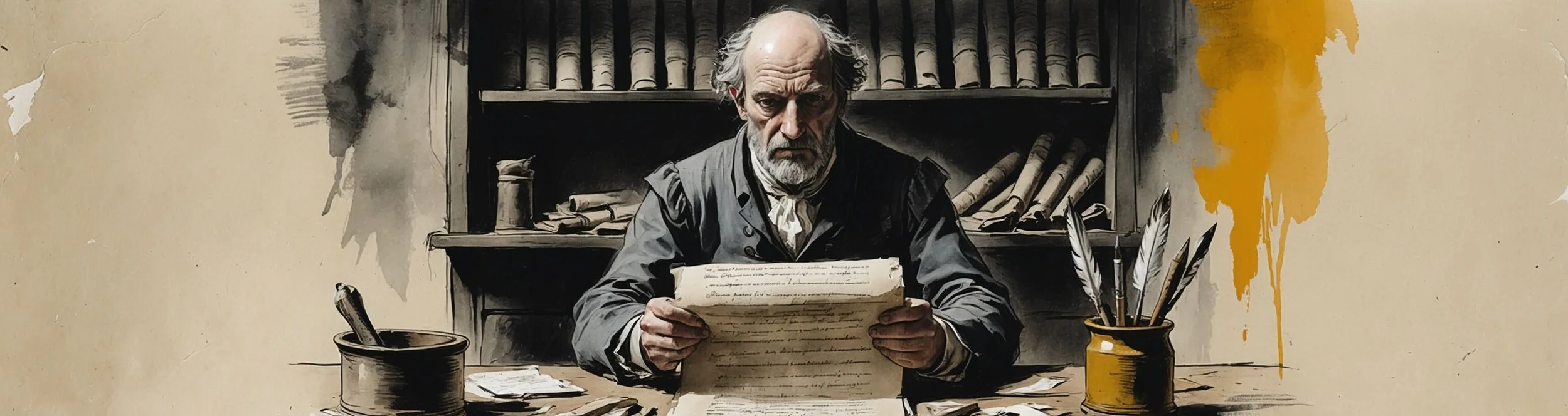
- What Happens: A Scrivener enters with the fair copy of the indictment against Hastings, which is to be read publicly at St Paul’s, and works out aloud that it was commissioned before the crime it charges.
- Key Characters: The Scrivener – a professional copyist, alone.
- Dramatic Function: A fourteen-line chorus between the execution of Hastings and the offer of the crown: an ordinary Londoner shows the audience the paperwork of tyranny.
- Famous Quote:
"Who is so gross
That cannot see this palpable device?
Yet who’s so bold but says he sees it not?"
(Scrivener, Act 3, Scene 6) - Why It Matters: The play’s shortest scene states its political argument most directly – everyone can see the device, and nobody dares say so.
Scene Summary
A Scrivener – a clerk who copies documents for a living – comes on alone holding a paper. It is the indictment of Lord Hastings, written out in a set hand and fairly engrossed so that it can be read aloud at St Paul’s today. He asks the audience to notice how well the sequel hangs together. He has spent eleven hours copying it; Catesby sent it to him last night; the original draft took as long again to prepare; and yet five hours ago Hastings was alive, untainted, unexamined and free.
He draws the conclusion. Here is a good world, when the device is so palpable that only a gross man could fail to see it, and yet nobody is bold enough to say he sees it. The world is bad, he says, and will come to nothing, when such ill dealing must be seen only in thought – and he goes out.
Eleven Hours
The Scrivener’s evidence is arithmetic. A document takes time to write, and this one took more time than has passed since the crime it describes.
Original
Eleven hours I have spent to write it over,
For yesternight by Catesby was it sent me;
The precedent was full as long a-doing,
And yet within these five hours Hastings lived,
Untainted, unexamined, free, at liberty.
(Scrivener, Act 3, Scene 6)
Shakespeare Retold (Modern Verse)
I wrote this out, which took eleven hours,
For last night I received it straight from Catesby;
And that note I received took just the same time,
But yet, five hours ago, Lord Hastings lived,
Without a worry, unaccused and free.
The clerk does not accuse anyone. He lays the timings side by side – eleven hours to copy, as long again to draft, five hours since Hastings was free – and lets the audience add them up. The indictment of a traitor was in preparation before the traitor was arrested, which means the treason was decided before it was discovered. “Untainted, unexamined, free, at liberty” is a list of the legal conditions Hastings still enjoyed while the paper condemning him was being written, and the list is the accusation. Shakespeare gives this to a man with no name and no stake because the point is procedural: tyranny in this play is not only murder but paperwork, and the paperwork is done by ordinary people who can count.
Who Is So Gross?
Having proved the case, the Scrivener asks the question the play has been circling since the citizens’ scene in Act 2: what do people do when they can see what is happening?
Original
Here’s a good world the while! Who is so gross
That cannot see this palpable device?
Yet who’s so bold but says he sees it not?
Bad is the world, and all will come to nought,
When such ill dealing must be seen in thought.
(Scrivener, Act 3, Scene 6)
Shakespeare Retold (Modern Verse)
Oh, what a world we live in! Who’s so stupid
That they can’t see this obvious deception?
But who can see this, yet denies he sees it?
Our world is bad, and all will end up broken
If we leave evil we observe unspoken.
The two questions are a matched pair. Who is so stupid as not to see the trick? Nobody. Who is so brave as to say he sees it? Nobody either. Between them lies the whole condition of Richard’s England, and the Scrivener names it in a closing couplet: a world in which wrongdoing must be seen in thought only will come to nought. It is the play’s argument about appearance and reality turned inside out – the appearance is not deceiving anyone; the reality is simply unsayable. The next scene shows the same thing at scale, when the citizens of London are told that Edward’s children are bastards and answer with silence. The Scrivener is the play’s one witness who says out loud what everyone else only thinks, and he says it to us, alone, in a street, and then goes back to work.
Language and Technique
- The soliloquy of a nobody: Fourteen lines from a character with no name and no other scene: Shakespeare gives the play’s plainest political statement to the man with the least power to make it.
- Evidence by timing: Eleven hours, as long again, five hours: the speech proves its case with numbers, so the audience does the sum and reaches the verdict itself.
- Legal vocabulary: Indictment, engrossed, untainted, unexamined: the Scrivener speaks in the language of the law, and the law is what has been counterfeited.
- Matched questions: “Who is so gross” against “who’s so bold” – two rhetorical questions with the same answer, nobody, which is the scene’s diagnosis.
- Closing couplet: The rhyme on nought and thought seals the speech like a proverb, and the last word is thought – the only place truth is allowed to exist.
Key Quotes from Act 3, Scene 6
Quote 1
Here is the indictment of the good Lord Hastings,
Which in a set hand fairly is engrossed
That it may be today read o’er in Paul’s.
(Scrivener, Act 3, Scene 6)
Shakespeare Retold (Modern Verse)
Here is the note accusing good Lord Hastings,
Which has been written down intelligibly,
To read today outside St Paul’s Cathedral.
Quote Analysis: The document itself, introduced with the adjective the state has just denied him: good Lord Hastings. To be “engrossed” is to be written out in the formal hand used for legal instruments, and St Paul’s was where proclamations were read to the city. The clerk is holding the official version of a lie, and admiring the penmanship.
Bad is the world, and all will come to nought,
When such ill dealing must be seen in thought.
(Scrivener, Act 3, Scene 6)
Shakespeare Retold (Modern Verse)
Our world is bad, and all will end up broken
If we leave evil we observe unspoken.
Quote Analysis: The couplet that ends the scene turns a specific forgery into a general law. A society in which evil can only be observed silently has no future; the rhyme of nought and thought puts the two ideas side by side, and the modern verse keeps the rhyme so the maxim still clicks shut.
Key Takeaways
- The paperwork came first: The indictment took longer to write than Hastings has been dead: the treason was decided before it was found.
- Everyone sees, nobody speaks: The Scrivener’s two questions describe a city that understands the trick and will not name it.
- A nobody as chorus: The play hands its clearest judgement to a copyist with no name, no power and one scene.
- Bridge to Baynard’s Castle: The scene prepares the citizens’ silence in Act 3, Scene 7: what the Scrivener says alone, London will demonstrate in a crowd.
Study Questions and Analysis
What is the Scrivener’s point, and why does the play stop for it?
His point is that the indictment against Hastings was written before Hastings did anything. He has spent eleven hours making the fair copy, the draft took as long again, and Hastings was a free man five hours ago; the document that convicts him of treason was therefore in preparation while he was still at liberty and unaccused. The Scrivener does not name Richard or Buckingham – he does not need to – and asks instead who could fail to see it and who dares to say so.
And yet within these five hours Hastings lived,
Untainted, unexamined, free, at liberty.
(Scrivener, Act 3, Scene 6)
Shakespeare Retold (Modern Verse)
But yet, five hours ago, Lord Hastings lived,
Without a worry, unaccused and free.
The play stops for fourteen lines because the point is not one the main characters can make. Richard and Buckingham have just spent Act 3, Scene 5 persuading the Lord Mayor that Hastings’ execution was lawful and necessary; the Scrivener shows the audience the mechanism from underneath, in the voice of a man paid by the hour to copy it out. Shakespeare took the detail from Sir Thomas More, whose History makes the same joke about the proclamation being too long to have been written in the time; the play turns More’s aside into a scene. A student can treat it as the play’s clearest statement about appearance and reality: the appearance fools nobody, and it works anyway.
Why is the scene so short, and is it ever cut?
It is fourteen lines because it needs no more, and it is cut constantly, because a production in a hurry can lose it without breaking the plot. What is lost is the play’s one moment of ordinary perspective between the execution of Hastings and the offer of the crown – the view of a Londoner who is neither a lord nor a victim, and who understands exactly what the lords are doing. Without him the two great scenes of political theatre on either side, the rusty armour and the prayer-book, have no witness from below.
The scene also does structural work. The Scrivener’s second question – who is so bold as to say he sees it – is answered in the next scene by the citizens’ silence at the Guildhall, and Richard’s whole seizure of the crown depends on that silence holding. Fourteen lines set up two hundred. In a play built from long formal speeches, the brevity is itself a technique: the truth takes a sonnet’s length to say, and the lies take the rest of the act.
Who is the Scrivener, and does he appear in the sources?
A scrivener was a professional writer – a copyist and drafter of legal documents, a member of a London trade company – and this one has been hired, through Catesby, to produce the formal version of the charge against Hastings for reading at St Paul’s Cross. He is the play’s only representative of the city’s working professionals, and Shakespeare gives him the trade’s habits: he notices the hand the document is written in, the hours it took, and the fact that the timings do not work.
He comes from More. Thomas More’s History of King Richard III, Shakespeare’s source at one remove through Hall and Holinshed, reports that the proclamation of Hastings’ treason was so long and so fairly written that it could not have been prepared in the time since his death, and that a schoolmaster who heard it said it was written by prophecy. Shakespeare gives More’s observation a body and a voice, and turns the schoolmaster’s joke into the Scrivener’s two questions. It is a small example of the play’s method with its sources: the chronicle supplies the fact, and the play supplies the person who has to live with it.