Richard III: Act 3, Scene 7 – Analysis
Scene Profile – At a Glance
- Location: Baynard’s Castle, Richard’s London house – a courtyard below and a gallery above.
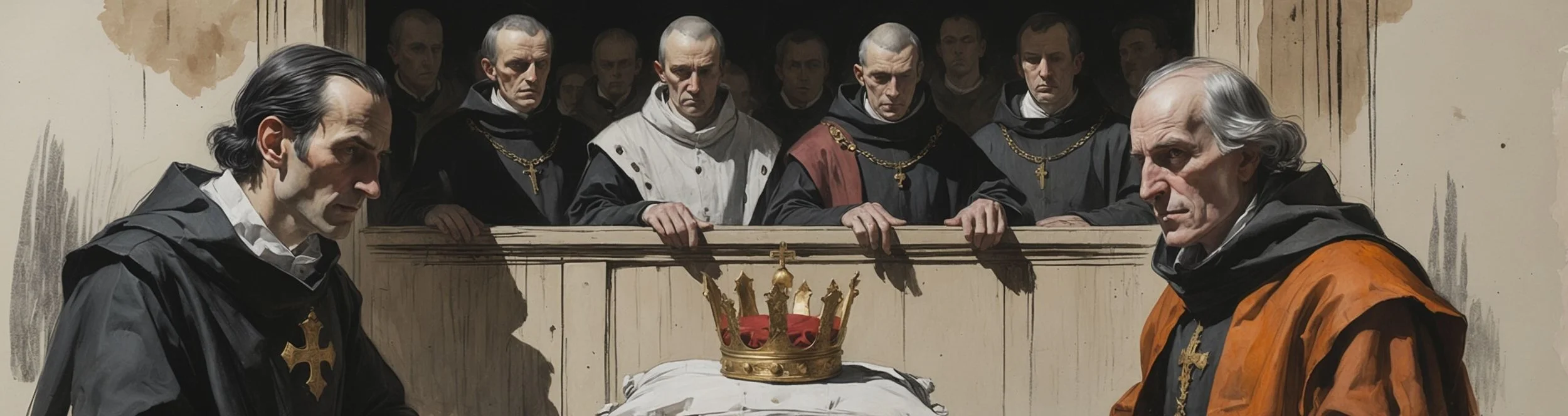
- What Happens: The Duke of Buckingham reports that the citizens would not cheer for Richard. The two men stage a show: Richard appears above between two bishops with a prayer-book, is begged by Buckingham and the Lord Mayor to take the crown, refuses twice, and on the third asking accepts.
- Key Characters: Richard, Duke of Gloucester, The Duke of Buckingham, the Lord Mayor, Catesby, aldermen and citizens, two bishops.
- Dramatic Function: The crown is won – not seized but accepted under protest, in a scripted performance the audience has watched being rehearsed.
- Famous Quote:
"Play the maid’s part, still answer nay, and take it."
(Buckingham, Act 3, Scene 7) - Why It Matters: The scene is the play’s masterpiece of political theatre: a coup dressed as reluctance, with the audience let in on the script and the citizens kept out.
Scene Summary
Richard and The Duke of Buckingham enter from different doors. Richard asks what the citizens said; Buckingham reports that they said nothing. He had told them everything – that Edward’s children were illegitimate because of Edward’s earlier contracts to Lady Lucy and to Bona of France, that Edward himself was a bastard conceived while the Duke of York was away, that Richard resembles his father in body and mind, that his record in Scotland and in peace was spotless – and had asked them to cry God save Richard. They stood like breathing stones. The Recorder repeated the speech at second hand, a few of Buckingham’s own followers threw up their caps and cried God save King Richard, and Buckingham thanked the crowd for its general applause and left.
The Mayor is at hand. Buckingham gives Richard his instructions: pretend fear, refuse to be spoken to except by great entreaty, get a prayer-book in his hand, stand between two churchmen, and be hard to win – play the maid’s part, still answer nay, and take it. Richard goes up. The Mayor and citizens arrive and Buckingham makes a show of waiting; Catesby comes out to say the Duke is at his devotions with two reverend fathers and cannot be disturbed. Buckingham praises a prince who is on his knees rather than on a love-bed, and sends Catesby in again; Catesby returns to say the Duke fears they mean him harm.
Richard appears aloft between two bishops. Buckingham hails the two props of virtue and the prayer-book, and asks pardon for interrupting his devotions. Richard asks what offence he has given. Buckingham tells him: his fault is to resign the throne, his birthright, to the corruption of a blemished stock, while the noble isle wants her proper limbs; the citizens beg him to take the kingly government, not as protector but as king by blood. Richard answers at length that he is unworthy, that his defects are too many, that the royal tree has left royal fruit in young Edward, and that he would not wring the boy’s right from him.
Buckingham argues the bastardy again – Edward’s contract to Lady Lucy, the betrothal to Bona, the widow who seduced him into bigamy – and the Mayor and Catesby add their voices. Richard refuses a second time: he is unfit for state and majesty, and cannot and will not yield. Buckingham says that in that case the citizens will plant someone else on the throne to the downfall of Richard’s house, swears, and leads them off. Catesby urges Richard to call them back. Richard does: he is not made of stones, and if scandal follows he is acquitted of it by their enforcement. The Mayor blesses him, Buckingham salutes him as England’s worthy king, all say amen, and the coronation is fixed for the next day. Richard returns to his holy work.
The Citizens Are Mum
The scene begins with a failure. Buckingham has delivered the speech that was meant to make Richard king by acclamation – the bastardy of Edward’s children, Richard’s virtues, a call to shout – and the people of London answered with silence.
Original
No, so God help me, they spake not a word,
But like dumb statues, or breathing stones,
Stared each on other, and looked deadly pale...
(Buckingham, Act 3, Scene 7)
Shakespeare Retold (Modern Verse)
God help me, no, they didn’t speak a word,
But stood like silent statues made of stone,
And stared at one another, deathly pale...
The silence is the play’s one act of popular judgement, and it is total: dumb statues, breathing stones, staring at each other. Buckingham’s account of what he did next is an education in how consent is manufactured. The Mayor produced the excuse that the people are used to being addressed only by the Recorder; the Recorder repeated the speech as reported speech, with no endorsement of his own; ten of Buckingham’s followers at the back of the hall threw their caps up and shouted; and Buckingham thanked the whole assembly for its “general applause” and left before anyone could correct him. Ten voices become a city. Richard’s reaction – what tongueless blocks – is contempt, but the two men understand that they now need a different kind of scene: not a vote but a spectacle, in which the crown is pressed on a man who does not want it. The play’s argument about manipulation moves here from persuading individuals to staging public opinion.
Play the Maid’s Part
Buckingham’s briefing is the scene’s script, and the audience hears it before it sees it performed. Prayer-book, two churchmen, reluctance, refusal, acceptance: the whole of the next two hundred lines is set out in eight, and the last of them names the part.
Original
And look you get a prayer-book in your hand,
And stand between two churchmen, good my lord –
For on that ground I’ll make a holy descant –
And be not easily won to our requests:
Play the maid’s part, still answer nay, and take it.
(Buckingham, Act 3, Scene 7)
Shakespeare Retold (Modern Verse)
And go and hold a prayerbook in your hand,
And stand between two priests, my noble lord –
So I can talk about your holy nature –
And push back on requests that you be king:
Act virgin-like, say no, but then accept it.
The comparison is with a maid who says no to be persuaded, and its coarseness is Buckingham’s. What it tells the audience is that piety is a costume and refusal a technique – exactly what Richard promised in Act 1, Scene 3, that he would clothe his naked villainy with old ends stolen out of holy writ and seem a saint. Richard’s reply, that he will say nay for himself as well as Buckingham pleads for the others, is a director and an actor agreeing on their cues. Everything the Mayor then sees – the Duke at his beads, the two reverend fathers, the Duke’s fear that armed citizens mean him harm – is Catesby relaying lines. Buckingham’s praise of a prince not lulling on a lewd love-bed but on his knees is aimed at the Mayor’s memory of Edward IV, and it works; the Mayor prays God defend that his Grace should say them nay. The scene’s study of appearance and reality is unusually explicit because the reality was shown first and the appearance is built in front of us.
Between Two Bishops
Richard appears above, flanked by clergy, holding the book, and the play gives him his longest speech of false modesty. He is unworthy; his defects are many; the royal tree has left royal fruit. Every sentence is a lie the audience can date.
Original
Alas, why would you heap this care on me?
I am unfit for state and majesty.
I do beseech you take it not amiss,
I cannot nor I will not yield to you.
(Richard, Act 3, Scene 7)
Shakespeare Retold (Modern Verse)
Oh dear, why do you force this role on me?
I am unfit to be a regal monarch.
I ask that you don’t take it personally,
But I cannot, nor will not, take your offer.
The refusals are the performance’s centre, and Shakespeare gives Richard two of them so that the third asking can be an acceptance. The first is elaborate – a bark to brook no mighty sea, the vapour of my glory – and hands the crown to young Edward with the line “Which God defend that I should wring from him”, spoken by the man who has the boy in the Tower. The second is short, and its shortness is the cue: “I cannot nor I will not yield to you” is what Buckingham needs in order to walk out, which is what makes the citizens seem to force the issue. The audience knows the boy will be dead within an act, and the pleasure of the scene is watching a lie constructed with such care by a man who told us he would tell it. Buckingham’s bastardy argument, delivered between the refusals, is the legal case Richard needs on the record – Lady Lucy, Bona, the widow, loathed bigamy – and Richard has to be seen to have heard it before he yields. Power is taken here without a weapon drawn.
Call Them Again
Buckingham leaves, with an oath, and Catesby – the third member of the company – delivers the line that turns Richard round. The acceptance speech that follows is the scene’s final piece of engineering: a man taking the crown while disclaiming the desire for it.
Original
Cousin of Buckingham, and sage grave men,
Since you will buckle Fortune on my back,
To bear her burden whe’er I will or no,
I must have patience to endure the load;
But if black scandal or foul-faced reproach
Attend the sequel of your imposition,
Your mere enforcement shall acquittance me
From all the impure blots and stains thereof;
For God doth know, and you may partly see,
How far I am from the desire of this.
(Richard, Act 3, Scene 7)
Shakespeare Retold (Modern Verse)
My cousin Buckingham, and all you wise men,
Since you intend to force me to accept,
To take it if I want the role or not,
I have to find the patience to endure it;
But if there’s any scandal or resentment
That follows when your wish is realised,
The fact you’ve made me king will thus absolve me
Of any criticism I receive;
For God’s aware, and you can partly see,
That this is far from what I want to happen.
Fortune buckled on his back like a burden; patience to endure the load; and, most usefully, an indemnity – if scandal or reproach should follow, their enforcement acquits him of it. Richard accepts the crown as a favour to the people and gets them to say so: the Mayor’s “We see it and will say it” is the witness statement he needs. Then the salute, the amen, the date of the coronation, and Richard’s exit line, “Come, let us to our holy work again”, which is the maid’s part played to the last word. The scene has taken a crown without a single command; the audience has watched every move being planned; and the citizens of London, who said nothing, have been quoted as having consented. It is the last scene in which Richard is entirely in control, and the play lets him enjoy it. The next time he appears he is king, and the reign begins with a murder.
Language and Technique
- Script before performance: Buckingham’s briefing – prayer-book, two churchmen, answer nay – is given first, so the audience watches the staging with the stage directions in its head.
- Reported speech: The citizens’ silence and the Recorder’s second-hand repetition are narrated, not shown: the scene makes the audience imagine the people’s judgement, and then watch it overridden.
- Piety as costume: Bishops, beads, a book of prayer, holy work: every religious sign is named aloud, so the audience sees the props for what they are.
- Three refusals: Two elaborate noes and an exit before the yes – the rhythm of a courtship, exactly as the maid’s part prescribes.
- The indemnity clause: Richard’s acceptance includes a condition – their enforcement acquits him – so the speech is a contract as well as a performance.
- The Mayor as chorus: The Lord Mayor’s few lines – God defend, do good my lord, God bless your Grace – are the sound of an honest man being used, which is the scene’s real horror.
Key Quotes from Act 3, Scene 7
Quote 1
But like dumb statues, or breathing stones...
(Buckingham, Act 3, Scene 7)
Shakespeare Retold (Modern Verse)
But stood like silent statues made of stone...
Quote Analysis: Buckingham’s image for the citizens is the scene’s one glimpse of London’s conscience. Statues and stones do not consent, and the phrase “breathing stones” holds the paradox: alive, and refusing to speak. Richard’s answer, tongueless blocks, turns the same silence into stupidity.
Play the maid’s part, still answer nay, and take it.
(Buckingham, Act 3, Scene 7)
Shakespeare Retold (Modern Verse)
Act virgin-like, say no, but then accept it.
Quote Analysis: The scene’s stage direction, spoken by its director. A maid says no and takes it; a prince says no and takes the crown. Buckingham’s line compresses two hundred lines of performance into one, and the crudeness tells the audience how the two men regard what they are about to do.
Two props of virtue for a Christian prince,
To stay him from the fall of vanity;
And see, a book of prayer in his hand –
True ornaments to know a holy man.
(Buckingham, Act 3, Scene 7)
Shakespeare Retold (Modern Verse)
Two props of goodness for a Christian prince,
To stop his downfall into vanity;
And look, he has a prayerbook in his hand…
These are all signs that he’s a holy man.
Quote Analysis: Buckingham describes the tableau for the Mayor’s benefit: bishops as props (the word means supports, and the pun is available), a prayer-book as an ornament. The audience has heard these items ordered like stage furniture a hundred lines earlier, and hears them now presented as evidence of holiness.
The royal tree hath left us royal fruit,
Which mellowed by the stealing hours of time,
Will well become the seat of majesty,
And make (no doubt) us happy by his reign.
(Richard, Act 3, Scene 7)
Shakespeare Retold (Modern Verse)
The royal tree has left us royal fruit,
For young Prince Edward will mature with time
And will become well suited as a monarch,
And I am sure his reign will make us happy.
Quote Analysis: Richard’s argument for young Edward’s kingship, spoken by the man who has the boy locked in the Tower. The image of fruit ripening on the tree is gentle and orderly, which is the point: Richard sounds like a loyal uncle, and the audience knows the fruit will be picked green.
Your mere enforcement shall acquittance me
From all the impure blots and stains thereof;
For God doth know, and you may partly see,
How far I am from the desire of this.
(Richard, Act 3, Scene 7)
Shakespeare Retold (Modern Verse)
The fact you’ve made me king will thus absolve me
Of any criticism I receive;
For God’s aware, and you can partly see,
That this is far from what I want to happen.
Quote Analysis: The clause that makes the acceptance safe. Richard takes the crown on condition that any blame belongs to those who forced it on him, and asks God and the citizens to witness his reluctance. The Mayor obliges. It is a man writing his own alibi in public, and getting it signed.
Key Takeaways
- The people said nothing: London’s silence is the play’s only popular verdict on Richard, and the scene shows it converted into applause by ten planted voices.
- The audience holds the script: Buckingham’s briefing tells us what we are about to see; the tension of the scene is watching the plan work on people who do not know it.
- Religion as stage property: Two bishops, a prayer-book and holy work: piety is worn like a costume, exactly as Richard promised in Act 1.
- Refused twice, accepted once: The maid’s part structures the scene – no, no, and a yes that is made to look like surrender.
- A crown without a command: Richard becomes king in this scene without giving an order, and secures a public indemnity for whatever follows.
Study Questions and Analysis
Why do Richard and Buckingham stage the offer of the crown instead of simply taking it?
Because they need it to look like consent. A duke who seized the throne from his nephew would be a usurper; a duke pressed to accept it by the Mayor and citizens, against his own will, is a public servant. Buckingham has already tried the direct route – a speech at the Guildhall asking the people to acclaim Richard – and it failed: the citizens said nothing. The Baynard’s Castle scene is the alternative, a performance in which the citizens’ request is played out in front of them so that they appear to have made it.
The Mayor is here at hand. Intend some fear,
Be not you spoke with but by mighty suit;
And look you get a prayer-book in your hand,
And stand between two churchmen, good my lord –
For on that ground I’ll make a holy descant –
And be not easily won to our requests:
Play the maid’s part, still answer nay, and take it.
(Buckingham, Act 3, Scene 7)
Shakespeare Retold (Modern Verse)
The Mayor’s nearby. Pretend that you are scared,
And do not speak until you’re pleaded with;
And go and hold a prayerbook in your hand,
And stand between two priests, my noble lord –
So I can talk about your holy nature –
And push back on requests that you be king:
Act virgin-like, say no, but then accept it.
The staging also solves a problem of law. Buckingham’s case that Edward IV’s children are illegitimate – the contracts to Lady Lucy and Bona, the bigamy – has to be heard and answered in public, and Richard has to be seen to accept the crown as the lawful heir, not as a conqueror. Historically the petition presented to Richard at Baynard’s Castle in June 1483 was later enrolled as the act called Titulus Regius; Shakespeare’s source, Sir Thomas More, describes the whole event as a play everyone could see through, and the scene follows him. A student can use it as the clearest example in Shakespeare of power being taken by theatre rather than by force.
What does “Play the maid’s part” mean?
Buckingham is telling Richard how to behave when the Mayor arrives: like a girl being courted, who says no to every advance and then accepts. “Still answer nay, and take it” is the whole instruction – keep refusing, and take the crown at the end. The comparison is deliberately coarse, and it fixes the shape of the scene: Richard will refuse twice, Buckingham will storm out, and the third approach will be accepted with a show of reluctance.
Play the maid’s part, still answer nay, and take it.
(Buckingham, Act 3, Scene 7)
Shakespeare Retold (Modern Verse)
Act virgin-like, say no, but then accept it.
The line matters because it is said in the audience’s hearing before the performance begins. Shakespeare lets the spectators hold the script, so that every pious word Richard speaks from the gallery is heard against Buckingham’s briefing. The technique – rehearsal shown, then performance – is the play’s way of making its audience complicit; we cannot mistake the show for the truth because we watched it being built. It is also the last time the partnership works. In Act 4, Scene 2 Buckingham will be asked to play a part he refuses, and the man who directed this scene will be discarded.
Why does Richard appear between two bishops with a prayer-book?
Because Buckingham told him to, and because it is the costume for the part. The two churchmen are “props of virtue”, the prayer-book an “ornament” of holiness, and Catesby’s reports that the Duke is at his beads and cannot be drawn from his devotions are part of the same picture. Buckingham points the moral for the Mayor: this prince is not lulling on a lewd love-bed like Edward, but on his knees. The Mayor, whose memory of Edward IV’s court is fresh, is meant to draw the comparison.
The tableau pays off a promise. In Act 1, Scene 3 Richard told the audience that he clothes his naked villainy with odd old ends stolen out of holy writ and seems a saint when most he plays the devil; here the clothing is literal. The image also has a source: Thomas More’s History describes Richard appearing at Baynard’s Castle in a gallery, between two bishops, and Shakespeare keeps the detail because it is already theatre. William Hazlitt, in Characters of Shakespear’s Plays (1817), called Richard a princely hypocrite; this is the scene in which the hypocrisy is princely – staged, costumed and watched by a city.
What is Buckingham’s case that Edward’s children are illegitimate?
Two arguments, both used in the real events of 1483. First, that Edward IV was already contracted in marriage before he married Elizabeth Woodville – to Lady Elizabeth Lucy, and by proxy to Bona of Savoy, sister to the King of France in the play’s telling (historically his sister-in-law) – so that his marriage to Elizabeth was bigamous and its children bastards. Second, in the Guildhall speech Buckingham reports at the start of the scene, that Edward himself was illegitimate, conceived while his father the Duke of York was in France, and that Richard is the true image of the Duke. Buckingham says he spared the second argument some detail out of reverence for those alive – Richard’s mother.
These both put off, a poor petitioner,
A care-crazed mother to a many sons,
A beauty-waning and distressed widow,
Even in the afternoon of her best days,
Made prize and purchase of his wanton eye,
Seduced the pitch and height of his degree
To base declension and loathed bigamy.
(Buckingham, Act 3, Scene 7)
Shakespeare Retold (Modern Verse)
But after both these failed, a hard-up temptress,
Preoccupied with many sons to mother,
With faded beauty, sad that she’d been widowed,
Well past her former prime of yesteryear,
Had flirted and intrigued the randy King,
Seducing him, and lowering his standards,
Descending to the shame of bigamy.
Historically the precontract story named Lady Eleanor Butler rather than Lady Lucy, and it was the basis of the petition that made Richard king; the slander of the Duchess of York’s honour was also current, and More reports that Richard’s own mother resented it. Shakespeare keeps both because the play’s Richard will use anything, including his mother’s reputation, and because the arguments have to be spoken aloud so that Richard’s acceptance can be framed as lawful. Whether the audience believes them is irrelevant to the scene; what matters is that the Mayor has heard them and says amen.
What does the citizens’ silence tell us?
That the people of London are not fooled. Buckingham’s report is careful: the citizens heard the whole case and stood like breathing stones; only the Recorder, under pressure, repeated it as someone else’s opinion; only ten of Buckingham’s own men cheered. The silence is the play’s single act of popular resistance, and it is enough to force Richard and Buckingham into the elaborate performance of the rest of the scene. The citizens in Act 2, Scene 3 said what they feared; here they say nothing, which is the same judgement in a more dangerous room.
The silence is then used. Buckingham thanks the crowd for its general applause on the strength of ten voices, and at Baynard’s Castle the Mayor and aldermen stand in for a city that has not consented. The scene makes a point that runs through the play’s treatment of appearance and reality: the truth is known, and it does not matter, because the people who know it have no way to act. The Scrivener in the previous scene said it directly – who is so gross that cannot see this palpable device, yet who so bold but says he sees it not – and this scene is that question staged.
Why is this the high point of Richard’s career, and what changes after it?
It is the last scene in which everything Richard plans happens. The performance works to the letter of Buckingham’s script; the crown is offered, refused, and accepted with a public indemnity; the coronation is fixed for the next morning. Richard has spent three acts telling the audience what he would do, and this is the scene in which the last item is ticked off. His exit line – come, let us to our holy work again – is the wink to the audience that closes the first movement of the play.
What changes is the audience’s access to him. From Act 4 Richard has no soliloquies, and the play stops showing its plans in advance; instead it shows a king reacting to news, refusing a partner, and being cursed by his mother. Charles Lamb, writing in 1802, took the quality of unstrained mirth to be a prime feature of Richard’s character, and Baynard’s Castle is the mirth at its height – a whole city as the butt of the joke. The play’s structure is a rise and a fall, and this scene is the top of the rise; the audience that has laughed with Richard here is about to be asked what it was laughing at.
How does the scene use the Lord Mayor?
As the honest witness the performance needs. The Mayor has a handful of lines – God defend his Grace should say us nay; do, good my lord, your citizens entreat you; God bless your Grace, we see it and will say it – and every one of them is a response to something Buckingham or Catesby has just told him. He believes the Duke is at prayer because Catesby says so, believes the Duke fears the citizens because Catesby says so, and believes Richard is reluctant because Richard says so, twice.
The Mayor is not a fool; he is a man given only the information he is meant to have, and his good faith is the scene’s material. Shakespeare had already used him in Act 3, Scene 5, where Richard and Buckingham in rusty armour convinced him that Hastings’ execution was self-defence and sent him to tell the citizens; here he is used again, to carry the citizens’ supposed consent back to them. A student writing on the play’s minor figures can pair the Mayor with the Scrivener of Act 3, Scene 6: one sees the device and says nothing, the other does not see it and says amen.