Richard III: Act 3, Scene 5 – Analysis
Scene Profile – At a Glance
- Location: The walls of the Tower of London.
- What Happens: Richard and The Duke of Buckingham, in rusty armour, act out a state of alarm for the Lord Mayor. Hastings’ head is brought in; they persuade the Mayor that the execution was self-defence and send him to tell the citizens. Richard then briefs Buckingham to declare Edward’s children – and Edward himself – illegitimate.
- Key Characters: Richard, Duke of Gloucester, The Duke of Buckingham, the Lord Mayor, Catesby, Lovel and Ratcliffe with Hastings’ head.
- Dramatic Function: The cover-up for the council murder, and the launch of the campaign for the crown – the play’s most explicit scene of two men rehearsing and performing a lie.
- Famous Quote:
"Tut, I can counterfeit the deep tragedian..."
(Buckingham, Act 3, Scene 5) - Why It Matters: The scene shows the audience the acting before the performance, so that everything the Mayor believes we have already seen invented.
Scene Summary
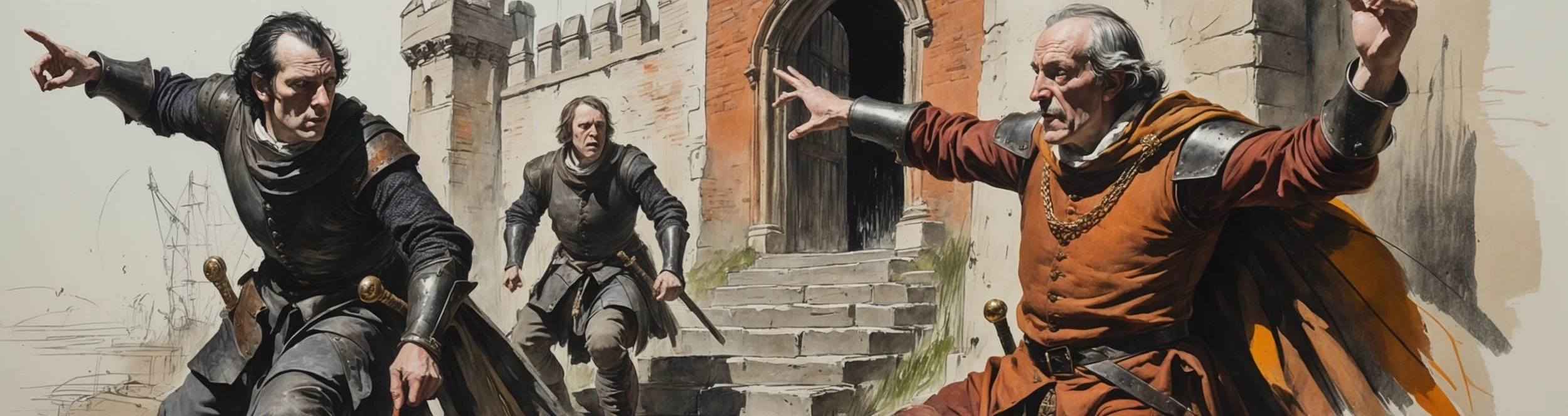
Richard and The Duke of Buckingham enter in rotten armour, looking marvellously ill-favoured, and Richard asks whether his cousin can tremble, change colour, stop in the middle of a word and start again like a man mad with terror. Buckingham can: he can counterfeit the deep tragedian, look behind him, start at the wagging of a straw, and produce ghastly looks and enforced smiles at any time to grace his stratagems.
Catesby brings the Lord Mayor. The two men immediately play their scene – look to the drawbridge, hark, a drum, look back, defend thee, here are enemies – until Lovel and Ratcliffe enter with Hastings’ head and Richard tells the Mayor they are friends. Richard weeps for the man: he loved Hastings, took him for the plainest harmless Christian alive, made him the book in which his soul recorded its secrets, and was deceived by a show of virtue that only his affair with Shore’s wife gave away. Buckingham adds that this subtle traitor had plotted that very day in the council-house to murder them both. Had he? asks the Mayor. Richard is affronted: does the Mayor think they are Turks or infidels, to proceed against the form of law except under extreme peril to England’s peace and their own persons?
The Mayor is satisfied: Hastings deserved his death, and their Graces did well. Buckingham regrets only that the Mayor came too late to hear the traitor confess, which he had wished so that the Mayor could tell the citizens; the Mayor promises to report their just proceedings anyway, and Richard says that is why they sent for him – to avoid the censures of the carping world. The Mayor leaves for the Guildhall.
Richard sends Buckingham after him with a brief for the citizens: infer the bastardy of Edward’s children; remind them how Edward executed a citizen for saying he would make his son heir to the Crown, meaning the tavern of that name; urge Edward’s lust for their wives and daughters; and, if need be, say that Edward himself was not the Duke of York’s son, conceived while the Duke was at war in France – but touch that sparingly, because Richard’s mother is alive. Buckingham promises to play the orator as if the golden fee were for himself, and is told to bring the citizens to Baynard’s Castle at three or four o’clock, where Richard will be found among reverend fathers and learned bishops. Richard sends Lovel to Doctor Shaw and Catesby to Friar Penker, and goes to give secret orders that Clarence’s children be kept out of sight and that no one at all be allowed to see the princes.
The Deep Tragedian
The scene opens with a costume note – rotten armour, marvellous ill-favoured – and a rehearsal. Richard asks whether Buckingham can act frightened, and Buckingham answers with a list of his skills.
Original
Tut, I can counterfeit the deep tragedian,
Speak and look back, and pry on every side,
Tremble and start at wagging of a straw;
Intending deep suspicion, ghastly looks
Are at my service, like enforced smiles;
And both are ready in their offices
At any time to grace my stratagems.
(Buckingham, Act 3, Scene 5)
Shakespeare Retold (Modern Verse)
Pah! I can fake fear like a tragic actor,
And speak and look around as though I’m frightened,
And tremble when a blade of grass is nodding;
Pretending I’m suspicious, looking scared,
Are all skills at my service, like a fake smile;
And both those skills are ready to deploy
At any time to liven up my plans.
This is the play’s most open statement that its politics are theatre. Buckingham describes his repertoire in an actor’s terms – the tragedian’s counterfeit, the look back, the start at a straw, ghastly looks and enforced smiles kept ready like tools in a box – and the word “stratagems” tells us what the tools are for. The audience is then shown the performance immediately: the drawbridge, the drum, the imaginary enemies, all of it acted for a Mayor who has just walked in and cannot know that the alarm was scripted a minute earlier. The two men wear armour that is deliberately old and ugly so that the Mayor will think they have thrown it on in haste. Everything the scene’s victim sees has been chosen. The play’s study of appearance and reality works here by showing the reality first and letting the appearance be built in front of the audience – exactly the method of Baynard’s Castle two scenes later, in miniature.
So Dear I Loved the Man
Hastings’ head arrives, and Richard delivers a eulogy for the man he beheaded an hour earlier. It is the scene’s best joke and its most chilling speech, and it is spoken with the head on stage.
Original
So dear I loved the man that I must weep.
I took him for the plainest harmless creature
That breathed upon the earth a Christian;
Made him my book, wherein my soul recorded
The history of all her secret thoughts.
(Richard, Act 3, Scene 5)
Shakespeare Retold (Modern Verse)
I loved that man so much I have to cry.
I thought he was the sweetest and most harmless
Christian that ever walked upon our earth.
That man was like my diary, for I told him
The secret thoughts I’d had throughout my life.
Richard weeps, and calls Hastings the plainest harmless creature that ever breathed – which is very nearly true, and is the reason he is dead. The image of the friend as a book in which the soul records its secrets is the language of intimacy, and it is spoken by the man who confided his real secrets to the audience in Act 1 and to Buckingham in Act 3; Hastings was the one councillor he did not trust, which is why he was tested in Act 3, Scene 2 and killed in Act 3, Scene 4. The grief is a performance for the Mayor, but the audience notices something else: Richard’s language of deceit is always about deceit. Hastings, he says, daubed his vice with a show of virtue – which is Richard’s own description of himself in Act 1, seeming a saint when most he plays the devil. The liar’s charge against his victim is the liar’s own method, and the play lets the audience hear it twice.
Turks or Infidels
The Mayor asks the one question that matters – had Hastings really plotted their deaths? – and Richard answers by being offended. It is the scene’s turning point, and it is over in six lines.
Original
What? Think you we are Turks or infidels?
Or that we would, against the form of law,
Proceed thus rashly in the villain’s death,
But that the extreme peril of the case,
The peace of England, and our persons’ safety,
Enforced us to this execution?
(Richard, Act 3, Scene 5)
Shakespeare Retold (Modern Verse)
What? Do you think we’re savage Turks, not Christians?
Or do you think that we would break the law
By swiftly murdering this villain here
Unless we were in mortal jeopardy,
Which threatened England’s peace, and people’s safety
Which forced us then to execute this man?
The rhetorical question does what argument could not. Richard does not answer the Mayor’s question; he asks whether the Mayor takes them for savages who would kill a man against the form of law unless the peril were extreme – and the Mayor, who does not want to be the man who took the Protector for a Turk, answers that Hastings deserved his death. Buckingham finishes the job with a regret: he had meant the Mayor to hear the traitor confess, but the loving haste of their friends prevented it. The Mayor accepts a confession he has not heard and promises to report proceedings he has not seen. Richard’s line that they sent for him to avoid the censures of the carping world is the truest thing said in the scene – the Mayor is there to be a witness, and he has agreed to witness whatever he is told. The play’s argument about power is that it needs honest men to carry its lies, and the Mayor is one.
Infer the Bastardy
With the Mayor gone, Richard gives Buckingham the brief for the next scene, and the audience hears the case for the crown assembled from slanders.
Original
Tell them, when that my mother went with child
Of that insatiate Edward, noble York,
My princely father, then had wars in France,
And by true computation of the time,
Found that the issue was not his begot;
Which well appeared in his lineaments,
Being nothing like the noble Duke my father.
Yet touch this sparingly, as ’twere far off,
Because, my lord, you know my mother lives.
(Richard, Act 3, Scene 5)
Shakespeare Retold (Modern Verse)
Tell them that when my mother had got pregnant
With lustful Edward, noble Duke of York,
My royal father was at war in France,
And if you truly calculate the time,
You’d find that Edward couldn’t be his son;
And also, it was clear from his appearance
That he looked nothing like my noble father.
Yet say this carefully, like a suggestion,
Because you know my mother’s still alive.
The brief moves outward in circles: Edward’s children are bastards; Edward was a tyrant who executed a citizen for a joke about a tavern sign; Edward was a lecher who preyed on the citizens’ wives and daughters; and finally Edward was not his father’s son, conceived while the Duke of York was in France. The last item is a slander on Richard’s own mother, and he asks Buckingham to touch it sparingly because she is alive – the only trace of scruple in the scene, and it is a tactical one. The historical Duchess of York did resent exactly this charge, which More reports the real Buckingham making; Shakespeare gives the order to Richard so that the audience knows whose idea it was. Buckingham’s promise to play the orator as if the golden fee were his own is the partnership at its closest, and the arrangements that follow – Doctor Shaw and Friar Penker, the two clergymen who will preach Richard’s title, the bishops at Baynard’s Castle, the princes and Clarence’s children shut away – are the stage management for the coup. The scene ends with an order that no one at all may see the princes, which is the beginning of their disappearance.
Language and Technique
- Costume as evidence: Rotten armour, marvellous ill-favoured: the stage direction makes the disguise deliberately shabby, so that haste can be read on the actors’ bodies.
- Rehearsal then performance: Buckingham lists his tricks, and the scene shows them used within twenty lines – the audience sees the acting twice, once as craft and once as fraud.
- Eulogy over a head: Richard’s grief for Hastings is delivered with the head on stage; the prop makes the speech’s every word a lie the audience can see.
- Rhetorical question as defence: “Think you we are Turks or infidels?” answers an accusation by making the accuser ashamed of it.
- The brief as list: Richard’s instructions to Buckingham are a numbered set of slanders – bastardy, tyranny, lust, illegitimacy – the case for the crown assembled like a shopping list.
Key Quotes from Act 3, Scene 5
Quote 1
Come, cousin, canst thou quake and change thy colour,
Murder thy breath in middle of a word,
And then again begin, and stop again,
As if thou were distraught and mad with terror?
(Richard, Act 3, Scene 5)
Shakespeare Retold (Modern Verse)
Come, cousin, can’t you shake with fear, turn ashen,
And cease from speaking halfway through a word,
And then begin again, then stop again,
As though you were distraught and mad from fear?
Quote Analysis: The director’s question to his actor. Richard lists the symptoms of fear – colour, breath, the stop and restart – as things to be produced on demand, and Buckingham’s reply confirms that they can be. The scene begins by teaching the audience that everything it is about to see is a performance.
So smooth he daubed his vice with show of virtue
That, his apparent open guilt omitted –
I mean, his conversation with Shore’s wife...
(Richard, Act 3, Scene 5)
Shakespeare Retold (Modern Verse)
He covered up his sins so expertly
That, if he hadn’t shown that he was guilty –
I mean, by his affair with Mistress Shore...
Quote Analysis: Richard’s charge against Hastings, and his own self-portrait. To daub vice with virtue is what he promised to do in Act 1, and the parenthesis about Shore’s wife – Hastings’ mistress, and the pretext for the witchcraft charge in the council – is the one true fact in the speech, used to make the lies plausible.
Yet had we not determined he should die
Until your lordship came to see his end,
Which now the loving haste of these our friends,
Something against our meanings, have prevented...
(Buckingham, Act 3, Scene 5)
Shakespeare Retold (Modern Verse)
Yet we’d decided he must not be killed
Until you had arrived to see his death, sir,
But swift, kind actions of Lovel and Ratcliffe,
Who got our orders wrong, have stopped that happening...
Quote Analysis: Buckingham’s masterpiece of regret: they had meant Hastings to confess in the Mayor’s hearing, but their friends were too eager. The excuse explains the absence of a trial while sounding like a complaint about excess zeal, and it works – the Mayor says their words will serve as well as a confession.
Doubt not, my lord, I’ll play the orator
As if the golden fee for which I plead
Were for myself – and so, my lord, adieu.
(Buckingham, Act 3, Scene 5)
Shakespeare Retold (Modern Verse)
Don’t doubt it, sir, I’ll speak like I’m performing
To win the golden crown as King I ask for
Like it was for myself. So, sir, goodbye.
Quote Analysis: Buckingham’s promise to speak for Richard’s crown as if it were his own. The golden fee is the throne, and the image of oratory as pleading for a fee makes the coup a piece of paid advocacy. The line also names the earldom of Hereford without naming it – his own fee is coming, he thinks, and Act 4, Scene 2 will say otherwise.
Key Takeaways
- Politics as acting: Buckingham’s speech on counterfeiting the tragedian is the play’s most explicit admission that its power-seeking is theatre.
- The Mayor as witness: Sent for to avoid the censures of the carping world, the Mayor agrees to report a confession he never heard.
- Richard describes himself: The charge against Hastings – vice daubed with a show of virtue – is Richard’s own method from Act 1.
- The case for the crown is a set of slanders: Bastardy, tyranny, lust and a charge against his own mother: Richard’s brief to Buckingham is the script for the Guildhall.
- The princes vanish: The scene’s last order shuts the boys away from every visitor – the beginning of their disappearance.
Study Questions and Analysis
Why do Richard and Buckingham wear rusty armour?
To look as if they have just survived an attempt on their lives. The stage direction calls the armour rotten and the men marvellous ill-favoured; the idea is that they have thrown on whatever was nearest when the alarm was raised, and the Mayor, arriving in the middle of shouts about drawbridges and drums, is meant to read the costume as evidence. It is a piece of staging within the play – a disguise designed to be seen through by the audience and believed by its victim.
Tut, I can counterfeit the deep tragedian,
Speak and look back, and pry on every side,
Tremble and start at wagging of a straw...
(Buckingham, Act 3, Scene 5)
Shakespeare Retold (Modern Verse)
Pah! I can fake fear like a tragic actor,
And speak and look around as though I’m frightened,
And tremble when a blade of grass is nodding...
The armour goes with Buckingham’s speech about counterfeiting the tragedian, and together they make the scene the play’s clearest lesson in how its politics work. The lie about Hastings’ plot is not argued; it is acted, with props and costume, and its audience is a single honest man whose job is to carry it to the city. The detail comes from Sir Thomas More, who describes Richard and Buckingham appearing in old rusty harness after Hastings’ death and pretending they had been surprised; Shakespeare’s addition is the rehearsal, which lets us watch the appearance being made.
How is the Lord Mayor persuaded that Hastings was a traitor?
He is not persuaded so much as embarrassed into agreement. He asks one question – had Hastings really plotted to murder them? – and Richard answers with another: does the Mayor think they are Turks or infidels, who would kill a man against the form of law without extreme cause? The Mayor, who cannot say yes, says instead that Hastings deserved his death. Buckingham then regrets that the Mayor arrived too late to hear the traitor confess, and the Mayor replies that their words will serve as well as if he had heard it himself.
But, my good lord, your Grace’s words shall serve
As well as I had seen, and heard him speak...
(Lord Mayor, Act 3, Scene 5)
Shakespeare Retold (Modern Verse)
But, my good lord, I’ll take your Grace’s word
As though I’d seen and heard him speak myself...
The exchange is a small study in how consent is extracted from decent people. The Mayor is not corrupt; he is a civic official faced with two dukes, a severed head and an account of events that it would be dangerous to doubt, and he chooses to believe it. Richard’s remark that they sent for him to avoid the censures of the carping world tells the audience what the Mayor is for. He will be used again in Act 3, Scene 7, where he pleads with Richard to accept the crown, and his good faith is the raw material of both scenes. A student writing on manipulation can use him as the play’s example of the honest instrument.
What is Richard’s brief to Buckingham for the Guildhall?
A list of things to say to the citizens, in order of boldness. First, that Edward’s children are illegitimate. Second, that Edward was a tyrant: he executed a citizen for saying he would make his son heir to the Crown, when the man meant his tavern, which bore that sign. Third, that Edward’s lust ran unchecked through the citizens’ servants, daughters and wives. Fourth, and only if needed, that Edward himself was not the Duke of York’s son but was conceived while the Duke was at war in France – a charge to be touched sparingly, since Richard’s mother is alive to hear it.
Tell them how Edward put to death a citizen
Only for saying he would make his son
Heir to the Crown – meaning indeed his house,
Which by the sign thereof was termed so.
(Richard, Act 3, Scene 5)
Shakespeare Retold (Modern Verse)
Explain how Edward put a man to death
For only saying that he’d make his son
The ‘heir to The Crown’, meaning his tavern
Which had a sign outside saying, ‘The Crown’.
The brief is the script for Act 3, Scene 7, where Buckingham reports having delivered every item of it. The tavern story is historical – More tells it of a London merchant executed under Edward IV for a pun on his shop sign – and the charge against Edward’s legitimacy was also current in 1483; the real Buckingham is said to have made it, and the real Duchess of York to have been outraged. What Shakespeare adds is the order of command: the slander on the Duchess is Richard’s idea, and his one qualm about it is practical. The scene ends with him arranging the clergy for Baynard’s Castle and shutting away the princes, and the audience can see the whole coup laid out as a sequence of tasks.
Why does Richard say he loved Hastings?
Because the Mayor is watching, and grief is the appropriate performance for a man who has just had a friend executed for treason. Richard weeps, calls Hastings the plainest harmless creature alive, and says he made him the book of his soul’s secrets. None of it is true – Richard trusted Hastings so little that he had him tested in Act 3, Scene 2 and destroyed him in Act 3, Scene 4 for one hesitation – but it is what the Mayor needs to hear to believe that the execution was reluctant.
There is a second layer. The vice Richard attributes to Hastings, daubed so smoothly with a show of virtue that only his affair with Mistress Shore gave him away, is Richard’s description of himself in Act 1, Scene 3: seeming a saint when most he plays the devil. The audience, which heard that soliloquy, hears this speech as self-portrait, and the effect is the play’s characteristic double register – a lie for the character on stage, a confession for the audience. William Hazlitt, in Characters of Shakespear’s Plays (1817), thought the play belonged to the theatre rather than the closet; this speech, delivered over a severed head with tears, is the kind of moment he meant.