Richard III: Act 3, Scene 4 – Analysis
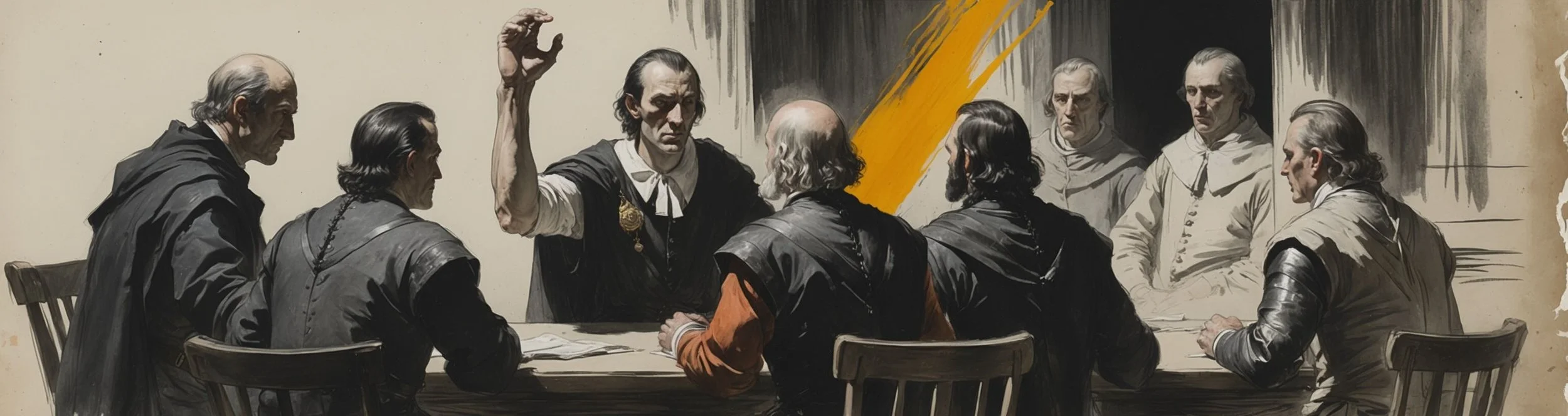
Scene Profile – At a Glance
- Location: The Tower of London – the council chamber, the lords at a table.
- What Happens: The council meets to fix the coronation. Richard arrives late, sends the Bishop of Ely for strawberries, leaves, and returns accusing the Queen and Mistress Shore of withering his arm by witchcraft. Hastings says “if”, and is condemned on the spot. He recognises Margaret’s curse and Stanley’s dream, and is led to the block.
- Key Characters: Richard, Duke of Gloucester, The Duke of Buckingham, Lord Hastings, Lord Stanley, the Bishop of Ely, Ratcliffe, Lovel, Norfolk.
- Dramatic Function: The play’s most famous execution: a councillor destroyed for a conditional clause, and the first of Richard’s murders committed in daylight, in public, without a hired hand.
- Famous Quote:
"Off with his head! Now by Saint Paul I swear
I will not dine until I see the same."
(Richard, Act 3, Scene 4) - Why It Matters: Hastings is the play’s lesson in what happens to the man who thinks Richard’s face shows his heart – and his death clears the last obstacle between Richard and the crown.
Scene Summary
The council has gathered in the Tower to name the day of Prince Edward’s coronation. Hastings asks when the royal day shall be; the Bishop of Ely suggests tomorrow; The Duke of Buckingham asks who knows the Lord Protector’s mind, and observes that they know each other’s faces, not each other’s hearts. Hastings says Richard loves him well, though he has not sounded him on the coronation, and offers to speak for the Duke.
Richard enters, apologising for sleeping late, and Buckingham notes that had he not come on his cue, Hastings would have pronounced his part. Richard praises Hastings, then asks the Bishop of Ely for the strawberries he saw in his garden in Holborn. The Bishop goes. Richard takes Buckingham aside: Catesby has sounded Hastings, who would lose his head before he consented to Edward’s child losing the throne. The two withdraw. Stanley says tomorrow is too soon; the Bishop returns with the strawberries sent for; and Hastings, asked what Richard’s face shows, says there is no man in Christendom who can hide his love or hate less, and that Richard is offended with no one here.
Richard returns and asks the council what those deserve who have plotted his death by witchcraft and prevailed on his body with hellish charms. Hastings, eager, says they deserve death, whoever they are. Then look, says Richard: his arm is withered like a blasted sapling, and Edward’s wife, that monstrous witch, with the strumpet Shore, has done it. Hastings begins, “If they have done this deed” – and gets no further. If? Talk’st thou to me of ifs? Thou art a traitor. Off with his head; Richard will not dine until he sees it. Lovel and Ratcliffe are to see it done, and the rest who love Richard follow him out.
Hastings, left with his executioners, understands. Woe for England, not for himself; he was too fond, and might have prevented this. Stanley dreamt that the boar razed their helms, and he scorned it; his horse stumbled three times on the way to the Tower; he needs now the priest he spoke to; he repents boasting to the pursuivant of his enemies’ deaths at Pomfret and his own security. Margaret’s curse has lit on his head. Ratcliffe hurries him: the Duke wants his dinner. Hastings speaks of the momentary grace of mortal men, hunted for more than the grace of God – a man who builds on a great lord’s favour lives like a drunken sailor on a mast, ready to tumble into the deep. Lovel tells him it is bootless to exclaim. Hastings curses bloody Richard, prophesies the fearfullest time England has looked upon, and goes to the block with a couplet: they smile at me who shortly shall be dead.
Faces and Hearts
The council scene opens on the word that will kill Hastings: knowledge. Buckingham says the lords know each other’s faces but not each other’s hearts, and Hastings, asked to read Richard’s, reads it wrong.
Original
I think there’s never a man in Christendom
Can lesser hide his love or hate than he,
For by his face straight shall you know his heart.
(Hastings, Act 3, Scene 4)
Shakespeare Retold (Modern Verse)
I don’t think there is any man alive
Who shows his feelings any more than him,
For you can know his heart by looking at him.
The irony is the most exact in the play. Hastings is describing the least readable man in England and calling him the most transparent, and he does it in the moments between Richard’s departure with Buckingham and their return with the charge that will end him. The strawberries are part of the same design: Richard sends the Bishop of Ely out of the room on an errand of perfect courtesy, so that the councillor most likely to protest is absent for the arrest and the rest see the Protector in a good humour. The detail comes from Sir Thomas More, who was a boy in Morton’s household and may have had it from the Bishop himself; Shakespeare keeps it because nothing could better show a murder planned in the language of a garden. Hastings’ confidence has been built since Act 3, Scene 2, where he laughed at Stanley’s dream and boasted to the pursuivant, and here it reaches its height a hundred lines before his death. The scene’s study of appearance and reality is a study of a man who thinks appearances are all there is.
Talk’st Thou to Me of Ifs?
Richard returns changed, and the scene’s temperature drops in a line. The withered arm, the witchcraft, the queen and Mistress Shore: the charge is absurd, and its absurdity is the trap, because the only honest response is a qualification.
Original
If? Thou protector of this damned strumpet,
Talk’st thou to me of "ifs"? Thou art a traitor.
Off with his head! Now by Saint Paul I swear
I will not dine until I see the same.
(Richard, Act 3, Scene 4)
Shakespeare Retold (Modern Verse)
If? Are you standing up for that damned whore,
By saying ‘if’ to me? You are a traitor.
Off with his head! And I swear by Saint Paul
I will not eat until I’ve seen his head.
Hastings has already agreed that the plotters deserve death, whoever they are, in his eagerness to please; what he cannot do, when the plotters turn out to be the queen and his own mistress and the evidence an arm that has been withered since birth, is agree without a conditional. “If” is the whole of his treason, and Richard pounces on it as if he had been waiting for it, which he had. The speed matters: there is no trial, no charge beyond the word, and the sentence is followed by a detail about lunch. “I will not dine until I see the same” makes the execution a matter of appetite, and Ratcliffe repeats it to Hastings on the way out – the Duke would be at dinner. It is the first murder Richard commits in his own person and in public, and the council, which has just been asked to condemn unnamed offenders, watches one of its members taken from the table and follows Richard out. The play’s account of power has been building to this: a room full of lords, and one man’s mood is the law.
The Momentary Grace of Mortal Men
Left with his executioners, Hastings does what every victim in the play does: he reads back over the warnings and finds them exact. The dream, the stumbling horse, the priest, the pursuivant, Margaret’s curse – the scene gives him time to name each one.
Original
O momentary grace of mortal men,
Which we more hunt for than the grace of God!
Who builds his hope in air of your good looks
Lives like a drunken sailor on a mast,
Ready with every nod to tumble down
Into the fatal bowels of the deep.
(Hastings, Act 3, Scene 4)
Shakespeare Retold (Modern Verse)
Why do we seek the blessing of mere mortals,
When we should really seek the grace of God!
Those men whose hopes are built on others’ views
Live like a drunken sailor on a mast
Who, with each rock from waves, risks falling in
To drown within the ocean’s fatal grasp.
The recognition speech is a small sermon, and its text is the difference between two kinds of grace: the favour of a lord, which is momentary, and the grace of God, which is not. Hastings’ image for his own life – a drunken sailor on a mast, one nod from the sea – is the play’s plainest picture of what it is to build on a tyrant’s smile, and it comes from a man who told the council thirty lines earlier that the smile could be trusted. He blames himself first: too fond, I might have prevented this. Then he blames the world, and his curse on bloody Richard and prophecy of the fearfullest time England has seen join the play’s list of predictions that come true. The exit couplet, they smile at me who shortly shall be dead, is aimed at the lords who followed Richard out, and the play honours it – Buckingham, Stanley’s hostage son and the king himself are all within two acts of the block or the field. Hastings is the play’s clearest case of recognition arriving with the axe.
Language and Technique
- Dramatic irony: Hastings praises Richard’s open face while Richard is in the next room planning his arrest; the audience holds both facts, and the gap is the scene.
- The strawberries: A courteous errand that empties the room of the Bishop of Ely: politeness as tactics, and the play’s most quoted piece of stage business.
- The single word: “If” is the crime. Richard seizes on a conditional clause as treason, and the speed of the seizure shows the audience that the evidence was never the point.
- Appetite and death: “I will not dine until I see the same”: the execution is timed to lunch, and Ratcliffe repeats the detail, so the killing sounds like an errand before a meal.
- Recognition by list: Dream, horse, priest, pursuivant, curse: Hastings itemises the warnings he ignored, and the list is the scene’s moral.
- The sailor on the mast: One image for a whole political condition – a life built on favour is a drunk man clinging to a pole above the sea.
Key Quotes from Act 3, Scene 4
Quote 1
We know each other’s faces; for our hearts,
He knows no more of mine than I of yours,
Or I of his, my lord, than you of mine.
(Buckingham, Act 3, Scene 4)
Shakespeare Retold (Modern Verse)
We recognise each other, but inside
He knows no more of me than me of you,
Or me of him, or you of me, my lord.
Quote Analysis: Buckingham’s answer to the question of who knows the Protector’s mind is a small philosophy of the court: faces are public, hearts are private, and nobody knows anybody. It is spoken by the one man in the room who does know Richard’s heart, and it is a warning Hastings is about to ignore.
My Lord of Ely, when I was last in Holborn,
I saw good strawberries in your garden there.
I do beseech you send for some of them.
(Richard, Act 3, Scene 4)
Shakespeare Retold (Modern Verse)
Lord Ely, last time in your home in Holborn
I saw delicious strawberries in your garden.
I kindly ask you get me some of them.
Quote Analysis: The most famous request for fruit in English drama. Richard’s tone is perfect – a neighbourly memory, a small favour – and the Bishop goes with all his heart. The strawberries have no other function than to remove him, and the play never mentions them again once he is back.
Look how I am bewitched; behold, mine arm
Is like a blasted sapling, withered up;
And this is Edward’s wife, that monstrous witch,
Consorted with that harlot, strumpet Shore,
That by their witchcraft thus have marked me.
(Richard, Act 3, Scene 4)
Shakespeare Retold (Modern Verse)
See how I’m cursed, and how this arm of mine
Is withered like a blighted, sickly sapling
And this was caused by Edward’s wife, the witch,
Who partnered with that hooker Mistress Shore.
And thus I’m twisted by the spells they cast.
Quote Analysis: The charge, with the evidence displayed. Richard’s arm has been withered since birth – the audience heard him say so in the first scene – and he presents it as fresh sorcery by two women, one of them the mistress of the man he is about to kill. The lie is not meant to convince; it is meant to be impossible to contradict without saying if.
O Margaret, Margaret, now thy heavy curse
Is lighted on poor Hastings’ wretched head!
(Hastings, Act 3, Scene 4)
Shakespeare Retold (Modern Verse)
Oh Margaret, Margaret, now your evil curse
Has landed on my godforsaken head!
Quote Analysis: Hastings names the curse from Act 1, Scene 3 as it lands, and the play’s pattern is confirmed for the third time in the act – Rivers and Grey said the same at Pomfret a scene earlier. Margaret cursed him for standing by when her son was stabbed; he has stood by again, this scene, while Richard prepared to stab him.
Come, lead me to the block; bear him my head.
(Hastings, Act 3, Scene 4)
Shakespeare Retold (Modern Verse)
Come, take me to the block; give him my head.
Quote Analysis: The exit couplet, and Hastings’ last act of clarity: the head is a gift to be carried to Richard, who wants it before dinner, and the smilers who followed the Duke out of the room are named as the next dead. The rhyme of head and dead closes the scene like a lid.
Key Takeaways
- Hastings reads the wrong face: He calls Richard the most open man in Christendom minutes before Richard has him beheaded.
- The strawberries clear the room: A courteous errand removes the Bishop of Ely so that the arrest happens without protest.
- One word is treason: “If” is the whole charge; the speed of the sentence shows that the witchcraft story was never meant to be believed.
- The warnings were all there: Stanley’s dream, the stumbling horse, the priest, the pursuivant, Margaret’s curse: Hastings lists them on the way to the block.
- Favour is a mast in a storm: The drunken sailor is the play’s image for a life built on a great man’s smile.
Study Questions and Analysis
Why does Richard have Hastings executed?
Because Hastings will not support his taking of the crown. In Act 3, Scene 2 Catesby sounded him out on Richard’s behalf and Hastings said he would rather lose his head than see Edward’s son deprived of the throne; Richard reports the answer to Buckingham here, in the words Hastings used. Hastings is loyal to the old king’s children, he is Lord Chamberlain, and he cannot be bought. The council scene is the removal of the last obstacle, and the witchcraft charge is the pretext.
Catesby hath sounded Hastings in our business,
And finds the testy gentleman so hot
That he will lose his head ere give consent
His master’s child, as worshipfully he terms it,
Shall lose the royalty of England’s throne.
(Richard, Act 3, Scene 4)
Shakespeare Retold (Modern Verse)
Catesby asked Hastings how he viewed our plan
And found the touchy gentleman committed
So much he’d die before he gave agreement
For his old master’s child – as he esteems him –
To lose the royal lineage of England.
The pretext is chosen for its impossibility. Richard’s arm has been withered since birth, as he told the audience in Act 1, Scene 1, so nobody at the table can believe that the queen and Mistress Shore withered it last night; the only answer available is a qualified one, and the qualification is the treason. Hastings’ affair with Shore’s wife supplies the link Richard needs – the protector of this damned strumpet – and gives the execution a moral colour for the Lord Mayor in the next scene. Historically Hastings was executed without trial on 13 June 1483, and More’s account, which Shakespeare follows, is the source of the strawberries, the withered arm and the speed of the killing.
What is the point of the strawberries?
To get the Bishop of Ely out of the room. Richard asks him, with elaborate courtesy, to send for the strawberries he saw in the Bishop’s garden at Holborn; the Bishop goes, Richard takes Buckingham aside, and by the time the Bishop returns the trap is set. Ely – John Morton, historically the cleverest of the queen’s party and later Henry VII’s chancellor – is the councillor most likely to object, and the errand ensures he is fetching fruit while the arrest is arranged.
The strawberries have become famous because of what they show about Richard’s method: a murder prepared in the tone of a man discussing his neighbour’s garden. The detail is Thomas More’s, and More had lived in Morton’s household as a boy, which is why editors suspect the anecdote came from the Bishop himself. Shakespeare keeps it exactly, including the Bishop’s return with the fruit already sent for, so that the audience sees the good-humoured Protector of the first half of the scene and the tyrant of the second within a few minutes. A student can use the episode as the scene’s example of manipulation by courtesy.
Why does Hastings say Richard’s face shows his heart?
Because he believes it, and because the play needs him to say it at the moment it is least true. Stanley asks what Richard’s face revealed today, and Hastings answers that no man in Christendom hides his love or hate less, and that Richard is offended with nobody present. Richard is at that moment in the next room telling Buckingham that Hastings must die. The line makes Hastings the play’s representative of everyone who takes Richard at face value – Clarence, Anne, Edward, the Mayor – and gives the audience the pleasure and the horror of knowing better.
Marry, that with no man here he is offended;
For were he, he had shown it in his looks.
(Hastings, Act 3, Scene 4)
Shakespeare Retold (Modern Verse)
Well, that nobody here’s offended him,
For if they had, he’d show it in his face.
Hastings’ confidence has a history. In Act 3, Scene 2 he dismissed Stanley’s dream of the boar, sent word that he feared nothing, chatted with a priest, and boasted to a pursuivant of his security and his enemies’ deaths; the play has spent a scene making him certain so that this scene can make him wrong. William Hazlitt, in Characters of Shakespear’s Plays (1817), called Richard a princely hypocrite, and Hastings is the hypocrisy’s most complete success: a man who studied the face for years and never saw the heart.
What does “Talk’st thou to me of ifs?” mean?
Richard has just claimed that the queen and Mistress Shore withered his arm by witchcraft, and Hastings has begun to reply, “If they have done this deed” – meaning that, if it is true, the culprits deserve to die. Richard hears the conditional and stops him: to say “if” is to doubt the Protector’s word, and to doubt it is treason. He orders Hastings beheaded before dinner. The line is the play’s most famous piece of tyranny because it makes grammar a capital offence.
HASTINGS: If they have done this deed, my noble lord –
RICHARD: If? Thou protector of this damned strumpet,
Talk’st thou to me of "ifs"? Thou art a traitor.
(Act 3, Scene 4)
Shakespeare Retold (Modern Verse)
HASTINGS: If they have done this deed to you, my lord…
RICHARD: If? Are you standing up for that damned whore,
By saying ‘if’ to me? You are a traitor.
The word “if” is the scene’s test, and it was rigged to be failed. No honest councillor could agree that a man’s lifelong deformity had been caused overnight by two women; the only possible reply is conditional, and the condition is the crime. Richard’s own charge against Hastings – protector of this damned strumpet – shifts the ground from witchcraft to Hastings’ affair with Shore’s wife, so that by the time the head arrives in the next scene the Mayor can be told a story about treason and lust. The audience, which has watched every step, is meant to notice that the fastest sentence in the play follows the flimsiest evidence, and that nobody at the table says a word.
What does Hastings realise before he dies?
That he was warned, repeatedly, and refused to listen. His speech after the council leaves is a list: Stanley dreamt the boar razed their helms and he scorned it; his horse stumbled three times on the way to the Tower and started at the sight of it; he met a priest and did not confess; he boasted to the pursuivant of his enemies’ deaths at Pomfret and his own favour; and Margaret’s curse from Act 1, Scene 3 has now landed on his head. Each item was shown to the audience in Act 3, Scene 2, and Hastings names them in order.
Stanley did dream the boar did rase our helms,
And I did scorn it and disdain to fly.
Three times today my foot-cloth horse did stumble,
And started when he looked upon the Tower,
As loath to bear me to the slaughter-house.
(Hastings, Act 3, Scene 4)
Shakespeare Retold (Modern Verse)
Stanley had dreamt the boar cut off our heads
But yet I laughed and didn’t run away.
Three times today my riding horse slipped up,
And it seemed startled when it saw the Tower,
As though averse to take me to my death.
He then draws the moral in the speech about momentary grace: the man who builds his hope on a great lord’s looks lives like a drunken sailor on a mast, ready to tumble into the deep. It is the play’s clearest statement of what it costs to depend on Richard’s favour, and Hastings ends with a prophecy of his own – the fearfullest time England has looked upon, and death for the men who smiled at him as they left. Both come true. Wolfgang Clemen, in his commentary on the play (English edition 1968), treated this pattern of warning, disregard and recognition as the play’s characteristic rhythm; Hastings is its most fully worked example, because the play gives him a whole scene of warnings and a whole speech of recognition.
How does this scene change the play?
It is the first time Richard kills in public and in his own voice. Clarence was murdered by hired men, Rivers and Grey by Ratcliffe at Pomfret, the king by grief; Hastings is condemned at a council table, in front of the lords of England, by a man who then goes to dinner. Nobody objects. Stanley, who dreamt the boar, sits silent; the Bishop of Ely, who fetched the strawberries, will flee to Richmond; the rest follow Richard out. The scene establishes that the machinery of the state will do what Richard says, and the next three scenes – the Mayor, the Scrivener, Baynard’s Castle – are the crown being collected from a country that has just watched this.
It also completes Margaret’s curse on the courtiers. Rivers, Grey and Vaughan named it at Pomfret in the previous scene; Hastings names it here; Buckingham will name it at Salisbury in Act 5. The play is keeping an account, and the audience is meant to keep it too. For an essay on prophecy and curses, this scene and the one before it are the point where the curses stop being threats and become a timetable.