Richard III: Act 3, Scene 3 – Analysis
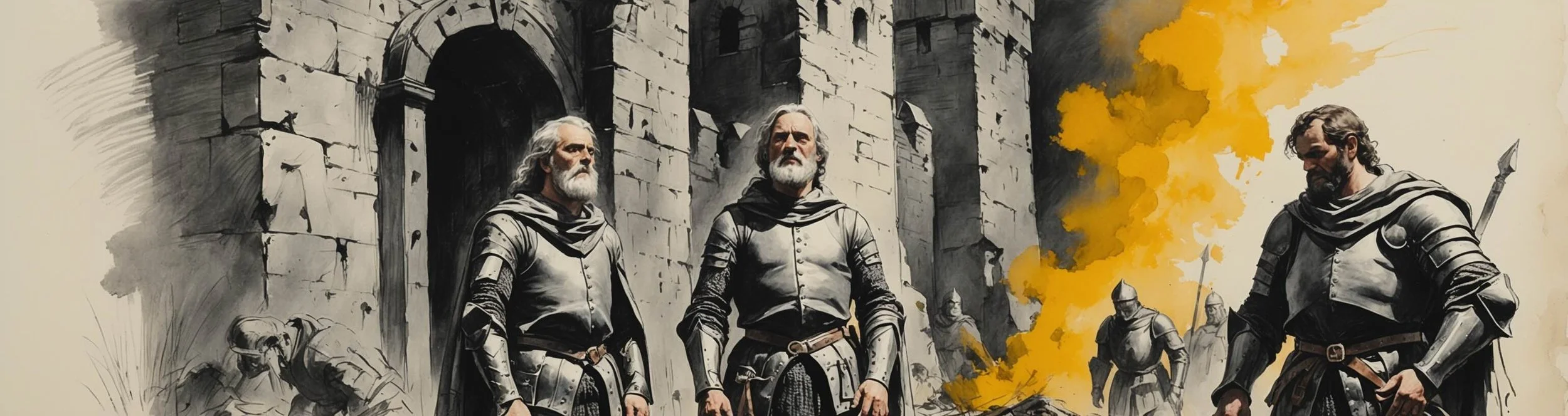
Scene Profile – At a Glance
- Location: Pomfret Castle, Yorkshire – the walls, on the way to the block.
- What Happens: Ratcliffe leads Rivers, Grey and Vaughan – the Queen’s brother, son and ally – to execution. They protest their innocence, remember Margaret’s curse, pray for the Queen and the princes, and embrace before they die.
- Key Characters: Earl Rivers, Lord Grey, Sir Thomas Vaughan, Sir Richard Ratcliffe, guards with halberds.
- Dramatic Function: Twenty-six lines that clear the queen’s party from the board and start the play’s series of recognition scenes – the first victims to say aloud that Margaret’s curse has come true.
- Famous Quote:
"O Pomfret, Pomfret! O thou bloody prison!"
(Rivers, Act 3, Scene 3) - Why It Matters: The scene is placed between Hastings’ boasting and Hastings’ death so that the audience hears the curse named at Pomfret an hour before it is named in the Tower.
Scene Summary
Ratcliffe orders the prisoners brought forth. Rivers tells him that he will see a subject die today for truth, duty and loyalty; Grey prays God to bless the Prince from the pack of them, a knot of damned blood-suckers; Vaughan warns that they will live to cry woe for this. Ratcliffe tells them their time is up.
Rivers addresses the castle: Pomfret, bloody prison, fatal and ominous to noble peers, where Richard II was hacked to death, and which now drinks their guiltless blood. Grey says that Margaret’s curse has fallen on their heads – the curse she made on Hastings, Rivers and himself for standing by when Richard stabbed her son. Rivers remembers that she cursed Richard, Buckingham and Hastings too, and asks God to hear that part of her prayer as he now hears this part; and he asks that God be satisfied with their blood and spare his sister the Queen and her princely sons. Ratcliffe hurries them. The three embrace and say farewell until they meet in heaven.
A Bloody Prison
Pomfret – Pontefract – was the castle where Richard II died in 1400, and Rivers knows it. His speech turns the building into a witness for the prosecution.
Original
O Pomfret, Pomfret! O thou bloody prison!
Fatal and ominous to noble peers!
Within the guilty closure of thy walls
Richard the Second here was hacked to death;
And for more slander to thy dismal seat,
We give to thee our guiltless blood to drink.
(Rivers, Act 3, Scene 3)
Shakespeare Retold (Modern Verse)
Oh Pomfret! You’re a bloody awful prison!
You frighten and you kill nobility!
Within these guilty walls you put behind bars
Richard the Second, who was hacked to death here;
And slurring your bad reputation further,
We’ll bleed to death here, though we’re innocent.
Rivers gives the castle a history and a diet. It is fatal to noble peers, it saw a king hacked to death, and now it will drink innocent blood – the image of the walls swallowing what is spilt inside them. The reference to Richard II reaches back to the beginning of the whole cycle of civil war that Richmond will close in Act 5; the deposition of that king was, in the Tudor account, the sin England has been paying for ever since, and Rivers, dying at the same spot, joins his death to the sequence. The three men’s openings are a small chorus of defiance – truth, duty, loyalty; a pack of blood-suckers; you will live to rue this – and Ratcliffe’s answers are two lines of pure administration: the limit of your lives is out, the hour of death is expiate. The play’s account of power under Richard is often this flat – an officer, a timetable, three men with something to say and no one obliged to listen.
Now Margaret’s Curse Is Fallen
Grey says the thing that every victim in the play will say in turn: Margaret’s curse has come true. He says it first, and he is exact about what she cursed them for.
Original
Now Margaret’s curse is fall’n upon our heads,
When she exclaimed on Hastings, you, and I,
For standing by when Richard stabbed her son.
(Grey, Act 3, Scene 3)
Shakespeare Retold (Modern Verse)
And now Queen Margaret’s curse on us has happened
When she condemned Lord Hastings, you and me,
For standing by when Richard stabbed her son.
In Act 1, Scene 3 Margaret cursed Rivers, Grey and Hastings together, as bystanders at the murder of her son Edward at Tewkesbury; the three names are hers, and Grey repeats them. Rivers goes further and does the play’s accounting: she also cursed Richard, Buckingham and Hastings, and he asks God to remember the rest of the list as this part is paid. It is a prayer for the play’s remaining action, and the play grants it – Hastings within the hour, Buckingham in Act 5, Richard at Bosworth. Rivers’ last request, that God be satisfied with their blood and spare his sister and her sons, is refused, and the audience knows it will be. The embrace and the farewell until heaven are the scene’s only tenderness, and they are given to men the play has treated until now as a faction. The scene’s contribution to the design of prophecy and curses is to start the roll-call: the first victims to name the curse aloud, in the act that will hear it named twice more.
Language and Technique
- Apostrophe to a building: Rivers addresses Pomfret Castle as if it could hear – a prison given a memory and an appetite, so that the place itself becomes an accuser.
- Historical echo: Richard II hacked to death here: one line ties this execution to the death that began the civil wars, and to the play that Shakespeare would write next.
- Three voices, one defiance: Rivers, Grey and Vaughan each get a short opening protest, so the scene sounds like a chorus rather than a single lament.
- The officer’s register: “The limit of your lives is out”, “the hour of death is expiate”: Ratcliffe speaks like a clerk, and the flatness is the tyranny.
- The curse named: Grey and Rivers recite Margaret’s list of victims, so the audience hears the play’s plot summarised by the men it is killing.
Key Quotes from Act 3, Scene 3
Quote 1
Today shalt thou behold a subject die
For truth, for duty, and for loyalty.
(Rivers, Act 3, Scene 3)
Shakespeare Retold (Modern Verse)
Today you’re going to see a person die
For speaking truth and acting loyally.
Quote Analysis: Rivers’ opening claim is a definition of his death: a subject, not a traitor, dying for the three virtues a subject owes. The line is aimed at Ratcliffe and over his head at the audience, and it sets the terms of the scene – these are the loyal party, and loyalty is what is being executed.
Then cursed she Richard, then cursed she Buckingham,
Then cursed she Hastings. O, remember, God,
To hear her prayer for them, as now for us!
(Rivers, Act 3, Scene 3)
Shakespeare Retold (Modern Verse)
She first cursed Richard, then cursed Buckingham,
And then cursed Hastings. Dear God, please remember
Her prayers for them, then hear the prayers for us now!
Quote Analysis: Rivers turns Margaret’s curse into a petition. He lists the three names still outstanding and asks God to hear that part of the prayer as he is now hearing this one. It is the play’s plot handed to heaven as a request, and heaven fills the order.
Come, Grey, come, Vaughan, let us here embrace.
Farewell, until we meet again in heaven.
(Rivers, Act 3, Scene 3)
Shakespeare Retold (Modern Verse)
Come, Grey and Vaughan, let all of us embrace.
Goodbye, until we meet again in heaven.
Quote Analysis: The exit couplet. Three men who have been a political faction for three acts become, in the last two lines, brothers-in-law and friends. The embrace is the only physical tenderness the scene allows, and the rhyme of embrace and heaven’s promise gives their exit a calm the play denies to Richard’s later victims.
Key Takeaways
- The queen’s party is cleared: Rivers, Grey and Vaughan die at Pomfret, and Elizabeth is left with no kin at court to protect the princes.
- The curse is named first here: Grey says Margaret’s curse has fallen; Hastings will say it within the hour, Buckingham in Act 5, and the pattern begins.
- Pomfret remembers Richard II: The castle’s history ties this death to the deposition that started the civil wars the play is ending.
- Loyalty is the crime: Rivers dies, he says, for truth, duty and loyalty – the scene’s one-line summary of what Richard’s rise costs.
Study Questions and Analysis
Who are Rivers, Grey and Vaughan, and why are they executed?
They are the queen’s party. Earl Rivers is Queen Elizabeth’s brother; Lord Grey is her son by her first marriage; Sir Thomas Vaughan is a loyal servant of the young Prince Edward. Richard and Buckingham arrested them on the road from Ludlow in Act 2, as reported to the queen in Act 2, Scene 4, on the pretext of a plot; the real reason is that they stood between Richard and control of the boy king. Executing them removes the princes’ protectors and leaves Elizabeth, as she says in Act 4, with no sons of royal blood left for Richard to kill.
God bless the Prince from all the pack of you!
A knot you are of damned blood-suckers.
(Grey, Act 3, Scene 3)
Shakespeare Retold (Modern Verse)
May God protect the Prince from all of you!
You are a bunch of goddamned parasites.
Historically the three were beheaded at Pontefract on 25 June 1483, without trial, on the same day the citizens of London were being told that Edward IV’s children were bastards; Shakespeare moves the execution to coincide with Hastings’ death so that the two blows fall in one act. The scene is only twenty-six lines because the audience already knows why the men must die; what it adds is their voices – defiance, a curse remembered, a prayer for the queen – so that the deaths are felt rather than merely reported. For an essay on power and ambition, the scene is the play’s clearest example of what Richard’s rise costs people who have done nothing but be in the way.
Why is Margaret’s curse mentioned here?
Because this is the first time it comes true, and the play wants the audience to notice. In Act 1, Scene 3 Margaret cursed Rivers, Grey and Hastings together for standing by when Richard stabbed her son at Tewkesbury; Grey remembers the exact terms, and Rivers adds the rest of her list – Richard, Buckingham and Hastings – and asks God to complete it. The scene is placed immediately before the council scene in which Hastings dies, so that the curse is named at Pomfret and then, within a hundred lines, at the Tower.
Then cursed she Richard, then cursed she Buckingham,
Then cursed she Hastings. O, remember, God,
To hear her prayer for them, as now for us!
(Rivers, Act 3, Scene 3)
Shakespeare Retold (Modern Verse)
She first cursed Richard, then cursed Buckingham,
And then cursed Hastings. Dear God, please remember
Her prayers for them, then hear the prayers for us now!
Rivers’ prayer is the play’s structure spoken aloud: he asks that the remaining names be paid, and they are, in order. The pattern – a victim naming the curse on the way to death – becomes the play’s ritual of recognition, repeated by Hastings, Anne, Buckingham and finally, in his own way, Richard. E. M. W. Tillyard, in Shakespeare’s History Plays (1944), read this machinery as the working out of God’s plan against the house of York; the scene supports him by having the victims themselves treat their deaths as instalments, and pray that the rest will follow.
Why does Rivers mention Richard II?
Because Pomfret is where Richard II died. Pontefract Castle in Yorkshire was the prison in which the deposed king was killed in 1400, on the orders of the man who had taken his crown, Henry IV – the event that, in the Tudor reading of history, began the century of civil war that Richard III ends. Rivers, about to die in the same castle, calls it fatal and ominous to noble peers and gives it the king’s death as its first crime.
The line does two things. It makes the castle an emblem – a place where the powerful kill the inconvenient – and it links this small execution to the largest pattern in Shakespeare’s history plays, which he would go on to dramatise in Richard II a few years later. A student can use it to show that the play’s sense of fate is historical as well as supernatural: Rivers dies where a king died, for reasons that go back to that king’s death, and he knows it.