Richard III: Act 5, Scene 5 – Analysis
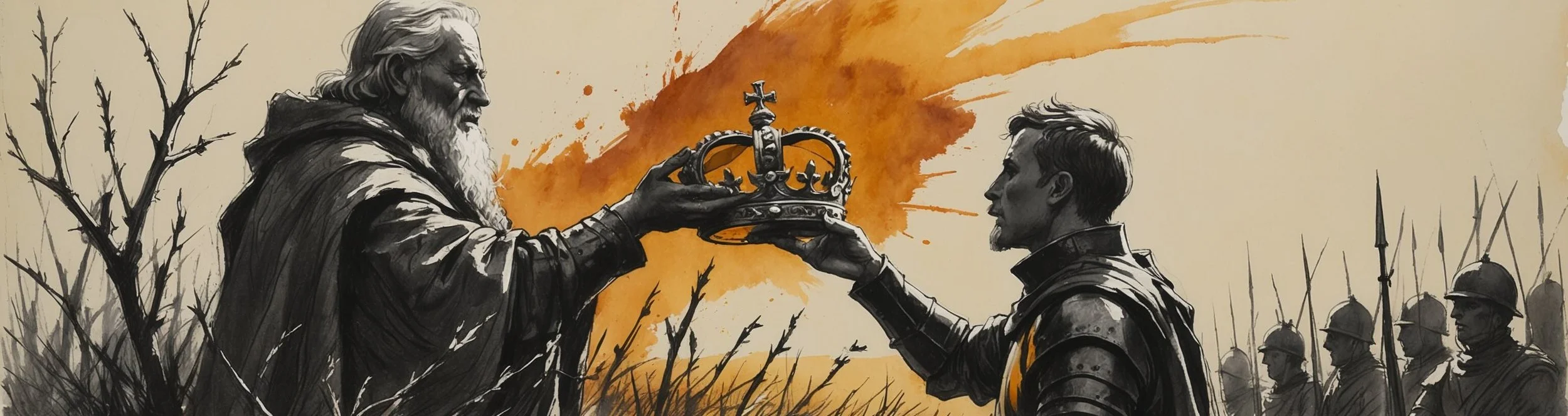
Scene Profile – At a Glance
- Location: Another part of Bosworth Field, moments after the battle.
- What Happens: King Richard and Richmond fight; Richard is killed. Stanley brings Richmond the crown, the dead are named, and Richmond announces his marriage to Elizabeth of York and the union of the two houses.
- Key Characters: Richmond, King Richard, Lord Stanley, lords and soldiers.
- Dramatic Function: The play’s resolution in forty-one lines: the villain’s death, the crown changing heads, and the Tudor settlement proclaimed as God’s peace.
- Famous Quote:
"We will unite the White Rose and the Red."
(Richmond, Act 5, Scene 5) - Why It Matters: This is the ending Shakespeare’s audience lived inside: the grandfather of their queen taking the crown and closing thirty years of civil war in a prayer.
Scene Summary
The scene opens with a stage direction, not a speech: King Richard and Richmond enter fighting, and Richard is slain. There is no death speech. A retreat is sounded, and Richmond returns with Lord Stanley, who is carrying the crown. Richmond praises God and his soldiers, and calls the dead king “the bloody dog”. Stanley tells him he has plucked the “long-usurped royalty” from Richard’s dead temples, and sets it on Richmond’s head.
Richmond’s first question is not about the crown but about Stanley’s son George, the hostage Richard threatened to behead; the boy is safe in Leicester. He asks who of note has died on either side (Norfolk, Ferrers, Brakenbury and Brandon), orders them buried according to their rank, and proclaims a pardon for any of Richard’s soldiers who submit. Then he turns to the audience with the speech that ends the play: he will marry Elizabeth of York and unite the White Rose and the Red; England has long been mad, brother killing brother, father killing son; now the true heirs of both houses will join, traitors will be blunted, and civil wounds are stopped. The last word is a prayer: God say amen.
The Crown Changes Heads
Richard has had the play’s best lines for five acts, and he dies without one. The direction says he is slain; the next voice is Richmond’s, and it gives thanks. The contrast is the point. Everything Richard did was talk; the man who replaces him begins with God and ends with amen.
Original
Lo here this long-usurped royalty
From the dead temples of this bloody wretch
Have I plucked off to grace thy brows withal.
Wear it, enjoy it, and make much of it.
(Stanley, Act 5, Scene 5)
Shakespeare Retold (Modern Verse)
Look here, I took this stolen royal crown
From off the bleeding head of lifeless Richard
To claim it from him to bestow on you.
Wear it, enjoy it, and appreciate it.
Stanley’s five lines are the coronation, and they are deliberately unceremonious. The crown is “plucked” from a “bloody wretch”, and Richmond is told to “Wear it, enjoy it, and make much of it” – the language of a gift, not a rite. Stanley, who sat out the battle and let his son’s life ride on the outcome, has earned the right to hand it over. The play is careful to make Richmond’s first act a question about that son: the new order begins with a hostage released rather than a head struck off.
England Hath Long Been Mad
Richmond’s closing speech is the whole first tetralogy summed up and put to bed. It looks back past this play to the three parts of Henry VI, where brothers, fathers and sons did kill one another, and it announces the cure Shakespeare’s audience already knew: the Tudor marriage.
Original
England hath long been mad and scarred herself:
The brother blindly shed the brother’s blood,
The father rashly slaughtered his own son,
The son, compelled, been butcher to the sire.
(Richmond, Act 5, Scene 5)
Shakespeare Retold (Modern Verse)
England has long been crazy with self-harm:
For brothers blindly murdered their own brothers,
And fathers rashly slaughtered their own sons,
And sons have been compelled to kill their fathers.
The four lines are built as a ladder of horrors, each a family relationship turned into a killing: brother and brother, father and son, son and father. “Compelled” is the important word – the last killer did not choose. The speech treats the civil wars as a national illness, something England did to herself, and it prepares the ground for a king who is a doctor rather than a hero. Richmond claims nothing for himself; the marriage is by “God’s fair ordinance”, the peace is heaven’s to grant, and even the traitors are handed to God to blunt. It is the voice of the Tudor myth speaking in its own person, and the play lets it have the last word.
Language and Technique
- Silence for the villain: Richard dies in a stage direction. After five acts of soliloquy, the play denies him a last speech, so the audience feels his voice go out like a light.
- The word amen: Richmond says “amen” three times in forty lines and asks who dares not say it – the speech turns the whole theatre into a congregation answering a prayer.
- Family words as violence: Brother, father, son, sire: the speech names the closest bonds and pairs each with a verb of killing, so the civil war sounds like a household destroying itself.
- Roses as heraldry: “The White Rose and the Red” are the badges of York and Lancaster; uniting them in one line is the marriage done in emblems before it is done in church.
Key Quotes from Act 5, Scene 5
Quote 1
The day is ours, the bloody dog is dead.
(Richmond, Act 5, Scene 5)
Shakespeare Retold (Modern Verse)
This day belongs to us, the dog is dead.
Quote Analysis: Richmond’s first words after the killing. “God and your arms” gives the victory to heaven and the soldiers, in that order, and the dead king is not named at all – he is “the bloody dog”, an animal rather than a man. After a play in which Richard called everyone else names, the last name is applied to him, and it is an animal’s.
We will unite the White Rose and the Red.
Smile heaven upon this fair conjunction,
That long have frowned upon their enmity!
What traitor hears me, and says not amen?
(Richmond, Act 5, Scene 5)
Shakespeare Retold (Modern Verse)
We will unite the Lancasters and Yorks.
And may God smile upon this happy union,
Who long has frowned on how both sides have fought!
What traitor hears me, but does not agree?
Quote Analysis: The political programme in four lines: pardon for those who submit, a sacramental oath, the union of the roses, and heaven’s smile on it. The last line is a trap for the audience as much as for the lords on stage – a traitor is anyone who will not say amen, which is how a new dynasty asks for consent. The verse is smooth and public where Richard’s was jagged and private.
Now civil wounds are stopped, peace lives again...
(Richmond, Act 5, Scene 5)
Shakespeare Retold (Modern Verse)
Now civil war is done, there’s peace again...
Quote Analysis: The play’s final couplet. “Civil wounds” makes the war a body’s injury and the peace its healing; “she” is peace itself, hoped to live long in England. The rhyme lands on “amen”, and the play that opened with a villain telling the audience what he would do closes with a king asking God to agree with him.
Key Takeaways
- Richard dies wordless: The great talker gets no last speech; his death is a stage direction and his epitaph is “the bloody dog”.
- The crown is handed, not seized: Stanley plucks it from a corpse and gives it to Richmond – the play’s one transfer of power that is not a theft.
- Richmond speaks for the Tudors: The closing speech looks back over the whole civil war and forward to the marriage that Shakespeare’s queen descended from.
- The ending is a prayer: Amen three times, and a challenge to any traitor who will not say it: the peace is declared God’s, and consent is demanded.
Study Questions and Analysis
How does Richard die, and why does he get no death speech?
In single combat with Richmond, according to the stage direction, which says only that they fight and Richard is slain. Shakespeare gives him nothing to say. This is unusual – Macbeth, Hotspur and Richard II all die talking – and it is deliberate. Richard’s power in the play has been his voice: the soliloquies, the asides, the wooing, the four-word death sentence on Hastings. Taking the voice away before the body is the play’s final judgement on him.
It also protects the ending. A last speech would have invited sympathy, and the scene needs the audience to move cleanly from the villain to the settlement. Richmond’s first line supplies the epitaph instead: the bloody dog is dead. Productions sometimes give Richard a longer fight or a wordless struggle to compensate, but the text’s silence is the point – after five acts of being told everything, we are told nothing.
What does Richmond’s final speech mean?
It is the political and religious conclusion of Shakespeare’s first four history plays. Richmond announces that he will marry Elizabeth of York, daughter of Edward IV, uniting the houses of Lancaster (the red rose) and York (the white) that have fought since Henry VI. He describes the civil wars as England’s self-inflicted madness, prays for heirs who will bring peace, asks God to blunt any traitor who would restart the bloodshed, and ends on amen.
O now let Richmond and Elizabeth,
The true succeeders of each royal house,
By God’s fair ordinance conjoin together!
(Richmond, Act 5, Scene 5)
Shakespeare Retold (Modern Verse)
But now let Richmond and Elizabeth,
The rightful heirs of Lancaster and York,
Be married with the blessings of our God!
E. M. W. Tillyard, in Shakespeare’s History Plays (1944), read this as the true business of the play: the working out of God’s plan to restore England, with Richmond as its instrument. Later critics have found the speech thin beside the villain it replaces, and some have heard in its demand for amen the sound of a new regime asking for obedience. Both readings are usable in an essay, and the best answers hold them together: the speech is the official ending, and the play has spent five acts making the unofficial one more interesting.
Why does Richmond ask about George Stanley before anything else?
Because the boy’s life was the price of the battle. In Act 4, Scene 4 Richard took Stanley’s son as a hostage to force Stanley to fight for him, and in Act 5, Scene 3 he ordered the boy beheaded if Stanley failed to bring his troops. Stanley refused, and Richard’s order was overtaken by the fighting. Richmond’s question, before the casualty list and before the crown is discussed, closes that thread: George is safe in Leicester.
It also characterises the new king in one line. Richard’s first act on being crowned in Act 4, Scene 2 was to ask Buckingham to murder two children; Richmond’s first act on being crowned is to ask whether a child has survived. The play draws the contrast without comment, and it is the clearest sign that the scene is written to make the change of regime feel like a change of nature.
Is the ending of Richard III convincing?
It depends what you ask it to do. As history it is exact: Richard did die at Bosworth on 22 August 1485, Henry Tudor did marry Elizabeth of York the following year, and their grandchild was on the throne when the play was written. As theatre it is often felt to be abrupt. Richmond has had three short scenes to establish himself, Richard has had the whole play, and forty-one lines of thanksgiving are asked to balance five acts of brilliance.
Jan Kott, in Shakespeare Our Contemporary (1964), argued that every one of Shakespeare’s history plays runs the same cycle – a struggle for the throne, a coronation, a death, a new coronation – and that the machine simply turns again; on that reading Richmond’s amen is one more coronation, not an ending. Against that, the play’s own frame is providential: every curse has been paid, the ghosts have blessed the winner, and the last word is a prayer. A strong essay can argue that the ending is convincing as a statement of what the Tudor audience needed to believe, and deliberately unconvincing as a replacement for the man the audience has been enjoying.