Richard III: Act 5, Scene 4 – Analysis
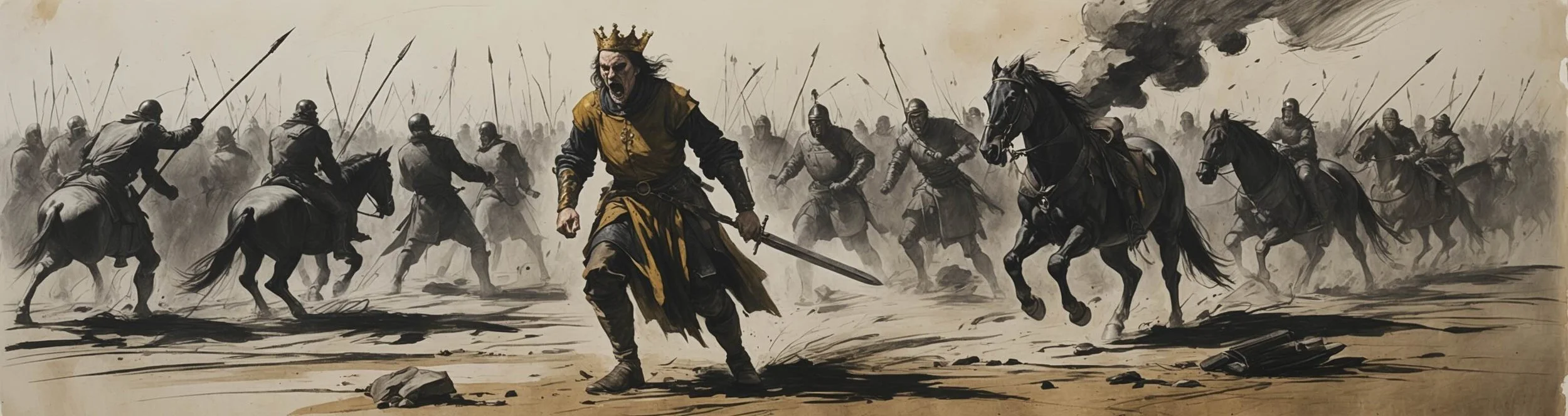
Scene Profile – At a Glance
- Location: Another part of Bosworth Field, in the thick of the battle.
- What Happens: Catesby calls for rescue: the king’s horse is dead and he is fighting on foot. Richard enters crying for a horse, refuses to withdraw, and goes back to hunt for Richmond.
- Key Characters: King Richard, Catesby, Norfolk.
- Dramatic Function: Richard’s last words: a thirteen-line scene that turns the play’s villain into a soldier and hands the language its most famous cry.
- Famous Quote:
"A horse, a horse! My kingdom for a horse!"
(King Richard, Act 5, Scene 4) - Why It Matters: The kingdom Richard spent four acts acquiring is offered here for one horse – and he means it as a way to keep fighting, not to run.
Scene Summary
Alarums and excursions – the sounds of a battle in progress. Catesby runs on calling to the Duke of Norfolk for rescue: the king is performing more wonders than a man, challenging every danger, his horse has been killed under him, and he is fighting on foot, seeking Richmond “in the throat of death”. Unless help comes, the day is lost.
Richard enters with the cry that has outlived the play: a horse, a horse, his kingdom for a horse. Catesby urges him to withdraw and offers to find him a mount. Richard calls him a slave and refuses. He has staked his life on a single throw and will stand by the result; there seem to be six Richmonds in the field, and he has killed five of them already in place of the man himself. He repeats the cry and goes back into the fight.
The Hazard of the Die
Catesby’s report is the only description of Richard in battle the play gives us, and it is admiring: more than a man, daring every danger, looking for Richmond in the mouth of death. The villain who has done all his work by talking turns out to be, at the end, a soldier. Then he speaks.
Original
Slave, I have set my life upon a cast,
And I will stand the hazard of the die.
I think there be six Richmonds in the field;
Five have I slain today in stead of him.
A horse, a horse! My kingdom for a horse!
(King Richard, Act 5, Scene 4)
Shakespeare Retold (Modern Verse)
I’ve risked my life on one throw of the dice,
And I will stand by what the dice reveal;
It seems this battle has six Earls of Richmond;
I’ve slaughtered five, but not the one I want.
A horse! I’d give my kingdom for a horse!
The famous line is usually heard as panic, and the speech around it shows it is something else. Richard refuses the horse Catesby offers because he does not want to leave the field; he wants a horse to continue the hunt. The image he chooses is a gambler’s: life on a single cast, standing the hazard of the die, the language of a man who knows the odds and has stopped calculating them. “Six Richmonds” refers to the decoys in royal armour Richmond has put into the field; Richard has cut down five and is still looking for the sixth. The kingdom-for-a-horse exchange rate is the play’s last joke at his expense – the crown he plotted, murdered and married for is now worth one animal – and he makes the offer twice, without irony, because the fight is all that is left.
Language and Technique
- Report before entrance: Catesby describes the king before we see him, so Richard’s cry arrives already framed as heroism rather than fear.
- Gambling imagery: “Cast”, “hazard”, “die”: Richard turns the battle into a single throw of dice – chance, not providence, is his last philosophy.
- Repetition as bookend: The horse line opens and closes his speech, so the scene is built like a frame around the one thing he still wants.
- The word slave: Richard’s answer to the man trying to save his life is an insult – to the end, help is something he refuses and others are things.
Key Quotes from Act 5, Scene 4
Quote 1
The King enacts more wonders than a man,
Daring an opposite to every danger.
His horse is slain, and all on foot he fights,
Seeking for Richmond in the throat of death.
(Catesby, Act 5, Scene 4)
Shakespeare Retold (Modern Verse)
The King has fought more than humanly possible,
By challenging each foe despite the danger.
His horse is dead, yet now he fights on foot,
In search of Richmond though he’s close to death.
Quote Analysis: Catesby’s four lines are a small heroic portrait, and they are spoken by the man who has been Richard’s most useful servant since Act 1. “More wonders than a man” and “the throat of death” are the vocabulary of epic, not of villainy; for a moment the play lets Richard be Hotspur. It is also practical staging: the audience needs to know the horse is dead before the cry for one makes sense.
A horse, a horse! My kingdom for a horse!
(King Richard, Act 5, Scene 4)
Shakespeare Retold (Modern Verse)
A horse! I’d give my kingdom for a horse!
Quote Analysis: The most quoted line in the play and among the most quoted in Shakespeare, and its fame has changed its meaning. Out of context it sounds like a man who would give anything to escape. In context Richard has just refused to withdraw. What he wants the horse for is to reach Richmond, and the kingdom he offers is one he already knows is lost. The modern verse keeps the exchange plain: he would give the kingdom for the horse, and the kingdom is not worth very much.
Key Takeaways
- Richard the soldier: The play’s one glimpse of Richard fighting is admiring – more wonders than a man – and it comes from Catesby, not from Richard.
- Not a cry to flee: He refuses the horse that would take him off the field; the horse he wants is for hunting Richmond.
- Everything on one throw: Cast, hazard, die: the language of gambling replaces the language of providence in his last speech.
- Six Richmonds: Richmond’s decoys mean Richard has been killing the wrong man all morning – the play’s last trick played on the trickster.
Study Questions and Analysis
What does “A horse, a horse! My kingdom for a horse!” actually mean?
Richard’s horse has been killed under him and he is fighting on foot, still searching for Richmond. He is calling for a mount so that he can continue the hunt, and offering the kingdom for one because, in the middle of a battle he is losing, a horse is worth more to him than the crown. It is not a plea to escape: in the same speech he refuses Catesby’s offer to withdraw and find him a horse, calling him a slave for suggesting it.
Slave, I have set my life upon a cast,
And I will stand the hazard of the die.
(King Richard, Act 5, Scene 4)
Shakespeare Retold (Modern Verse)
I’ve risked my life on one throw of the dice,
And I will stand by what the dice reveal...
The gambling image explains the cry. Richard has staked his life on one throw and will stand by whatever the dice show; the horse is simply the means of finishing the game. The line has become proverbial for desperate need of any kind, and that is fair enough, but a good essay should notice that the desperation is aimed at the enemy, not away from him. The kingdom is offered as a soldier’s currency, and the offer is repeated because it has no takers.
Why are there “six Richmonds in the field”?
Richmond has dressed several of his followers in royal armour and coat-of-arms so that Richard cannot find him. The device is historical – chroniclers describe decoys at Bosworth – and Shakespeare uses it for a purpose beyond the battlefield. Richard, who has spent the play making other people mistake seeming for being, is defeated by exactly that trick: he has killed five men who looked like the king’s rival and cannot find the sixth.
The line also completes a pattern. Richard called himself, in Act 1, a man who could seem a saint while playing the devil, and the play’s theme of appearance and reality has run through every scene since. At Bosworth the disguise is on the other side, and it works. Richard’s last recorded act is to have wasted his strength on impostors – a fitting end for the man who taught the play the value of a false face.
Does Richard die bravely?
The scene says so, and it is the only witness. Catesby’s account – more wonders than a man, daring every danger, fighting on foot in the throat of death – is admiration without irony, and Richard’s refusal to leave the field confirms it. He does not run, does not bargain, and does not try to save his life; he goes back to look for the one opponent who matters. Whatever else he has been, the play makes him a soldier at the end.
That has consequences for how the play is read. William Hazlitt, in Characters of Shakespear’s Plays (1817), described Richard as “confident in his strength as well as in his cunning”, and the two halves of that phrase are the two halves of the play: the cunning runs out in Act 4, and the strength is all that remains in Act 5. Some productions make the last fight a long, wordless struggle to give the audience a chance to feel the loss; the text gives it thirteen lines and a stage direction in the next scene. The brevity is a choice – Richard is denied a death speech – and the courage is the compensation the play allows him.