Richard III: Act 5, Scene 3 – Analysis
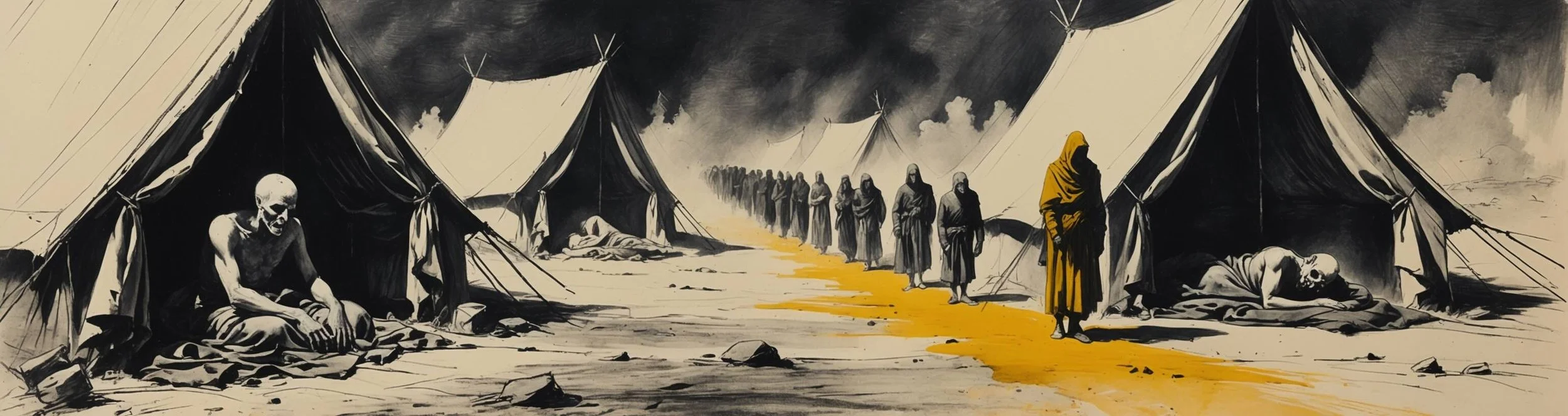
Scene Profile – At a Glance
- Location: Bosworth Field, the night before the battle – two tents, Richard’s and Richmond’s, pitched on the same stage.
- What Happens: King Richard and Richmond make camp. Stanley slips across to Richmond; both leaders sleep; the ghosts of Richard’s victims visit both tents. Richard wakes in terror, then rallies; each man addresses his army; Stanley refuses to come.
- Key Characters: King Richard, Richmond, Lord Stanley, Norfolk, Ratcliffe, Catesby, and the ghosts of Prince Edward, Henry VI, George, Duke of Clarence, Rivers, Grey, Vaughan, Hastings, the two princes, Lady Anne and The Duke of Buckingham.
- Dramatic Function: The play’s climax and reckoning: every curse is paid off in one procession of ghosts, and Richard’s conscience speaks for the first and last time.
- Famous Quote:
"O coward conscience, how dost thou afflict me!"
(King Richard, Act 5, Scene 3) - Why It Matters: Bosworth is decided here, before a blow is struck – Richmond sleeps sweetly and Richard wakes hating himself, and the morning simply carries out the verdict of the night.
Scene Summary
The armies have arrived at Bosworth. King Richard orders his tent pitched, jokes with Norfolk about the blows to come, counts the enemy at six or seven thousand against his own three times that, and goes off to survey the ground. On the other side of the stage Richmond watches the sun set, gives his captains their orders, and sends Captain Blunt to find Lord Stanley, his stepfather, with a note. Richard returns, refuses supper, checks his armour, sends word to Stanley that his son George dies unless he brings his troops by sunrise, calls for wine, admits he lacks his usual cheer, and orders Ratcliffe to wake him at midnight to arm.
Stanley comes secretly to Richmond’s tent. He brings a blessing from Richmond’s mother and a warning: he will help as far as he dares, but cannot openly, because Richard holds his son. Richmond, alone, prays that God will look on his forces and make them his ministers of chastisement, and sleeps.
The ghosts come. Prince Edward of Lancaster, stabbed at Tewkesbury; Henry VI, murdered in the Tower; George, Duke of Clarence, drowned in wine; Rivers, Grey and Vaughan, executed at Pomfret; Hastings; the two young princes; Lady Anne; and last The Duke of Buckingham, who helped Richard to the crown and was the last to feel his tyranny. Each speaks to Richard first, telling him to despair and die, and then to Richmond, telling him to live and flourish.
Richard starts awake calling for a horse and bandages, still in the dream. What follows is the play’s strangest speech: he asks what he is afraid of, answers that there is no one there but himself, and then puts himself on trial. Richard loves Richard; is there a murderer here? No – yes, I am. His conscience has a thousand tongues and every one calls him villain. He shall despair; no creature loves him, and if he dies no one will pity him. Ratcliffe enters: the cock has crowed twice and his friends are arming. Richard confesses that the shadows of the night have frightened him more than ten thousand soldiers could, and goes to eavesdrop on his own men to see whether any mean to desert.
Richmond wakes at four from the sweetest sleep he has ever had, and addresses his soldiers: God and a good cause fight on their side, the man they face is a bloody tyrant raised in blood, and every man who fights for wives, children and country will be rewarded. Richard, meanwhile, notes that the sun has refused to rise, reads a note found on Norfolk’s tent warning that Dickon is bought and sold, dismisses it, and gives his own oration: conscience is a word cowards use; the enemy are vagabonds and Bretons led by a milksop. A drum sounds. Stanley has refused to bring his troops. Richard orders young George Stanley beheaded, Norfolk tells him there is no time, and the king charges with a thousand hearts in his bosom.
Two Tents
The scene is built on a stage divided in two. Richard and Richmond never meet in it, but the audience watches them do the same things in turn – pitch a tent, give orders, ask the time, lie down – and the comparison does the work that a debate would do in another play.
Original
Up with my tent! Here will I lie tonight
But where tomorrow? Well, all’s one for that.
(King Richard, Act 5, Scene 3)
Shakespeare Retold (Modern Verse)
Put up my tent! I will sleep here tonight,
But where tomorrow? Well, that doesn’t matter.
Richard’s camp talk is all bustle and bravado – knocks to be given and taken, the traitors counted and found wanting, the king’s name a tower of strength – but the bravado has a crack in it. “But where tomorrow? Well, all’s one for that” is a man refusing to think about the day after, and he says it in the middle of ordering a tent. Richmond, across the stage, is quieter and busier: he draws a battle plan on paper, delegates by name, and sends for the one man whose choice will decide the day. Richard demands wine and admits he has lost his “alacrity of spirit”. The night has not begun and the audience already knows which tent is winning.
The Hostage and the Prayer
Stanley’s visit to Richmond’s tent is the scene’s hinge, and the play’s quietest act of treason. He cannot fight for his stepson openly because Richard has his son George; he promises to “deceive the time” as best he can, and leaves. Then Richmond prays.
Original
O Thou whose captain I account myself,
Look on my forces with a gracious eye;
Put in their hands thy bruising irons of wrath,
That they may crush down with a heavy fall
The usurping helmets of our adversaries;
Make us thy ministers of chastisement,
That we may praise thee in the victory!
(Richmond, Act 5, Scene 3)
Shakespeare Retold (Modern Verse)
Oh God, as I’m a captain under you,
I ask that you look kindly on my forces;
Give them destructive swords to use in anger
So that they may completely overwhelm
Our enemy unlawfully in power;
Make us your holy agents of revenge,
So we can praise you in our victory!
The prayer defines the man. Richmond calls himself God’s captain, asks for irons of wrath for his soldiers’ hands, and asks to be made a minister of chastisement – a punisher, not a conqueror. Everything is God’s: the cause, the weapons, the victory to be praised. Set beside Richard’s demand for a bowl of wine and a watch, it is the providential half of the play speaking, and the plainness of the verse is deliberate. Richmond has no wit, no asides and no interior; he has a cause, and the play is about to show whose side the dead are on.
Despair and Die
Eleven victims file across the stage in the order Richard killed them, and each speaks twice: a curse to one tent, a blessing to the other. The formality is the point. This is not a nightmare but a court, and the sentence is repeated until it becomes a chant.
Original
The first was I that helped thee to the crown;
The last was I that felt thy tyranny.
O, in the battle think on Buckingham,
And die in terror of thy guiltiness!
(Ghost of Buckingham, Act 5, Scene 3)
Shakespeare Retold (Modern Verse)
I was the first to help you win the crown,
And was the last to feel your tyranny.
Oh, in the battle think of Buckingham,
And die in fear from all your guiltiness!
Buckingham’s ghost comes last because he died last, and his two opening lines sum up the whole play’s machinery: first to help, last to suffer. Every ghost delivers the same instruction, and “despair” is a technical word – in the theology Shakespeare’s audience knew, it was the sin of believing yourself beyond forgiveness, the state Judas died in. The ghosts are not merely frightening Richard; they are cursing him with a particular damnation, and he wakes and reports that it has taken: “I shall despair”. To Richmond they promise sleep, victory and a happy race of kings, which is the Tudor line in the audience’s own present. The procession is the curse-and-fulfilment pattern of the play made visible, with Margaret’s prophecies of Act 1 now walking.
Richard Loves Richard
Richard wakes fighting, calls for a horse, and then hears himself. The speech that follows has no model in the earlier soliloquies; the man who spent four acts confiding his plans to the audience now has nobody to confide in but himself, and finds that self split in two.
Original
What do I fear? Myself? There’s none else by.
Richard loves Richard, that is, I am I.
Is there a murderer here? No. Yes, I am.
Then fly. What, from myself? Great reason why –
Lest I revenge. What, myself upon myself?
(King Richard, Act 5, Scene 3)
Shakespeare Retold (Modern Verse)
What am I scared of? Me? There’s no one else here.
Richard loves Richard, that is, I’m just me.
Is there a murderer here? No. Yes, I am.
Then run! Run from myself? Why should I do that…
In case I seek revenge? What, from myself?
The grammar breaks. Questions answer themselves, answers contradict each other, and the word “myself” turns up six times in five lines because there is nothing else in the tent. Richard tries the old trick – a villain declares himself and dares the audience to disapprove – and it fails: “I am a villain; yet I lie, I am not.” Then the court assembles inside him, conscience with a thousand tongues, every one crying guilty, and he reaches the conclusion the ghosts prescribed. There is no creature that loves him, and he cannot find in himself any pity for himself. It is the only moment in the play he wants what he told us in Act 1 he could not have, and it passes in a few lines; by the time Ratcliffe enters he is asking whether his friends will prove true, which is the practical form of the same fear. The scene’s argument about conscience is that it cannot be reasoned away, only outshouted – and the morning oration is the shouting.
Two Orations
Dawn brings the speeches. Richmond’s is a list of rights and rewards under God; Richard’s is a list of insults. Both are effective rhetoric, and the play wants the audience to hear them side by side.
Original
Conscience is but a word that cowards use,
Devised at first to keep the strong in awe:
Our strong arms be our conscience, swords our law!
March on, join bravely, let us to it pell-mell;
If not to heaven, then hand in hand to hell.
(King Richard, Act 5, Scene 3)
Shakespeare Retold (Modern Verse)
‘Conscience’ is just a word that cowards use
At first to keep those stronger men in awe:
Our strength will show we’re right, swords prove our law!
March on together, bravely, let’s be swift;
We’ll go to heaven, else to hell we’ll shift.
Richard’s answer to the night is to deny that it happened. Conscience is a word invented by cowards to frighten the strong; swords are the law; and if the road does not lead to heaven, then hand in hand to hell. The couplet is the old Richard – the swagger, the joke, the intimacy with damnation – and it is delivered about forty lines after he told Ratcliffe he was afraid. The contempt that follows, for the “vagabonds, rascals, and runaways” and the milksop who leads them, is the same weapon he used on Anne, on Hastings and on the citizens: name the enemy something small and the audience will believe it. It works on his soldiers. It has stopped working on him, and the play lets us hear both things at once. Then the omens arrive – a sun that will not rise, a note nailed to Norfolk’s tent, a stepfather who will not come – and the last order he gives before the charge is one more execution.
Language and Technique
- The divided stage: Two tents, two kings, one set of ghosts speaking to both: the scene’s meaning is in the comparison, so it stages the rivals side by side without letting them meet.
- Refrain: “Despair and die” is spoken by ghost after ghost, and “Live and flourish” answers it. The repetition turns the procession into a liturgy – a curse and a blessing chanted in turn.
- A self in two halves: “Richard loves Richard”, “myself upon myself”: the waking speech splits its speaker into judge and defendant, and the broken sentences act out the split.
- Legal language: Conscience has “tongues”, sins “throng to the bar” and cry “Guilty”: Richard imagines his guilt as a courtroom, and the verdict is his own.
- Omens: The blue candle, the missing sun, the note on the tent: the morning is thick with signs, and Richard reads each one and dismisses it, which is how the play shows a man refusing to know what he knows.
- Two kinds of oration: Richmond builds his speech from if-clauses and promises; Richard builds his from abuse. One persuades by what soldiers will gain, the other by what the enemy is.
Key Quotes from Act 5, Scene 3
Quote 1
Give me another horse! Bind up my wounds!
Have mercy, Jesu! Soft, I did but dream.
O coward conscience, how dost thou afflict me!
(King Richard, Act 5, Scene 3)
Shakespeare Retold (Modern Verse)
Bring me another horse! Bind up my wounds!
Have mercy, Jesus! Wait…I was just dreaming.
My conscience is a coward! How it hurts me!
Quote Analysis: Richard’s first waking words are still inside the dream – a horse, bandages, the battle already lost – and then the recognition: “I did but dream.” The third line names the enemy for the first time. Conscience is a coward because it attacks in the dark, when he cannot fight back, and “afflict” is a word for illness. He has caught something, and the rest of the speech is the fever.
My conscience hath a thousand several tongues,
And every tongue brings in a several tale,
And every tale condemns me for a villain.
(King Richard, Act 5, Scene 3)
Shakespeare Retold (Modern Verse)
I hear my conscience speak a thousand voices,
And every voice recounts a different story,
But every story damns me as a villain.
Quote Analysis: The image is a courtroom that has assembled itself inside a man. Each tongue is a witness, each tale a charge, and the verdict is unanimous. “Several” means separate: the tongues do not agree with one another about anything except him. The word “villain” is the one Richard chose for himself in Act 1, and it comes back here as a sentence rather than a boast.
I shall despair; there is no creature loves me,
And if I die no soul will pity me.
(King Richard, Act 5, Scene 3)
Shakespeare Retold (Modern Verse)
Now I despair, for there’s no one that loves me,
And if I die, no one will pity me.
Quote Analysis: The ghosts told him to despair and die, and here he reports that the first half has happened. The two lines are the saddest in the play, and the reason he gives is the reason the audience has been given for four acts: nobody loves him. What is new is that he minds. The modern verse keeps the flatness of the statement – no rhetoric, no joke, a man describing his own position.
The sweetest sleep and fairest-boding dreams
That ever ent’red in a drowsy head
Have I since your departure had, my lords.
Methought their souls whose bodies Richard murdered
Came to my tent and cried on victory.
(Richmond, Act 5, Scene 3)
Shakespeare Retold (Modern Verse)
I’ve had the sweetest sleep and finest dreams
That ever have consumed a sleepy head
Since you all left me here to sleep, my lords.
I thought the souls of those who Richard murdered
Came to my tent and shouted that I’d win.
Quote Analysis: Richmond’s morning report is Richard’s inverted. Same tent, same ghosts, opposite effect: the murdered came and cried victory, and the sleeper woke jocund. The play could not make its point more plainly – the dead have chosen a side – and the plainness is the style. Richmond speaks in complete, comfortable sentences because nothing inside him is divided.
By the apostle Paul, shadows tonight
Have struck more terror to the soul of Richard
Than can the substance of ten thousand soldiers
Armed in proof and led by shallow Richmond.
(King Richard, Act 5, Scene 3)
Shakespeare Retold (Modern Verse)
The ghosts I’ve seen tonight – I swear by Saint Paul –
Have struck more terror in the heart of me
Than can an army of ten thousand soldiers
All dressed in armour, led by shallow Richmond.
Quote Analysis: Richard’s confession to Ratcliffe, made in the dark before the bravado of the morning. Shadows have done what an army could not; “the substance of ten thousand soldiers” is his own arithmetic from the night before, and it no longer comforts him. “Shallow Richmond” is the insult he will build the oration on, and here it sits next to an admission of terror. The play lets the two live in one sentence.
RICHARD: Off with his son George’s head!
NORFOLK: My lord, the enemy is past the marsh,
After the battle let George Stanley die.
(Act 5, Scene 3)
Shakespeare Retold (Modern Verse)
RICHARD: Off with his son George’s head!
NORFOLK: The enemy’s already past the marsh, sir,
So let George Stanley die after the battle.
Quote Analysis: The last exchange before the charge. Richard’s reflex on hearing that Stanley will not come is the four-word order he used on Hastings, and Norfolk’s answer is the first time in the play anyone has told Richard there is no time for an execution. The battle has overtaken the tyranny; the boy lives because the enemy is past the marsh. It is the moment Richard stops being able to make the world do what he says.
Key Takeaways
- The battle is won in the tents: Richmond sleeps well and Richard does not; the morning only carries out what the night decided.
- The ghosts are the reckoning: Eleven victims in the order of their deaths, each cursing one king and blessing the other – Margaret’s prophecies walking.
- Richard meets himself: The waking speech is the play’s first real interior monologue: a self split into judge and accused, ending in despair.
- Conscience is denied, not defeated: The oration calls conscience a coward’s word within an hour of the confession that it afflicts him; the two speeches sit in one scene on purpose.
- Stanley decides: The hostage plot runs through the whole scene, and Stanley’s refusal to come is the practical cause of Richard’s defeat.
Study Questions and Analysis
What happens on the night before the Battle of Bosworth?
Both armies camp, and the play stages both camps at once. Richard pitches his tent, counts his advantage in numbers, checks his armour, sends a threat to Stanley about his hostage son, and orders Ratcliffe to wake him at midnight. Richmond gives his orders, sends a note to Stanley, receives Stanley’s secret visit and his mother’s blessing, prays, and sleeps. Then the ghosts of Richard’s victims cross from one tent to the other, cursing Richard and blessing Richmond.
Richard wakes in terror, examines his own conscience in the play’s strangest soliloquy, and admits to Ratcliffe that shadows have frightened him more than an army. Richmond wakes refreshed. At dawn each man addresses his troops – Richmond invoking God and a just cause, Richard dismissing conscience and abusing the enemy – and the news comes that Stanley has refused to bring his men. Richard orders the hostage killed, is told there is no time, and charges. The whole scene runs to 361 lines, the longest stretch of continuous action in the play, and it contains the climax: the battle itself, in the next two scenes, is an afterthought.
Who are the ghosts, and in what order do they appear?
Eleven of Richard’s victims, appearing in the order in which he killed them. Prince Edward of Lancaster, Henry VI’s son, stabbed at Tewkesbury in Henry VI, Part 3; Henry VI himself, murdered in the Tower in the same play; Clarence, drowned in Act 1, Scene 4; Rivers, Grey and Vaughan, executed at Pomfret in Act 3, Scene 3; Hastings, beheaded after the council of Act 3, Scene 4; the two princes, smothered in the Tower and reported dead in Act 4, Scene 3; Lady Anne, whose death Richard mentions in the same scene; and Buckingham, executed at Salisbury in Act 5, Scene 1.
Dream on thy cousins smothered in the Tower.
Let us be lead within thy bosom, Richard,
And weigh thee down to ruin, shame, and death!
(Ghosts of the Princes, Act 5, Scene 3)
Shakespeare Retold (Modern Verse)
Dream of your cousins smothered in the Tower.
Let us be heavy lead within your heart,
And weigh you down to ruin, shame, and death!
Each ghost addresses Richard first and then Richmond, and each uses the same formula – despair and die to one, live and flourish to the other – so that the procession works as a roll-call of the play. The princes’ image of themselves as lead in Richard’s bosom is the physical form of guilt: a weight that will pull his sword down in the field. E. M. W. Tillyard, in Shakespeare’s History Plays (1944), read the ghosts as the clearest statement of the play’s providential design, the dead lining up behind God’s instrument; a student can add that they are also the fulfilment of Margaret’s curse in Act 1, Scene 3 that Richard’s sleep would be broken by hideous dreams.
What does “O coward conscience, how dost thou afflict me!” mean?
Richard has just woken from the ghosts and, for the first time in the play, feels guilt. He calls conscience a coward because it has attacked him in his sleep, when he could not answer it, and “afflict” treats the feeling as a disease – something that has happened to him rather than something he has done. The line is the exact opposite of the position he takes in the morning oration, where conscience is only a word that cowards use.
Richard loves Richard, that is, I am I.
Is there a murderer here? No. Yes, I am.
(King Richard, Act 5, Scene 3)
Shakespeare Retold (Modern Verse)
Richard loves Richard, that is, I’m just me.
Is there a murderer here? No. Yes, I am.
What follows the line is a self-interrogation without parallel in the earlier acts. Richard splits into questioner and answerer, tries to reassure himself that he loves himself, and cannot make the sentence hold. S. T. Coleridge, in his lectures of 1811–12, described Richard’s character as pride of intellect without moral feeling; this is the moment the moral feeling arrives, uninvited, and the intellect has no procedure for it. The modern verse keeps the stammering yes-and-no of the original, because the disorder is the meaning.
Does Richard really repent, or does he shake the dream off?
Both, in the space of a hundred lines, and the play refuses to say which is the real man. In the dark he despairs, admits that nobody loves him, and tells Ratcliffe that shadows have terrified him. In daylight he denies all of it: dreams are babble, conscience a coward’s invention, and the enemy a rabble of Bretons. The oration is not a change of heart but a change of audience – he has soldiers to address, and the old weapon of contempt still works on them.
The play’s answer is structural. It puts the confession and the denial in the same scene so that the audience carries the first into the second; the swagger of “Conscience is but a word that cowards use” is heard by people who know he does not believe it. Colley Cibber, adapting the play in 1700, resolved the tension with a line of his own – “Richard’s himself again” – which is not Shakespeare’s and tidies away exactly the doubt Shakespeare left. Sigmund Freud, in his 1916 essay on The Exceptions, argued that the play works by keeping the audience identified with Richard and away from critical reflection; this scene is where the identification is tested, because for the first time Richard reflects on himself and does not like what he sees.
Why does Stanley matter so much in this scene?
Because he holds the balance of the battle and Richard holds his son. Lord Stanley is Richmond’s stepfather – married to his mother, Margaret Beaufort – and commands a force camped between the two armies. Richard, who suspects him, has taken young George Stanley as a hostage and sends word that the boy dies unless Stanley brings his troops before sunrise. Stanley’s secret night visit to Richmond’s tent is his answer: he will help as far as he dares, but not openly, for the boy’s sake.
But on thy side I may not be too forward,
Lest being seen, thy brother, tender George,
Be executed in his father’s sight.
(Stanley, Act 5, Scene 3)
Shakespeare Retold (Modern Verse)
But my support cannot be obvious
Else Richard sees, and then your brother George
Will be beheaded right in front of me.
In the morning Stanley refuses to come, Richard orders George beheaded, and Norfolk tells him there is no time. Historically Stanley’s neutrality until the decisive moment was the event that lost Richard the battle, and the play keeps the shape of it while turning it into a story about a father and a son. It also completes a pattern: the man who threatened a child’s life to secure a battle is defeated by the child’s father declining to be threatened, and Richmond’s first question after the victory in Act 5, Scene 5 is whether George is alive.
How do Richmond’s and Richard’s speeches to their armies compare?
They are built on opposite principles. Richmond’s oration is a ladder of if-clauses: if you fight against God’s enemy, God will guard you; if you fight for your wives, your wives will welcome you; if you free your children, your children’s children will repay you. Every line offers a reward, the cause is God’s, and the speaker promises to die rather than be ransomed. Richard’s is a ladder of insults: vagabonds, rascals, runaways, Bretons vomited forth by their own country, a milksop who has never been cold. It offers no reward but the enemy’s humiliation.
God and our good cause fight upon our side;
The prayers of holy saints and wronged souls,
Like high-reared bulwarks, stand before our faces.
(Richmond, Act 5, Scene 3)
Shakespeare Retold (Modern Verse)
We all have God and virtue on our side;
The prayers of holy saints and murdered people,
Like rampart walls, are all here to protect us.
Both are good rhetoric, and Richard’s is arguably the livelier – the play’s villain has always had the better tunes. But Richmond’s speech has the ghosts behind it and Richard’s has the night’s confession in front of it, and the audience hears both speeches knowing which sleep each man had. Jan Kott, in Shakespeare Our Contemporary (1964), heard in Richmond only the next turn of the same machine that produced Richard; on that reading the two orations are two candidates for the same crown, and the play’s providential frame is the story the winner tells. Either way, an essay can show that the scene stages the contest of language the whole play has been about, and lets the audience judge it before the swords do.
What are the omens on the morning of the battle?
Three, and Richard reads all of them. The sun does not rise when the almanac says it should, and he decides that the sky frowns equally on both sides. A note is found pinned to Norfolk’s tent – a rhyme warning “Jockey of Norfolk” that his master Dickon is bought and sold – and Richard calls it a thing devised by the enemy. Then Stanley refuses to bring his power, which is the omen that turns out to be a fact.
The sun will not be seen today,
The sky doth frown and low’r upon our army.
(King Richard, Act 5, Scene 3)
Shakespeare Retold (Modern Verse)
The sun will not appear today,
The darkened sky is frowning on my army.
The pattern is a man dismissing signs he has understood. Richard’s reasoning about the sun is correct – the same heaven frowns on Richmond – and beside the point, because the play has already shown the audience which man the heavens favour. The note about Dickon is recorded in the Tudor chronicles as a real warning found at Bosworth, and Shakespeare keeps it because it lets Richard do what he has done all night: know something and refuse it. His last order, to behead the hostage, is the same refusal in action, and Norfolk’s reply is the first time the world has said no to him.
Why is the ghost scene so formal, and how is it staged?
Because it is a judgement, not a haunting. The ghosts speak in couplets and formulae, address both sleepers in turn, and file across the stage in chronological order; Shakespeare took the shape from Senecan tragedy and from The Mirror for Magistrates, where the ghosts of the fallen recite their own histories. The formality makes the scene a public verdict – the dead are witnesses, and the audience hears the sentence eleven times.
On stage the problem is that the formality can read as monotony, and directors have solved it in every possible way: ghosts as a single voice, ghosts played by the actors who died earlier in the evening, ghosts cut down to three or four, or the whole procession replaced by Richard’s waking speech alone. William Hazlitt, in Characters of Shakespear’s Plays (1817), thought the play belonged to the theatre rather than the closet, and the ghost scene is the test of that claim – it is written to be seen, as a procession, with the two tents visible, and it loses most of its force on the page. The modern verse keeps the couplets and the refrains so that a reader can at least hear the ritual.