Romeo and Juliet: Act 2, Scene 6 – Analysis
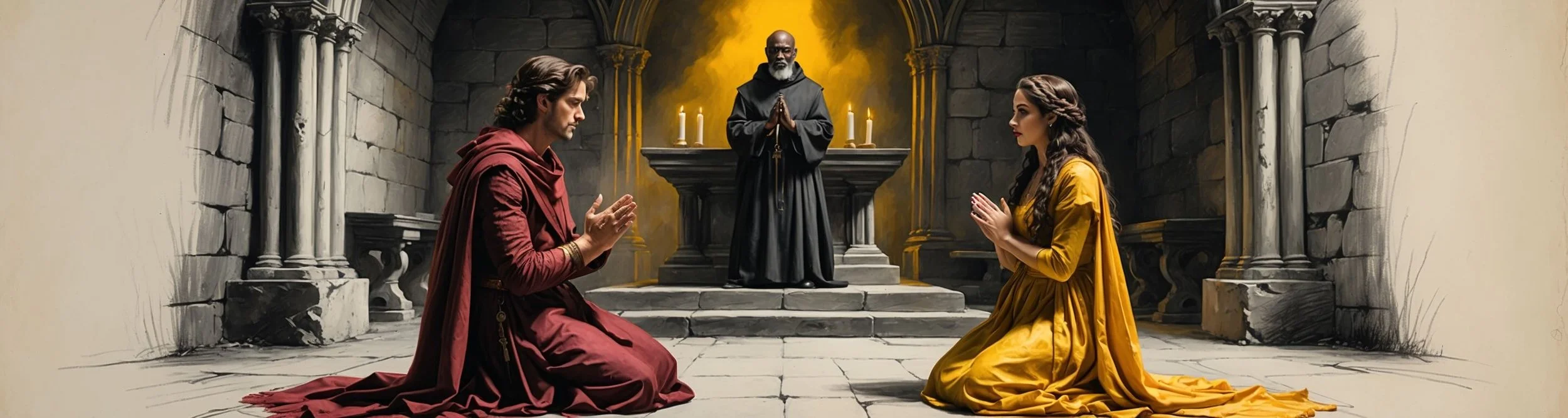
Scene Profile – At a Glance
- Location: Friar Laurence's cell.
- What Happens: Friar Laurence waits with Romeo for Juliet, praying the marriage turns out well but warning Romeo against the speed and intensity of his passion. Juliet arrives, the lovers greet each other rapturously, and the Friar takes them away to be married.
- Key Characters: Friar Laurence, Romeo, Juliet.
- Dramatic Function: The short, ominous hinge between the joy of the courtship and the disaster of Act 3 – the lovers are married, and the Friar's warning hangs over everything that follows.
- Famous Quote:
"These violent delights have violent ends"
(Friar Laurence, Act 2, Scene 6) - Why It Matters: Romeo and Juliet are finally married here – but the Friar's caution against haste and excess names, in advance, exactly what will destroy them.
Scene Summary
At his cell, Friar Laurence waits with Romeo for Juliet to arrive for the wedding. The Friar prays that the marriage will turn out well, but he also warns Romeo against the violence and speed of his passion, urging him to love moderately so that the love will last. Romeo, impatient and certain, brushes the caution aside: whatever sorrow may come, one minute in Juliet's company outweighs it.
Juliet enters, and the lovers greet each other in heightened, overflowing language, each insisting their happiness is too great to put into words. The Friar, refusing to leave the two of them alone together until they are properly wed, takes them away to perform the marriage.
The Friar's Warning
The scene opens with Friar Laurence and Romeo waiting for Juliet. The Friar's first words are a prayer that the marriage he is about to perform will not bring grief in its wake – a hope shadowed, from the very start, by the fear of what may follow.
Original
So smile the heavens upon this holy act,
That after hours with sorrow chide us not!
(Friar Laurence, Act 2, Scene 6)
Shakespeare Retold (Modern Verse)
I pray the heavens smile upon this marriage,
To make us sad when we reflect upon it!
It is a strange, double-edged blessing: even as he prepares to marry them, the Friar half-expects sorrow to follow. That foreboding sharpens into open counsel when he turns to warn Romeo directly. He has watched the boy swing from despair over Rosaline to ecstasy over Juliet in a matter of days, and he distrusts the speed of it. His advice is the moral centre of the scene, and one of the most quoted passages in the play: feelings this fierce burn themselves out, and only a measured, patient love can endure. The tragedy, of course, is that nobody listens – least of all the Friar himself, who is about to marry two children in secret within a day of their meeting.
Two Speeds of Love
Against the Friar's call for restraint, Romeo and Juliet speak only the language of excess. Romeo cannot wait; Juliet, when she arrives, declares her love too large to count. The whole scene sets the old man's caution against the lovers' headlong intensity – and the lovers win every exchange.
Original
Conceit, more rich in matter than in words,
Brags of his substance, not of ornament...
(Juliet, Act 2, Scene 6)
Shakespeare Retold (Modern Verse)
Romantic thoughts, far more than words can state,
Are overwhelming, and I can’t describe them...
Juliet's claim is that real love is too rich to be measured or described – only the poor can count their wealth, and her love has grown beyond counting. It is beautiful, and it is the exact opposite of moderation. Where the Friar pleads for a love that is slow, careful and lasting, the lovers prize a love that is total, immediate and beyond reckoning. The audience cannot help siding with the young, but the play has just told us, in the Friar's voice, why they are in danger. The Friar ends the scene as briskly as he began it, hurrying the pair off to be married and refusing to leave them alone until the ceremony binds them – a last touch of his cautious, watchful care, set against a haste he cannot slow.
Language and Technique
- Foreboding: The Friar's opening prayer that "after hours" should not "with sorrow chide us" plants dread at the very moment of joy, preparing the audience for the disaster to come.
- Fire imagery: The Friar compares fierce love to "fire and powder, / Which as they kiss consume" – an explosion that destroys itself in its own triumph.
- The honey image: "The sweetest honey / Is loathsome in his own deliciousness" turns sweetness sickly, showing how too much of a good thing turns to harm.
- Antithesis: "Too swift arrives as tardy as too slow" balances fast against slow in one neat line, making moderation sound like simple common sense.
- Hyperbole: The lovers speak in deliberate excess – love too great to measure, joy worth any sorrow – the rhetorical opposite of the Friar's calm balance.
Key Quotes from Act 2, Scene 6
Quote 1These violent delights have violent ends
And in their triumph die, like fire and powder,
Which as they kiss consume...
(Friar Laurence, Act 2, Scene 6)
Shakespeare Retold (Modern Verse)
Infatuation often ends in pain,
And when it ends, like gunpowder and fire,
That lust will self-combust...
Therefore love moderately; long love doth so;
Too swift arrives as tardy as too slow.
(Friar Laurence, Act 2, Scene 6)
Shakespeare Retold (Modern Verse)
And so, take time with love, so love can last;
For love too slow is as bad as love too fast.
Come, come with me, and we will make short work;
For, by your leaves, you shall not stay alone
Till holy church incorporate two in one.
(Friar Laurence, Act 2, Scene 6)
Shakespeare Retold (Modern Verse)
Come with me, and we’ll quicky get this done:
For, with permission, you won’t stay alone
Till married, then the two of you are one.
Key Takeaways
- The lovers are married: This short scene contains the wedding – the act that binds Romeo and Juliet together and sets the tragedy on its course.
- The Friar's warning: "These violent delights have violent ends" – a prophecy that fierce, sudden love destroys itself, which the rest of the play proves true.
- Moderation ignored: The Friar preaches patience and slowness even as he rushes the marriage through, naming the cure he then refuses to follow.
- An ominous hinge: The scene sits between the joy of the courtship and the deaths of Act 3, its happiness shadowed by dread from the opening line.
Study Questions and Analysis
What does Friar Laurence mean by "These violent delights have violent ends"?
The Friar is warning Romeo against the speed and intensity of his love. His argument is that feelings this fierce cannot last: they burn themselves out, destroying themselves in the very moment of their triumph.
These violent delights have violent ends
And in their triumph die, like fire and powder,
Which as they kiss consume...
(Friar Laurence, Act 2, Scene 6)
Shakespeare Retold (Modern Verse)
Infatuation often ends in pain,
And when it ends, like gunpowder and fire,
That lust will self-combust...
The image of fire and powder is precise: gunpowder meeting a flame explodes and is consumed in the same instant. So too, the Friar fears, with a passion as sudden and total as Romeo's. Susan Snyder, in her essay 'Romeo and Juliet: Comedy into Tragedy' (1970), argued that the play turns from comedy to tragedy across its central scenes, and this warning sits squarely on that turn – spoken at the moment of the lovers' greatest happiness, it points directly at their doom. Critics have long read the line as the play's own thesis: the very thing that makes the love sublime, its intensity and haste, is the thing that destroys it. The Friar is right; the tragedy is that he, of all people, then ignores his own counsel.
Why does Friar Laurence advise Romeo to "love moderately"?
Having warned against violent passion, the Friar offers its opposite as a remedy. He counsels a love that is slow, measured and patient, on the grounds that only such a love can last.
Therefore love moderately; long love doth so;
Too swift arrives as tardy as too slow.
(Friar Laurence, Act 2, Scene 6)
Shakespeare Retold (Modern Verse)
And so, take time with love, so love can last;
For love too slow is as bad as love too fast.
The advice is sensible, even wise, and the balanced couplet gives it the ring of proverb. Yet the dramatic irony is heavy. Harry Levin, in his classic essay 'Form and Formality in Romeo and Juliet' (1960), drew attention to the gap between the play's formal, patterned language and the headlong rush of its action, and this line is a prime example: the Friar speaks in calm, measured verse about the dangers of haste, then immediately hurries the wedding through. He preaches moderation and practises speed. The whole tragedy can be read as the punishment of haste, and the Friar – who marries the lovers within a day of their meeting and later devises the rushed, half-baked plan with the sleeping potion – is as guilty of it as anyone. His advice names the moral the play will enforce, and his own failure to heed it makes him quietly complicit in the disaster.
How does this scene present the marriage of Romeo and Juliet?
Strikingly, the marriage itself is not shown. The scene ends with the Friar leading the lovers off to be wed, and the ceremony happens offstage. What Shakespeare gives us instead is the moment before – the Friar's warning, Romeo's impatience, Juliet's overflowing declaration of love – and the decisive instruction that sets the marriage in motion.
Come, come with me, and we will make short work;
For, by your leaves, you shall not stay alone
Till holy church incorporate two in one.
(Friar Laurence, Act 2, Scene 6)
Shakespeare Retold (Modern Verse)
Come with me, and we’ll quicky get this done:
For, with permission, you won’t stay alone
Till married, then the two of you are one.
Keeping the wedding offstage is a deliberate choice. The audience is denied the joy of the ceremony itself and left instead with the Friar's foreboding and his insistence on speed – "make short work". The effect is to undercut the happiest event in the play with dread. We know the marriage is taking place, but we do not get to celebrate it; we are hurried past it, just as the lovers are, towards the catastrophe of Act 3. The scene marks the high point of the love story and, simultaneously, the moment the trap closes: from here, the two are bound together, and everything that follows flows from this secret union.
Why is this short scene so important to the play?
For all its brevity, Act 2, Scene 6 is one of the play's true hinges. It contains the marriage that binds Romeo and Juliet, and it sits exactly between the lyrical joy of the courtship in Act 2 and the violence and grief of Act 3. After this scene, the tone of the play darkens for good: the very next scene, Act 3, Scene 1, brings the deaths of Mercutio and Tybalt and Romeo's banishment.
The scene also crystallises the play's central concerns. The Friar's two great speeches name the theme of time and haste – the danger of a love too swift and too fierce – while the lovers' rapturous excess embodies exactly the intensity he fears. Caroline Spurgeon, in her study Shakespeare's Imagery and What It Tells Us (1935), traced the play's recurring images of sudden light and quick-burning fire, and the Friar's "fire and powder" belongs to that pattern: brilliance that consumes itself. The scene works, finally, as a piece of dramatic irony stretched to breaking point. Everything the Friar warns against is about to happen, and the audience, who know the lovers are "death-marked", watch the marriage go forward under the shadow of his prophecy. It is the calm, ominous pause before the play's machinery of fate begins to grind.