Romeo and Juliet: Act 3, Scene 1 – Analysis
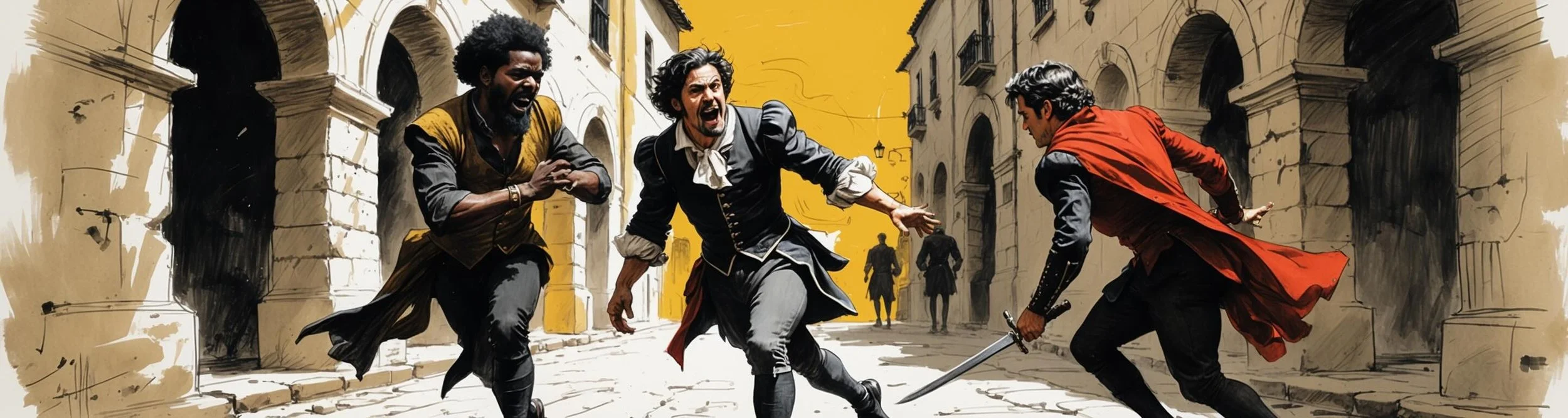
Scene Profile – At a Glance
- Location: A public place in Verona, on a hot afternoon.
- What Happens: Tybalt comes looking for Romeo. Romeo, secretly married to Juliet, refuses to fight. Mercutio fights Tybalt instead and is killed under Romeo's arm. Romeo then kills Tybalt, and the Prince banishes him from Verona.
- Key Characters: Mercutio, Tybalt, Romeo, Benvolio, and the Prince.
- Dramatic Function: The turning point of the whole play – the scene that swings the action from comedy into tragedy and seals Romeo's doom.
- Famous Quote:
"A plague o' both your houses!"
(Mercutio, Act 3, Scene 1) - Why It Matters: Two deaths in minutes change everything. Mercutio's wit is silenced, Tybalt is slain, and Romeo – now a killer and an exile – can no longer escape the feud he tried to refuse.
Scene Summary
It is a hot day, and Benvolio wants to go home before the heat and the wandering Capulets spark a brawl. Mercutio teases him for being quarrelsome and refuses to budge. Tybalt arrives, looking for Romeo, and trades sharp words with Mercutio.
When Romeo enters, Tybalt insults him and tries to provoke a duel. But Romeo – newly and secretly married to Juliet, and therefore now Tybalt's kinsman – refuses to fight, answering the insult with strange affection. His refusal baffles and disgusts everyone watching.
Mercutio, appalled by what looks like cowardice, draws his own sword and fights Tybalt in Romeo's place. Romeo rushes between them to stop the fight, and under his arm Tybalt stabs Mercutio. Tybalt flees. Mercutio, dying, curses both families – "A plague o' both your houses!" – and is helped away. Benvolio returns with the news: Mercutio is dead.
When Tybalt comes back, Romeo's grief turns to fury. He kills Tybalt, then realises what he has done and cries, "O, I am fortune's fool!" before fleeing. The Prince arrives to find Tybalt dead, hears Benvolio's account, and delivers his judgement: rather than death, Romeo is banished from Verona on pain of death if he returns.
The Heat and Benvolio's Unease
The scene opens not with a fight but with a warning. Benvolio, usually the peacemaker, can feel the danger in the air: the day is hot, the Capulets are out, and tempers are short. He wants to leave before anything starts.
Original
The day is hot, the Capulets abroad,
And, if we meet, we shall not scape a brawl;
(Benvolio, Act 3, Scene 1)
Shakespeare Retold (Modern Verse)
It’s hot, and Capulets are everywhere,
And, if we meet, we won’t escape a fight;
The heat is more than weather. Shakespeare makes the afternoon stifling on purpose, so that the violence feels like something boiling over rather than chosen. Mercutio's reply – mocking Benvolio as the real hothead – is funny, but it is also dramatic irony of the cruellest kind: the man joking about quarrels is minutes from dying in one. The whole opening crackles with a tension the characters keep laughing off, and the audience feels the brawl coming before anyone draws.
Tybalt Seeks Romeo, and Romeo Refuses
Tybalt arrives hunting Romeo, and when Romeo appears Tybalt insults him outright, calling him a villain and demanding he draw. Everything in the scene's logic – the feud, Tybalt's honour, the watching friends – expects Romeo to fight. Instead he does the one thing no one can understand.
Original
Tybalt, the reason that I have to love thee
Doth much excuse the appertaining rage
To such a greeting: villain am I none;
(Romeo, Act 3, Scene 1)
Shakespeare Retold (Modern Verse)
Tybalt, the reasons that I have for loving you
Prevent me getting overwhelmed with anger
From how you’ve greeted me. I’m not a villain.
Romeo answers an insult with love – a word that lands as nonsense on everyone who hears it. Only Romeo (and the audience) knows why: his marriage to Juliet has made Tybalt his cousin, and he will not raise a sword against family. It is a genuinely noble refusal, an attempt to step outside the feud entirely. But because the reason must stay secret, it reads to Mercutio as cowardice, and that misunderstanding is the hinge on which the tragedy turns.
Mercutio Fights and Falls
Mercutio cannot bear it. To him, Romeo's gentle reply is a shameful surrender, and he draws his own sword to answer the insult Romeo will not.
Original
O calm, dishonourable, vile submission!
Alla stoccata carries it away.
(Mercutio, Act 3, Scene 1)
Shakespeare Retold (Modern Verse)
What a pathetic, weak capitulation!
The first to draw his sword will win the fight.
Mercutio fights for a reason that does not even exist – to defend an honour Romeo has not actually lost. When Romeo throws himself between the two men to stop the duel, he makes things fatally worse: Tybalt thrusts under Romeo's arm and Mercutio is mortally wounded. The man whose wit has lit up the play is killed almost by accident, in a quarrel he had no real part in, and Shakespeare lets him die still cracking jokes – "ask for me to-morrow, and you shall find me a grave man" – until the laughter curdles into the curse the play never forgets.
Romeo's Revenge and "Fortune's Fool"
Mercutio's death breaks something in Romeo. The man who minutes ago refused to fight now abandons mercy altogether, choosing rage as his guide.
Original
Away to heaven, respective lenity,
And fire-eyed fury be my conduct now!
(Romeo, Act 3, Scene 1)
Shakespeare Retold (Modern Verse)
Get lost, my lenient nature, and from now on
I’ll let my red-faced anger be my guide!
When Tybalt returns, Romeo kills him – and the instant it is done, the fury drains away and horror floods in. "O, I am fortune's fool!" is the cry of a man who sees, too late, that he has become exactly what he tried to avoid: a killer, an exile, and a plaything of the fate the Prologue promised. The Prince's banishment that follows is, in the world of the play, a kind of mercy – but for Romeo, cut off from Juliet, it will feel worse than death. From this scene on, the play can only end one way.
Language and Technique
- Heat imagery: The "hot" day and "mad blood stirring" make the violence feel like something boiling over – the weather itself seems to push the men towards the fight.
- Dramatic irony: We know Romeo's secret marriage makes Tybalt his kinsman, so his "love" for Tybalt makes sense to us even as it baffles everyone on stage.
- Prose for Mercutio: Mercutio jokes in quick, witty prose right up to his death, so the shift to his bitter curse lands all the harder.
- The repeated curse: "A plague o' both your houses!" is said three times as Mercutio dies, hammering home that the feud, not one man, has killed him.
- Fire and light turned dark: The same imagery of light and heat that surrounded the lovers now becomes "fire-eyed fury" – passion curdled into violence.
Key Quotes from Act 3, Scene 1
Quote 1Tybalt, you rat-catcher, will you walk?
(Mercutio, Act 3, Scene 1)
Shakespeare Retold (Modern Verse)
Tybalt, you pussy, will you walk away?
A plague o' both your houses! I am sped.
(Mercutio, Act 3, Scene 1)
Shakespeare Retold (Modern Verse)
God damn to both your families. I am done for.
Now, Tybalt, take the villain back again,
That late thou gavest me; for Mercutio's soul
Is but a little way above our heads,
(Romeo, Act 3, Scene 1)
Shakespeare Retold (Modern Verse)
Tybalt, retract that you called me a villain;
You called me that before: Mercutio’s soul
Is just a little way above our heads
O, I am fortune's fool!
(Romeo, Act 3, Scene 1)
Shakespeare Retold (Modern Verse)
Oh, I am fortune’s fool!
And for that offence
Immediately we do exile him hence:
(Prince Escalus, Act 3, Scene 1)
Shakespeare Retold (Modern Verse)
And for that offence,
He’ll live in exile; that’s his recompense.
Key Takeaways
- The turning point: This scene swings the play from comedy to tragedy – before it the tone is light, after it everything moves towards death.
- Romeo's refusal: Secretly married to Juliet, Romeo will not fight Tybalt, but the secret he cannot share makes him look like a coward.
- Mercutio's death: Mercutio fights in Romeo's place and is killed under Romeo's arm, cursing "both your houses" for a feud that was never his.
- Romeo's revenge and exile: Grief drives Romeo to kill Tybalt; he becomes "fortune's fool", and the Prince banishes him from Verona.
Study Questions and Analysis
Why is Act 3, Scene 1 considered the turning point of the play?
Up to this point, Romeo and Juliet has many of the features of a romantic comedy: a feast, a masked ball, love at first sight, a witty best friend, a secret marriage. This scene destroys all of it. Within minutes Mercutio and Tybalt are dead and Romeo is banished, and from here the play can only move towards the tomb.
Susan Snyder, in her influential essay 'Romeo and Juliet: Comedy into Tragedy' (1970), argued that the play actually changes genre at this point: the comic world of the first two acts gives way to a tragic one, and Act 3, Scene 1 is the join. Harley Granville-Barker, in his Prefaces to Shakespeare (1930), made the related and famous observation that Mercutio's death precipitates the change in Romeo and so determines the tragedy – kill Mercutio, and the laughter dies with him. After this scene the play accelerates: the banishment, the Friar's plan, and the deaths all follow as consequences of these few violent minutes.
Why does Romeo refuse to fight Tybalt?
Romeo refuses because, an hour earlier, he married Juliet in secret. Tybalt is now his cousin by marriage, and Romeo will not draw his sword against family. When Tybalt calls him a villain and demands he fight, Romeo answers with something that sounds like love.
Tybalt, the reason that I have to love thee
Doth much excuse the appertaining rage
To such a greeting: villain am I none;
(Romeo, Act 3, Scene 1)
Shakespeare Retold (Modern Verse)
Tybalt, the reasons that I have for loving you
Prevent me getting overwhelmed with anger
From how you’ve greeted me. I’m not a villain.
The refusal is genuinely noble – an attempt to step outside the cycle of family honour and revenge that drives the play. But because the marriage is secret, no one else can understand it. To Mercutio and Tybalt, Romeo's restraint looks like cowardice, an insult to manhood. The tragedy of the scene lies precisely here: Romeo's most peaceable, mature choice is unreadable to everyone around him, and the gap between his private reason and its public appearance is what gets Mercutio killed.
How does Mercutio die, and who is to blame?
Disgusted by what he sees as Romeo's cowardice, Mercutio draws his own sword and fights Tybalt in Romeo's place. When Romeo tries to stop the duel by stepping between them, Tybalt thrusts under Romeo's arm and wounds Mercutio fatally, then flees. Mercutio dies cursing both families.
A plague o' both your houses! I am sped.
(Mercutio, Act 3, Scene 1)
Shakespeare Retold (Modern Verse)
God damn to both your families. I am done for.
The question of blame is deliberately tangled. Tybalt strikes the blow, but it lands because Romeo intervened – Mercutio himself says, "Why the devil came you between us?" Romeo blames himself; Tybalt's malice is the proximate cause; and Mercutio's own recklessness put him in the duel at all. Critics have read the moment in different ways. Harley Granville-Barker (Prefaces to Shakespeare, 1930) treated Mercutio's death as the structural pivot of the tragedy. Harold Bloom, in Shakespeare: The Invention of the Human (1998), saw Mercutio as so vital a presence that Shakespeare had to kill him before he overran the play. But Mercutio's own answer cuts through the question of individual fault: it is "both your houses" – the feud itself – that has killed him, and the curse hangs over everything that follows.
What does "A plague o' both your houses!" mean and why is it important?
Dying, Mercutio calls down a curse on both the Montagues and the Capulets – "a plague" on both families. The line matters because Mercutio belongs to neither house: he is the Prince's kinsman and Romeo's friend, an outsider to the feud, and so he sees with painful clarity that the quarrel itself, not any one person, has destroyed him.
The curse is repeated three times as he is helped offstage, growing heavier each time, which turns a single exclamation into something closer to a prophecy. And it is fulfilled: the feud goes on to kill Tybalt, Romeo, Juliet and Paris before it ends. Caroline Spurgeon, in Shakespeare's Imagery and What It Tells Us (1935), traced how images of light and dark dominate the play; Mercutio's curse belongs to the opposite, darker register – plague, death, and "worms' meat" – that floods in once the comedy is over. Coming from the wittiest character in the play, the bitterness of the line is itself a measure of how far the world has darkened.
Why does Romeo kill Tybalt after refusing to fight him?
Romeo's restraint does not survive Mercutio's death. The moment Benvolio confirms that Mercutio is dead, grief and guilt overwhelm Romeo – guilt especially, since Mercutio was hurt under his arm – and he deliberately casts off the mercy that has guided him.
Away to heaven, respective lenity,
And fire-eyed fury be my conduct now!
(Romeo, Act 3, Scene 1)
Shakespeare Retold (Modern Verse)
Get lost, my lenient nature, and from now on
I’ll let my red-faced anger be my guide!
Coppélia Kahn, in Man's Estate: Masculine Identity in Shakespeare (1981), read the moment in terms of the play's pressure to prove manhood through violence: Romeo, having been seen to "submit", is pulled back into the masculine code of honour by Mercutio's death, and killing Tybalt is in part an attempt to reclaim the standing he lost. Others stress the human simplicity of it – raw grief turned to rage. Either way, the killing is the scene's bitter irony: the one character who tried to refuse the feud ends up committing its deadliest act, and his choice, not fate alone, drives him into exile.
What does Romeo mean when he calls himself "fortune's fool"?
Standing over Tybalt's body, Romeo cries out a single short line that names his whole predicament.
O, I am fortune's fool!
(Romeo, Act 3, Scene 1)
Shakespeare Retold (Modern Verse)
Oh, I am fortune’s fool!
To be "fortune's fool" is to be the plaything or jester of Fortune – the wheel of luck that medieval and Renaissance writers imagined raising people up only to cast them down. Romeo feels mocked by fate: he married for love in the morning and has killed his wife's cousin by the afternoon. The line connects directly to the play's larger language of fate and destiny, especially the Prologue's "star-cross'd lovers". Critics have long debated how literally to take this. The play certainly invites a fatalistic reading; yet Marjorie Garber, in Shakespeare After All (2004), is among those who note how often the lovers' "fate" is in fact the product of their own haste and the adults' failures. The tension is the point: Romeo experiences himself as fortune's victim at the very moment his own choices have damned him.
Why does the Prince banish Romeo rather than execute him?
The Prince has already promised death to anyone who disturbs the peace again. But when he weighs the case, he finds it complicated: Tybalt killed Mercutio – the Prince's own kinsman – and Romeo killed Tybalt in revenge, doing what the law would otherwise have done. Montague argues that Romeo's "fault" only finished what justice should have ended. So the Prince chooses banishment instead of the scaffold.
And for that offence
Immediately we do exile him hence:
(Prince Escalus, Act 3, Scene 1)
Shakespeare Retold (Modern Verse)
And for that offence,
He’ll live in exile; that’s his recompense.
Dramatically, the ruling is essential. Execution would simply end Romeo's story; banishment keeps him alive but cuts him off from Juliet, creating the impossible situation the rest of the play must try to resolve. It is the decision that forces Friar Laurence's risky plan, the sleeping potion and the catastrophe of the tomb. The Prince also turns the moment into a statement about order and authority: his closing couplet, "Mercy but murders, pardoning those that kill", shows a ruler trying to balance justice and clemency – and, in trying to be merciful, unknowingly setting the tragedy's final act in motion.
How does this scene present the theme of love and violence?
Act 3, Scene 1 shows how completely the play's love and its violence are entangled. Romeo's love for Juliet is the very thing that makes him refuse to fight Tybalt; his love is also, indirectly, what gets Mercutio killed, because his peaceable intervention opens the gap through which Tybalt strikes. Love does not stand apart from the feud here – it feeds straight into the bloodshed.
The same fusion runs through the language. Romeo speaks of "love" to Tybalt in the middle of a death-threat, then minutes later replaces "respective lenity" with "fire-eyed fury". Coppélia Kahn (Man's Estate, 1981) argued that the feud functions as a violent rite of manhood that the young men cannot escape, and that Romeo's marriage puts him fatally at odds with it. The deeper reading is that in Verona there is no safe space for love: the moment Romeo tries to act on his marriage by keeping the peace, the world of love and violence punishes him for it. The scene is the clearest demonstration of the Prologue's warning that this love is bound, from the start, to death.