Twelfth Night: Act 3, Scene 3 – Analysis
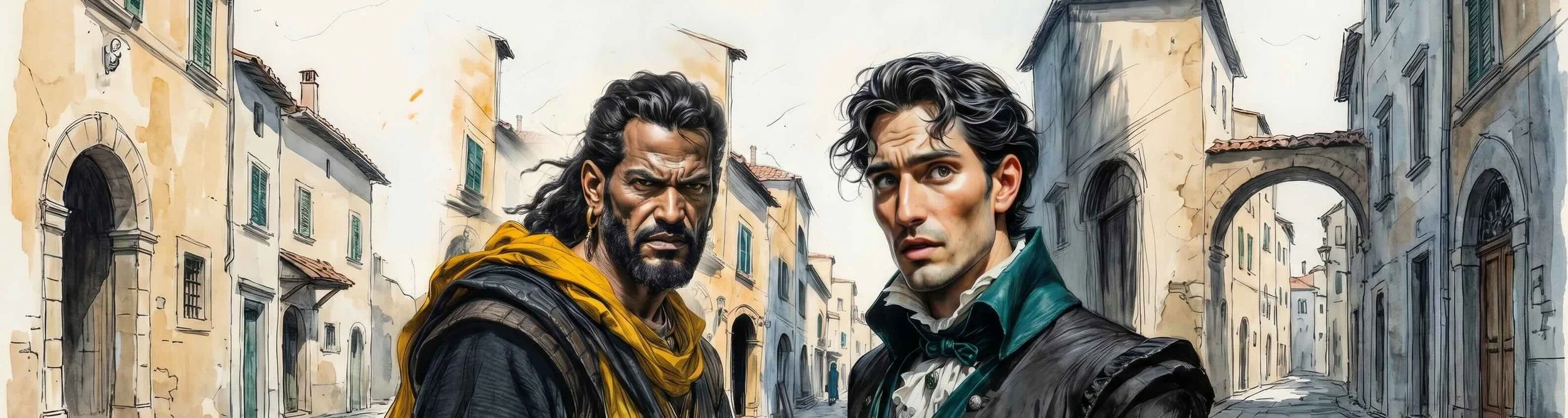
Scene Profile – At a Glance
- Location: A street in the city of Illyria.
- What Happens: Antonio has followed Sebastian into a city where he himself is in danger. He hands Sebastian his purse and agrees to meet him later at the Elephant inn.
- Key Characters: Antonio and Sebastian.
- Dramatic Function: It plants two devices the plot will later spring – Antonio's purse, lent to Sebastian, and the danger that puts Antonio at risk of arrest the moment he is recognised.
- Famous Quote:
"It doth not fit me. Hold, sir, here's my purse."
(Antonio, Act 3, Scene 3) - Why It Matters: It deepens Antonio's selfless devotion to Sebastian and sets up the mistaken-identity crisis: when Antonio next meets the disguised Viola, he will ask for that purse back and be denied.
Scene Summary
The scene takes place on a street in the city, where Sebastian and Antonio have arrived together. Sebastian, embarrassed that his friend has gone to so much trouble for him, gently apologises for being a burden. Antonio brushes the apology aside: he could not bear to let Sebastian wander a strange city alone, and his love and worry drove him to follow.
Sebastian wants to go sightseeing and see the famous monuments of the town. Antonio explains that he cannot walk the streets openly: he once fought against Count Orsino's ships in a sea battle, and if he were caught here he would be in serious trouble. He gives Sebastian his purse so the young man can buy anything he fancies, and arranges to book a room and order food at the Elephant inn. They agree to meet there in an hour, and part.
"My Desire, More Sharp Than Filed Steel"
The scene opens on the bond between the two men. Sebastian feels he has imposed; Antonio will not hear it. His answer is the language of love and pursuit – a desire so urgent it drove him after his young friend like a spur of steel. There is real warmth and devotion here, and a note of something stronger than ordinary friendship.
Original
I could not stay behind you: my desire,
More sharp than filed steel, did spur me forth;
And not all love to see you, though so much
As might have drawn one to a longer voyage,
(Antonio, Act 3, Scene 3)
Shakespeare Retold (Modern Verse)
I couldn't stay behind once you had gone.
My wish, as sharp as steel, did spur me onwards
And wasn't just for love of seeing you,
Although for love I'd take a longer trip,
Antonio measures his feeling in extremes. He would have followed Sebastian further still, and the worry for his friend's safety in a strange land is, by his own account, the real engine of his journey. Shakespeare gives this minor scene an emotional charge that pays off later: it is precisely because Antonio loves Sebastian this much that the coming betrayal – when Viola, mistaken for Sebastian, denies knowing him – will wound so deeply.
The Purse and the Hidden Danger
The second half turns practical, but Shakespeare loads it with future consequence. Antonio reveals he is a marked man in this city, then hands over his purse anyway. The two gifts – his protection and his money – are exactly the two things the plot will later use to trap him.
Original
It doth not fit me. Hold, sir, here's my purse.
In the south suburbs, at the Elephant,
Is best to lodge: I will bespeak our diet,
Whiles you beguile the time and feed your knowledge
With viewing of the town: there shall you have me.
(Antonio, Act 3, Scene 3)
Shakespeare Retold (Modern Verse)
It's not a good idea. Wait, here's my purse.
The Elephant hotel, south of the city,
Will be the best to stay at. I'll get food,
While you can take your time and learn about
The sights within the town. I'll meet you there.
The arrangement could not be simpler, and that is the point: Antonio cannot show his face in the streets, so he stays back to book the inn while Sebastian roams free with his money. Shakespeare quietly separates the two friends and puts Antonio's purse in the wrong man's pocket. When Antonio later steps in to defend the person he thinks is Sebastian, is arrested, and asks for his purse back, the audience will remember this calm, generous moment and feel the cruelty of the mix-up.
Language and Technique
- Imagery of pursuit: Antonio's desire is "more sharp than filed steel" and "did spur me forth" – the language of riding hard after someone, showing how driven his devotion is.
- Plain, warm verse: The blank verse here is direct and unshowy, fitting two friends speaking honestly rather than performing emotion.
- Dramatic irony: We are told plainly that Antonio is in danger and that he has given his money away – seeds the audience will watch grow into his arrest and rejection.
- The purse as a prop: A simple object is handed over on stage, and that physical purse becomes the trigger for the later mistaken-identity quarrel.
Key Quotes from Act 3, Scene 3
Quote 1I do not without danger walk these streets:
Once, in a sea-fight, 'gainst the count his galleys
I did some service; of such note indeed,
That were I ta'en here it would scarce be answered.
(Antonio, Act 3, Scene 3)
Shakespeare Retold (Modern Verse)
I'm not devoid of danger on these streets.
I once fought in a sea fight with the Count
Against his ships; I did so well I fear
That if they captured me, I'd be defenceless.
I can no other answer make but thanks,
And thanks; and ever [ ] oft good turns
Are shuffled off with such uncurrent pay...
(Sebastian, Act 3, Scene 3)
Shakespeare Retold (Modern Verse)
I've nothing else to say but thanks a lot;
My thanks, eternal thanks. Good deeds are often
Fobbed off with words of thanks, instead of cash.
Key Takeaways
- Antonio's devotion: He follows Sebastian into a dangerous city out of love and worry, showing the depth of his attachment.
- The hidden danger: Antonio is a wanted man in Illyria, which is why he cannot walk the streets openly.
- The purse: Antonio gives Sebastian his money, separating the two friends and setting up the later mix-up.
- A plot trap is laid: Both gifts – protection and money – become the means of Antonio's downfall when he is later arrested.
- A quiet, important scene: Short and calm, it plants the devices that drive the play's mistaken-identity crisis.
Study Questions and Analysis
What is the purpose of this short scene?
On the surface very little happens: two friends arrange to meet for dinner. But the scene is doing important plot work. It separates Sebastian from Antonio so that Sebastian can later be mistaken for the disguised Viola, and it places Antonio's purse in Sebastian's hands – the object Antonio will demand back from the wrong person in the very next scene.
It also tells us, clearly and early, that Antonio is in danger in this city. Shakespeare is loading the stage with consequences. A student writing about structure can point to this scene as a model of how a comedy plants its devices quietly, so that the later confusion feels both surprising and, in hindsight, perfectly prepared.
How does the scene present Antonio's feelings for Sebastian?
Antonio's language is unusually intense for a friendship. He says his desire was "more sharp than filed steel" and that it "did spur me forth" after Sebastian, and he is willing to risk arrest simply to keep the younger man company. He gives away his purse and asks for nothing in return.
Many readers find a romantic or homoerotic charge in Antonio's devotion, and productions often play it that way – Antonio as a man who loves Sebastian more than Sebastian loves him. C. L. Barber, in his 1959 Shakespeare's Festive Comedy, reads the comedy as a movement towards marriage and social harmony, and within that pattern Antonio is the figure left outside the final pairings: his love is real but cannot be absorbed into the play's neat couplings. Whether one reads the bond as romantic love or as the deep loyalty of comrades, Shakespeare makes it strong enough that its later rejection genuinely hurts.
Why does Antonio give Sebastian his purse?
Practically, Antonio cannot walk the streets himself, so he stays back to book a room at the Elephant while Sebastian sightsees; he hands over the purse so Sebastian can buy anything that catches his eye. It is an act of casual generosity, entirely in character.
Dramatically, the purse is a planted device. Because Antonio gives his money to Sebastian here, he is left with nothing when he is arrested in the next scene – and when he turns for help to the person he believes is Sebastian, that person is really Viola in disguise, who knows nothing of any purse. The gift that shows Antonio's love becomes the proof, in his eyes, of Sebastian's ingratitude. Shakespeare uses a simple stage prop to wire together kindness, mistaken identity, and betrayal.