Grief and Time
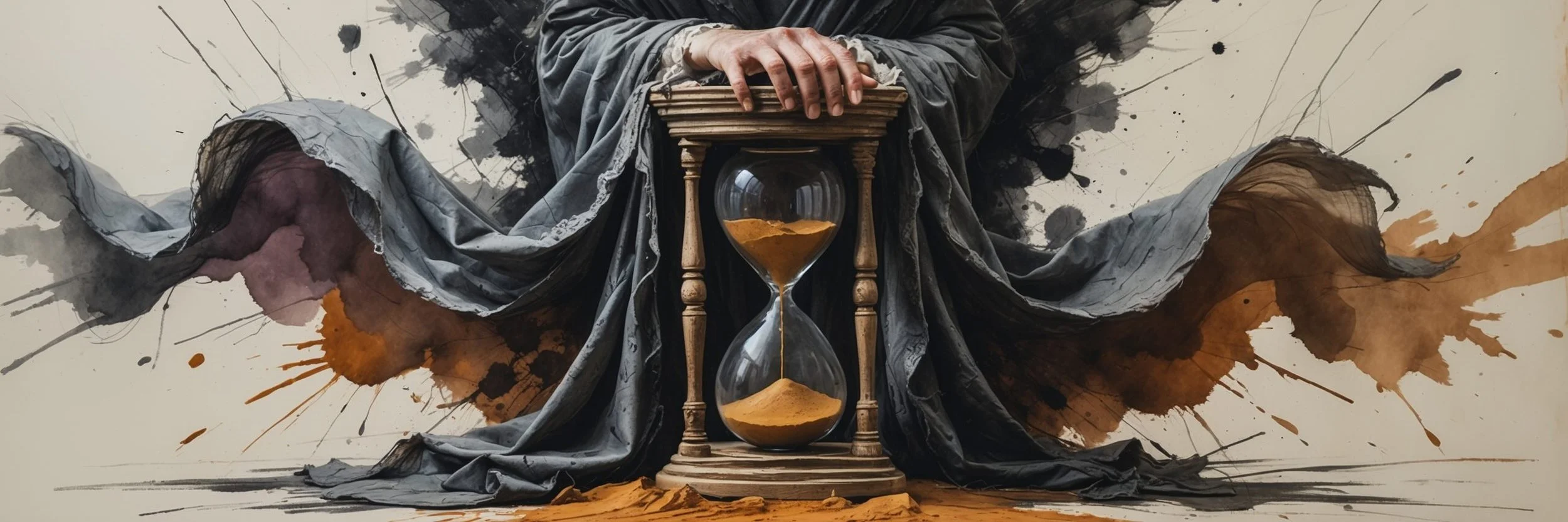
Theme Profile – At a Glance
- Focus: A comedy that begins with two drowned brothers and ends with a song about rain – grief carried, postponed and outgrown, with time as the only physician.
- Key Characters: Viola, Olivia, Sebastian, Feste, Malvolio.
- The Core Tension: Olivia schedules her grief for seven years; Viola carries hers to work. The play asks which mourning is real – and lets time answer.
- Key Manifestations: Viola on the beach (Act 1, Scene 2); the "cloistress" vow (Act 1, Scene 1); "O time, thou must untangle this" (Act 2, Scene 2); the whirligig (Act 5, Scene 1); the rain song (Act 5, Scene 1).
- Famous Quote:
"...the whirligig of time brings in his revenges."
(Act 5, Scene 1) - The Outcome: Time untangles every knot the characters could not – restores the drowned, dissolves the vows, settles the fool's old score – and then keeps raining.
Elysium
The play's first griever gets no household, no veil and no seven-year plan. Viola walks out of the sea with one question and one fact.
Original
And what should I do in Illyria?
My brother he is in Elysium.
(Act 1, Scene 2)
Shakespeare Retold (Modern Verse)
Illyria? What am I doing here?
My brother’s in Elysium, our heaven.
Two lines, and the theme has its template. The grief is total – a twin lost an hour ago – and the response is already in motion: within the same scene Viola has interrogated the captain for grounds of hope ("perchance he is not drowned"), accepted the "perchance" as enough to live on, and made a plan. Her mourning is the play's gold standard precisely because it never becomes an institution: no vow, no costume of sorrow (her disguise is for survival, not display), no schedule. She carries the loss into employment, into love, into danger – present in every "sister" she invents and every tear she almost explains – and the play rewards the method with the theme's only miracle: the grief carried lightly enough to keep walking is the one that walks into its own consolation.
The Cloistress
Olivia's grief, by contrast, arrives in the play as an architecture. Before we meet her, we are given the schedule – seven years of it.
Original
But, like a cloistress, she will veiled walk
And water once a day her chamber round
With eye-offending brine: all this to season
A brother's dead love, which she would keep fresh
And lasting in her sad remembrance.
(Act 1, Scene 1)
Shakespeare Retold (Modern Verse)
Because she’ll wear a veil like a nun,
And cry each day as she walks round her bedroom
With stinging tears, for only to preserve
The love for her dead brother, which she’ll keep
Alive in her sad memories of him.
The give-away is in the cooking metaphor: tears as brine, to "season" the dead love and keep it "fresh" – grief as preservation, sorrow run like a larder. Olivia is not mourning her brother so much as curing the mourning itself, so it will last. The play treats the project with respect and zero confidence: Feste proves its theology absurd (why weep for a soul in heaven?), Toby files a health objection, and the timetable – daily watering, seven years – collapses at the first interesting visitor. The point is not that Olivia's love for her brother was false. It is that grief, made into a programme, becomes a way of stopping time – and time, in this play, declines to be stopped. The veil was scheduled for seven years; it lasted five scenes.
O Time, Untangle This
Holding the ring Olivia sent after the man who does not exist, Viola maps the love-knot in full – she loves Orsino, who loves Olivia, who loves "Cesario" – and then delivers the theme's thesis.
Original
O time! Thou must untangle this, not I;
It is too hard a knot for me to untie!
(Act 2, Scene 2)
Shakespeare Retold (Modern Verse)
Oh time, you must untangle this, not I.
This knot’s too tight for me to now untie!
The couplet is a decision disguised as a sigh. Viola has just itemised the tangle with perfect accuracy – her analysis is never the problem – and concluded that no action available to her can loosen it: confession destroys her, silence wounds Olivia, withdrawal abandons Orsino. So she delegates, and the delegation is the play's deepest wisdom about both grief and love: some knots are not puzzles but seasons – they are not solved, they pass. The choice is active, not passive; she goes on working, wooing and enduring while time does its untangling, which is exactly the difference between her patience and Olivia's preservation project. And the play keeps her promise for her: the knot is untangled by an arrival no one engineered – the sea giving back, in its own time, what it took in the first scene.
The Whirligig
Time's last appearance in the play is not as healer but as auditor. As the weddings assemble, Feste finally answers Malvolio for an insult delivered in the play's fifth scene – quoting it back, word for word, after months of plot.
Original
and thus the whirligig of time brings in his revenges.
(Act 5, Scene 1)
Shakespeare Retold (Modern Verse)
And so, what goes around will come around.
The whirligig – a child's spinning-top – is the play's final image of how time works, and it corrects every other model on offer. Olivia tried to make time stand still; Orsino tried to furnish it; Viola trusted it to untangle. Feste's emblem says: time spins – it brings everything around again, the good turns and the bad ones, the insult and its answer, the drowned brother and the wedding. The spin is impartial: the same revolution that returns Sebastian from the sea returns Malvolio's sneer to its sender. Grief and justice ride the same wheel. It is the comedy's most clear-eyed theology, delivered by its least sentimental voice – and it sets up the final song, where the wheel widens into weather: the wind and the rain, every day, the whirligig running on past the play's last chord.
"The play does not overflow with wit and gaiety like its predecessor; we feel that Shakespeare's joy of life has culminated and is about to pass over into melancholy..."
— George Brandes, William Shakespeare, A Critical Study, 1898
Key Quotes on Grief and Time
Quote 1
She is drowned already, sir, with salt water, though I seem to drown her remembrance again with more.
(Act 2, Scene 1)
Shakespeare Retold (Modern Verse)
She drowned in salty water, And now my salty tears remind me of her.
Quote Analysis: Sebastian's grief for Viola is the play's hidden mirror: each twin spends the play mourning the other, each wrong, each sustained by the error's tenderness. His image – drowning her remembrance in tears as the sea drowned her body – carries the theme's signature blend of feeling and self-awareness: he hears his own excess ("I seem to drown her... again") even as he weeps. Salt water kills and salt water mourns; the same element does both offices. The play lets the symmetry wait four acts for its payoff – two griefs, walking toward each other, both about nothing.
O my poor brother! And so perchance may he be.
(Act 1, Scene 2)
Shakespeare Retold (Modern Verse)
Oh, my poor brother! There’s a chance he lived.
Quote Analysis: One line, two movements: the cry of grief and the clutch at "perchance". The captain has just said that he himself was saved by chance, and Viola seizes the word and turns it – if chance saved you, chance may have saved him. It is hope built knowingly on the thinnest of grammar, and the play endorses the method: holding probability open, refusing to finalise the loss, is what lets Viola function – and is, in the event, simply correct. The theme's quietest lesson: in the space between "drowned" and "perchance", a person can live, work and love. Grief that closes the case too early buries the living.
I think his soul is in hell, madonna.
(Act 1, Scene 5)
Shakespeare Retold (Modern Verse)
I think his soul’s in hell, my good madonna.
Quote Analysis: Feste's opening gambit in the catechism is deliberately outrageous – tell a mourner her brother is damned, and let her contradict you. Olivia takes the bait ("I know his soul is in heaven, fool"), and the trap closes: then why mourn? The fool practises the play's only effective grief-therapy, and its method is worth naming: he does not console, he contradicts – forcing the mourner to argue for the consolation herself, out loud, until she hears it. Olivia laughs, the veil's logic never recovers, and the play has made its point about institutional sorrow: it survives sympathy easily, and argument not at all.
What's to come is still unsure:
In delay there lies no plenty;
Then come kiss me, sweet and twenty,
Youth's a stuff will not endure.
(Act 2, Scene 3)
Shakespeare Retold (Modern Verse)
What’s to come is still unclear.
There is no point in wasting time
So kiss me now whilst in your prime.
We don’t stay young for every year.
Quote Analysis: The second verse of Feste's love song is the theme's pivot from grief to time. Sung between a drinking knight and his dupe, it states the play's case against every form of postponement on offer – Olivia's seven years, Orsino's connoisseur courtship, Viola's enforced waiting: the future is unsure, delay yields nothing, youth is perishable stuff, fabric that wears. The carpe diem is conventional; its placement is the art. Every plot in the play is, at this moment, in delay – and the song, heard by none of the delayers, is the clock striking in the next room while the house argues about mourning.
Key Takeaways
- Two Mournings: Olivia builds her grief a building; Viola carries hers to work. The play's sympathy follows the one that keeps moving.
- Delegate to Time: "O time, thou must untangle this" is the play's wisdom in one couplet – some knots are seasons, not puzzles, and they pass rather than solve.
- The Whirligig Is Impartial: The same revolution that returns the drowned brother returns the fool's old insult. Time heals and time audits, on the same wheel.
- The Rain Outlasts the Feast: The final song widens grief into weather – every life-stage gets a verse, and every verse ends in rain. The comedy knows what's outside.
Study Questions and Analysis
How do Viola and Olivia grieve differently – and why does it matter?
The play opens with the same wound twice: each woman has lost a brother (Olivia a father too, within the year), and the two responses are built as a controlled comparison. Olivia's grief is architectural: the vow, the veil, the daily watering, the closed gates – mourning as an institution with staff and a calendar. Viola's is ambulatory: no vow, no costume of sorrow, the loss carried into work and risk, surfacing only in fictions – the invented sister, the "brothers" she may or may not still have. One grief stops the clock; the other consults it ("perchance") and keeps walking.
The play's judgement is delivered through outcomes rather than sermons. Olivia's institution is dismantled from outside in five scenes – by a fool's syllogism and a messenger's voice – because grief built as a fortress can only be maintained or breached, never grown through. Viola's mobile grief is the one that time can actually work on: it stays open to information (the captain's "perchance"), to feeling (Orsino), and finally to the miracle it never demanded. Charles Cowden Clarke (1863) heard in Viola the play's "spirit almost divine", and the divinity is largely this: she is the only character who neither performs her sorrow nor postpones her life.
The deeper point is about what mourning is for. Olivia's project aims to keep a dead love "fresh" – preservation; Viola's allows her brother to be both dead and "perchance" alive – suspension. Preservation fights time; suspension trusts it. In a play where time is the only competent physician, the difference is everything: the griever who made an ally of uncertainty is the one the sea repays.
Is Olivia's mourning sincere, or a way of avoiding life?
The play answers "both", and locates the avoidance precisely. The sincerity is not in doubt – two deaths in a year is real devastation, and nothing in the text mocks the feeling itself. What the play examines is the use the feeling has been put to. Olivia's mourning institution arrives bundled with a striking policy: the seven-year veil happens to be, among other things, the perfect instrument for refusing Orsino – a suit she never wanted – without refusing him. Grief gives her household a government (hers), her person an unanswerable privacy, and her unmarried state an unimpeachable cover. The veil is sincere and it is sovereignty.
This is why the collapse is so swift and so telling. The fortress repels the duke's embassies effortlessly and falls in one afternoon to a messenger who refuses the script – because the defence was never against love; it was against being claimed. The moment desire is her own choice rather than a suitor's campaign, the seven years are abandoned without a backward glance, and the play does not charge her with hypocrisy: it observes, with complete sympathy, that the mourning had quietly become a room she lived in, and that she left it the moment there was somewhere she wanted to go.
C. L. Barber (1959) reads Olivia's vow as one of the play's "postures" that festive comedy exists to dissolve – sincere attitudes hardened into immobility, awaiting release. The theme's verdict is gentler than satire: grief is real, but it has a half-life, and a mourning that outlives its feeling becomes a costume. Olivia's tragedy-that-isn't is that she nearly gave seven years to a dress the heart had already finished wearing.
What does "O time, thou must untangle this" say about agency?
It draws the line between what action can do and what only duration can – and the drawing is itself the action. Viola's couplet is sometimes read as passivity: the heroine, unable to act, hands the plot to fate. The scene's logic is more rigorous. She has just completed a flawless analysis of the love-triangle – "my master loves her dearly; / And I, poor monster, fond as much on him; / And she, mistaken, seems to dote on me" – and a survey of available moves: every honest act (confess, withdraw, refuse the errand) injures someone she is bound to, and every dishonest one compounds the knot. The conclusion "not I" is not helplessness; it is a correct proof that the solution space is empty – for now.
What she delegates to time is therefore not the work but the timing. She continues to act throughout – serving, wooing, fencing, enduring – while declining to force the one outcome that force would ruin. The play makes her policy explicit elsewhere: she sits "like patience on a monument", patience being not inertia but a discipline of waiting. The contrast cases surround her: Orsino forces (sieges of messengers), Olivia forces (rings, pearls, a priest within the hour), Malvolio forces hardest of all – and every act of forcing tightens some knot. The one character who names time as the untangler is the one for whom the tangle untangles.
Harold Bloom (1998) reads Viola's patience as the comedy's still centre – wit without will-to-power, unique in the play. The theme's claim, tested and confirmed by the plot, is precise: in matters of grief and love, agency's highest form is knowing which knots are yours and which are the calendar's. Viola unties everything she can reach. The rest she addresses, correctly, to time – and time, flattered, delivers.
How does time function as the play's real plot-solver?
Audit the ending's miracles and a pattern appears: nothing is solved by any character's cleverness. The love-triangle is dissolved by Sebastian's arrival – an event no one in Illyria caused, predicted or even wished for, since everyone believed him dead. Olivia's unmarriageable passion becomes a lawful wedding by the accident of mistaken identity. Viola's impossible love becomes possible when her disguise is outed by genealogy, not confession. Even the subplot's justice – Feste's answer to Malvolio – waits for the day the whole tangle resolves. The play's title points at the mechanism: a night in a festal calendar, a date that arrives when it arrives.
This is unusual engineering even for comedy, and the play seems aware of it. Where other Shakespearean comedies give their heroines the solving intelligence – Rosalind stages her own ending; Portia wins hers in court – Twelfth Night gives Viola equal intelligence and then builds a plot her intelligence explicitly cannot solve, so that the resolution must arrive as event: the sea's long delivery, "golden time" (Orsino's final phrase) convening the marriages. C. L. Barber (1959) reads this as festive form: the clarification comes "through release", not through mastery – the holiday's gift, not the plotter's wage. The darker corollary belongs to George Brandes (1898): a comedy whose joys are dispensed by time rather than earned by wit already feels its author's "joy of life... about to pass over into melancholy" – time that gives the twins back is the same time that, in the song, raineth every day.
The theme's summary: in this play grief cannot be argued away, love cannot be forced, knots cannot be untied – and all three yield to duration. The characters' real moral choices are about how to wait: preserving (Olivia), performing (Orsino), forcing (Malvolio), or trusting (Viola). The plot is time's verdict on the four methods.
What is the significance of the whirligig of time?
It is the play's last and best metaphor for its own structure. The sentence arrives at a precise dramatic moment: the weddings are made, the letter exposed, and Feste – settling the oldest account in the play – reminds Malvolio of the exact words he used in A1S5 ("Madam, why do you laugh at such a barren rascal?") before delivering the emblem: the whirligig of time brings in his revenges. A whirligig is a child's top: it spins, and everything on its surface comes around again. The image corrects the straight-line time the characters have assumed – seven-year schedules, deferred loves, postponed lives – with circular time, in which nothing is left behind and everything returns to its starting point transformed.
The emblem reads the whole play backwards. The sea that took Sebastian in scene one returns him in act five – the whirligig's upstroke. The insult Malvolio flicked at a fool in scene five returns as the fool's perfectly remembered justification – the downstroke. Olivia's mourning comes around as marriage; Orsino's generic passion comes around to land on the person who stood beside him all along; even Viola's "O time, thou must untangle this" is answered by the same revolution. Grief and justice, the play's two long arcs, turn out to ride one wheel.
What keeps the image comic rather than grim is its scale and its speaker. A. C. Bradley (1916) noted Feste's way of carrying the play's deepest knowledge in its lightest container; the whirligig is exactly that – cosmic recurrence as a toy. But the toy has edges: "his revenges" concedes that time's returns are not all kind, and Malvolio's exit seconds later ("I'll be revenged on the whole pack of you") threatens to keep the wheel spinning past the curtain. The final song then widens the whirligig into the weather – the rain that raineth every day – and the play's clock, which began with a duke demanding music stop and start at his pleasure, ends keeping its own time, indifferent, in the rain.
Why does a comedy begin with so much death?
Because this comedy's subject is what life does after death has had its say. Count the losses active before the first scene ends: Viola's father (dead since her thirteenth year), Sebastian (believed drowned), Olivia's father (dead within the year), Olivia's brother (dead within the year) – and Orsino's opening speech is itself a small funeral, love sickening and dying in fourteen lines. Shakespeare assembles a stage on which every principal household is in some stage of bereavement, and then writes a comedy on it – not despite the deaths, but out of them: every plot in the play is a grief looking for what to do next.
The structural answer is that the deaths are the comedy's fuel. Viola's disguise exists because her protectors are dead; Olivia's inaccessibility – the obstacle the whole love-plot climbs – is mourning; even the festive subplot is a war over how a house in grief should sound at midnight. The play's question is never "will death intrude on the feast?" (it already has) but "how long does the feast stay cancelled?" – and the answers, character by character, are the theme: seven years (Olivia, lapsed), indefinitely with music (Orsino), not for one working day (Viola).
The deeper answer is the one George Brandes (1898) heard in the play's whole timbre – a comedy written at the edge of the tragedies, its gaiety conscious of its own expiry. The deaths at the start and the rain at the end are the same fact, framing the feast: Twelfth Night is the demonstration that comedy is not the absence of grief but a particular conduct of it – the whirligig's bright half-turn, taken knowingly, between one rain and the next. That a play this deathward-facing remains, by common consent, the most delightful of the comedies is not a paradox the theme needs to resolve. It is the theme.
Does time heal anyone in this play – or just rearrange them?
Run the cases. Viola: healed in the fullest sense – the brother restored, the love legitimised, the disguise retired (in word if not yet in wardrobe); but the healing was time's gift, not time's therapy – her grief was answered by reversal, not absorbed. Olivia: rearranged, conspicuously – the mourning was not worked through but replaced, sorrow swapped for desire in an afternoon; the play never tells us the brother was finished being grieved, only that the grieving stopped. Orsino: rearranged almost mechanically, his passion re-addressed like a letter. Sebastian: healed by the same reversal as his twin. Antonio: neither – his loss is created by the ending, not cured by it. And Malvolio is the control: time brings him not healing but the whirligig's bill, and he leaves promising to keep the wound open on purpose.
So the honest tally reads: one genuine restoration (the twins), several substitutions, one fresh wound, one refusal. "Healing", as a modern therapeutic arc, is scarcely in the play at all – which is the theme's most bracing feature. What time does in Twelfth Night is closer to weather than to medicine: it changes the conditions, and the characters' griefs are not resolved but outgrown, overwritten, or – in the song's last word – simply rained on until they are part of the landscape of a life. The rain it raineth every day is not a cure; it is a scale. Boyhood's follies, man's knavery, marriage's swagger, the drunken beds at the end: the final song files every sorrow and every feast under the same recurring weather, and the filing is the comfort – nothing is singular, everything is survivable, the play is done, and the players will strive to please you every day.
Hazlitt (1817) thought the play "too good-natured for comedy"; the good nature, examined closely, is precisely this: it does not pretend grief is curable. It demonstrates, with three weddings and a song in the rain, that grief is companionable – that time does not close wounds so much as widen the world around them. Which may be why the play's last word on the subject is not spoken by a lover or a mourner, but sung by the man who was never allowed either: the fool, in the weather, promising tomorrow's performance.