A Midsummer Night’s Dream: Act 5, Scene 1 – Analysis
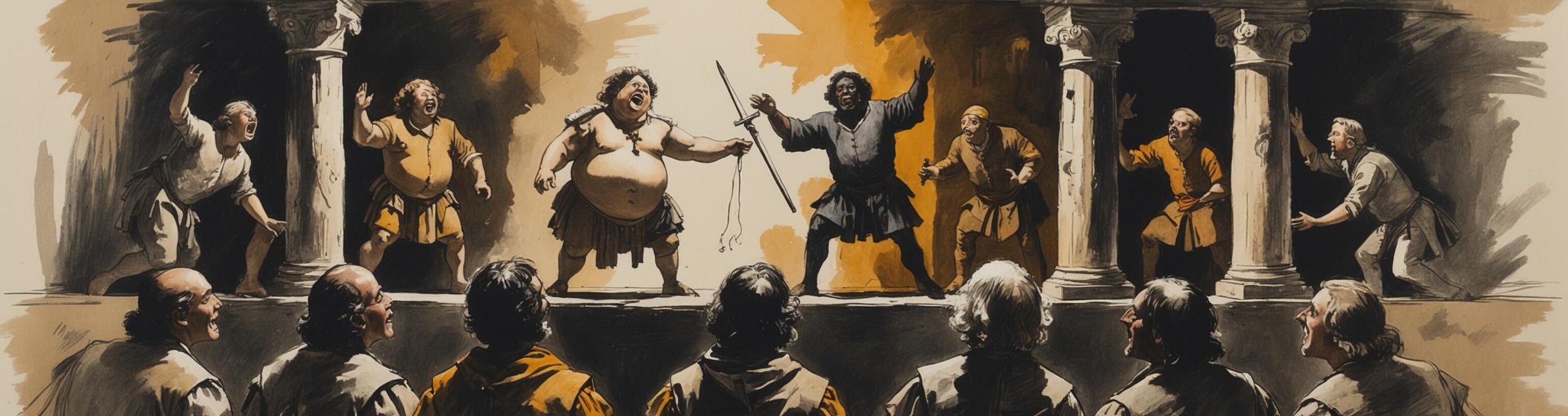
Scene Profile – At a Glance
- Location: The palace of Theseus, on the wedding night, from after supper until midnight and beyond.
- What Happens: Theseus dismisses the lovers’ story as imagination; Hippolyta is less sure. The court chooses the workmen’s Pyramus and Thisbe and heckles it through to its double death. At midnight the couples go to bed, the fairies bless the house, and Puck asks the audience to think it all a dream.
- Key Characters: Theseus and Hippolyta; Lysander, Hermia, Demetrius and Helena; Philostrate; Bottom, Quince, Flute, Snout, Snug and Starveling; Oberon, Titania and Puck.
- Dramatic Function: The play’s resolution and its commentary on itself: three marriages, a play within the play that retells the lovers’ story as farce, and a fairy blessing that hands the whole evening back to the audience as a dream.
- Famous Quote:
"The lunatic, the lover and the poet
Are of imagination all compact..."
(Theseus, Act 5, Scene 1) - Why It Matters: Everything the play has done – love, magic, theatre, dream – is discussed on stage by the people it happened to, and the last word goes to a fairy with a broom.
Scene Summary
Hippolyta finds the lovers’ account of the night strange. Theseus does not believe it: lovers and madmen have seething brains that see more than reason can, and the lunatic, the lover and the poet are all made of imagination, which gives airy nothing a local habitation and a name. Hippolyta answers that four people telling the same story, with their minds all changed the same way, add up to something of great constancy. The lovers enter, and Theseus asks Philostrate what entertainments there are to fill the three hours before bed. He rejects a battle of centaurs, a riot of Bacchanals and a satire on the death of Learning, and is caught by a tedious brief scene of young Pyramus and Thisbe, very tragical mirth. Philostrate warns him that it is nothing, performed by hard-handed men who have never used their minds before; Theseus insists, because nothing can be amiss when simpleness and duty offer it, and tells Hippolyta that he has learned to read a welcome in the stammering of frightened subjects.
Quince speaks a prologue so badly punctuated that it says the opposite of what it means, and the court comments on it. A second prologue introduces the cast: Pyramus, Thisbe, Wall with his lime and rough-cast, Moonshine with lantern, dog and bush, and Lion, and tells the whole story in advance. Snout as Wall explains his chink. Bottom as Pyramus addresses the night and the wall, looks through the chink, and curses the wall for showing him no Thisbe; Theseus remarks that the wall should curse back, and Bottom steps out of character to explain that it should not. Flute as Thisbe arrives, the lovers exchange vows through the chink, kiss the wall’s hole, and agree to meet at Ninny’s tomb. Wall departs. Hippolyta calls it the silliest stuff she ever heard; Theseus answers that the best actors are only shadows and the worst no worse if imagination amends them.
Snug as Lion assures the ladies that he is only Snug the joiner and no lion; the court praises his conscience. Starveling as Moonshine tries to explain his lantern and is heckled until he simply states that the lantern is the moon, he is the man in it, and the bush and dog are his. Thisbe comes to the tomb, the Lion roars, she runs, and the court applauds lion, moon and Thisbe by turns. Pyramus returns, finds the bloodied mantle, laments in short rhyming lines, stabs himself in the left pap and dies at length. The lovers joke that he is no die but an ace. Thisbe returns, mourns his lily lips and cherry nose, calls on the Fates, stabs herself and dies. Bottom gets up to say that the wall is down between the fathers and to offer an epilogue or a Bergomask dance; Theseus declines the epilogue and takes the dance.
The clock strikes twelve. Theseus sends the lovers to bed – it is almost fairy time – and declares a fortnight of revels. Puck enters with a broom: the lion roars, the wolf howls, the ploughman snores, the graves let out their ghosts, and the fairies, following darkness like a dream, have come to sweep the house. Oberon and Titania lead their trains through the palace by the dying fire, and Oberon blesses the bride-beds: the couples shall be true, their children shall be born without mole, hare-lip or scar, and every chamber shall have sweet peace. The fairies go. Puck, alone, tells the audience that if the shadows have offended they should think they slept and dreamed it; he asks pardon, promises to make amends, and asks for their hands.
The Lunatic, the Lover and the Poet
The scene opens on the morning after, in a palace, with the play’s most famous sceptic explaining why nothing the audience has watched can be true. Theseus has heard the lovers’ story and does not believe it.
Original
The poet's eye, in fine frenzy rolling,
Doth glance from heaven to earth, from earth to heaven;
And as imagination bodies forth
The forms of things unknown, the poet's pen
Turns them to shapes and gives to airy nothing
A local habitation and a name.
(Theseus, Act 5, Scene 1)
Shakespeare Retold (Modern Verse)
The poet always looks around the place,
And stares up at the sky, then back to earth,
And as they see things with imagination
That are not real, the poet starts to write
And gives to fancies that are made of nothing,
A name and somewhere that they might exist.
Lovers, madmen and poets all see what is not there: the madman devils, the lover Helen’s beauty in a gipsy’s face, the poet shapes for things unknown. It is a sceptic’s creed, and it undercuts itself in the speaking, since the account of the poet’s eye rolling from heaven to earth is verse only a poet could write, and the man speaking it is a shape given to airy nothing by a poet’s pen. The lines about the poet have been taken as Shakespeare’s own account of his art ever since, and the irony is that they are put in the mouth of the one character who has seen nothing. Thirty lines after this, Puck will walk on with a broom. The play’s argument about dreams and reality is stated here at full confidence by the person least entitled to it, and the audience, who spent the night in the wood, is in no position to agree with him.
Something of Great Constancy
Hippolyta’s answer is short, and it is the one argument in the play the duke loses.
Original
But all the story of the night told over,
And all their minds transfigured so together,
More witnesseth than fancy's images
And grows to something of great constancy;
But, howsoever, strange and admirable.
(Hippolyta, Act 5, Scene 1)
Shakespeare Retold (Modern Verse)
But all the tales the lovers told of last night,
And as their stories all were told the same,
It seems it must be true, and not a dream,
And this is strengthened by each common story,
Despite how strange and dumbfounding it is.
Four people tell the same story; four minds changed in the same way are evidence, not fancy; the story grows to something of great constancy, strange and admirable. Theseus does not reply. He announces the lovers and calls for a play. The exchange gives the play’s last word on its own reality to the character who saw least of it: Hippolyta was not in the wood, does not believe in fairies, and has no stake in the lovers; she simply listens better than her husband. Her phrase became the title of David P. Young’s study of the play in 1966 because it states the play’s own claim for itself. The Amazon whose silence in Act 1 the play left unexplained has, by Act 5, the better of the argument about order and chaos: the duke’s reason cannot account for the night, and she says so in five lines.
Choosing the Play
Theseus reads the list of entertainments like a man who has seen them all, and stops at the one that contradicts itself.
Original
Merry and tragical! tedious and brief!
That is, hot ice and wondrous strange snow.
How shall we find the concord of this discord?
(Theseus, Act 5, Scene 1)
Shakespeare Retold (Modern Verse)
Happy and sad! It’s boring and it’s brief!
That’s like saying hot ice or weird snow.
How can we make sense of such contradictions?
Hot ice and wondrous strange snow: the workmen’s title is an oxymoron, and Theseus, who has just dismissed imagination, is caught by a phrase. Philostrate’s warning is honest – not one word apt, not one player fitted, and the funniest tears he ever shed – and it is the reason Theseus chooses it. His speech about the tongue-tied welcome, the clerks who shivered and broke off and paid him more respect by their silence than any eloquence could, is the duke at his best, and it explains the evening: he will take what they mistake, and read duty in the botching. It is also a theory of audiences. The court will laugh at the workmen for the next two hundred lines, and the laughter will be kinder than Philostrate’s contempt, because Theseus has decided in advance that the effort is the point. The theme of art and theatre arrives at the play’s centre through a ruler choosing bad theatre on purpose.
Wall, Lion and Moonshine
The play within the play begins with a prologue whose punctuation has gone wrong – if we offend, it is with our good will – and the court’s jokes about it, a rough colt, a child on a recorder, a tangled chain, are all about control. Then the props speak.
Original
Then know that I, one Snug the joiner, am
A lion-fell, nor else no lion's dam;
For, if I should as lion come in strife
Into this place, 'twere pity on my life.
(Snug as Lion, Act 5, Scene 1)
Shakespeare Retold (Modern Verse)
But know that it’s just Snug the joiner here,
Who’s not a lion nor a lioness;
For if a real lion did appear,
I would be killed, alas, I must confess.
Snout as Wall explains his loam and rough-cast and holds up his fingers; Snug as Lion tells the ladies he is a joiner and no lion’s dam; Starveling as Moonshine, heckled out of his verse, simply states that the lantern is the moon, he is the man in it, and the dog is his dog. Every fear the workmen had in Act 3, Scene 1 has been answered with the solution they proposed there, and each solution is funnier than the fear. The court’s running commentary – would you desire lime and hair to speak better, the wittiest partition I ever heard, a very gentle beast of a good conscience – is the play teaching its own audience how to enjoy bad theatre, and Hazlitt’s remark that Snug the joiner is the moral man of the piece, proceeding by measurement and discretion in all things, catches what the lion’s speech is: a decent man refusing to frighten anyone. The magic and illusion of the fairies asked the audience to see spirits in actors; the workmen ask it to see a wall in a man, and say so.
The Most Lamentable Comedy
Pyramus finds the bloodied mantle and dies, and the play within the play reaches its climax in the shortest rhyming lines Shakespeare wrote.
Original
Now am I dead,
Now am I fled;
My soul is in the sky:
Tongue, lose thy light;
Moon take thy flight:
Now die, die, die, die, die.
(Bottom as Pyramus, Act 5, Scene 1)
Shakespeare Retold (Modern Verse)
Now I am dead,
Now I have fled;
My soul is in the sky:
Tongue, do not shine;
Moon, speak no line:
Now die, die, die, die, die.
Tongue, lose thy light; moon, take thy flight; die, die, die, die, die. The death is long, loud and in the wrong order, and Demetrius’s joke – no die but an ace, for he is but one – is the court’s verdict. Then Thisbe returns, mourns his lily lips and cherry nose and eyes green as leeks, calls on the Sisters Three with hands as pale as milk, and dies too. It is the lovers’ own story. Two young people forbidden by their parents, meeting in the dark by moonlight, one frightened by a beast, the other finding what looks like proof of death: Hermia and Lysander’s night, retold without a fairy to sort it out. The court laughs, and does not see the resemblance, and the play does not point it out. Hippolyta’s beshrew my heart, but I pity the man, is the one line in the heckling that takes the tragedy at its word, and it is spoken about Bottom. The theme of love and folly ends in the play as farce played straight by a weaver, and the audience is allowed to feel both things.
Fairy Time
The iron tongue of midnight tells twelve, the mortals go to bed, and the palace changes hands. Puck comes in first, with a broom, and describes the hour: the lion roaring, the wolf howling, the graves gaping, the fairies following darkness like a dream.
Original
And the blots of Nature's hand
Shall not in their issue stand;
Never mole, hare lip, nor scar,
Nor mark prodigious, such as are
Despised in nativity,
Shall upon their children be.
(Oberon, Act 5, Scene 1)
Shakespeare Retold (Modern Verse)
And, too, Mother Nature’s flaws
Will not on their children cause;
A mole, a hare lip, nor a scar,
Nor a birthmark, for they are
Unliked when baby’s life’s begun,
So their children will have none.
Oberon’s blessing is the fairy plot’s last act and its answer to Titania’s speech on the ruined harvest in Act 2: where the quarrel blighted the fields, the reconciliation blesses the beds. The couples shall be true; their children shall be born without mole, hare-lip, scar or any mark despised at birth; every chamber shall have peace. The blessing is specific and old, the kind of protection a fairy might give a house in return for a bowl of milk, and it is spoken over three marriages the audience has watched being made by conquest, by law overruled and by a flower. The play’s order and chaos is restored by the creatures who broke it, in the same short rhymed line they used to break it, and the fairies leave the palace as they found it, blessed and asleep. Oberon’s last order is the play’s: trip away, meet me all by break of day.
If We Shadows Have Offended
Puck stays behind. Alone on the stage with the audience, he offers them a way of taking the play they have seen.
Original
If we shadows have offended,
Think but this, and all is mended,
That you have but slumbered here
While these visions did appear.
And this weak and idle theme,
No more yielding but a dream.
(Puck, Act 5, Scene 1)
Shakespeare Retold (Modern Verse)
If we ghosts have caused offence,
Think of this as recompense:
You’ve been merely sleeping here
While these visions did appear.
And this poor and silly tale
Was merely just a dreamy veil.
If the shadows have offended, think you slept and dreamed it; the theme was weak and idle and yielded nothing more than a dream. Shadows is Oberon’s word for his fairies and Theseus’s for actors, and Puck is both, so the epilogue folds the fairy world and the theatre into one and hands it to the house. It changes the audience’s relationship with him. For four acts we watched Puck watching mortals; now he watches us, asks pardon, promises amends, and asks for our hands. Peter Holland observed that Robin gives the whole audience the option of treating the entire play as a dream, and that the obligation is to treat it as a benevolent one. The applause he asks for is the one thing in the theatre that is certainly real, and the play ends by asking for it. The theme of dreams and reality is completed not by the lovers or by Bottom but by the audience, who are told what to call the evening and invited to agree.
Language and Technique
- Antithesis: Apprehend against comprehend, seething brains against cool reason, airy nothing against a local habitation: Theseus’s speech is built on paired opposites, and the structure makes it sound more certain than it is.
- Oxymoron: Tedious brief, tragical mirth, hot ice, wondrous strange snow: the workmen’s title puts opposites together by accident and Theseus enjoys it on purpose; the play’s own title is a season and a dream.
- Mispunctuation: Quince’s prologue – “If we offend, it is with our good will” – is a correct speech with the stops in the wrong places, so that every sentence says the reverse of what it means. Meaning depends on delivery.
- Bombast and short lines: Pyramus’s “O grim-looked night! O night with hue so black!” parodies the old thundering style, and his death in two-stress lines (“Now am I dead, / Now am I fled”) parodies the ballad. The court hears both and jokes.
- The running commentary: The court’s asides – well roared, Lion; well run, Thisbe; well shone, Moon – are a second play laid over the first, and they teach the theatre audience how to laugh.
- Night catalogue: Puck’s “Now the hungry lion roars” builds midnight from a list: lion, wolf, ploughman, embers, screech-owl, gaping graves. Coleridge thought the lines perfect in proportion, grace and spontaneity.
- Trochaic blessing: Oberon’s blessing and Puck’s epilogue are in the fairies’ four-stress rhymed line; the play ends in the metre of its magic, not the blank verse of its court.
Key Quotes from Act 5, Scene 1
Quote 1
HIPPOLYTA: 'Tis strange my Theseus, that these lovers speak of.
THESEUS: More strange than true: I never may believe
These antique fables, nor these fairy toys.
(Act 5, Scene 1)
Shakespeare Retold (Modern Verse)
HIPPOLYTA: These things these lovers speak about seem strange.
THESEUS: More strange than true: I never have believed
Old folklore nor these made-up fairy tales.
Quote Analysis: The scene’s first exchange, and the play’s argument in miniature: Hippolyta finds the story strange, Theseus finds it more strange than true and dismisses fairy toys. The modern verse keeps the two temperatures. The audience, who has spent three acts among the fairy toys, knows which of them is right.
I will hear that play;
For never anything can be amiss,
When simpleness and duty tender it.
(Theseus, Act 5, Scene 1)
Shakespeare Retold (Modern Verse)
I will see this play;
For nothing ever can be truly awful
When it is simply offered out of duty.
Quote Analysis: Theseus’s reason for choosing the workmen: nothing can be wrong when it is offered with simplicity and duty. The modern verse keeps the generosity. It is the duke’s best moment, and it commits the court to two hundred lines of bad theatre taken in good part.
HIPPOLYTA: This is the silliest stuff that ever I heard.
THESEUS: The best in this kind are but shadows; and the worst
are no worse, if imagination amend them.
HIPPOLYTA: It must be your imagination then, and not theirs.
(Act 5, Scene 1)
Shakespeare Retold (Modern Verse)
HIPPOLYTA: This is the silliest play I’ve ever seen.
THESEUS: The best plays are merely a reflection of reality; and the worst
plays aren’t so bad if you let your imagination run free.
HIPPOLYTA: Then your imagination is the strength, not their acting skills.
Quote Analysis: Hippolyta’s verdict and Theseus’s defence: actors are shadows, and imagination must mend them. Her reply – then it is your imagination, not theirs – wins the exchange, and Theseus changes the subject. The modern verse keeps all three lines. It is the play’s clearest account of how theatre works, and the woman has the better of it.
These lilly lips,
This cherry nose,
These yellow cowslip cheeks,
Are gone, are gone:
Lovers, make moan:
His eyes were green as leeks.
(Flute as Thisbe, Act 5, Scene 1)
Shakespeare Retold (Modern Verse)
These lily-white lips,
This cherry-red nose,
These yellow marigold cheeks,
Are gone, they’re gone.
Lovers will moan:
His eyes were green as leeks.
Quote Analysis: Thisbe’s lament, spoken by Flute in a beard over Bottom’s body. Lily lips, cherry nose, cowslip cheeks, eyes green as leeks: every colour is wrong and every rhyme lands. The modern verse keeps the leeks. It is a parody of the blazon, the poem that lists a beloved’s features, and it is sung over the play’s only corpse.
The iron tongue of midnight hath told twelve:
Lovers, to bed; 'tis almost fairy time.
(Theseus, Act 5, Scene 1)
Shakespeare Retold (Modern Verse)
The iron clock-hand shows it’s midnight now:
Lovers, to bed; it’s nearly fairy time.
Quote Analysis: The clock, and the handover. Theseus, who believes in no fairies, sends the lovers to bed because it is almost fairy time, and the fairies arrive on cue. The modern verse keeps the iron tongue. The duke’s joke is the play’s truth.
Now the hungry lion roars,
And the wolf behowls the moon;
Whilst the heavy ploughman snores,
All with weary task fordone.
(Puck, Act 5, Scene 1)
Shakespeare Retold (Modern Verse)
Now the hungry lion roars,
And the wolf howls at the moon;
Whilst the tired farmer snores,
Exhausted from the work he’s done.
Quote Analysis: Puck’s entrance with the broom: the lion that terrified the ladies a few minutes ago is now a real one, roaring in the night outside, and the ploughman snores. The modern verse keeps the lion and the wolf. Coleridge called these lines very Anacreon in perfectness, proportion, grace and spontaneity.
Key Takeaways
- Theseus disbelieves what we saw: The lunatic, the lover and the poet speech dismisses the wood as imagination, in verse only a poet could write, thirty lines before Puck comes on.
- Hippolyta wins the argument: Four matching stories grow to something of great constancy: the character who saw least has the play’s last word on its reality.
- The bad play is the lovers’ story: Pyramus and Thisbe is Hermia and Lysander’s night with the tragic ending the fairies prevented; the court laughs and does not see it.
- Shadows is the play’s word for itself: Theseus’s actors, Oberon’s fairies and Puck’s epilogue all use it; the play ends by admitting it is made of shadows and asking for applause.
- The fairies have the last word: The blessing answers the blighted harvest of Act 2, and Puck’s epilogue hands the whole evening to the audience as a dream.
Study Questions and Analysis
What does Theseus mean by “the lunatic, the lover and the poet”?
That all three see what is not there. Explaining to Hippolyta why the lovers’ story of the night cannot be true, Theseus says that lovers and madmen have seething brains and shaping fantasies that apprehend more than cool reason ever comprehends. The lunatic sees more devils than hell can hold; the lover sees Helen of Troy’s beauty in a dark gipsy’s face; the poet’s eye rolls from heaven to earth and his pen gives airy nothing a local habitation and a name. Strong imagination, he adds, turns a bush into a bear.
Such tricks hath strong imagination,
That if it would but apprehend some joy,
It comprehends some bringer of that joy;
Or in the night, imagining some fear,
How easy is a bush supposed a bear!
(Theseus, Act 5, Scene 1)
Shakespeare Retold (Modern Verse)
These people have such strong imagination,
That every time that they are feeling happy,
They think some other force has brought them joy;
Or, when at night they start feeling afraid,
They think a bush is actually a bear!
The speech has been read since the Romantics as Shakespeare’s own account of the poet’s art, and it does describe it, but the play surrounds it with irony. Theseus is dismissing as fantasy a night the audience watched; the description of the poet’s frenzy is itself a poet’s work; and Puck will enter within thirty lines. Anne Barton, writing in Shakespeare Survey in 1971, noted how oddly the duke’s confident speech is qualified by everything around it; R. W. Dent (1964) went further and denied Theseus the wisdom usually credited to him; and Catherine Belsey (1993) put the audience’s position directly – having seen the fairies, we are in no position to share his entirely rational dismissal of lovers, along with lunatics and poets. A student should quote the speech and then quote its context. The play’s theme of dreams and reality is not what Theseus says it is, and the play arranges for us to know that.
Is Hippolyta right that the story grows to “something of great constancy”?
The play thinks so. Her answer to Theseus is that the whole story of the night, told over by four people whose minds were all transfigured together, is more than fancy’s images and grows to something of great constancy – strange, and admirable. Theseus does not answer. Four independent witnesses agreeing is evidence, and Hippolyta reasons like a judge where her husband reasons like a lecturer.
David P. Young took her phrase as the title of his 1966 study, Something of Great Constancy, because it states the play’s claim for itself: the wood was real, and its strangeness is not an argument against it. Hippolyta’s position is the more interesting because she has no stake in it. She was not in the wood, she has no fairies to defend, and she spoke barely a dozen lines in the first four acts; her authority in this exchange comes from listening. It also completes something the play began in Act 1, where Theseus told her he had won her by the sword and she said nothing. In Act 5 she disagrees with him three times – about the story, about the workmen, about the wall – and is right each time. The theme of gender and patriarchy in the play includes an Amazon who was silenced by conquest and has, by the wedding night, the better of every argument.
Why does Theseus choose the workmen’s play?
Because it is offered in simplicity and duty, and because he has decided that is what matters. Philostrate warns him that it is nothing, ten words too long, with not one word apt or one player fitted, performed by hard-handed men who have never used their minds; Theseus replies that he will hear it, since nothing can be amiss when simpleness and duty offer it. When Hippolyta says she does not like to see wretchedness overcharged, he tells her that their sport will be to take what the players mistake, and that where duty cannot perform, noble respect takes the intention for the deed.
Love, therefore, and tongue-tied simplicity
In least speak most, to my capacity.
(Theseus, Act 5, Scene 1)
Shakespeare Retold (Modern Verse)
And so, my darling, timid, simple words
Reveal more to me by their restraint.
His speech about the frightened clerks – who shivered, broke off in the middle of sentences, and paid him a better welcome by their silence than any practised eloquence – is the duke at his most attractive, and it is a theory of audiences as much as of subjects: a good audience reads the intention and forgives the execution. That is what the court then does, with jokes. The choice also fits the man who has just dismissed imagination; he picks the entertainment that will need most of it. For an essay on art and theatre the passage is central: the play’s ruler defines good theatre-going as generosity, and the play tests the definition for two hundred lines.
What is the joke of Wall, Lion and Moonshine?
That the workmen have solved every problem of staging by explaining it away. In Act 3, Scene 1 they worried that the ladies would fear the sword and the lion, and that a wall and moonlight could not be brought indoors; here the solutions are performed. Snout is Wall, with loam and rough-cast about him and his fingers held up for the chink; Snug is Lion, and tells the ladies he is Snug the joiner and would not hurt them; Starveling is Moonshine, with a lantern for the moon, a bush of thorns and a dog. Each explains what he represents, and the court asks why the man is not in the lantern.
This loam, this rough-cast and this stone doth show
That I am that same wall; the truth is so...
(Snout as Wall, Act 5, Scene 1)
Shakespeare Retold (Modern Verse)
This sun-dried clay and rough-cut stone I hold
Shows that I am that wall that you behold...
The joke is about the theatre the play is in. Shakespeare’s stage had no scenery either, and asked its audience to take a bare platform for a wood and a boy for a queen; the workmen’s error is not that they ask the audience to imagine, but that they will not trust it to. Hazlitt (1817) wrote that Bottom understood dramatic illusion as well as any modern essayist, and that Snug the joiner was the moral man of the piece, proceeding by measurement and discretion in all things; the Lion’s speech is measurement applied to a roar. Theseus’s later line, that the best in this kind are but shadows, says what the workmen cannot: all actors are only stand-ins, and the difference between good and bad theatre is how much the audience is willing to lend. The scene turns the play’s theme of magic and illusion into a question about props.
Is the court cruel to the workmen?
They heckle throughout, and the play lets us hear every joke: the wall is the wittiest partition ever heard, the lion is a very fox for his valour and a goose for his discretion, the dead Pyramus is no die but an ace, and with a surgeon’s help might recover and prove an ass. Hippolyta is bored by the moon and calls the whole thing the silliest stuff she ever heard. The workmen hear none of it as unkindness, and Bottom answers the duke from inside his part.
Two things soften the picture. Theseus chose the play knowing it would be bad and has committed the court to taking the intention for the deed; the jokes are the sport he promised, not contempt, and Philostrate’s earlier dismissal is much colder. And the play gives the court a heart: Hippolyta, who called it silly, says of Pyramus’s death that she pities the man, and Theseus’s final verdict is that the play was very notably discharged and needs no excuse. Catherine Belsey has noted that the play does not ignore the trace of violence in love; the same is true of laughter, and the scene shows both the cruelty of an audience and its generosity within a few lines. A student can argue that the court’s laughter is the play’s model of how to watch it, and that the art and theatre theme depends on the audience being kind and unkind at once.
What does “the best in this kind are but shadows” mean?
That all actors, good and bad, are only stand-ins for what they play, and that the difference between the best and the worst is made up by the audience. Hippolyta has just called the workmen’s play the silliest stuff she ever heard; Theseus answers that the best in this kind are but shadows, and the worst no worse if imagination amend them. She replies that in that case it must be his imagination doing the work, not theirs, and he changes the subject.
Shadows is the play’s word for itself. Oberon called Puck king of shadows in Act 3; Puck will call the whole company shadows in the epilogue; Theseus uses it here for actors. The line is a generous theory of theatre from a man who has just denied that imagination shows anything true, and Hippolyta’s reply is the sharper one. Hazlitt, who thought the play unstageable, quoted Theseus against the theatre itself, and the exchange has been the starting point for most discussion of the play’s art and theatre theme. What it establishes is simple: theatre is a shadow the audience agrees to fill, and the fairies, who asked for the same agreement, were shadows too.
Why is Pyramus and Thisbe the lovers’ story?
Because it has the same plot with the ending the fairies prevented. Two young lovers forbidden by their parents agree to meet in secret at night; one arrives first and is frightened off by a beast; the other finds what looks like proof of death and kills himself; the first returns and dies too. Hermia and Lysander fled their parents into the wood by night, Hermia woke alone to find her lover gone, and the night nearly ended in a duel. What kept it a comedy was Puck.
Asleep, my love?
What, dead, my dove?
O Pyramus, arise!
Speak, speak. Quite dumb?
Dead, dead? A tomb
Must cover thy sweet eyes.
(Flute as Thisbe, Act 5, Scene 1)
Shakespeare Retold (Modern Verse)
You sleeping, love?
You’re dead, my dove?
Oh Pyramus, arise!
Speak up. You’re dumb?
Dead? Then a tomb
Must cover your sweet eyes.
Shakespeare knew the story from Ovid, and used it straight at almost the same time in Romeo and Juliet; here he gives it to a weaver and a bellows-mender and plays it as farce in front of the very lovers whose night it was. They laugh and do not see themselves, and the play does not point out the resemblance. It does not need to. The audience has watched both versions in one evening and can hear, under the leeks and the cherry nose, what the wood might have been. An essay on love and folly can use the play within the play as the tragedy the comedy contains, and notice that the only person in the court who takes it seriously for a moment is Hippolyta.
Why do the fairies bless the house?
Because it is fairy time, and a wedding night, and the fairy king and queen promised in Act 4 to dance in Theseus’s house at midnight and bless it. Oberon’s blessing is specific: the fairies will visit every chamber and the best bride-bed, the three couples shall be ever true in love, and their children shall be born without mole, hare-lip, scar or any mark thought unlucky at birth. Each fairy takes field-dew to consecrate a room, and the owner of the palace shall rest in safety.
So shall all the couples three
Ever true in loving be...
(Oberon, Act 5, Scene 1)
Shakespeare Retold (Modern Verse)
All three couples get the same
Everlasting love to claim...
The blessing answers the curse. In Act 2, Titania described what the fairies’ quarrel had done to the harvest, the flocks and the seasons; the reconciled king and queen now do the opposite for a household, and the play ends with the natural world put right at the scale of a bedroom. The specific fear of birthmarks was real: a hare-lip or a mole was a sign, in folk belief, of fairy malice or a mother’s fright, and the blessing is exactly what a country household would have wanted from Robin Goodfellow in exchange for a bowl of milk. A student can also notice what the blessing does not mention. One of the three marriages was made by a flower nobody removed, and the fairies bless it with the others. The play’s order and chaos is complete, and the audience knows what it is made of.
What does Puck’s epilogue mean?
That the audience may take the play as a dream if it likes. Alone on the stage, Puck says that if the shadows have offended, the audience should think it slept and dreamed while the visions appeared; the theme was weak and idle and yielded nothing but a dream. He asks them not to reprehend, promises that if they pardon the actors will mend, swears as an honest Puck to make amends and escape the serpent’s tongue – the hiss – and asks for their hands, meaning applause, if they are friends.
Give me your hands, if we be friends,
And Robin shall restore amends.
(Puck, Act 5, Scene 1)
Shakespeare Retold (Modern Verse)
Join hands if we’re still friends tonight,
And Robin Puck shall put it right.
The epilogue completes the play’s habit of calling real events dreams. Oberon promised in Act 3 that the lovers would remember the night as a dream; Titania woke calling her visions a dream; Bottom named his dream and could not describe it; now the audience is offered the same word for the whole evening. Peter Holland (1994) observed that Robin gives the audience the option of considering the entire play as a dream, and that the obligation is to treat it as a benevolent one, a true prophetic dream rather than a nightmare. Shadows, once more, is the play’s word for fairies and actors alike. The applause Puck asks for is the one thing in the theatre that cannot be dreamed, and the play’s theme of dreams and reality ends by handing reality to the audience.
Why do Hermia and Helena say nothing in Act 5?
Because the text gives them nothing to say. Both women are on stage throughout the play within the play – Theseus greets the lovers together, and the couples go to bed together at midnight – but every comment on the workmen comes from Theseus, Hippolyta, Lysander and Demetrius. Hermia’s last words in the play are spoken in Act 4, Scene 1, when she confirms that her father was in the wood; Helena’s are her line about finding Demetrius like a jewel. The two women who drove the plot, one by defying a duke and the other by betraying a friend, watch the wedding entertainment in silence.
Critics have read the silence as meaning something. Louis Montrose (1983) argued that the play’s festive conclusion depends on bringing female pride and power – unruly wives and wilful daughters among them – under the control of lords and husbands, and the silence of the married women in Act 5 is that control made audible. Shirley Nelson Garner (1981) connected it to the broken friendship of Act 3: the play has no more use for the women once they are paired. A gentler reading is that Act 5 belongs to the court and the workmen, and the lovers as a group say little; Lysander and Demetrius have a handful of jokes each. But the contrast with Hippolyta, who speaks more in this scene than in the rest of the play, is hard to miss, and an essay on gender and patriarchy in the play should notice which women the wedding night gives a voice to.