Henry V: Act 1, Scene 2 – Analysis
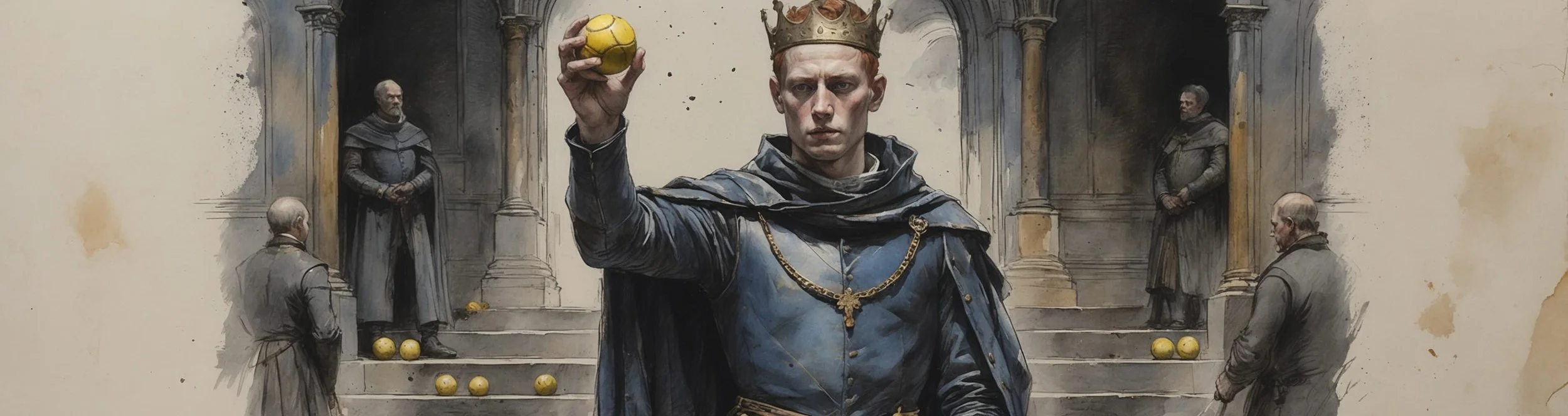
Scene Profile – At a Glance
- Location: The Presence Chamber of the royal palace, London.
- What Happens: King Henry asks the Church whether his claim to France is lawful; Canterbury says yes. The King resolves on war – and the French ambassadors deliver the Dauphin’s mocking gift of tennis balls.
- Key Characters: King Henry V, the Archbishop of Canterbury, Exeter, Westmoreland, Ely, and the French ambassadors speaking for the Dauphin.
- Dramatic Function: The scene that launches the war. The legal case, the decision to invade, and the personal insult all land within three hundred lines.
- Famous Quote:
"And tell the pleasant prince this mock of his
Hath turned his balls to gun-stones; and his soul..."
(King Henry V, Act 1, Scene 2) - Why It Matters: Everything the play will question begins here: who is responsible for the war, whether the cause is just, and what Henry’s words can do to an enemy.
Scene Summary
The court assembles, and King Henry summons the Archbishop of Canterbury to answer one question: may he, "with right and conscience", claim the crown of France? Before the Archbishop speaks, Henry issues a long and solemn warning – take heed what you say, because armies will march and blood will fall on the strength of it.
Canterbury answers with the famous Salic Law speech. The French bar Henry’s claim because it descends through a woman, citing the ancient rule that "no woman shall succeed in Salique land" – but, Canterbury argues at enormous length, the Salic land is in Germany, not France; the law never applied to France; and French kings themselves have inherited through the female line. The bar is a sham, and Henry’s claim stands. The assembled nobles urge the King on, invoking his warlike ancestors, and the Church promises the mightiest financial aid it has ever raised.
One anxiety remains: if England empties itself for France, the Scots will attack, as they always have. Canterbury answers with his celebrated picture of the honey-bees – a kingdom, like a hive, thrives when every rank does its proper work – so England can divide its forces and still stand. Henry resolves: France will be his, or the throne will be broken. He is now "well resolved".
The French ambassadors are admitted. They bring an answer from the Dauphin to Henry’s claim on some French dukedoms: a barrel of tennis balls, a jibe at the King’s sporting, wasted youth. Henry’s reply is long, controlled and chilling – the Dauphin’s mock has turned the balls to cannon-stones, and thousands of widows, mothers and unborn children will curse the joke. The ambassadors are dismissed with safe conduct, and the scene ends in a burst of preparation: every man’s thought is now to France.
The Question of Conscience
Henry’s first substantial speech in the play is not a claim but a warning – delivered to the man about to give him what he wants.
Original
Therefore take heed how you impawn our person,
How you awake our sleeping sword of war:
We charge you, in the name of God, take heed...
(King Henry V, Act 1, Scene 2)
Shakespeare Retold (Modern Verse)
So, contemplate advice you’re going to give me,
If you invoke a war now we’re at peace.
And, in the name of God, I urge you’re careful...
Read generously, this is a scrupulous king refusing to shed blood without lawful cause, and demanding the truth on the Archbishop’s soul. Read sceptically, it is a masterpiece of moral bookkeeping: before the advice is given, responsibility for everything that follows is formally lodged with the adviser. Both readings are available, and the previous scene sharpens the second – we know Canterbury prepared this answer for reasons of his own, and Henry may know it too. Either way, the pattern that will govern the whole play is set in its first movement: whenever guilt approaches this king, it is transferred, with perfect courtesy, to someone else. Canterbury completes the transfer in one line: "The sin upon my head, dread sovereign!"
The Salic Law
Canterbury’s answer is the longest speech in the play – some sixty lines of genealogy, geography and Latin – and its length is the point.
Original
'In terram Salicam mulieres ne succedant:'
'No woman shall succeed in Salique land:'
Which Salique land the French unjustly gloze
To be the realm of France, and Pharamond
The founder of this law and female bar.
(Canterbury, Act 1, Scene 2)
Shakespeare Retold (Modern Verse)
'In terram Salicam mulieres ne succedant: '
‘In Salic land, a woman can’t inherit.’
The French misrepresent that Salic land
Is part of France, and that King Pharamond
Devised the law that blocked the female claim.
The argument is real: Shakespeare versifies Holinshed’s chronicle almost clause by clause, and the historical case was genuinely made. But no listener, on stage or off, can follow five centuries of Pharamonds and Pepins at speaking pace – the speech is designed to be survived rather than understood, and its sheer weight becomes the proof. The killing word is "gloze": the French, says Canterbury, interpret the law speciously – exactly what a hostile observer would say the Archbishop is doing. In performance the speech is often played for comedy, drowning the court in parchment; the joke and the menace coexist, because at the end of it thousands of deaths have acquired a legal basis.
The Honey-Bees
The Scottish anxiety produces the scene’s most beautiful passage – Canterbury’s vision of the kingdom as a beehive, where obedience is written into nature itself.
Original
Obedience: for so work the honey-bees,
Creatures that by a rule in nature teach
The act of order to a peopled kingdom.
(Canterbury, Act 1, Scene 2)
Shakespeare Retold (Modern Verse)
Based on obedience. Take honey-bees,
Whose instinct shows how natural hierarchies
Reflect how structured nations should behave.
The bees have kings, magistrates, merchants and soldiers; each rank works, and the hive prospers. It is the great Elizabethan commonplace of natural order, gorgeously done – and put to immediate practical use: because a kingdom works like a hive, England can send a quarter of its strength to France and remain safe. The image also quietly teaches the audience how this play’s England is supposed to work – every degree from king to labourer bent on one aim. The rest of the play tests that picture against real soldiers, real captains and real thieves, who prove considerably less orderly than bees.
Tennis Balls to Gun-Stones
The scene’s climax is an insult answered. The Dauphin’s tennis balls say: you are still the playboy prince, fit for games rather than dukedoms. Henry’s reply shows the court – and the audience – exactly who is now wearing the crown.
Original
And tell the pleasant prince this mock of his
Hath turned his balls to gun-stones; and his soul
Shall stand sore charged for the wasteful vengeance
That shall fly with them: for many a thousand widows
Shall this his mock mock out of their dear husbands;
Mock mothers from their sons, mock castles down;
And some are yet ungotten and unborn
That shall have cause to curse the Dauphin's scorn.
(King Henry V, Act 1, Scene 2)
Shakespeare Retold (Modern Verse)
And tell that lovely prince, this joke of his
Has turned his balls to cannonballs; and he will
Be guilty of the carnage of revenge
These cannonballs inflict. Thousands of widows
Will joke about this joke that killed their husbands;
Mothers will joke of dead sons; ruined castles;
And children, not yet thought of or conceived,
Will have good cause to damn the Dauphin’s joke.
The speech works by seizing the joke and refusing to let go of it. The balls become gun-stones; the mock becomes a verb that widows wives, unchilds mothers and flattens castles; and the guilt for all of it is signed over to the joker. It is brilliantly controlled – Henry is never angrier than he chooses to appear – and it is the first full display of the King’s characteristic weapon: language that converts whatever it is given into justification. The Dauphin supplied a joke; Henry returns it as a casus belli, with the moral invoice attached.
Language and Technique
- The loaded question: Henry frames his opening question in the language of law and conscience – "right", "conscience", "truly" – so the answer arrives pre-weighted with responsibility.
- Overwhelming detail: The Salic Law speech buries the court in names, dates and places. Sheer accumulation stands in for proof – a rhetorical trick worth naming in essays.
- The bee conceit: An extended comparison (a "conceit") of kingdom to beehive makes political obedience seem as natural as instinct.
- Repetition as weapon: In the tennis-balls reply, "mock" is repeated until the joke itself becomes the killer – the word turned back on its maker.
- Royal "we": Henry speaks as "we" throughout – the crown speaking, not the man – until the insult briefly sharpens the voice to something personal.
Key Quotes from Act 1, Scene 2
Quote 1
Original
Now are we well resolved; and, by God's help,
And yours, the noble sinews of our power...
(King Henry V, Act 1, Scene 2)
Shakespeare Retold (Modern Verse)
I’ve now made up my mind; and with God’s help,
And you, my noblemen, our source of strength...
Quote Analysis: The pivot of the scene: deliberation ends and policy begins. "Well resolved" quietly closes the question of conscience – from here on, doubt belongs to other people – and "by God’s help" enlists heaven on the expedition’s side, a partnership Henry will invoke at every crisis to come. Notice too "the noble sinews of our power": the nobles are muscles in the King’s body. The court has stopped being a council and become an instrument.
Original
We never valued this poor seat of England;
And therefore, living hence, did give ourself
To barbarous licence; as 'tis ever common
That men are merriest when they are from home.
(King Henry V, Act 1, Scene 2)
Shakespeare Retold (Modern Verse)
I never valued being king of England;
So lived away from royal courts, allowing
Myself to live a riotous life; it’s common
For men to frolic when they’re far from home.
Quote Analysis: Henry’s reply to the tennis balls begins with a disarming confession: he never valued England’s throne, and lived wildly away from court. The admission looks like weakness and works as strategy – by owning the wasted years himself, he empties the Dauphin’s joke of its sting before answering it. The wild-prince story, told by the bishops in the previous scene as a miracle, is here retold by the King as a deliberate phase now over: "living hence" – away from his true self. Even his self-criticism is managed.
Original
This was a merry message.
(Exeter, Act 1, Scene 2)
Shakespeare Retold (Modern Verse)
That was a funny message.
Quote Analysis: Five dry words from the King’s uncle, spoken as the ambassadors leave. After forty lines of prophesied widows and burning castles, Exeter’s laconic verdict lands like a slammed door – the joke was "merry", and the reply has ended the comedy. The understatement is characteristic of Exeter, the play’s plainest official voice, and it tells the audience how to read what it has just heard: the Dauphin sent a jest, and received a declaration of war.
Original
We'll chide this Dauphin at his father's door.
(King Henry V, Act 1, Scene 2)
Shakespeare Retold (Modern Verse)
Before his dad, the Dauphin we will slay.
Quote Analysis: The scene’s exit line, and a preview of the play’s method. "Chide" is a schoolmaster’s word – to scold a naughty child – and the image of doing it "at his father’s door" reduces the Dauphin from rival prince to misbehaving boy, punished in front of his parent. After the terrifying formal reply, this flick of contempt shows the other register of Henry’s anger: the massive threat and the small humiliation, both delivered in perfect control.
Original
Therefore, my lords, omit no happy hour
That may give furtherance to our expedition...
(King Henry V, Act 1, Scene 2)
Shakespeare Retold (Modern Verse)
And so, seize every opportunity
That’s going to help our military campaign...
Quote Analysis: The scene’s closing energy in two lines: no happy hour omitted, everything bent towards the expedition. The war that began the scene as a question of conscience ends it as a schedule. The speed matters – between the Archbishop’s answer and this order, barely two hundred lines have passed – and the play will keep this tempo, leaping from resolution to embarkation to siege. Once this king is resolved, the play suggests, hesitation is simply not among his qualities.
Key Takeaways
- Responsibility moves first: Before the case for war is even heard, Henry lodges the guilt for it with the Archbishop – the play’s defining manoeuvre, performed in its first court scene.
- The law is a performance: The Salic Law speech is genuine chronicle material staged as overwhelming spectacle – proof by exhaustion.
- Order is the official creed: The honey-bee speech paints obedience as nature’s own design – the ideal the rest of the play will test.
- The insult built the legend: The tennis balls hand Henry his first great speech: a joke converted into a justification for war.
- The tempo is set: From question to invasion plan in one scene – this king, once resolved, moves fast.
Study Questions and Analysis
What is the Salic Law, and is Canterbury’s argument sound?
The Salic Law was an ancient Frankish legal code, one clause of which – "In terram Salicam mulieres ne succedant" – barred women from inheriting land. The French crown used it to deny claims descending through the female line, and Henry’s claim to France runs through his great-great-grandmother Isabella. Canterbury’s answer: the "Salic land" is in Germany, not France; the law was never France’s; and French kings themselves repeatedly inherited through women. Therefore the bar is hypocrisy and Henry’s claim is good. The entire apparatus exists to answer one plain question from the King:
Original
May I with right and conscience make this claim?
(King Henry V, Act 1, Scene 2)
Shakespeare Retold (Modern Verse)
So, with clear conscience, can I claim the French throne?
As history, the argument is essentially the one made in Henry’s reign, and Shakespeare versifies it from Holinshed with remarkable fidelity. As drama, its soundness is beside the point – nobody on stage checks a word of it, and no audience could. What the play stages is not a legal proof but the appearance of one: an unfollowable mass of erudition, delivered by a man the previous scene showed us preparing it for the Church’s own ends, and accepted instantly because everyone in the room wants its conclusion. The scene is less about whether the claim is lawful than about how lawfulness is manufactured.
Why does Henry make Canterbury answer "in the name of God"?
Because the answer will kill people, and Henry says so before it is given: take heed, for never did two such kingdoms contend "without much fall of blood". By charging the Archbishop before God to speak truly, Henry makes the coming war conditional on another man’s conscience – if the cause is false, the falsehood is Canterbury’s.
The question is whether this is scruple or strategy, and the play keeps both alive. A king genuinely unwilling to invade on a bad title would speak exactly like this; so would a king who wants the invasion pre-absolved. What is certain is the effect: Canterbury accepts the transfer in a single line – "The sin upon my head, dread sovereign!" – and Henry proceeds with his conscience formally cleared. Jonathan Dollimore and Alan Sinfield, in their 1985 essay in Alternative Shakespeares, made this exchange a centrepiece of their reading of the play: ideology being assembled in plain sight, with the audience watching every rivet go in. The same manoeuvre will reappear at Harfleur and in the midnight debate with Williams; it starts here.
What do the tennis balls mean?
They are a taunt about Henry’s past. Asked to respond to Henry’s claim on certain French dukedoms, the Dauphin sends a barrel of tennis balls: a suggestion that the young King of England is still the tavern playboy of the Henry IV years, better suited to games than to government – go and play, boy. The insult misjudges its target completely, and the ambassadors visibly know it, asking leave to speak the message plainly before daring to deliver it.
Dramatically, the gift is a gift: it hands Henry the perfect stage for his first great performance. The claim to France was legal and cold; the tennis balls make it personal and hot, converting a dynastic quarrel into an insult every apprentice in the audience could feel. It also supplies the play’s recurring pattern in miniature – Henry never generates his own provocations; he receives them, and returns them transformed. A joke goes in; gun-stones, widows and burning castles come out.
How does Henry’s reply to the Dauphin actually work?
By accepting the insult’s terms and playing them to destruction. Henry does not deny the wasted youth – he opens by embracing it ("We never valued this poor seat of England"), which disarms the jibe. Then he takes the joke’s own vocabulary and loads it: the balls become "gun-stones", the "mock" becomes an agent that will mock husbands from wives and sons from mothers, and even the unborn are enlisted as future cursers of the Dauphin’s scorn. The wit stays cool throughout – rhymes, wordplay, the tennis conceit sustained to the end – which is precisely what makes it frightening.
Original
But tell the Dauphin I will keep my state,
Be like a king and show my sail of greatness
When I do rouse me in my throne of France...
(King Henry V, Act 1, Scene 2)
Shakespeare Retold (Modern Verse)
But tell the Dauphin I’ll act honourably,
With regal dignity and show my greatness
When I am seated on my throne of France...
Two things are worth noting for essays. First, the responsibility transfer: the speech makes the Dauphin the author of the coming war, exactly as the earlier exchange made Canterbury the owner of its sin – by the end of the scene Henry has started a war and holds title to none of its guilt. Second, the performance is for the room as much as the enemy: a new king, doubted abroad and untested at home, turns an ambassadorial embarrassment into a demonstration that the crown has changed heads. The court’s response – Exeter’s dry "This was a merry message" – says the demonstration worked.
What is the point of the honey-bee speech?
Practically, it answers a strategic worry. Westmoreland and the nobles fear the old pattern – when England’s armies leave, Scotland pounces – and Canterbury’s bees justify dividing the kingdom’s strength: a well-ordered state, like a hive, has ranks for everything at once, so a quarter of England’s power can conquer France while the rest guards home.
Original
Therefore doth heaven divide
The state of man in divers functions,
Setting endeavour in continual motion...
(Canterbury, Act 1, Scene 2)
Shakespeare Retold (Modern Verse)
That’s how God split up our world
So different people take on different roles,
To move societies forever forward...
Beyond the tactics, the speech is the play’s fullest statement of the Elizabethan ideal of natural order – every creature obedient, every rank purposeful, the whole crowned by a king the bees themselves obey. It is beautiful, confident and official, which is exactly why it repays suspicion. The speaker is a churchman selling a war; the image proves whatever it is asked to prove; and the play spends its remaining acts introducing us to the actual bees – Pistol the drone, Williams the questioning worker, four captains who cannot agree on what the hive even is. The speech is best read as the play’s official theory of England, published just before the evidence arrives.
Why do the nobles keep talking about Scotland?
Because in 1415 – and in 1599 – it was the standing strategic fact of English war-making: France in front, Scotland behind. Westmoreland voices the proverb-level fear with the scene’s most vivid animal image:
Original
For once the eagle England being in prey,
To her unguarded nest the weasel Scot
Comes sneaking and so sucks her princely eggs...
(Westmoreland, Act 1, Scene 2)
Shakespeare Retold (Modern Verse)
For England, like an eagle that’s out hunting,
Will leave her nest exposed to cunning Scotland
Who will come sneaking, snatching precious eggs...
England as the hunting eagle, Scotland as the weasel sucking the eggs of the unguarded nest – the anxiety is that conquest abroad means robbery at home. Canterbury’s reply (England’s defences have always held; the hive has ranks for war and watch alike) settles the debate on stage. For Shakespeare’s first audience the exchange had a topical hum: an English army was in Ireland that very year, and the question of what happens at home when the fighting men leave was live. The passage also quietly justifies the play’s later pride in a British army – by Act 3, a Scot is fighting for Henry, not against him.
Is the war justified by the end of this scene?
Formally, yes, three times over: a legal opinion from the highest churchman in England, the enthusiastic consent of the nobility, and a personal insult that would have entitled a private gentleman, let alone a king, to satisfaction. By every standard the scene’s own world recognises, Henry leaves it with a just cause – and the play never produces a character who argues otherwise on the law.
What the play has quietly done, though, is show the audience how each justification was assembled: the legal opinion was promised in the previous scene by a Church protecting its lands; the nobles’ enthusiasm feeds on glory and precedent rather than right; and the insult justifies anger, not conquest – the claim to France existed before the tennis balls arrived. Nothing is exposed as false; everything is shown being made. That is this play’s distinctive honesty, and it is why the same war can be staged as a crusade or an indictment without changing a line. The strongest essays hold the formal justice and the visible manufacture together, because the scene does – and so does its criticism. John Dover Wilson, in his 1947 New Cambridge edition, took the scene at its word: this is "a righteous war, and seemed as much so to Shakespeare’s public as the war against the Nazis seems to us". Norman Rabkin, in his 1977 essay Rabbits, Ducks, and Henry V, replied in effect that the play "points in two opposite directions", virtually daring us to choose between the hero-king and the cold-eyed conqueror – and that the choice cannot honestly be made.
How does this scene connect to the Henry IV plays?
It is built to be watched by people who remember them. The Dauphin’s insult only works because Prince Hal’s wild years were legendary; Henry’s reply only lands because we watch the supposed playboy dismantle a diplomatic incident with total command. His own account of those years here – that he "never valued" the throne and lived wildly away from it – matches the promise the prince made in Henry IV Part 1: to imitate the sun, hiding behind clouds so that his emergence would astonish. The astonishment is now happening on schedule.
The scene therefore completes the reformation story the bishops told in Scene 1, but from the inside. They called it a miracle; Ely called it a strawberry ripening under a nettle; Henry’s own performance suggests something more deliberate – a long game reaching its payoff. Students who know the earlier plays can use this scene to argue that Henry’s kingship is continuous with Hal’s playacting rather than a break from it; students who do not need only this scene’s evidence, because the King who turns tennis balls into gun-stones is visibly a master of turning appearances to use. For E. M. W. Tillyard, in Shakespeare’s History Plays (1944), that continuity was nothing sinister: it completes the long arc of the histories, the wild prince’s education issuing at last in the ideal king. Whether the arc reads as an education or as a performance is exactly the choice this play declines to make for you.